Cities of the Arabian Peninsula reveal contradictions of contemporary urbanization
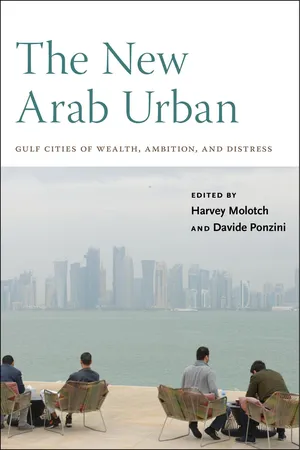
The fast-growing cities of the Persian Gulf are, whatever else they may be, indisputably sensational. The world's tallest building is in Dubai; the 2022 World Cup in soccer will be played in fantastic Qatar facilities; Saudi Arabia is building five new cities from scratch; the Louvre, the Guggenheim and the Sorbonne, as well as many American and European universities, all have handsome outposts and campuses in the region. Such initiatives bespeak strategies to diversify economies and pursue grand ambitions across the Earth.
Shining special light on Dubai, Abu Dhabi, and Doha—where the dynamics of extreme urbanization are so strongly evident—the authors of The New Arab Urban trace what happens when money is plentiful, regulation weak, and labor conditions severe. Just how do authorities in such settings reconcile goals of oft-claimed civic betterment with hyper-segregation and radical inequality? How do they align cosmopolitan sensibilities with authoritarian rule? How do these elite custodians arrange tactical alliances to protect particular forms of social stratification and political control? What sense can be made of their massive investment for environmental breakthrough in the midst of world-class ecological mayhem?
To address such questions, this book's contributors place the new Arab urban in wider contexts of trade, technology, and design. Drawn from across disciplines and diverse home countries, they investigate how these cities import projects, plans and structures from the outside, but also how, increasingly, Gulf-originated initiatives disseminate to cities far afield.
Brought together by noted scholars, sociologist Harvey Molotch and urban analyst Davide Ponzini, this timely volume adds to our understanding of the modern Arab metropolis—as well as of cities more generally. Gulf cities display development patterns that, however unanticipated in the standard paradigms of urban scholarship, now impact the world.
eBook - ePub
The New Arab Urban
Gulf Cities of Wealth, Ambition, and Distress
- 368 pages
- English
- ePUB (mobile friendly)
- Available on iOS & Android
eBook - ePub
The New Arab Urban
Gulf Cities of Wealth, Ambition, and Distress
About this book
Information
INDEX
Page numbers followed by f indicate photographs; page numbers followed by m indicate maps; page numbers followed by t indicate tables, charts, or graphs.
Abadan, Iran, 40–42, 44
Abdul Aziz (king of Saudi Arabia), 281
Abdullah (king of Saudi Arabia), 280, 291
A blocks (NYU Abu Dhabi), 164–166
Abu Dhabi: Aldar Properties, 89–91; automobiles as consumption item in, 259–260; consumption adjustments and outcomes, 268–269; consumption in, 256–269; free zones, 285; housing as consumption item in, 258–259; jobs in, 261–262; large-scale cultural imports, 262–264; museums, 50, 288–289; NYU Abu Dhabi (see NYU Abu Dhabi); skyline as seduction, 260–261; unskilled/semi-skilled labor, 267–268; urban planning in, 50. See also Masdar City
Abu Dhabi Global Market, 285
Abu Dhabi Investment Council, 15
Abu Dhabi National Bank, 112, 113, 114f
Abu Dhabi Plaza (Astana), 89–91
Abu-Lughod, Janet, 302–303
ACA (Arab Center for Architecture), 67–69
actor network theory (ANT), 11, 132–133, 215
Adjaye, David, 74
Africa, 223
Agbar Tower. See Torre Agbar
agriculture, 5
Ahmadi, Kuwait, 40–43
AIF (Arab Image Foundation), 67–68
Aishiti Foundation (Beirut), 74–75, 74f
Ak Maktoum airport (Dubai), 179
Al Bandar (Abu Dhabi), 119, 120f
alcohol, 264, 266
Aldar Properties (Abu Dhabi), 89–91
Al-Futaim, 245, 246
Al-Futtaim Carillion, 156
Alissa, Reem, 42–43
Al Sayegh, Ahmed Ali, 90
al-Wasl (Dubai), 248
American University of Cairo, 163, 167
Anglo-Iranian Oil Company, 42
Anglo-Persian Oil Company, 47
Anker, Peder, 197
ANT. See actor network theory
Apollo space program, 210n22
Arab architecture, 302
Arab Center for Architecture (ACA), 67–69
Arab city, concept of, 58–59
Arab Image Foundation (AIF), 67–68
Arab nationalism, 67
Arab Spring: in Abu Dhabi, 268; and Arab cities, 58; and investment in Dubai, 241; Saudi response to, 268; and visions of Islam, 66–67
Arabtec, 289
Arab Village (Ahmadi), 41–43
Ara...
Table of contents
- Cover
- Title Page
- Copyright
- Dedication
- Contents
- List of Figures
- Introduction: Learning from Gulf Cities
- Section I. The Gulf as Transnational
- Section II. Assembling Hybrid Cities
- Section III. Urban Test Beds for Export
- Section IV. Audacity, Work-Arounds, and Spatial Segmentation
- Conclusion: From Gulf Cities Onward
- Acknowledgments
- About the Contributors
- Index
Trusted by 375,005 students
Access to over 1.5 million titles for a fair monthly price.
Study more efficiently using our study tools.
Frequently asked questions
Yes, you can cancel anytime from the Subscription tab in your account settings on the Perlego website. Your subscription will stay active until the end of your current billing period. Learn how to cancel your subscription
No, books cannot be downloaded as external files, such as PDFs, for use outside of Perlego. However, you can download books within the Perlego app for offline reading on mobile or tablet. Learn how to download books offline
Perlego offers two plans: Essential and Complete
- Essential is ideal for learners and professionals who enjoy exploring a wide range of subjects. Access the Essential Library with 800,000+ trusted titles and best-sellers across business, personal growth, and the humanities. Includes unlimited reading time and Standard Read Aloud voice.
- Complete: Perfect for advanced learners and researchers needing full, unrestricted access. Unlock 1.5M+ books across hundreds of subjects, including academic and specialized titles. The Complete Plan also includes advanced features like Premium Read Aloud and Research Assistant.
We are an online textbook subscription service, where you can get access to an entire online library for less than the price of a single book per month. With over 1.5 million books across 990+ topics, we’ve got you covered! Learn about our mission
Look out for the read-aloud symbol on your next book to see if you can listen to it. The read-aloud tool reads text aloud for you, highlighting the text as it is being read. You can pause it, speed it up and slow it down. Learn more about Read Aloud
Yes! You can use the Perlego app on both iOS and Android devices to read anytime, anywhere — even offline. Perfect for commutes or when you’re on the go.
Please note we cannot support devices running on iOS 13 and Android 7 or earlier. Learn more about using the app
Please note we cannot support devices running on iOS 13 and Android 7 or earlier. Learn more about using the app
Yes, you can access The New Arab Urban by Harvey Molotch,Davide Ponzini, Harvey Molotch, Davide Ponzini in PDF and/or ePUB format, as well as other popular books in Social Sciences & Middle Eastern Politics. We have over 1.5 million books available in our catalogue for you to explore.