This publication discusses the real-world performance data of low-carbon buses in the People's Republic of China. It also reviews the environmental and financial impacts, as well as the policies used to promote them. The People's Republic of China has taken the lead in the deployment of low-carbon buses and is moving toward full electrification to address climate change and reduce greenhouse gas emissions. Data and information in this publication can benefit countries interested in promoting low-carbon buses to design appropriate climate change policies.
- 70 pages
- English
- ePUB (mobile friendly)
- Available on iOS & Android
eBook - ePub
About this book
Information
II. Low-Carbon Bus Technologies
A. Overview
This report on low-carbon buses (LCBs) discusses hybrid, plug-in hybrid, and full electric buses, (i.e., new bus technologies which potentially reduce greenhouse gas [GHG] emissions).
Biofuel-powered buses were not included in this analysis as the bus technology itself is a conventional diesel or gas engine. Their environmental impact is purely related to fuel and depends on upstream emissions caused by the production of the biofuel, including land use change impacts.
Gas buses are considered as conventional units as they are purely fossil fuel-powered. Depending on the environmental standard, their pollution levels can be significantly lower than diesel buses, but their GHG impact is comparable with diesel units when taking into consideration the methane slip and upstream emissions related to fuel extraction, processing, and transport (see Chapter III for a comparison of the environmental impact of bus technologies).
A fuel cell electric vehicle uses a hydrogen fuel cell as the power source for the drive wheels, sometimes augmented with batteries or a supercapacitor. Like battery electric vehicles, these vehicles have zero tailpipe emissions, but potentially have emissions from the production and distribution of hydrogen. Hydrogen can be produced from various sources, including fossil fuels, biomass, and electrolysis of water with electricity. The environmental impact and energy efficiency of hydrogen depend on how it is produced. The most common forms are:
(i)Natural gas reforming. Synthesis gas, a mixture of hydrogen, carbon monoxide, and a small amount of carbon dioxide, is created by reacting natural gas with steam at a high temperature. Carbon monoxide is reacted with water to produce additional hydrogen. This method is the cheapest, most efficient, and most common.
(ii)Electrolysis. An electric current divides water into hydrogen and oxygen. Power-to-hydrogen projects are taking off, where excess renewable electricity, when it is available, is used to make hydrogen through electrolysis. Typically, in electrolysis, around 50 kilowatt-hours (kWh) of electricity are required to produce 1 kilogram (kg) of hydrogen.5
The average hydrogen consumption of buses6 will result in 3–4 times more total electricity consumption than that of pure electric units, e.g., a 12 meter (m) hydrogen bus uses around 4 kWh/km of electricity (including the production of hydrogen from electrolysis) compared to around 1–1.5 kWh/km for a battery electric bus (BEB). Thus, the resulting GHG well-to-wheel (WTW) emissions of hydrogen buses are far higher than those of diesel or gas units in the PRC, which have a largely fossil fuel grid. For a 12 m fuel cell bus in the PRC, WTW GHG emissions are in the order of 2,800 grams of carbon dioxide equivalent emission per kilometer (gCO2e/km) 7 compared with 800 gCO2e/km for an electric bus, and 1,100–1,200 gCO2e/km for a fossil fuel unit.8 Therefore, hydrogen buses have not been included in this report based on their negative GHG impact in the case of the PRC and the lack of practical experience with such units within the cities surveyed.
Figure 2 shows a system diagram comparing conventional with hybrid and electric buses.
Figure 2: System Diagram for Conventional, Hybrid, and Electric Buses
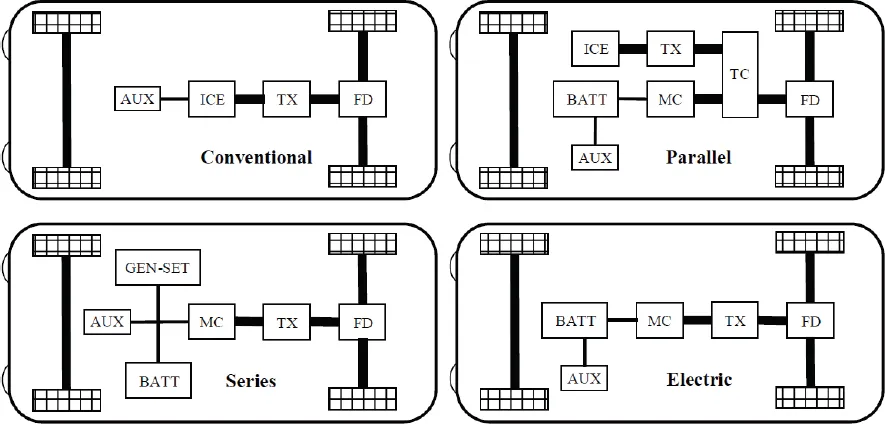
AUX = auxiliaries, BATT = battery, FD = final drive, GEN-SET = engine-generator, ICE = internal combustion engine, MC = motor/controller, TC = torque coupler, TX = transmission, conventional = standard diesel bus, electric = battery electric bus, parallel = parallel hybrid system, series = serial hybrid system.
Source: A. Lajunen. 2012. Evaluation of Battery Requirements for Hybrid and Electric City Buses. World Electric Vehicle Journal. Vol. 5.
B. Hybrid and Plug-in Hybrid Buses
Basically, types of hybrids include series and parallel hybrids as well as “mild” hybrids that use systems such as flywheels to recover braking energy. Fuel efficiency gains in hybrids are basically due to regenerative braking, shutting off the internal combustion engine during idling, and having two sources of onboard power, allowing the engine to operate at near peak efficiency more often. Reduced energy usage results in a proportional reduction of GHG emissions and of local pollutants. In terms of noise emissions, when leaving the bus stop, hybrid buses have approximately 3 decibels less noise compared with a diesel bus.9 Multiple cities in the PRC have been operating diesel, compressed natural gas (CNG), liquefied natural gas (LNG), and liquefied petroleum gas (LPG)10 hybrids for many years, where most of the units are 10–12 m buses. However, 8 m, 14 m, and 18 m hybrids are also plying the streets.
Plug-in hybrids have a larger battery than standard hybrids, and these can also be charged from an external power source. The key application of this is that they have the ability to run in an all-electric mode part of the time. The distance the bus can run on electric mode depends upon the characteristics of the route, charging frequency, and energy systems configuration. Standard or conventional hybrids run mostly on supercapacitors, while plug-in hybrids run on batteries.11
Thousands of plug-in hybrids in all sizes and with all types of fuel are operating in the PRC.12
Operators no longer purchase conventional hybrids, only plug-in hybrids because only the latter qualify for subsidies. These plug-in hybrids are basically 10–12 m units with a 25 kWh battery. Recently, a few cities have received models with a larger battery size (40 kWh). Cities in the PRC generally use plug-in hybrids without charging them at the grid. (The following chapters discuss further the impacts and the reasons for this operation mode.)
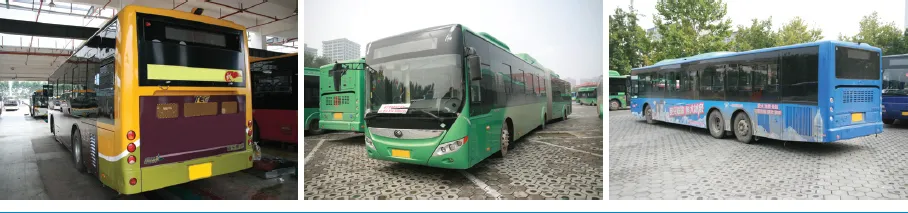
10-meter, 18-meter, and 14-meter hybrid buses in Hengyang and Zhengzhou, People’s Republic of China. Source: Asian Development Bank.
C. Full Electric Buses
1. Typologies
The core components of electric vehicles are the powertrain, battery, and charging system. The battery set is obviously a key component for the electric vehicle range. However, there are different combinations of charging systems and battery packs, including direct overhead charging, opportunity fast and ultrafast charging, slow and fast charging, and battery-swap. The charging system and battery set configuration have large technical and financial implications (Figure 3).
Figure 3: Typologies of Full Electric Buses
(battery capacity for a standard 12-meter bus)
(battery capacity for a standard 12-meter bus)
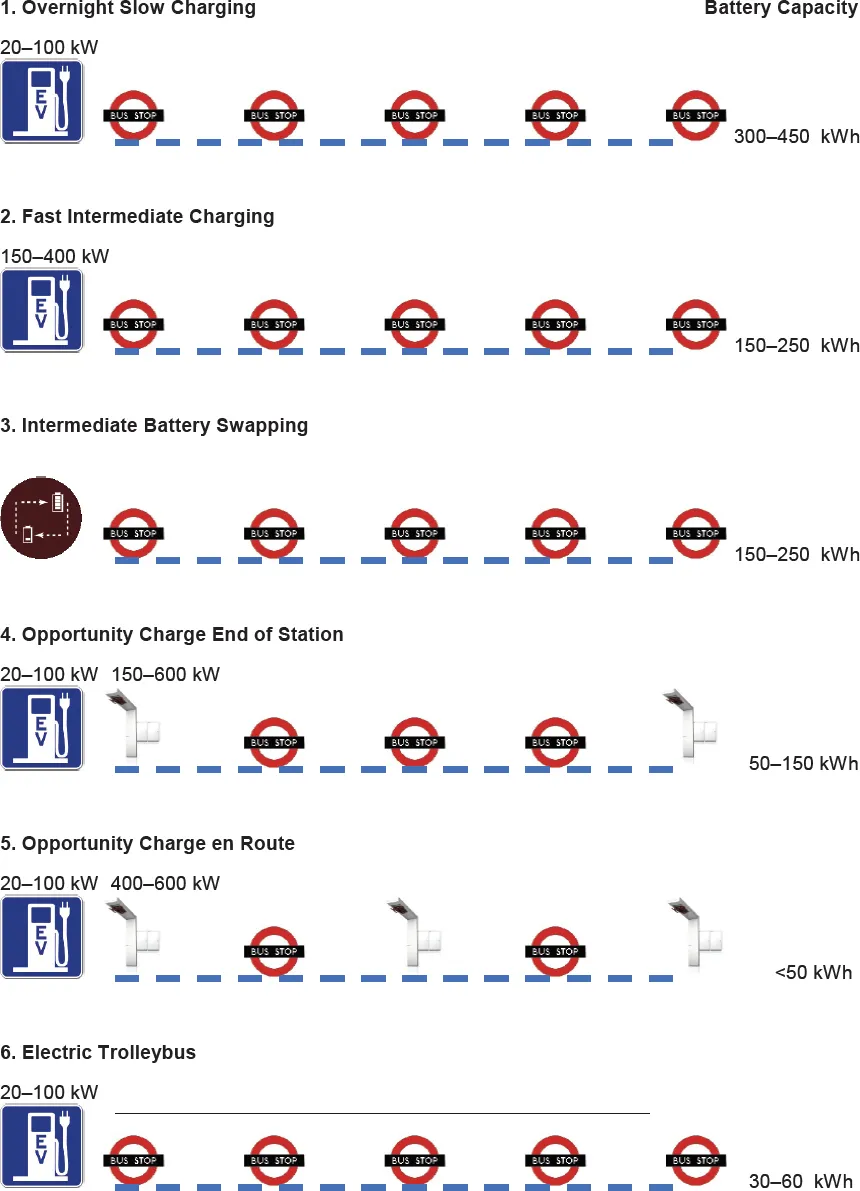
kW = kilowatt, kWh = kilowatt-hour.
Source: Asian Development Bank.
2 Battery Electric Buses
Characteristics of Battery Electric Buses
Large numbers of BEBs of multiple brands are operated in cities in the PRC. Many cities initiate electric bus operations with small 6–8 m BEBs and then progress to 10–12 m units. Some cities also manage electric double-deckers and 14 m electric buses. Generally, cities in the PRC do not realize pilots with small numbers of buses, but start operations with at least 50–100 units.
E-bus manufacturers in the PRC dominate the global market in terms of units sold. The top five manufacturers in terms of units sold in 201613 were Yutong with 19% of the market share in the PRC, followed by BYD, Zhontong, Nanjing Jinlong, and Zhuhai Yinlong.14 Cities frequently buy from local manufacturers because provincial or city subsidies are linked to local manufacturers; also, it makes for simpler and faster maintenance and repair of units.
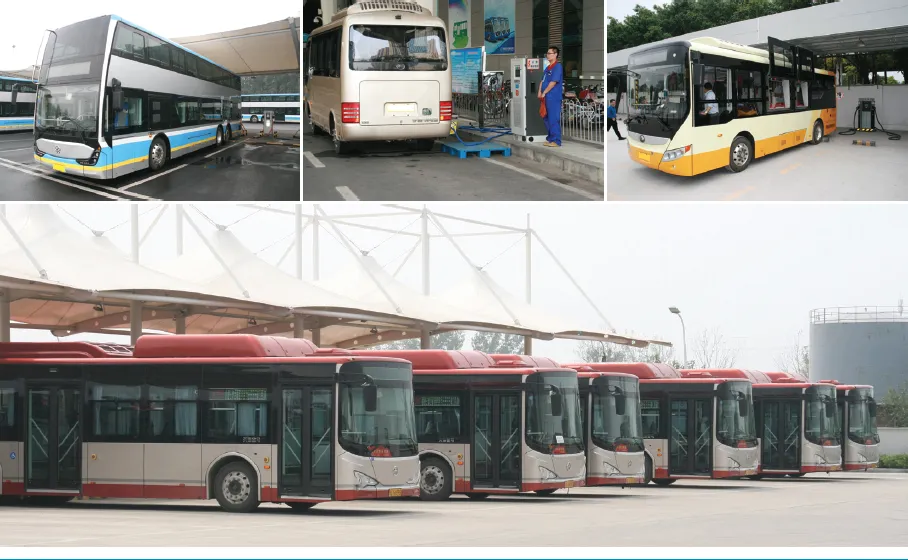
(From top left clockwise): Battery electric buses in Beijing, Jinan, Guangzhou, and Tianjin, People’s Republic of China.
Source: Asian Development Bank.
Table 1 shows the average battery size of different BEBs as used predominantly in cities in the PRC. There is a large variety of battery capacities, and average battery capacities are relatively low due to buses running predominantly on shorter routes. Generally, bus operators in the PRC do not optimize the battery capacity of buses relative to route requirements or cost.
Table 1: Average Battery Size of Battery Electric Buses in the People’s Republic of China

kWh = kilowatt-hour.
Source: Asian Development Bank, based on data on cities in the People’s Republic of China.
No operator has made any recent reports on significant safety issues with batteries and overheating. In the early years, although some buses caught fire due to the batteries overheating, this problem now very seldom occurs, and not more frequently than with conventional fossil fuel-powered buses. Cases where batteries overheated, resulting in damage or even fires, are clearly limited to only a few occasions.
Driving Range of Battery Electric Buses
The electric driving range is an important criterion when determining BEB specifications. The simplified calculation of a battery pack divided by average electricity consumption can result, thereby, in misleading driving range expectations as Figure 4 shows.
Figure 4: Driving Range of Battery Electric Buses
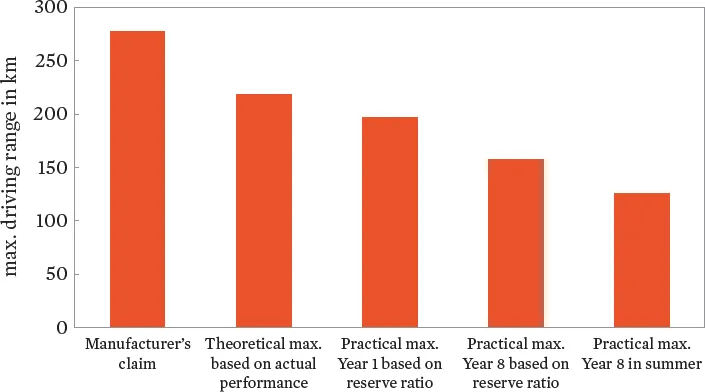
BEB = battery electric bus, km = kilometer, kWh = kilowatt-hour, m = meter, max = maximum, SOC = state of charge.
Note: This shows the maximum driving range of 12 m BEBs with a 250 kWh battery pack, based on the average electricity usage of 12 m BEBs of 1.14 kWh, manufacturer-claimed performance rate of 0.9 kWh/km, summer energy usage of an additional 25% to the average, 80% SOC of batteries in year 8, and 10% minimum reserve ratio (for operational safety reasons).
Sour...
Table of contents
- Cover
- Title Page
- Copyright Page
- Contents
- Tables and Figures
- Foreword
- Acknowledgments
- Currency Equivalents
- Abbreviations
- Weights and Measures
- Executive Summary
- I Introduction
- II Low-Carbon Bus Technologies
- III Environmental Performance of Low-Carbon Buses
- IV Financial Performance of Low Carbon Buses
- V Low-Carbon Bus Promotion Policies
- VI Challenges for the Future
- VII Conclusions and Recommendations
- Appendixes
- References
- Footnotes
- Back Cover
Trusted by 375,005 students
Access to over 1.5 million titles for a fair monthly price.
Study more efficiently using our study tools.
Frequently asked questions
Yes, you can cancel anytime from the Subscription tab in your account settings on the Perlego website. Your subscription will stay active until the end of your current billing period. Learn how to cancel your subscription
No, books cannot be downloaded as external files, such as PDFs, for use outside of Perlego. However, you can download books within the Perlego app for offline reading on mobile or tablet. Learn how to download books offline
Perlego offers two plans: Essential and Complete
- Essential is ideal for learners and professionals who enjoy exploring a wide range of subjects. Access the Essential Library with 800,000+ trusted titles and best-sellers across business, personal growth, and the humanities. Includes unlimited reading time and Standard Read Aloud voice.
- Complete: Perfect for advanced learners and researchers needing full, unrestricted access. Unlock 1.5M+ books across hundreds of subjects, including academic and specialized titles. The Complete Plan also includes advanced features like Premium Read Aloud and Research Assistant.
We are an online textbook subscription service, where you can get access to an entire online library for less than the price of a single book per month. With over 1.5 million books across 990+ topics, we’ve got you covered! Learn about our mission
Look out for the read-aloud symbol on your next book to see if you can listen to it. The read-aloud tool reads text aloud for you, highlighting the text as it is being read. You can pause it, speed it up and slow it down. Learn more about Read Aloud
Yes! You can use the Perlego app on both iOS and Android devices to read anytime, anywhere — even offline. Perfect for commutes or when you’re on the go.
Please note we cannot support devices running on iOS 13 and Android 7 or earlier. Learn more about using the app
Please note we cannot support devices running on iOS 13 and Android 7 or earlier. Learn more about using the app
Yes, you can access Sustainable Transport Solutions by in PDF and/or ePUB format, as well as other popular books in Technology & Engineering & Global Warming & Climate Change. We have over 1.5 million books available in our catalogue for you to explore.