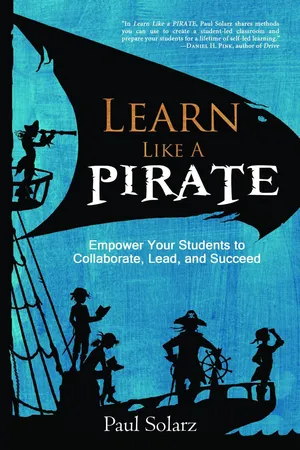
In Learn Like a PIRATE, Paul Solarz explains how to design classroom experiences that encourage students to take risks and explore their passions in a stimulating, motivating, and supportive environment where improvement, rather than grades, is the focus. Discover how student-led classrooms help students thrive and develop into self-directed, confident citizens who are capable of making smart, responsible decisions, all on their own.
- English
- ePUB (mobile friendly)
- Available on iOS & Android
eBook - ePub
About this book
Information
Topic
EducationSubtopic
Education Teaching MethodsSection 1
The Student-Led Classroom
1
What is a Student-Led Classroom?
“Right is right, even if no one is doing it; wrong is wrong even if everyone is doing it.”
— Augustine of Hippo
“Yesss!” exclaims an excited student, holding up his hand to his classmates in an offer of celebration. High-fives and words of encouragement pass around the group of four students before they turn back to their project. All around the classroom, clusters of three and four students work together, deeply engaged in meaningful work. As the boys and girls share ideas, no one fears being called “stupid.” Instead, they listen to one another’s opinions and ask one another questions without worry. Rather than bickering about getting their way, the students use conflict-management techniques and speak respectfully to each other. The teacher moves from group to group to hear what each is discussing. Suddenly, a student from one of those groups calls out, “Give me five! Give me five!” and everyone goes silent for the moment, waiting for the direction or announcement or question, and then quickly gets back to work.
Engaged children working together on meaningful tasks; this is what my classroom looks like after approximately two to three weeks of school. My job is to stoke this spirit of collaboration so that my students thrive all school year long.
I know I’m not alone in this goal. Many teachers today diligently work to eliminate the stereotype of students sitting in rows, completing worksheet after worksheet, only getting a break from the silent monotony to listen to a lecture they find uninteresting and irrelevant. Looking for a new way to teach, these forward-thinking educators seek to involve students in the learning process. They want to encourage students to take on more responsibility and ownership over their learning. Because you’ve picked up this book, I suspect you are one of these world-changing teachers. And you may be wondering where and how to begin.
Going against the flow isn’t easy. Resistance is a natural response to new ideas and methods. That’s particularly true in the educational system. Throughout my teaching career, I have relied on a non-traditional, student-led classroom to meet my students’ needs. This approach has worked effectively for more than fifteen years, even though the mix of students and their abilities and personalities has changed dramatically from year to year. Despite consistent success, other teachers warn me year after year that my style of teaching won’t work during the next year. Some claim that the particular mix of children isn’t well suited for student-led environments. Other teachers have told me that particular students cannot survive in my classroom. Year after year, I’ve proven that with a consistent message and belief, a student-led classroom environment is attainable — and it’s what children deserve. A student-led classroom is one in which students make decisions and choices throughout the day without consulting the teacher.
These decisions impact their own actions, the actions of others, and even the actions of the teacher. Everyone in the classroom appears to have equal power and equal say in what happens, although everyone understands that the teacher’s word is final.
So what? Do the kids just come into class every day and decide what to learn and how they want to learn it? No. Depending on the subject, most lessons include a component of teacher-led instruction (often a mini-lesson in the middle of the period), as well as collaborative work time (with regular feedback from their peers and the teacher) and time to reflect or synthesize. The curricular objectives don’t change — the method does. Lessons are set up so that students don’t have to be passive learners for long. The teacher says what needs to be said and then gets out of the way, allowing students ample opportunity to guide and lead one another.
Creating a student-led classroom doesn’t happen overnight. It requires a tremendous amount of commitment from both the teacher and the students. To get to the point where each student feels comfortable directing the class without consulting the teacher, lots of instruction and practice must take place. Teachers need to explain what a student-led classroom is and provide examples of how it might work for them. Every day, teachers need to provide learning opportunities for students to practice the necessary skills until they become habits. In addition, teachers must give encouraging feedback when students make positive decisions and supportive feedback when negative decisions are made. It is also extremely important to show appreciation for any attempt made despite the outcome in order to ensure that they try again in the near future! Practice makes permanent, so help them practice correctly!
One final note: Student-led classrooms are only effective if students feel safe, appreciated, and connected to their teacher. In my classroom, we talk about being a family on a regular basis. I show my students I care for them through informal conversations before and after school, taking a genuine interest in their passions, and providing time for them to work with me individually throughout the day. In turn, they begin to care for me as well. In reality, my connection with each student doesn’t start the year that they are placed in my classroom. Relationships are forged over time by interacting in the hallway, at recess, and walking into the building in the morning. A simple, “Hello!” or a high five is a great way to show students that you care about children and are happy to be a teacher. By the time a child is assigned to my classroom, I’ve already begun to lay a foundation for a successful school year. When children feel happy and safe at school, they’re willing to work hard for their teachers. And hard-working students are what it’s going to take to create a successful student-led classroom!
2
Common Concerns About Student-Led Classrooms
“You must be the change you wish to see in the world.”
— Mahatma Gandhi
The decision to transition to a student-led classroom can be a challenging one. Worries about managing a chaotic classroom, adding more work to an already busy schedule, or watching students’ grades slip can make the shift seem risky. In my experience, switching to a student-led classroom has eliminated many more challenges than it’s created. If you believe students should be empowered and have some control over their learning, you and your students can handle any adversity that may come along. After all, handling challenges that arise in a student-led classroom is better than dealing with a lack of motivation, poor behavior, and student apathy any day! Later in this chapter, I’ll share a few more of the amazing benefits that result when students are encouraged to collaborate and lead. But first, let’s take a look at a few common concerns that keep teachers from unfurling the sails and letting their students take charge of the ship… I mean classroom.
Most of the reasons and fears that cause teachers to hesitate to create student-led classrooms are easily addressed and dispelled. In fact, once you decide to embrace a new way of teaching that will have profound effects on your students, success is only a matter of staying the course. And yes, you will have some setbacks along the way. They’re to be expected. But the rewards outweigh the risks. Remember: Pirates don’t give up when the wind blows them off course; they adjust their sails and continue toward their destination!
I’ve heard from many teachers who want to create a better learning experience for their students but find this unfamiliar territory somewhat scary. If you are wary of creating a student-led classroom, the next few pages are specifically for you. I hope the encouragement and real-life insights here give you the confidence you need to make the change. And if you are already excited about creating a student-led classroom, then the tips and tricks included in this section will help you make the shift sooner rather than later.
CONCERN: “I’m worried about giving up control to my students.”
It’s hard to relinquish control. But let me tell you a little secret: You’re not really giving it up! Every one of my students knows that, ultimately, my say is final. I simply choose not to interfere with most of their decisions. Even when a decision is sure to lead us in the wrong direction, I usually choose to follow it through! I want them to learn from their mistakes! Of course, sometimes we don’t have time for that, and at those times I might intervene.
You should see my students’ faces when the group decides to take a big risk! They look at me to see if I appear to be scared or concerned; but I have a pretty good poker face! I might be thinking, “Oh, this won’t work!” But my body language and facial expressions are saying, “Let’s try it!” It’s so important to encourage your students to be risk-takers. Otherwise, they’ll be completely content to follow whatever everyone else is doing in life. The last thing I want to do is turn out a bunch of kids who give in to peer pressure!
CONCERN: “I can’t do this. I’m definitely going to make a lot of mistakes and fail.”
You will make mistakes. We all do. You might even make more mistakes than you’re used to at first. Whenever I make a mistake in my class, I choose to use it at as a teaching experience. I even point out my mistakes to my students! I want them to know failure is not embarrassing or something that needs to be hidden. Failure and mistakes are an important part of the learning process. Your students need you to model a healthy reaction to failure so they too can handle their mistakes with dignity and class.
CONCERN: “There’s just too much at stake. I can’t risk this not working.”
Here’s the good news: If you fail at creating a student-led classroom, you end up with a teacher-led classroom! At least you tried! Your students and administrators will certainly appreciate your efforts, and you will have learned a great deal in the process. Learning is the goal. Any progress you make toward empowering your students to become active leaders and doers, rather than passive followers who don’t know how to think for themselves, will benefit their education.
CONCERN: “This will be too much work. I can’t take on another thing right now!”
By definition, students take on most of the responsibility in a student-led classroom. Your job is to explain your expectations and provide students with opportunities to practice their skills. Be supportive and patient when they make mistakes. Remind them (and yourself) that new skills take time to develop. Teaching is hard no matter what we do, but I assure you that empowering your students to run the classroom will eliminate more issues than it creates.
CONCERN: “I’m overwhelmed. I don’t know where to begin!”
Why not start by talking with your class about the direction you’d like things to go? During this discussion, give them the power to interrupt when they have something important that needs to be said. (See “Give Me Five”.) The power to interrupt the class is the single, most important thing you can do to empower your students to lead.
Provide opportunities for your students to lead the class and one another. Give lots of feedback and spend time reflecting on your progress as a class. Those changes alone are enough to create dramatic differences. You’ll discover many ideas in the coming chapters that can be easily implemented in your classroom.
CONCERN: “But, won’t my room get loud?”
Absolutely! Think of it as the sound of productivity. My room is definitely one of the louder classes in the school. And that’s okay with me, because when I walk around, I see that my students are actively engaged in learning. They’re collaborating and problem-solving. Sometimes that requires making a little noise! (Occasionally, a student will interrupt the class and announce, “It’s getting too loud. I can’t even hear my partner!” When that happens, I comment that these conversations are productive noise. I suggest they move around the room to find a quieter location to work, rather than try to eliminate any of the important discussions.)
Because I have loud, active, motivated students, what I don’t have are sleepy, zoned-out children. I don’t have kids who want to sneak away to the bathroom for a break. I don’t have kids checking their phones or playing games online. Instead, my kids work through their recesses and forget that lunch has started because they’re excited about what they’re doing in class. These are the signs of engaged, motivated youngsters who enjoy learning, not for a grade or for a reward, but because it’s fun.
CONCERN: “There’s no time for all of this. There’s just too much to do.”
I get questions from teachers and administrators every year about how we fit so much into our schedule. “Show me your weekly schedule. What aren’t you teaching?” they ask. My answer is that we maximize our time-on-task, make transitions efficient, and we integrate subjects.
Ca...
Table of contents
- Lay of the Land
- Acknowledgements
- Foreword
- Get More Out of Learn Like a PIRATE
- Introduction
- Section 1 The Student-Led Classroom
- Section 2 Learn like a PIRATE
- More from Dave Burgess Consulting, Inc
- About the Author
- Resources
Trusted by 375,005 students
Access to over 1.5 million titles for a fair monthly price.
Study more efficiently using our study tools.
Frequently asked questions
Yes, you can cancel anytime from the Subscription tab in your account settings on the Perlego website. Your subscription will stay active until the end of your current billing period. Learn how to cancel your subscription
No, books cannot be downloaded as external files, such as PDFs, for use outside of Perlego. However, you can download books within the Perlego app for offline reading on mobile or tablet. Learn how to download books offline
We are an online textbook subscription service, where you can get access to an entire online library for less than the price of a single book per month. With over 1.5 million books across 990+ topics, we’ve got you covered! Learn about our mission
Look out for the read-aloud symbol on your next book to see if you can listen to it. The read-aloud tool reads text aloud for you, highlighting the text as it is being read. You can pause it, speed it up and slow it down. Learn more about Read Aloud
Yes! You can use the Perlego app on both iOS and Android devices to read anytime, anywhere — even offline. Perfect for commutes or when you’re on the go.
Please note we cannot support devices running on iOS 13 and Android 7 or earlier. Learn more about using the app
Please note we cannot support devices running on iOS 13 and Android 7 or earlier. Learn more about using the app
Yes, you can access Learn Like a PIRATE by Paul Solarz in PDF and/or ePUB format, as well as other popular books in Education & Education Teaching Methods. We have over 1.5 million books available in our catalogue for you to explore.