This publication examines the Kapit-Bisig Laban sa Kahirapan---Comprehensive and Integrated Delivery of Social Services National Community-Driven Development Program, which promotes women's participation and empowerment in the Philippines. The challenges and constraints observed in the program serve as lessons to enhance gender mainstreaming initiatives in community-driven development projects and programs.
- 48 pages
- English
- ePUB (mobile friendly)
- Available on iOS & Android
eBook - ePub
About this book
Information
II. SUMMARY OF GENDER EQUALITY RESULTS AND ACHIEVEMENTS
A. Program Description
KC-NCDDP is the scale-up of Kapit-Bisig Laban sa Kahirapan-Comprehensive and Integrated Delivery of Social Services (Kalahi-CIDSS), the biggest community-driven development (CDD) program of the Government of the Philippines implemented through the DSWD, which was launched in 2003.4 The scale-up to the KC-NCDDP was approved on 18 January 2013 by then President Benigno Aquino III, who headed the National Economic and Development Authority Board.5
As a development strategy, CDD ensures that poverty-related issues (i.e., low resources to meet basic needs; lack of access to basic services, ownership of assets, and capacity of citizens to earn sustained income; as well as limited participation in community decision making) are addressed at the local level in a participatory, collective, inclusive, and demand-driven manner.
The overall development objective of KC-NCDDP is “communities in target municipalities [are] empowered to achieve improved access to basic services and to participate in more inclusive local planning, budgeting, implementation, and disaster risk reduction and management”.6 The Asian Development Bank (ADB) project outcome is “improved access to services and infrastructure for communities in affected provinces and their participation in a more inclusive local disaster risk reduction and management planning, budgeting, and implementation.”7 The project administration manual cites three major outputs (footnote 7):
(i)community-driven development subprojects selected, implemented, and completed;
(ii)institutional and organizational capacity strengthened; and
(iii)program management and M&E systems enhanced.
KC-NCDDP covered 19,647 villages located in 847 municipalities across 58 provinces in 14 regions in the Philippines, benefiting about 5.3 million households. Special focus was placed on areas that were affected by Typhoon Yolanda (international name: Haiyan), one of the strongest typhoons in history, which devastated central Philippines on 8 November 2013, and caused the deaths of thousands and massive loss of and damage to property.
ADB provided the Government of the Philippines with an emergency assistance loan of $372.1 million (footnote 7) to support the KC-NCDDP in restoring basic social services and rebuilding communities affected by Typhoon Yolanda. ADB’s financing supported 352 municipalities; that of the World Bank, 319 municipalities; and that of ADB and the World Bank together, subprojects in 129 municipalities.
Gender was an integral part of KC-NCDDP. The program ensured equal opportunities and benefits for both men and women in its processes. Women’s inclusion was one of the program’s strategies to address the needs of the poor and most vulnerable sectors of communities.
The gender mainstreaming initiative of KC-NCDDP is consistent with the 2009 Magna Carta of Women (Republic Act 9710), which outlines the Government of the Philippines’ strategy to mainstream gender in all its programs, projects, and activities.8 Similarly, it is guided by the DSWD’s policies and guidelines on gender and convergence, and ADB’s gender policy.9 KC-NCDDP has its own gender mainstreaming policy as well.10
B. Gender Analysis and Program Design Features
1. Gender Issues and Gender Action Plan
Gender issues addressed by the program. Community norms continue to prevent women from taking more active roles in community development. Gender stereotyping, the competing demands of productive and reproductive work, and lack of control to manage and control their own affairs exclude women from opportunities that would allow them to develop their full potential and become partners in development. Moreover, culturally ingrained gender stereotypes result in stark disparities between men and women in political, economic, and social arenas.
The economic and poverty situation of women demonstrates these disparities. Women’s workforce participation rate is at 52% compared with 81% for men. Moreover, only two in five salaried workers are women. There is also an income discrepancy of 41%, favoring men. Political representation of women is low as well. They make up only 21.3% at all levels of electoral posts.11
Meanwhile, women continue to play traditional roles, with majority of domestic and familial responsibilities borne by them. For instance, women provide 84% of their total household time in rearing children.12
Statistics show that natural disasters have a greater effect on women. Girls and women compose more than half of the 200 million people who are affected by disasters every year. They are also typically exposed to more risks compared with men, particularly for those living in low-income countries and are part of the poor population.13
Development and disaster impacts can never be gender-neutral, especially since women become more vulnerable during times of disaster. Women and girls face threats of gender-related violence, such as rape and sexual harassment in these situations. As Margareta Wahlström, the United Nations Assistant Secretary-General for Disaster Risk Reduction, said in 2009, “Disaster risk reduction that delivers gender equality is a cost-effective, win-win option for reducing vulnerability and sustaining the livelihoods of whole communities” (footnote 13).
The Philippines, like other countries, culturally relegates women, resulting in their exclusion even in matters that directly affect them. The program principle of inclusiveness of KC-NCDDP can only be operationalized if barriers to meaningful participation are addressed, given that there are ingrained cultural practices and stereotypes that marginalize women. Needs and concerns of men and women should always form part of any development agenda, particularly for a CDD program. Affirmative action needs to be incorporated in the program design to empower women, and open up more opportunities for them to help contribute to gender equality.
Gender mainstreaming strategy. Gender mainstreaming was set in the program as a strategy to empower women and support gender equality. This initiative is consistent with the 2009 Magna Carta of Women, which mandates the “recognition, protection, fulfilment, and promotion of the rights of Filipino women,” especially those who belong to marginalized sectors.
Gender mainstreaming in KC-NCDDP is intended to improve women’s participation in decision making and access to development resources and benefits.
The following enabling mechanisms and system enhancements were established to operationalize the program’s gender mainstreaming initiatives:
(i)Monitoring and evaluation. Gender mainstreaming is included in the program’s results and key performance indicators. Sex-disaggregated data requirements also form part of the program’s M&E system.
(ii)Gender tool kit. The gender tool kit was developed to guide the program implementers in mainstreaming gender in a community development project.
(iii)Ladderized GAD training and other capacity building support mechanisms. The following capacity building activities were developed and rolled out:
(a) 4-hour basic GAD orientation;14
(b) an audiovisual version of the GAD orientation;
(c) 3-day training on mainstreaming gender in the CEAC processes; and
(d) 5-day training on gender-responsive planning and budgeting (GRPB). Otherwise known as GAD convergence training, this capacity building activity was one of the mechanisms for convergence of the three social protection programs of the DSWD: KC-NCDDP, Sustainable Livelihood Program, and Pantawid Pamilyang Pilipino Program (4Ps).15 The 5-day training served as a springboard for partnering with LGUs to sustain the gender mainstreaming initiatives of DSWD. Specifically, it was intended to be the jump-off point to advocate for full gender mainstreaming of municipal and barangay LGUs in their policies, establish enabling mechanisms to make their programs and services gender-responsive, and leverage the use of their 5% mandatory GAD fund as required by the 2009 Magna Carta of Women.
(iv)Staffing. Key consultants and staff (such as the gender specialist) were hired to ensure that gender mainstreaming initiatives are carried out and relevant issues addressed. At the regional level, the deputy regional program managers were designated as regional GAD focal persons who take the lead in the program’s gender mainstreaming efforts.
(v)LGU support and sustainability. One of the stipulations in the memorandum of agreement between a municipality and the DSWD for the implementation of KC-NCDDP is the designation by the municipal LGU of a GAD focal, who will also be part of the MCT. The GAD focal may be appointed through either a Sangguniang Bayan resolution or an executive order.
(vi)Safeguards. The program was designed with safeguards mechanisms to ensure the protection of vulnerable sectors. Monitoring these mechanisms is part of the major functions of the community development officers at the regional level.
Gender issues during program implementation, such as difficulties in engaging women in paid labor construction, were addressed. For example, the KC-NCDDP procurement manual16 was enhanced to include women in the workforce. Moreover, guidance notes provided in 201417 to the regional program management offices recommended the utilization of ADB’s Technical Assistance Fund to finance the provision of nontraditional skills trainings (NTST) (e.g., painting, carpentry, masonry, and electrical wiring) for women in response to the limited number of women engaging in construction during subproject implementation.
Key gender actions, targets, and indicators. The KC-NCDDP policy stipulates the promotion of active participation of both men and women in decision making within the opportunities of the program. It also ensures that they both have equal access to and enjoy the program benefits (footnote 10).
To operationalize this, key process indicators were developed and overlaid with the program’s community empowerment activity cycle to guide program staff and help them in determining whether target gender outputs are achieved (Figure 2).18
Figure 2: Community Empowerment Activity Cycle: Process Indicators on Gender Mainstreaming
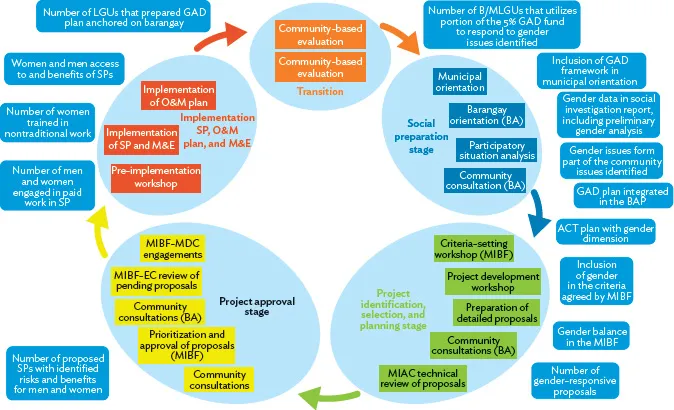
ACT = area coordinating team, BA = barangay assembly, BAP = barangay action plan, B/MLGU = barangay or municipal local government unit, GAD =gender and development, LGU = local government unit, MIAC = municipal inter-agency committee, MIBF = municipal inter-barangay forum, MIBF-EC = municipal inter-barangay forum-executive committee, MIBF-MDC = municipal inter-barangay forum-municipal development council, M&E = monitoring and evaluation, O&M = operation and maintenance, SP = subproject.
Source: Government of the Philippines, Department of Social Welfare and Development. 2013. Kalahi-CIDSS Gender Toolkit: Mainstreaming Gender in Community-Driven Development. Manila..
The four key gender output indicators of the program are:
(i)50% women in committee membership,
(ii)50% women leadership in committees,
(iii)20%–30% women in paid labor, and
(iv)50% women’s attendance in barangay assemblies.
These indicators are regularly monitored through the quarterly submission of reports by the regional PMOs. These are also subject to discussion during program reviews. Gaps may also be addressed through field monitoring and provision of technical assistance by national or regional PMOs to field staff to ensure that men and women are provided equal opportunities by the program.
Originally, there were 29 items in the GAP. As a result of an ADB midterm review in the early part of 2016, these were clustered to 11, all of which are anchored on the program’s key outputs, as can be seen in the GAP (Appendix). These were grouped under the three major gender indicators: (i) enhanced gender-responsiveness of activities in the CEAC processes, (ii) institutional capacity development, and (iii) program management and M&E.
The GAP is intended to help the program achieve its target impact and outcomes, a...
Table of contents
- Front Cover
- Title Page
- Copyright Page
- Contents
- List of Figures and Case Studies
- Acknowledgments
- Executive Summary
- Abbreviations
- I. Study Description
- II. Summary of Gender Equality Results and Achievements
- III. Lessons Learned, Challenges, and Constraints
- IV. Recommendations
- Appendix
- Footnotes
- Back Cover
Trusted by 375,005 students
Access to over 1.5 million titles for a fair monthly price.
Study more efficiently using our study tools.
Frequently asked questions
Yes, you can cancel anytime from the Subscription tab in your account settings on the Perlego website. Your subscription will stay active until the end of your current billing period. Learn how to cancel your subscription
No, books cannot be downloaded as external files, such as PDFs, for use outside of Perlego. However, you can download books within the Perlego app for offline reading on mobile or tablet. Learn how to download books offline
Perlego offers two plans: Essential and Complete
- Essential is ideal for learners and professionals who enjoy exploring a wide range of subjects. Access the Essential Library with 800,000+ trusted titles and best-sellers across business, personal growth, and the humanities. Includes unlimited reading time and Standard Read Aloud voice.
- Complete: Perfect for advanced learners and researchers needing full, unrestricted access. Unlock 1.5M+ books across hundreds of subjects, including academic and specialized titles. The Complete Plan also includes advanced features like Premium Read Aloud and Research Assistant.
We are an online textbook subscription service, where you can get access to an entire online library for less than the price of a single book per month. With over 1.5 million books across 990+ topics, we’ve got you covered! Learn about our mission
Look out for the read-aloud symbol on your next book to see if you can listen to it. The read-aloud tool reads text aloud for you, highlighting the text as it is being read. You can pause it, speed it up and slow it down. Learn more about Read Aloud
Yes! You can use the Perlego app on both iOS and Android devices to read anytime, anywhere — even offline. Perfect for commutes or when you’re on the go.
Please note we cannot support devices running on iOS 13 and Android 7 or earlier. Learn more about using the app
Please note we cannot support devices running on iOS 13 and Android 7 or earlier. Learn more about using the app
Yes, you can access Gender Mainstreaming in KALAHI–CIDSS National Community-Driven Development Program by in PDF and/or ePUB format, as well as other popular books in Social Sciences & Project Management. We have over 1.5 million books available in our catalogue for you to explore.