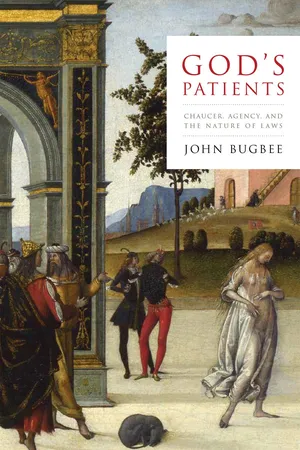
God's Patients approaches some of Chaucer's most challenging poems with two philosophical questions in mind: How does action relate to passion, to being-acted-on? And what does it mean to submit one's will to a law? Responding to critics (Jill Mann, Mark Miller) who have pointed out the subtlety of Chaucer's approach to such fundamentals of ethics, John Bugbee seeks the source of the subtlety and argues that much of it is ready to hand in a tradition of religious (and what we would today call "mystical") writing that shaped the poet's thought. Bugbee considers the Clerk's, Man of Law's, Knight's, Franklin's, Physician's, and Second Nun's Tales in juxtaposition with an excellent informant on a major stream of medieval religious culture, Bernard of Clairvaux, whose works lay out ethical ideas closely matching those detectable beneath the surface of the poems. While some of the positions that emerge—most spectacularly the notion that the highest states of human being are ones in which activity and passivity cannot be disentangled—are anathema to much modern ethical thought, God's Patients provides evidence that they were relatively common in the Middle Ages. The book offers striking new readings of Chaucer's poems; it proposes a nuanced hermeneutical approach that should prove fruitful in reading a number of other high- and late-medieval works; and, by showing how assumptions about its two fundamental questions have shifted since Chaucer's time, it provides a powerful new way of thinking about the transition between the Middle Ages and modernity.
- 478 pages
- English
- ePUB (mobile friendly)
- Available on iOS & Android
eBook - ePub
About this book
Information
PART 1
Action
and
Passion
Here we meet the most challenging problem in speculative theology, the problem of the relations between the Uncreated Freedom and the freedom of created beings.
—Jacques Maritain,
Freedom in the Modern World, 17
Freedom in the Modern World, 17
chapter one
Concerned with Constancy
The Clerk’s and Man of Law’s Tales
DIVISION 1:
GRISELDA, OR HOW NOT TO SUFFER
To renounce one’s autonomy to the point of abandoning all spontaneous and independent reflection, intellection, volition, even feeling, is sometimes presented as an ascetic ideal. But this is an impossibility, and even the idea that such a thing is desirable can do irreparable harm.
—Thomas Merton1
This in truth is the law of constancy, that we neither persist in evils, nor are we unsteady in goods. For there is a constancy also in evils, but one that is not a virtue.
—Moralium dogma philosophorum2
It is not real patience to allow yourself to become a slave when you could be free.
—Bernard of Clairvaux3
For such a quiet, unassuming person, Griselda starts a lot of fights. The heroine of the Clerk’s Tale has been the focus of disputed questions ever since Chaucer set her story in rhyme royal—and, indeed, even before.4 Critical opinion seems fairly settled on the idea that Walter is a cruelly manipulative figure, not to be admired; but what are we to make of Griselda? Is she, as the tale’s narrative voice at least occasionally tells us, a flour of wyfly pacience (line 919)? Does the tale hold her before us as an ideal to be imitated—even if only, as its conclusion assures us, for her constance in adversity, and not as an ideal of humylitee aimed at wyves (1143–46)? Many understand the Clerk’s to be this kind of morally exemplary tale, whether or not they agree with the teaching it allegedly imparts.5 Others, of course, have seen here a tale concerned first with religious allegory and only secondarily with moral teaching: the relations between Walter and Griselda are supposed to teach us something about the relations between God and humankind, or Christ, or perhaps the Virgin Mary.6 This approach imparts some relief from the uncomfortable possibility that the tale recommends Griselda’s extreme pliability to actual humans in everyday situations—but on the other hand it also risks making the tale harder to swallow rather than easier, by suggesting that it is not just a crazed nobleman but God himself who wants such reactions from his “subjects.” More recent critical trends, inspired in some cases by a reaction against the strongly allegorical readings of “patristic criticism,” have turned again to viewing the Clerk’s Tale as a realistic story about human interactions. The resulting readings are often still ethical, but in another way.7 Attempts to understand the tale continue to the present moment, with any major medievalists’ conference likely to feature one or several presentations on it from rising lights and established stars alike. Many of these efforts still wrestle directly or indirectly with the question of the tale’s genre as a key to interpretation—is it an allegory? An exemplum? A realistic drama of domestic life?
The trouble with beginning from questions of that sort is that each one too easily implies the existence of exactly two answers, a yes or a no, commitment to either of which will sharply limit what can subsequently be seen in the tale. If we think the tale is purely a religious allegory, we will try to believe with G. L. Kittredge that the gritty details of Walter’s cruelty have “no status in this particular court”—but we will then wonder why Chaucer has dwelt on those details at such length.8 If we opt, on the other hand, for an insistent realism, we will find ourselves trying to ignore strong evidence that Chaucer had something more than a purely realistic tale in mind. Thus I propose a different path across this contested field, beginning with a return to the most basic of questions: What are we to make of Griselda? What, particularly, of her most outstanding attribute, whether it is labeled “constancy” or “patience”? That approach helpfully staves off the descent into perhaps larger, but for our purposes less immediately useful, questions such as whether the tale “is” an allegory or not, thus allowing a more open-eyed (and eye-opening) way into the tale.
The alternative path, alas, will come at some cost. First of all, the basic question with which it begins will quickly find its way back into complexity. But this second complexity will be beneficial, as it will generate a question about Griselda that can be answered (as so many other questions cannot) in a convincing, even demonstrative way. The question is roughly this: Does Chaucer intend that we understand his character as what she frequently says she is—a kind of moral automaton, whose will is merely a mechanical extension of Walter’s—or rather as a more or less normal flesh-and-blood woman who struggles to be what she says she is? In the course of unearthing a variety of ways in which the tale opens possibilities for criticism of Griselda, the next two sections will see our basic question (“What are we to make of Griselda?”) transform into this more complex one.9
The complex question is indeed answerable, but only, it will emerge, by extensive recourse to source study. The Clerk’s Tale as we have it offers, on the question of Griselda’s “automaticity” as on so many others, evidence supporting both sides. But comparing the tale to its sources will reveal which pieces of evidence are Chaucer’s innovations and which are inheritances from Griselda’s previous incarnations—often inheritances that Chaucer has weakened even as he passes them along. Adding this second dimension, or “filter,” to the evidence will show a consistent pattern in Chaucer’s use of the older material, which in turn gives a relatively stable sense of what he had in mind—whether his conscious mind or his unconscious. Proceeding this way has required a great attention to detail: there are eleven key passages in Chaucer to be considered, eight apparently on one side of the question and three on the other, and each of them has had to be compared with all five of Chaucer’s potential sources. I attempt in what follows to lay out the case compactly, but nonetheless the mere presentation of the evidence occupies two further sections, after which two more (“The Evidence in Review” and “Chaucer, Petrarch, the Vertical and the Horizontal”) bring the accumulated knowledge back around to bear on the complex question of Griselda-as-automaton. Finally, a seventh section provides a first look at evidence from outside Griselda’s stories, drawing on theological remarks about patience, constancy, and Stoicism current in the fourteenth century to show that a desire to distinguish between true and false patience, life-giving virtues and debilitating near misses, was no invention of Chaucer’s. It is the first deployment of a strategy that will be repeated many times in the course of this book, as with the attention to Boethius near the end of chapter 2 and the detailed looks at Bernard of Clairvaux that fill most of chapters 3 and 6: the discovery of something very like Chaucer’s concerns in theological writers both validates the literary readings that have preceded and at some points extends them, casting further light back onto the stories and characters with which the search for understanding began.
The Griselda who emerges from these labors is, I think, of a new kind. Though it will become clear that Chaucer adds to his sources invitations to think of her allegorically, she is certainly not merely, nor even primarily, an allegorical figure. But neither is she merely a struggling woman caught in a realistic domestic tragedy; and least of all is she a positive moral exemplum. In fact Chaucer’s impact on the story is overwhelmingly in the opposite direction: the balance of the work he has done shapes Griselda into a negative exemplum, a picture of what must be avoided rather than imitated. She is, moreover, an answer to a question asked by Petrarch—an answer so emphatic that it registers more as a howl of protest than a simple word. And perhaps most significant of all, we will learn along the way that Chaucer’s howl is no rarity, but almost a commonplace in the writing of his time.
Some Initial Scruples Concerning Infanticide
A likely short description of Griselda’s story runs something like this: a woman’s astounding capacity for the endurance of suffering triumphs over tribulations imposed by her cruel husband. But at least in Chaucer’s version, we can find abundant, if scattered, evidence that a more complicated description is necessary. For one thing, the reader may leave the tale a bit unnerved by the sheer extent of its protagonist’s ability to remain silent. As one critic observes, it is difficult to uphold as a “paragon of virtue” a woman whose devotion allows her to watch without complaint as her husband’s agent carts off their children, as she thinks, to be murdered.10 Could there be something a bit wrong here?
If we begin by assuming that the tale is first and foremost an allegory—or, for that matter, that it is a more or less ordinary moral exemplum—we will think not: believing that the tale aims to describe God’s relations with humanity or to teach constancy, we will likely find such feats to be merely hyperbolic ways of driving the point home. We may also try to further dissolve the discomfort occasioned by Griselda’s failure to protest by judicious application of the solvent of cultural difference, imagining that medieval readers would not have felt a modern degree of outrage over such a laissez-faire attitude toward the death of one’s offspring. It is especially tempting to believe in such medieval insouciance where there is a suggestion of a divine demand for the deaths in question, as there will be for allegorizing readings that take Walter as a figure for God. But much concrete evidence about medieval audiences points in the opposite direction. For example, the tale contains relevant echoes, as one recent critic points out, of the medieval mystery plays: Walter’s faked abductions, Pamela Allen Brown suggests, would have instantly brought to many minds the spectacle of Herod’s soldiers carrying off the Holy Innocents to be murdered. That scene was often portrayed in high drama, with the infants’ mothers refusing to hand over the children, sometimes proposing to fight off fully armed soldiers with kitchen implements, and frequently giving their lives in the attempt to save their offspring—against which background Griselda’s failure to raise even her voice in protest looks less and less morally appealing.11 Nor does a comparison with contemporary descriptions of the lives of saintly women lead to any normalizing of Griselda’s complaisance: while the hagiography of the time does suggest that the late Middle Ages found a certain lack of enthusiasm about children acceptable in holy women, nothing appears there that approaches Griselda’s quiet acceptance of her children’s deaths.12
Another version of the attempt to quiet our discomfort by recourse to cultural difference might propose to excuse Griselda’s behavior not by her (arguable) status as a quasi-saint, but simply by her gender. Perhaps, the argument would run, a late-medieval audience would have expected women to be complaisant to such a degree that Griselda’s silence would not irritate; would it not have understood women to be physiologically, emotionally, and perhaps somehow even ontologically, “passive” with respect to their male counterparts, and therefore have expected them to receive with little resistance almost everything their male counterparts sent their way?13 But here too it would be wrong to reach such a conclusion too quickly. Petrarch famously tells, in one of his letters to Boccaccio about the story, of reading his version to a Veronese friend who protested that Griselda’s behavior was simply unbelievable.14 Recent scholarship has discovered another member of the story’s fourteenthcentury audience who went so far as to provide for Griselda, in the margin of a manuscript of Boccaccio’s version, the reaction that many a reader six or seven centuries in the future might also have liked to see: told at the end of the story that her trials were all a hoax, the marginal Griselda replies, “Go piss on your hand, Walter! Who’ll give me back twelve years? The gallows?”15 Thus it seems that at least some medieval readers, like many modern ones, experienced the story as raising the question it never makes explicit: why on earth does Griselda put up with it?
Once those attempts to contextualize the story have proved inadequate to account for Griselda’s troubling submissiveness, a reasonable next recourse is to have another look at Chaucer’s text. And when we do we may well feel our unease growing stronger rather than tapering off. Again, what are we to make of Griselda? If we are open to considering the status of her character as a whole, we will find quite a number of places where the tale itself encourages critical skepticism, subtly but insistently suggesting protest against her silence. On the occasion of the removal of her first child, for example, the poem comments:
I trowe that to a norice in this cas
It had been hard this reuthe for to se;
Wel myghte a mooder thanne han cryd “allas!”
(561–63)
This sounds like a straightforward expression of sympathy for Griselda—until one reflects that the mother in this case did not cry allas, nor make any other sound, when Walter’s ugly “sergeant” announced that he would take her daughter off to die. And even before this, the sergeant himself has had a few words for Griselda which it is hard not to hear ironically, once we have entertained the possibility that the tale contains quiet criticism of her extremely passive patience:
Ye been so wys that ful wel knowe ye
That lordes heestes mowe nat been yfeyned;
They mowe wel been biwailled or compleyned,
But men moote nede unto hire lust obeye,
And so wol I; there is namoore to seye.
(526–32)
This least sympathetic of characters has what might in other circumstances be an admirable, or at least admissible, outlook on the powers that be: one can certainly complain against them, but in the end one must obey. But his words serve as a biting sort of foil for Griselda, who obeys without even complaining.16
The force of the foil increases when one discovers that both these encouragements toward complaint are Chaucer’s insertions into the story—making these the first among many cases where comparison with the sources is vital. In Petrarch’s version, Walter’s retainer arrives with a similar-sounding philosophical speech: “You know, most wise lady, what it is to be under lords; nor is the hard necessity of obeying unknown to a lady gifted with such intelligence, however inexperienced.”17 But the suggestion that the orders of the powerful may at least “been biwailled or compleyned” in the course of the aforesaid obedience—and that complaint is an ordinary human reaction that one might expect alike from nurses, mothers, and henchmen of dubious character—is entirely Chaucer’s. As a result Petrarch’s version much more easily comes across as a bona fide appeal to a praiseworthy philosophical (and stereotypically “Stoic”) equanimity successfully achieved by his Griselda. The scene in Chaucer, newly adorned with these two reminders of Griselda’s failure to complain, is somewhat harder to pass off as a philosophy lesson.
These are not the only signs that Chaucer’s audience is allowed, even encouraged, to be skeptical of Griselda’s acquiescence in infanticide. The villainous Walter himself eventually begins to wonder whether there is something wrong with her silence. Hearing of her stolidity at the abduction of her second child, he seems to be as much shocked as impressed: he “wondred . . . upon hir pacience,” and he thinks to himself that he could almost believe that her equanimity grew from crueel corage, from malice, or from subtiltee—did he not already know that she loved her children parfitly (687–93). In this passage as in the earlier ones, Chaucer has inherited the basic shape of the story from his sources but intensif...
Table of contents
- Half Title
- Title Page
- Copyright
- Dedication
- Epigraph
- Contents
- Preface: A Foretaste of Two Philosophical Themes
- Acknowledgments
- List of Abbreviations
- Introduction: Passion as Theme and Method
- PART 1: ACTION AND PASSION
- PART 2: WILL AND LAW
- Notes
- Bibliography
- Index
Trusted by 375,005 students
Access to over 1.5 million titles for a fair monthly price.
Study more efficiently using our study tools.
Frequently asked questions
Yes, you can cancel anytime from the Subscription tab in your account settings on the Perlego website. Your subscription will stay active until the end of your current billing period. Learn how to cancel your subscription
No, books cannot be downloaded as external files, such as PDFs, for use outside of Perlego. However, you can download books within the Perlego app for offline reading on mobile or tablet. Learn how to download books offline
Perlego offers two plans: Essential and Complete
- Essential is ideal for learners and professionals who enjoy exploring a wide range of subjects. Access the Essential Library with 800,000+ trusted titles and best-sellers across business, personal growth, and the humanities. Includes unlimited reading time and Standard Read Aloud voice.
- Complete: Perfect for advanced learners and researchers needing full, unrestricted access. Unlock 1.5M+ books across hundreds of subjects, including academic and specialized titles. The Complete Plan also includes advanced features like Premium Read Aloud and Research Assistant.
We are an online textbook subscription service, where you can get access to an entire online library for less than the price of a single book per month. With over 1.5 million books across 990+ topics, we’ve got you covered! Learn about our mission
Look out for the read-aloud symbol on your next book to see if you can listen to it. The read-aloud tool reads text aloud for you, highlighting the text as it is being read. You can pause it, speed it up and slow it down. Learn more about Read Aloud
Yes! You can use the Perlego app on both iOS and Android devices to read anytime, anywhere — even offline. Perfect for commutes or when you’re on the go.
Please note we cannot support devices running on iOS 13 and Android 7 or earlier. Learn more about using the app
Please note we cannot support devices running on iOS 13 and Android 7 or earlier. Learn more about using the app
Yes, you can access God’s Patients by John Bugbee in PDF and/or ePUB format, as well as other popular books in Literature & Medieval & Early Modern Literary Criticism. We have over 1.5 million books available in our catalogue for you to explore.