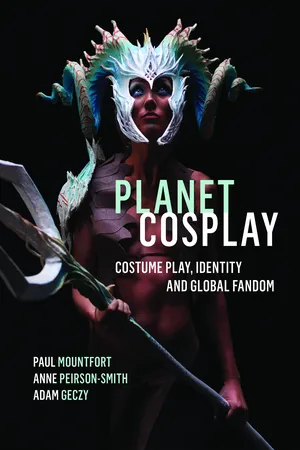
This book examines cosplay from a set of groundbreaking disciplinary approaches, highlighting the latest and emerging discourses around this popular cultural practice. Planet Cosplay is authored by widely published scholars in this field, examining the central aspects of cosplay ranging from sources and sites to performance and play, from sex and gender to production and consumption. Topics discussed include the rise of cosplay as a cultural phenomenon and its role in personal, cultural and global identities. Planet Cosplay provides a unique, multifaceted examination of the practice from theoretical bases including popular cultural studies, performance studies, gender studies and transmedia studies. As the title suggests, the book's purview is global, encompassing some of the main centres of cosplay throughout the United States, Asia, Europe and Australasia. Each of the chapters offers not only a set of entry points into its subject matter, but also a narrative of the development of cosplay and scholarly approaches to it.
eBook - ePub
Planet Cosplay
Costume Play, Identity and Global Fandom
- English
- ePUB (mobile friendly)
- Available on iOS & Android
eBook - ePub
Planet Cosplay
Costume Play, Identity and Global Fandom
About this book
Information
Topic
DesignSubtopic
Fashion DesignPart I
Chapter 1
Cosplay commentators universally agree that cosplay involves fans donning costumes and performing as characters from popular media texts, such as comics, animated or live action films and television, games and other popular cultural media including music videos. As seen in the Introduction, particular indebtedness to Japanese popular culture sources such as manga, anime, gaming, otaku and idol culture is often stressed, though western source texts are equally common and cosplayers mix and sometimes mash-up their influences.1 This chapter is concerned with cosplay as a contemporary fan practice via the ways in which cosplayers commonly reference their chosen source texts. In this particular respect, cosplay can be regarded as a form of citation, with cosplayers collectively involved in performing myriad ‘citational acts.’ This somewhat abstract concept is easily made concrete if we picture walking through a convention space where cosplayers are in action. The thousands of costumes and accoutrements, such as weapons and other props, are, on one level, like trees in a forest of citation that link the cosplay back to the source text (‘ah, look, there’s San from Princess Mononoke. Do you think she made that dagger?’). The ‘act’ is in how the player embodies and performs their chosen character (‘that Naruto’s posing in Sage Mode!’).2
It may seem strange to use the term citation in this context, as it is typically employed in scholarly settings to describe how academic texts reference each other.3 Some commentators are critical of the textual metaphor due to the highly visual and performance-orientated nature of cosplay. This occurs against a backdrop of alleged ‘textual bias’4 in discussions of cosplay, which risks downplaying other, performative dimensions at work in the practice. However, a type of referentiality similar to text-based citation occurs in other media, and is widespread in popular culture. Quentin Tarantino’s movies, for instance, are full of references to earlier films and film genres, from spaghetti westerns to Samurai classics, which they pay homage to, cheerfully parody and otherwise pillage. In the present context, it is the cosplayer’s costumed body that becomes the text or site that references another text—that is, the specific source media that the cosplayer chooses to perform. This embodiment includes not just costume but theatricalism, including pose and gesture. While there may be limitations to analogies between cosplay and citation, investigating the practice, on one level, as a system of reference between texts helps us differentiate it from other forms of dressing up and acting-out. After all, where cosplay differs from dressing up more generally—including fashion subcultures that are sometimes part of the milieu but not strictly cosplay, such as steampunk and Lolita—is in its specific indebtedness to source media on which it is heavily reliant. Cosplay also differs from dramatic performances for the theatre or screen in that cosplayers do not seek to realize an entire script in a sustained performance but smaller or ‘parcellized’ portions of an original, seldom longer than short skits. Due to these complex factors, descriptions of the ways in which cosplayers cite their source materials veer between textual and more performance-orientated metaphors. Commonly employed terms include modelling, textual performance, translation, transportation, actualization, identification, intertextual or transmedial process and, indeed, ‘embodied citational acts.’5
It is also important to recognize the political dimension to cosplay’s citational practices. A term that is useful in unpacking cosplay from this perspective is détournement.6 Associated with the Paris-based social revolutionary group of intellectuals and artists of the 1950s known as the Situationist International, it remains in use in critical theory today and resonates well with cosplay.7 Détournement literally means ‘to reroute’ or ‘to hijack’ and for the Situationists was linked to the ‘ludic,’ or purposive play. Unsurprisingly, many commentators have framed cosplay in terms of the ludic,8 but the Situationist détournement goes beyond mere playfulness to encompass the subversive, and included pranks designed to undermine authority and social hierarchy, political and aesthetic. Crucially, it involved a type of deliberate plagiarism whereby authoritative books, maps and other texts were cut and pasted along polemical and aesthetic lines. Détournement is useful for framing cosplay as not simply a form of fandom, but as a critical practice. Of course, for cosplay to work successfully for both player and audience, the minimum quotient of fandom, familiarity with the source text or at least its storyworld, is a required passport for entry to this play community. But while most cosplayers are fans, this does not mean they lack a critical faculty in relation to the franchises they choose to reference, or are necessarily cheerleaders for the characters they dress up as. Material and social concerns such as a player’s body type, the cost of garments, and their collaborative role within a cosplay group may be just as important. Cosplayers also frequently mess with their source material, employing ‘parody, pastiche, satire, burlesque, and caricature.’9 Thus cosplay’s particular form of détournement is a ‘re-contextualization’10 of sources which aligns it with other mixing and mashing practices, such as fanfiction and the making of anime music videos (AMVs) rather than simply dressing up or acting out a part. Cosplay also often subverts gender, as ‘crossplay’—where female fans dress as male characters and vice versa—demonstrates, and the representation of race is often fluid, too.
However exactly we frame its particular form of referentiality, cosplay citation is, in the first instance, inherent in the choice and subsequent appropriation of a source. When a cosplayer executes the intention to dress up as a particular character, citation of that source text is implicitly taking place, if in no one else’s eyes but the coser’s own, as they adjust garments and put the finishing touches on in front of the mirror. However, it is one thing to wear a lightsabre on your belt and another to come out with it swinging. In other words, it is possible to be in costume but not ‘in part,’ to be dressed up but not acting out the character role, as when we glimpse ‘Batman’ in a convention cafeteria incongruously stuffing his mouth with a hotdog. By contrast, when cosplayers perform their character role on the social stage of the competition catwalk, collaborate on a skit or pose in the convention hall or adjacent studio spaces for a photograph, they will play their chosen part in specific ways, especially through pose and gesture. It is thus only situationally that the performed identity is actualized in the eyes of an audience, where the reference becomes a performance, or, in the present terminology, the citation a citational act (pun intended). Such categories are of course fluid and readily flow into one another. Cosplayers can snap into or out of character in an instant, especially when cameras appear. Furthermore, invisible to the spectator are the moments of internal transformation of the cosplayer, the powerful and uncanny affect by which desire transports us into our fantasy selves, at least for an instant. Frenchy Lunning has framed this in terms of Félix Guattari’s notion of a traversal moment or ‘display of multiple identity eruptions.’11 Cosplayers often express this internal transubstantiation as one that thrills or, conversely, brings a sense of calm or empowerment, even as a zone to which one is transported. What takes place over a sustained period of cosplaying, then, is a constant elision between alternating states of mind and ways of being in the world.
Source media: Texts and pretexts
There is some debate about whether cosplay originated in the United States, in which, as the next chapter discusses, fannish ‘costuming’ goes back to the early twentieth century, or Japan, where the portmanteau term was first used in 1983. However, this chapter locates cosplay’s origins more contextually in the emergence of media and fan cultures in the latter half of the twentieth century. While dressing up in fantastical garb is evidenced in science fiction conventions from the 1940s and 1950s, it was the late 1960s when cosplay’s contemporary shape began to form. Arguably, what distinguishes cosplay, even if it was not yet named as such, from the earlier craze for costuming discussed in Chapter 2 is ...
Table of contents
- Cover Page
- Title Page
- Copyright
- Contents
- Acknowledgements
- Introduction
- Part I: Critical Practice
- Part II: Ethnographies
- Part III: Provocations
- Conclusion: Cosplay Futures
- Index
Trusted by 375,005 students
Access to over 1.5 million titles for a fair monthly price.
Study more efficiently using our study tools.
Frequently asked questions
Yes, you can cancel anytime from the Subscription tab in your account settings on the Perlego website. Your subscription will stay active until the end of your current billing period. Learn how to cancel your subscription
No, books cannot be downloaded as external files, such as PDFs, for use outside of Perlego. However, you can download books within the Perlego app for offline reading on mobile or tablet. Learn how to download books offline
Perlego offers two plans: Essential and Complete
- Essential is ideal for learners and professionals who enjoy exploring a wide range of subjects. Access the Essential Library with 800,000+ trusted titles and best-sellers across business, personal growth, and the humanities. Includes unlimited reading time and Standard Read Aloud voice.
- Complete: Perfect for advanced learners and researchers needing full, unrestricted access. Unlock 1.5M+ books across hundreds of subjects, including academic and specialized titles. The Complete Plan also includes advanced features like Premium Read Aloud and Research Assistant.
We are an online textbook subscription service, where you can get access to an entire online library for less than the price of a single book per month. With over 1.5 million books across 990+ topics, we’ve got you covered! Learn about our mission
Look out for the read-aloud symbol on your next book to see if you can listen to it. The read-aloud tool reads text aloud for you, highlighting the text as it is being read. You can pause it, speed it up and slow it down. Learn more about Read Aloud
Yes! You can use the Perlego app on both iOS and Android devices to read anytime, anywhere — even offline. Perfect for commutes or when you’re on the go.
Please note we cannot support devices running on iOS 13 and Android 7 or earlier. Learn more about using the app
Please note we cannot support devices running on iOS 13 and Android 7 or earlier. Learn more about using the app
Yes, you can access Planet Cosplay by Paul Mountfort,Anne Peirson-Smith,Adam Geczy, Paul Mountfort, Anne Peirson-Smith, Adam Geczy in PDF and/or ePUB format, as well as other popular books in Design & Fashion Design. We have over 1.5 million books available in our catalogue for you to explore.