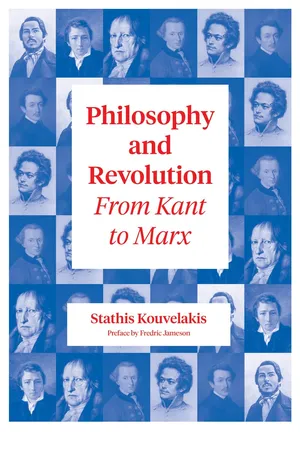
In this ambitious and original study, Stathis Kouvelakis paints a rich panorama of the key intellectual and political figures in the effervescence of German thought before the 1848 revolutions. He shows how the attempt to chart a moderate, reformist path entered into crisis, generating two antagonistic perspectives within the progressive currents of German society. On one side were those socialists - such as Moses Hess and the young Friedrich Engels - who sought to discover a principle of harmony in social relations. On the other side, the poet Heinrich Heine and the young Karl Marx developed a new perspective, articulating revolutionary rupture, thereby redefining the very notion of politics itself.
This new edition of the book includes a long interview with Kouvelakis which puts the work in context.
eBook - ePub
Philosophy and Revolution
From Kant to Marx
- 480 pages
- English
- ePUB (mobile friendly)
- Available on iOS & Android
eBook - ePub
About this book
Information
Topic
PhilosophySubtopic
Critical Theory1
Kant and Hegel, or the
Ambiguity of Origins
Like other truths that have been too often repeated, the picture of a Germany, even a ‘thinking man’s’ Germany, hailing the Paris events of July 1789 with a single voice has to be more finely shaded.1 Yet the broad wave of goodwill that swept over ‘enlightened’ German public opinion with the storming of the Bastille, and the euphoric period that followed, are not just the stuff of myth. This reaction was not confined to the princely courts that were most receptive to the ideas of the Aufklärung. From Bavaria to Weimar, even to Prussia, many a German momentarily succumbed – although the moment was strictly delimited by the prospect of establishing a liberal monarchy (this was, then, the moment before Varennes and, especially, the August 1792 insurrection) – to a taste for the unprecedented freedom then spreading from Paris to the whole of Europe. This provides some indication of the depth of the enthusiasm that the revolutionary event called up in the most militant wing of the German Enlightenment, particularly in Kant and Fichte, to mention no one else. Yet the concern of the thinkers who were then at the centre of the philosophical stage was not merely to defend this event, but, even more, to theorize it – so much so that it hardly seems an exaggeration to say that German philosophy as such became the philosophy of the Revolution par excellence. Hannah Arendt’s observation is therefore right on the mark:
the model for this new revelation [of the philosophers’ old absolute] by means of historical process was clearly the French Revolution, and the reason why post-Kantian German philosophy came to exert its enormous influence on European thought in the twentieth century, especially in countries exposed to revolutionary unrest – Russia, Germany, France – is not its so-called idealism but, on the contrary, the fact that it had left the sphere of mere speculation and attempted to formulate a philosophy which would correspond to and comprehend conceptually the newest and most real experience of the time.2
Contrary to what Arendt goes on to suggest, however, Kant and Fichte not only initiated this movement, but also remained faithful to it, even in the Jacobin period; they defended the Revolution’s universal significance at a time when others were turning away from it and abandoning previously held positions to seek refuge in the exalted spheres of art – or, conversely, to lose themselves in the depths of their own tormented souls. Yet it would be hard to overemphasize the fact that this enthusiasm and this fidelity were inseparable from their other face, German theory’s fundamental ambivalence towards the revolutionary phenomenon, an ambivalence that the next generation, the Vormärz generation, repeatedly came up against: it may be regarded as constitutive of the whole problematic of the ‘German road’ towards political and social modernity. Accepted as a fundamental point of reference, even admired, the Revolution was nevertheless also the object of an ongoing denial, doubtless for reasons having to do with the traumatic charge carried by the event and the many representations of it. Viewed from across the Rhine, the upheaval at the origins of the reflexivity crystallized in the modern sense of the word ‘timeliness’ [actualité] seemed simultaneously to bear the marks of a no less radical ‘untimeliness’ [inactualité] that had to do with the hic et nunc, with Germany itself and the fate of its ancien régime.
Kant is a good case in point. Even as he hails the event, the Jacobin moment not excepted, and unsparingly denounces the French and the foreign counter-revolution, he declares categorically that a revolutionary perspective is untimely and undesirable for Germany. Kant manages to theorize the revolution as the revelation of the secular millenarianism of history, a manifestation of the moral disposition of the human race and a sure sign of its immanent tendency towards progress, while simultaneously theorizing the insurmountable distance between this revolution and anyone who merely contemplates it from a spectator’s position. Committed spectator though he is, Kant takes pains to remain above the fray: ‘this revolution’, he says, ‘has aroused in the hearts and desires of all spectators who are not themselves caught up in it a sympathy which borders almost on enthusiasm, although the very utterance of this sympathy was fraught with danger. It cannot therefore have been caused by anything other than a moral disposition within the human race.’3 The revolution is thus a ‘historical sign’4 – contingent in itself, and therefore an ‘event’ external to the causal order – which nevertheless offers a concrete manifestation of the teleological unity of nature and human freedom. The meaning of this sign can be deciphered only by a spectatorial consciousness; the gap between such a consciousness and the event, between the order of causes and ends, remains irreducible. It is not at all difficult to grasp the political significance of this operation by which the event is reduced to its hermeneutical reception: it means that one can express one’s approval of the revolution as sign even while publicly exhibiting, especially for the benefit of the existing (absolutist) state, either a conspicuous lack of interest in the outcome of the actual revolution, or even – since all that matters is the impact the revolution has on the spectatorial consciousness – unfeigned hostility to seeing it spread.
Fichte’s language seems more radical. But, in its fashion, it reflects the same ambiguity. On the one hand, it is a defence of the ‘legitimacy of revolutions’, a paean to ‘action’, a wink to the reader about ‘the dawn [that] will soon break and the glorious day [that] will follow it’. On the other, it proclaims its desire for an emancipation achieved ‘without disorder’ and ‘from the top down’,5 and ultimately defines the ‘action’ it celebrates as conformity to the moral law, assigning it to the sphere of the inner self and the individual consciousness. Such action is resolutely nonviolent and generates its effects only very gradually; it is radically distinct from political action and, a fortiori, from any form of concrete revolutionary activity.6 At the limit, the very meaning of the word ‘revolution’ changes. It falls to ‘another’ revolution, one that is ‘incomparably more important’ than the French Revolution, yet complementary to it for as long as the French Revolution is just an enlightening ‘canvas’7 to be contemplated at a distance from the spectatorial position defined by Kant – it falls to the revolution that Kant himself has wrought in the philosophical realm to carry out the work of liberation by contributing to the progress of civic and spiritual education, thereby making further revolutions superfluous.
There, in a nutshell, are the founding themes of the ‘German road’. For, if civic and spiritual education – Bildung in Fichte’s terms – or the slow spread of ‘publicity’ or ‘aesthetic education’ in Kant’s or Schiller’s, or even the ‘reform in inwardness’ (that is, in the sphere of culture) celebrated by Hegel do not simply signal so many inevitable detours (or, rather, so many constitutive moments of the revolution considered as a process), but clearly mark out a distinct German path (whose results may well partially converge with its French equivalent, if only in a future as distant as it is indeterminate), when they do not name a historical possibility superior to the ‘French original’, then the whole meaning of the France–Germany relationship changes. Germany ceases to be a laggard, a mere spectator of events unfolding on a remote stage which is like no other; it becomes the protagonist of a distinct process, inasmuch as it strikes out on a path which – even if it remains, in a sense, derivative of, and dependent on, the revolutionary prototype – nevertheless displaces that prototype beyond the bounds of the political domain, and thereby supersedes it even while managing to do without it.
A FOUNDATION FOR POLITICS?
The impossible compromise
German Idealism, once posited as the philosophy of the revolution, takes its place under the sign of a paradoxical dialectic of compromise: to keep faith with the revolution, one must finally demonstrate that one can do without it, even if this requires transposing it to a very different realm. The most rigorous formulation of the idea is doubtless the one furnished by the old sage of Königsberg: the goal is plainly a republican form of government (as distinguished from democracy), ‘this one and only perfectly lawful kind of constitution’;8 but the ‘German road’ is the road of reform, not revolution, which is (and should continue to be) restricted to the French case. More precisely, the German road is that of a ‘reform from the top downwards’, charged with undermining the feudal order and ushering in the reign of freedom while avoiding a break with the legal order:
it can still be required of the individual in power that he should be intimately aware of the maxim that changes for the better are necessary, in order that the constitution may constantly approach the optimum end prescribed by laws of right. A state may well govern itself in a republican way, even if its existing constitution provides for a despotic ruling power; and it will gradually come to the state where the people can be influenced by the mere idea of the law’s authority, just as if it were backed up by physical force, so that they will be able to create for themselves a legislation ultimately founded on right.9
The philosopher, unlike ‘official’ professors of law and ‘jurists’ working in the service of absolutism, is undoubtedly duty-bound to elaborate a theory of freedom and put it to public use. However, he addresses himself, first and foremost, to a cultivated public and the king, whom he seeks to enlighten; he does not turn to the people with a view to inciting it to rebellion.10 He has no ambition to govern, but, rather, seeks to promote all necessary reforms by means of the counsel he offers the enlightened elites. Indeed, the place Kant assigns intellectuals is a crucial component of the compromise that he proposes. The Kantian intellectual is not the Platonic ‘philosopher-king’, given that the tension between power and truth is irreducible in Kant. He is a moderate version of the French Enlightenment thinker, an intellectual whose mission is that of a counsellor to the powerful; he enjoys freedom of expression, but has no direct political stake in the exercise of power. He is an educator and researcher devoted to the service, not of the monarch, but of what is ultimately the sole legitimate form of sovereignty, that of a ‘sovereign people’, an autonomous humanity capable of self-government.
Here are the exact terms of the pact Kant proposes:
It is not to be expected that kings will philosophise or that philosophers will become kings; nor is it to be desired, however, since the possession of power inevitably corrupts the free judgment of reason. Kings or sovereign peoples (i.e. those governing themselves by egalitarian laws) should not, however, force the class of philosophers to disappear or to remain silent, but should allow them to speak publicly. This is essential to both in order that light may be thrown on their affairs. And since the class of philosophers is by nature incapable of forming seditious factions or clubs, they cannot incur suspicion of disseminating propaganda.11
Yet the fact remains that, even in this moderate version, the proposed pact looks less like an immediately applicable compromise than an ideal addressed to a future ‘sovereign people’ – to, that is, a republican government based on popular sovereignty.
What the existing state is invited to do here and now is to tolerate philosophers’ criticisms, respect their autonomy, and even seek to benefit from their advice, which can only sustain it on its reform course. In exchange, philosophers are to keep strictly to the reformist road without attempting to elude the censors so as to forge direct contacts with the people – by, for example, distributing clandestine literature the way their French counterparts do, to say nothing of direct involvement in ‘subversive’ political action (again, in the clandestine forms exemplified by the proliferating secret societies and clubs patterned after the French model).12 Kant’s discussion, in fact, focuses on these points. What he advocates is a kind of self-imposed limitation – not so much on the Enlightenment project as such, but on the way it is concretely publicized. His aim is to relieve this project of the burden represented by what Reinhart Koselleck calls its ‘twin brother’13 – that is to say, its non-public face, guaranteed by the secret organization of the Freemasons and, to a lesser extent, by the obscurity of the intellectuals’ idiom.
Kant makes it abundantly clear that he has a top–down reform in mind, rather than anything resembling an initiative from below – that is, a popular initiative, even one of a gradualist kind:
It is certainly agreeable to think up political constitutions which meet the requirements of reason (particularly in matters of right). But it is foolhardy to put them forward seriously, and punishable to incite the people to do away with the existing constitution.… But it is not merely conceivable that we can continually approach such a state; so long as it can be reconciled with the moral law, it is also the duty of the head of state (not of the citizens) to do so.14
Here too, however, what Kant says is immediately qualified by a restriction that reduces its import. A few lines earlier, he had observed that ‘it is our duty to enter into a constitution of this kind; and in the meantime, since it will be a considerable time before this takes place, it is the duty of monarchs to govern in a republican … manner’.15 In other words, the fact that Kant leaves the initiative to the rulers alone is dictated by pragmatic considerations, not derived from a postulate of practical reason. A different reading of the passage is thus authorized in advance. That is why it is a mistake to accuse Kant, as a certain philosophical ‘common sense’ does, of neglecting practice for the sake of the pure formalism of theory and the ‘ought’.16 The question nevertheless arises as to whether the mediations designed to bridge the gulf that separates, ex ante, the ‘is’ and the ‘ought’ can be effective, or whether they merely reinforce the circle of political impotence.
One need not go so far as to accept Koselleck’s argument that the denial of politics in the name of morality paradoxically establishes the political and, indeed, revolutionary character of the Aufklärung, in order to recognize that impotence is also a political position – or, at any rate, a position that has determinate political effects. In the suffocating conditions of Prussian absolutism, Kant, who was more representative of the radical wing of the German intelligentsia in this respect than is commonly supposed, strikes out, both theoretically and practically, on the path of a laboured, ambiguous compromise, which aims to have done with the ancien régime without provoking a revolutionary rupture and, above all, without sparking off a mass mobilization, which Kant both fears and, in the German ...
Table of contents
- Cover Page
- Halftitle Page
- Title Page
- Dedication
- Copyright Page
- Contents
- Acknowledgements
- Preface
- Introduction: From Philosophy to Revolution
- 1. Kant and Hegel, or the Ambiguity of Origins
- 2. Spectres of Revolution: On a Few Themes in Heine
- 3. Moses Hess, Prophet of a New Revolution?
- 4. Friedrich Engels Discovers the Proletariat, 1842–1845
- 5. Karl Marx: From the Public Sphere to Revolutionary Democracy, 1842–1844
- Conclusion: Self-Criticisms of the Revolution
- Afterword: Interview with Sebastian Budgen
- Notes
- Index
Trusted by 375,005 students
Access to over 1.5 million titles for a fair monthly price.
Study more efficiently using our study tools.
Frequently asked questions
Yes, you can cancel anytime from the Subscription tab in your account settings on the Perlego website. Your subscription will stay active until the end of your current billing period. Learn how to cancel your subscription
No, books cannot be downloaded as external files, such as PDFs, for use outside of Perlego. However, you can download books within the Perlego app for offline reading on mobile or tablet. Learn how to download books offline
Perlego offers two plans: Essential and Complete
- Essential is ideal for learners and professionals who enjoy exploring a wide range of subjects. Access the Essential Library with 800,000+ trusted titles and best-sellers across business, personal growth, and the humanities. Includes unlimited reading time and Standard Read Aloud voice.
- Complete: Perfect for advanced learners and researchers needing full, unrestricted access. Unlock 1.5M+ books across hundreds of subjects, including academic and specialized titles. The Complete Plan also includes advanced features like Premium Read Aloud and Research Assistant.
We are an online textbook subscription service, where you can get access to an entire online library for less than the price of a single book per month. With over 1.5 million books across 990+ topics, we’ve got you covered! Learn about our mission
Look out for the read-aloud symbol on your next book to see if you can listen to it. The read-aloud tool reads text aloud for you, highlighting the text as it is being read. You can pause it, speed it up and slow it down. Learn more about Read Aloud
Yes! You can use the Perlego app on both iOS and Android devices to read anytime, anywhere — even offline. Perfect for commutes or when you’re on the go.
Please note we cannot support devices running on iOS 13 and Android 7 or earlier. Learn more about using the app
Please note we cannot support devices running on iOS 13 and Android 7 or earlier. Learn more about using the app
Yes, you can access Philosophy and Revolution by Stathis Kouvelakis, G M Goshgarian, G. M. Goshgarian in PDF and/or ePUB format, as well as other popular books in Philosophy & Critical Theory. We have over 1.5 million books available in our catalogue for you to explore.