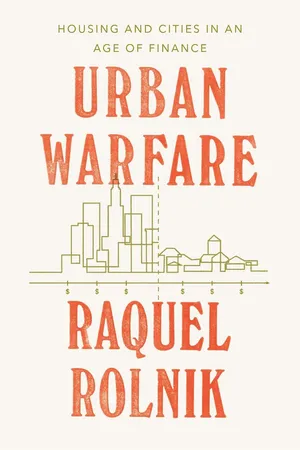
In Urban Warfare, Rolnik charts how the financialisation of housing has become a global crisis, as models of home ownership, originating in the US and UK, are being exported around the world. These developments were largely organised by htosw who benefit the most: construction companies and banks, supported by government-facilitated schemes, such as 'the right to buy', subsidies, and micro-financing.
Using examples ranging from Kazakhstan, Indonesia, Chile, Israel, Haiti, the UK and especially Brazil, Rolnik shows how our homes and neighbourhoods have effectively become the "last subprime frontiers of capitalism". This neoliberal colonialism is experienced on the scale of the city but also within our everyday lives. Yet since the financial crisis and wider urban politics that have left millions homeless, forced from their homes because of urban development politics, and mega-events such as the Rio World Cup in 2013. These narratives are weaved together with theoretical reflections and empirical evidence to explain the crisis in depth. In response, Rolnik restates the political need for activism and resistance. Examining in detail the June Days protests in Rio, 2013-14, she shows that housing remains an essential, and global, struggle.
- 384 pages
- English
- ePUB (mobile friendly)
- Available on iOS & Android
eBook - ePub
About this book
Information
PART I

1
The Global Financialisation of Housing
Scenes from the beginning of the twenty-first century, September 2010.
It was a cold and windy morning in Astana, the futuristic capital of Kazakhstan. After crossing a sort of plateau ablaze with the shiny creations of fashionable big-name architects, we finally arrived in a large tent to meet the hunger strikers. Lying on hammocks surrounded by signs written in Kazakh and Russian, Asian-looking elderly people were mixed with red-haired white women and middle-aged couples, taking shifts in beds and chairs. Having paid the instalments for apartments they had acquired off-plan, they were victims of construction companies that had gone bankrupt and disappeared, leaving the buildings’ skeletons unfinished and families with neither home nor money.
Astana’s hunger strikers were just the most daring among the 16,000 borrowers affected by the bankruptcy of – mainly Turkish – construction companies that had already halted 450 projects.1 In addition to the hunger strikers, there were also those affected by foreclosures in Almaty, the country’s historic capital and economic centre. During the years of credit boom, Kazakh banks and their clients contracted debts in both US dollars and euros, and were now struggling to pay their obligations.
In Astana and Almaty, the victims of the economic crisis, many now homeless, told us that they had been strongly encouraged by the government to buy apartments via mortgage credit certificates. (The president, Nursultan Nazarbayev, led the Communist Party during the USSR era and has been head of the government since Independence.) They also reported that the public institutions in which many of them used to work had even sponsored the sales of apartments to their employees. The group of strikers in Almaty, mostly made up of women, received me in a small apartment decorated with a banner that read: ‘Government, help your people’.2
May 2012
We climbed the highest hill of Puente Alto, in Santiago de Chile’s metropolitan region, in order to look across the Bajos de Mena area. It is one of the neighbourhoods in which thousands of social housing projects built by private companies are concentrated. They were commercialised via an association of mortgage credit certificates and governmental subsidies to low-income borrowers. These estates have been built in Chile since the beginning of the 1980s. The view is impressive: a sea of houses and four- or five-storey buildings as far as you can see.
The housing rights activists who accompanied me pointed to Volcán II, a housing estate in the process of being demolished. They explained that this neighbourhood has become one of the metropolitan region’s most problematic areas from a social point of view: drug addiction and trafficking, domestic violence and social vulnerability.3
They also showed me a 1983 document, written at the moment of the launch of Chile’s housing program. It was signed by the then minister of housing and urbanism, a man from the Chilean Chamber of Construction. In the document, he declared that the need for housing is ‘an element of social order that is translated and expressed in square metres’ and that the demand for housing is ‘a factor of economic order that is materialised in monetary quantities’.4
Autumn 2009
The streets of Pacoima, a few kilometres away from Los Angeles, California, looked like a ghost town. In the suburban landscape of front yards reaching to the streets, signs of abandonment were everywhere: mountains of forgotten rubble; dozens of ‘For Sale’ and ‘For Rent’ signs next to mailboxes; doors and windows sealed with wood or bricks. The minister of a local church, who accompanied me in the visit, told sad stories of families who’d had to leave their homes because they could not afford the repayments on their loans. He evoked the difficulties of those who remained in the neighbourhood, struggling to survive in a town that, having lost its fiscal base, could not keep basic services running.
At the end of a street, in an old SUV transformed into a home, Roger, Mary and their young children were cooking pasta on an improvised stove: ‘We’ve lost our house and we simply have nowhere to go.’
November 2012
As morning broke in a neighbourhood of Bilbao in the Basque Country, cash machines and bank headquarters were covered in graffiti: ‘murderers’. It was the day after fifty-three-year-old Amaia Egaña’s suicide. She jumped from the window of her fourth-floor apartment, moments before being evicted. She had failed to pay the instalments for the bank loan that she had taken out to buy the apartment. This was the second death in similar circumstances in less than one month.5 Bilbao was not the only – nor the most seriously – affected city in terms of foreclosures. According to data from the Spanish judicial system, between 2007 and the third trimester of 2011, 349,438 home foreclosures were initiated in Spain. According to the same source, on each day of 2011, 212 new foreclosure processes were opened.6
1 March 2012
In Barcelona, one of the cities most rocked by the crisis, I attend an assembly of the Plataforma de Afectados por la Hipoteca (Platform for People Affected by Mortgages). Since 2009, this social movement has worked to organise the people concerned in order to make the crisis visible, establishing support networks and lobbying for the promotion of public policies to address this situation. I listen to dozens of testimonies during the meetings: Latin American migrants who lost their jobs and could no longer pay the instalments; pensioners who, as guarantors of their children’s loans, now must hand over their own home to banks; couples who lost their home and still have huge debts … All this because, in Spain, with the drop in property prices after the bubble burst, the value that banks obtain from the sale of a house does not cover the entirety of the debt.
Moreover, if no buyer is present at the auction of the confiscated house (which happens in 90 per cent of cases), the law stipulates that the value of the property covers only 60 per cent of the total loan.7 As a result, in addition to losing their homes, people remain mired in debt.
Summer 2011
At dawn in Tel Aviv, one of the city’s most important arteries, Dizengoff Street, is filled by tents. The occupation of public spaces was part of the strategy of thousands of demonstrators – mostly young people – against the lack of accessible housing. The decade-long spiralling rise of real-estate prices had reached its peak. The lack of rental options and public housing in areas in which economic opportunities are concentrated had put housing policy at the centre of Israel’s political agenda that summer.
August 2013
When I entered the nineteenth-century hall of an old factory, now converted into a culture and events centre in Manchester, I remembered Friedrich Engels’s writings and thought: ‘The saga started here’.8
We arrived just as the first part of the meeting was about to finish. On the walls, signs written in marker spelt out strategies and schedules for the following months. It was one of the regional meetings for the campaign against the bedroom tax – one of the coalition government’s recently implemented fiscal austerity measures that most severely affected residents of British housing estates. Our presence was announced, and anyone who felt comfortable sharing their experience was invited through to another room.
Around thirty people gathered next door. There was hesitation at first. Many of them had known each other for months, having participated together in preparatory mobilisations and meetings; however, they had never talked about their personal dramas. A middle-aged lady stood up and said that she was a professional nurse, a widow, and that she used the extra bedroom in her house to occasionally host her two granddaughters. Her daughter, addicted to cocaine, was unable to look after the children in moments of relapse. Losing the two-bedroom house would mean inability to provide this support to her daughter and granddaughters.
Another woman said she suffered from depression and, having lived for thirty years on the same estate, could count on a network of friendly neighbours to help her keep stable. Therefore, she said, she chose not to move out, despite having to pay a penalty to live alone in a two-bedroom apartment. Ashamed, she admitted that now she could hardly afford to buy food, so that, as well as resorting to food banks,9 she had often looked for left-overs in the estate’s bins.
Other accounts followed, but the most touching moment – at least for me – was when a young man, in an electric wheelchair and showing clear signs of a learning disability, said that he could never move away from the estate where he lived, alone, in a two-bedroom apartment. For him, daily life required a herculean effort to remain autonomous and dignified despite his extremely fragile physical and mental situation. His life was entirely based on his existence – and permanence – in that community.
October 2010
After walking for seventy kilometres, a forty-year-old Indian carpenter suffers a fatal heart attack. The goal of his walk was to borrow money from friends who lived in a different town, in order to pay his micro-credit debts. A report from the Indian government stated that his death was ‘due to pressure put by the micro-finance institutions for repayment’. In 2002, the carpenter had borrowed US$350 from a micro-credit institution in order to build a room in his house. His wife, working in a tobacco factory, had already borrowed US$1,100 from her employers. In 2008, he was persuaded by another micro-credit agent to borrow an additional US$330 in order to cover the previous debts. When he died, the payment of all three loans was more than twenty weeks late. This was not the first nor the last death related to micro-credit debts occurring that year in the state of Andhra Pradesh.10
The scenes I have described – in places as diverse as Europe, the US, Latin America, the Middle East and Asia – are the expression and result of a long process of deconstruction of housing as a social good and its transformation into a commodity and a financial asset, which began in the first decade of the twenty-first century.
The extent and impact of this process go far beyond the financial subprime mortgage crisis that, spreading from the US since 2007, contaminated the international financial system. It is, in fact, the takeover of the housing sector by finance – the structural element of contemporary capitalism. We live under the empire of finance and fictitious capital hegemony, an era of increasing dominance of rent extraction over productive capital.11 The international literature on political economy of housing has termed this process ‘financialisation’, that is, ‘the increasing dominance of financial actors, markets, practices, measurements and narratives, at various scales, resulting in a structural transformation of economies, firms (including financial institutions), states and households’.12
The promotion of the ideology of homeownership,13 already deeply rooted in some societies and more recently introduced in others, has been a central element of the new paradigm of housing. Together with the ‘socialisation of credit’, it supported a double movement: on one hand, the inclusion of middle- and low-income consumers into financial circuits; on the other, the takeover of the housing sector by global finance. This process opened a new frontier for capital accumulation, allowing the free circulation of funds throughout almost all urbanised land.14
Between 1980 and 2010, the value of the world’s financial assets – stocks, debentures, private and government bonds, bank investments – increased by a factor of 16.2, while the world’s GDP increased by less than a factor of five in the same period.15 This pool of super-accumulation resulted not only from the profits earned by large corporations, but also from the emergence of economies such as China. This ‘wall of money’16 increasingly sought new fields of application, transforming whole sectors (such as commodities, education financing and health care) into assets to feed the hunger for new vectors of profitable investment. The imbalance between the size of the available financial capital and the domestic markets from which they originated resulted – mainly from the 1990s – in the search for internationalisation of investments. This environment was responsible for creating a structural scarcity of high-quality collateral. There was a wall of money as if airborne, seeking a ‘spatial fix’ (David Harvey’s concept), a place to land.17
The creation, reform and strengthening of housing financial systems became one of these new fields for surplus investment, both for macroeconomics and domestic finance and for this new flux of international capital. The creation of a subprime mortgage market was one of the main vehicles used to connect domestic systems of housing finance to global markets. However, other non-bank financial instruments, as well as interbank loans, allowed local banks and other intermediaries to increase their leverage, enlarging credit availability.18 The entrance of global surpluses of capital allowed credit to grow beyond internal markets’ sizes and capacities, creating and inflating real-estate bubbles.
The takeover of the housing sector by finance does not represent the mere opening of another field of investment for capital. It is, in fact, a peculiar form of value storage, as it directly relates macroeconomics to individuals and families, and allows, through financing mechanisms, the interconnection of many central actors of the global financial system – such as pension funds, investment banks, shadow banking, credit institutions and public institutions.19
In highly dynamic economies, including some EU countries and the US, homeownership, because of its capacity to feed growth via credit, was also responsible for propelling the rise in household consumption in a context of wage reduction and limited employment growth.20
On the other hand, the public or semi-public nature of housing institutions and financial policies defines this sector as one of high political relevance.21 No setting-up of housing financing systems – regardless of its degree of...
Table of contents
- Cover Page
- Halftitle Page
- Title Page
- Copyright Page
- Dedication
- Contents
- Foreword
- Introduction
- Part I
- Part II
- Part III
- Afterword: The Rental Housing Boom: New Frontiers of Housing Financialisation
- Acknowledgements
- Notes
- Index
- Maps
Trusted by 375,005 students
Access to over 1.5 million titles for a fair monthly price.
Study more efficiently using our study tools.
Frequently asked questions
Yes, you can cancel anytime from the Subscription tab in your account settings on the Perlego website. Your subscription will stay active until the end of your current billing period. Learn how to cancel your subscription
No, books cannot be downloaded as external files, such as PDFs, for use outside of Perlego. However, you can download books within the Perlego app for offline reading on mobile or tablet. Learn how to download books offline
We are an online textbook subscription service, where you can get access to an entire online library for less than the price of a single book per month. With over 1.5 million books across 990+ topics, we’ve got you covered! Learn about our mission
Look out for the read-aloud symbol on your next book to see if you can listen to it. The read-aloud tool reads text aloud for you, highlighting the text as it is being read. You can pause it, speed it up and slow it down. Learn more about Read Aloud
Yes! You can use the Perlego app on both iOS and Android devices to read anytime, anywhere — even offline. Perfect for commutes or when you’re on the go.
Please note we cannot support devices running on iOS 13 and Android 7 or earlier. Learn more about using the app
Please note we cannot support devices running on iOS 13 and Android 7 or earlier. Learn more about using the app
Yes, you can access Urban Warfare by Raquel Rolnik, Gabriel Hirschhorn in PDF and/or ePUB format, as well as other popular books in Politics & International Relations & City Planning & Urban Development. We have over 1.5 million books available in our catalogue for you to explore.