eBook - ePub
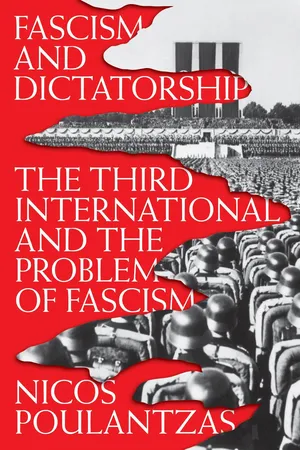
Fascism and Dictatorship
The Third International and the Problem of Fascism
- 592 pages
- English
- ePUB (mobile friendly)
- Available on iOS & Android
eBook - ePub
Fascism and Dictatorship
The Third International and the Problem of Fascism
About this book
The resurgence of the far right across Europe and the emergence of the "alt-right" in the US have put the question of fascism urgently back on the agenda. For those trying to understand these forms of politics, there is no better place to start than Fascism and Dictatorship, the unrivalled Marxist study of German and Italian fascism. It carefully distinguishes between fascism as a mass movement before the seizure of power and what it becomes as an entrenched machinery of dictatorship. It compares the distinct class components of the counterrevolutionary blocs mobilised by fascism in Germany and Italy; analyses the changing relations between the petty bourgeoisie and big capital in the evolution of fascism; discusses the structures of the fascist state itself, as an emergency regime for the defence of capital; and provides a sustained and documented criticism of official Comintern attitudes and policies towards fascism in the fateful years after the Versailles settlement. Fascism and Dictatorship represents a challenging synthesis of factual evidence and conceptual analysis, a standard bearer of what Marxist political theory should be.
Information
Part One
The Period of Fascism
The first problem to face in studying fascism is its specificity in relation to regimes such as military dictatorship and Bonapartism, and to other forms of the capitalist State. In other words, is it possible to define a form of exceptional capitalist State, which is distinct from other forms of capitalist State, and which itself fits various specific forms of exceptional regime, such as fascism, military dictatorship, and Bonapartism?
The question can only be posed accurately by studying both the political crisis to which the exceptional State is a response, and the particular kinds of political crises to which its specific forms correspond. But this requires, first of all, an analysis of the question of the historical period of capitalist formations within which these political crises and exceptional regimes occur. To avoid foundering in abstract typology, we have to be clear that the kinds of political crises which produce any given form of exceptional regimes, still have features which vary according to the period in which they arise. Nineteenth-century differs from twentieth-century Bonapartism, and the same is true of military dictatorship and fascism.
Although the analysis of the general historical periods to which exceptional regimes belong does not in itself explain their emergence, it remains a fact that the period affects the conjuncture of the class struggle (political crisis), which alone provides an answer.
1
Imperialism and Fascism.
Monopoly Capitalism and the
Imperialist Chain
Monopoly Capitalism and the
Imperialist Chain
I shall begin by looking at the period of fascism, and use the opening provided by a quotation from Max Horkheimer, which forms the inscription in a recent German work, Faschismus und Kapitalismus. Horkheimer, reacting early against the whole conception of ‘totalitarianism’, wrote: ‘Anyone who does not wish to discuss capitalism should also stay silent on the subject of fascism.’ Strictly speaking, this is incorrect: it is he who does not wish to discuss imperialism who should stay silent on the subject of fascism.
Fascism in effect belongs to the imperialist stage of capitalism. The point is therefore to try to elucidate certain general characteristics of the stage, and their impact on fascism. The primary causes of fascism are not the factors often seen as its basic sine qua non, such as the particular economic crises Germany and Italy were caught in when fascism was establishing itself, the national peculiarities of the two countries, the consequences of the First World War, etc. These factors are important only in relation to the stage of imperialism, as elements of one of the possible conjunctures of this stage.
It becomes necessary, then, to dwell on the question of imperialism – though I am well aware that the present discussion cannot be exhaustive. Nonetheless there are positions which require correction, and fascism as a crisis of the imperialist stage provides a basis for doing this.
The crux of the matter appears to be the following: imperialism, considered as a stage in capitalist development as a whole, is not simply or solely an economic phenomenon; in other words, it is not determined by events in the economic domain alone, nor can it be located within it. The Third International, however, held quite strongly to an ‘economistic’ conception of imperialism.
This became very clear in its particular interpretation of Lenin’s theory of imperialism, and especially of Imperialism, the Highest Stage of Capitalism – an interpretation governed by the Third International’s economism. To summarize the thesis I elaborate below: economism seems to be the point of convergence for the currents of the Second International, and is, moreover, the focal point of Lenin’s attacks on it. As far as the Third International is concerned, while it made a clear break under Lenin from the conceptions of the Second International, this lasted only for a short space of time; then economism seems to have been restored step by step in a new guise, hidden behind a certain language and certain organizational forms.
The inevitable corollary of this ‘economism’ was the lack of a mass line, linked in turn to the progressive abandonment of proletarian internationalism, characteristics not only of the Comintern’s general line, but also of the line of the Bolshevik Party and its leadership within the USSR.
Before going any further, a particular clarification is required. This line did not come out of the blue. It would be completely idealistic to think that the Comintern line, and the line followed by the USSR, were no more than ‘errors’ or ‘deviations’ in theory and politics in the thinking of the leaders. It would be giving a purely subjectivist meaning to what was an effective political line which governed the destiny of the world proletariat. Nor was this line the result of a simple organizational ‘degeneration’ of the Bolshevik Party and the other sections of the Comintern. It was in fact rooted in the class struggle between bourgeoisie and proletariat, the struggle between the ‘two roads’ in the USSR itself during the transitional phase. I shall try to pin-point this in the Appendix, ‘The USSR and the Comintern’.
Although the Comintern’s general political line, and the turns in it, were determined by the struggle between fractions and tendencies within the Bolshevik Party, by the Party’s policy within the USSR, Soviet foreign policy, and therefore by the struggle between bourgeoisie and proletariat within the USSR, it was determined by no means directly or immediately, as a whole historiographical tradition would have it. Economism, the lack of a mass line, and the growing abandonment of internationalism (i.e. the effects of the struggle between the bourgeoisie and the proletariat in the USSR), formed the necessary link by means of which the USSR, or ‘what was happening in the USSR’ determined the policy of the Comintern and the local Communist Parties. For the general line had its own decisive effects on the course of the concrete struggle between the bourgeoisie and the proletariat in the USSR itself.
There were, in addition, particular ‘errors’ in the line, which, by accumulation, had their own effects both on the struggle between bourgeoisie and proletariat in the USSR, and on Comintern policy, the point of immediate interest to us.
In the attempt to demonstrate this, my account will in a sense reverse the order of real causation.
To go back to Lenin, it is true that his text deals only with the economic aspects of imperialism – but with the key distinction that Lenin himself draws attention to the fact in his last preface, clearly affirming its inadequacies: ‘This pamphlet was written with an eye to the tsarist censorship. Hence, I was not only forced to confine myself strictly to an exclusively theoretical, specifically economic analysis of facts, but to formulate the few necessary observations on politics with extreme caution, by hints, in an allegorical language – in that accursed Aesopian language … It is painful, in these days of liberty, to reread the passages of the pamphlet which have been distorted….’1
However, it was not accidental that the Third International used this work in a particular way: it was a function of its particular economism, just as the Second International took as its holy writ Marx’s ‘Preface’ to the Contribution to the Critique of Political Economy and Engels’s Socialism, Utopian and Scientific. These works do have real ‘economistic’ overtones – and it would be as well to examine the reasons for this some day. Still, Lenin’s pamphlet, and his work as a whole, quite clearly contain a theory of imperialism as something which cannot be reduced to a mere economic phenomenon. Only with reference to this theory is it possible to understand fascism.
Imperialism, considered as a stage in the ensemble of the capitalist process, is not in fact just a question of modifications in the economic domain, such as monopoly concentration, the fusion of banking and industrial capital into finance capital, the export of capital, and the search for colonies for purely ‘economic’ reasons, etc. These ‘economic’ factors actually determine a new articulation of the ensemble of the capitalist system, thereby producing profound changes in politics and ideology.
These modifications affect not only each national social formation, but also social relations on an international scale. Moreover, the particular relations between these two sectors, which precisely characterize imperialism, depend on these modifications.
For the first sector, the main feature of the process is monopoly capitalism. Here a phenomenon of decisive importance enters: the economic modifications of this stage assign a new role to the capitalist State, giving it new functions and an extended field of intervention, and also a new level of effectiveness. There are frequent attempts nowadays to attribute this role of the State to present-day conditions, in order to define a new stage of ‘State monopoly capitalism’; but the role in fact belongs precisely to the imperialist stage as a whole. To make this even clearer: the evident break in the State’s role and effectiveness does not mark two decisive stages – ‘classic’ imperialism and ‘State monopoly capitalism’ – but marks rather the pre-imperialist from the imperialist (monopoly capitalist) stage. Undoubtedly, important modifications occur at the same time, but only as a periodization within the imperialist stage itself.
There was never a stage of capitalism in which the State did not play an important economic role: the ‘liberal State’, confined to policing competitive capitalism, has always been a myth. Nonetheless, a new State role characterizes the imperialist stage. It is known as the interventionist State because of the profound repercussions of the stage on the political forms of the capitalist State, in relation to previous forms. Lenin indicated this many times; in the passages about the rentier State in the above-mentioned pamphlet, and in his analyses of State capitalism, which went far beyond the simple framework of the historical conjunctures of Germany during the First World War, and the USSR after the 1917 revolution.
The phenomenon of fascism can only really be understood in so far as it is located within a stage characterized by this modification in the State’s role. Most Marxist authors who have discussed fascism have correctly pointed to this key question.
Fascism combines the role of the State in the imperialist stage with the specific role of the State in a transitional phase between stages. There is already an account elsewhere of the specific role of the State in transition between two modes of production in a single social formation.2 It should be added here that the State also plays a decisive role in the transition between two stages in a single mode of production. In the particular instance of German and Italian fascism, the decisiveness of the State’s role is expressed not only in its new role in the imperialist stage, but also in its crucial role in the particular transition to the establishment of monopoly capitalism in these two countries.
Lenin wrote in Imperialism: ‘For Europe, we can establish quite accurately the moment when the new (monopoly) capitalism decisively replaced the old: it is the beginning of the twentieth century.’3 In fact what should be understood by this, in the light of what we now know, is that for the major European countries the beginning of the twentieth century marked a break with the preceding stage, and therefore the decisive start of the phase of transition towards the dominance of monopoly capitalism.4 Taken literally, Lenin’s statement does not seem correct, at least for Germany and Italy, countries where capitalism and imperialism came late.
The role of the State in the transitional phase in question is relatively different from its role in the monopoly capitalist stage. This explains the fact that when the transition was complete (i.e. after the end of the Second World War), the State confined itself to its role in the monopoly capitalist stage, having already consolidated its dominance. Its role undoubtedly remained very important, but seemed to be less so, a retreat from its ‘enlarged’ role during the transition. This is as much the case in Germany and Italy as in England and even the United States, after the period of Roosevelt’s New Deal.5
Finally, the imperialist stage is also characterized by profound changes in ideology, more specifically in the dominant ideology and its political scope: the formation of imperialist ideology, in all its variants, takes place within it. We shall see to what extent fascist ideology is a variant of it, and also how far this upheaval in the dominant ideology was an essential element in the ideological crisis which marked the conjuncture of Germany and Italy during the rise of fascism.
It is now necessary to apply these remarks at the international level, where the crucial questions are posed. Imperialism, as a stage in the capitalist system on the international level, is not a phenomenon which can be reduced to economic developments alone. To put it more strongly: only in so far as one sees imperialism as a phenomenon with economic, political and ideological implications, can the internationalization of social relations peculiar to this stage be understood. We can then grasp the two dominant elements in this respect – the imperialist chain and the uneven development of its links – and analyse concrete situations in their light.
In studying imperialism, it is not enough to speak of the international flow of capital, or of economic interpenetration: it is necessary to see the very important fact that imperialism is a chain. A chain implies links. But here again, it is not enough to speak only of the weakest link. Discussion of the link in itself requires us to bring in the element of uneven development of the various national formations which constitute the chain. It is the very existence of this chain which gives a new meaning to the particular uneven development characteristic of imperialism; for as we know, uneven development is characteristic of capitalism from its very beginning.6 The uneven development of the imperialist chain means for one thing that other links than the weakest are not of equal strength: they too are relatively weaker or stronger. Strictly speaking, the strength of some depends on the weakness of others, and vice versa.
Lenin’s analysis of Russia enables us to see more closely how he came to an understanding of the imperialist chain. When Lenin analyses Russia and defines it as the weakest link, he is not referring to economic factors alone. He found in Russia, as the weakest link, an accumulation of economic, political and ideological contradictions. The uneven development of the imperialist chain made itself felt within the Russian social formation, in an uneven development of the economy (with the various forms of production coexisting in Russia), of politics (the tsarist State) and of ideology (the ideological crisis). If this accumulation made Russia the weakest link, it was because the chain itself was not held together by economic ties alone.
It is well known that, on the other hand, the Second International, with its marked economism, was expecting revolution in Germany, the most economically developed country. The Second International’s economism led, we might say, to a conception of the strongest link. But it is wrong in this case to speak of links, because the Second International’s economism (and this is the crucial point) hides the imperialist chain itself from its sight. If the Second International was expecting revolution in the most economically developed country, it was because at the same time it saw international relations as ‘economic ties’ alone. (Hilferding’s work is an example.)
So Lenin’s conception d...
Table of contents
- Cover Page
- Halftitle Page
- Title Page
- Copyright Page
- Contents
- Foreword
- Introduction
- Part One: The Period of Fascism
- Part Two: Fascism and the Class Struggle
- Part Three: Fascism and the Dominant Classes
- Part Four: Fascism and the Working Class
- Part Five: Fascism and the Petty Bourgeoisie
- Part Six: Fascism and the Countryside
- Part Seven: The Fascist State
- Notes
- Conclusion
- Index
Trusted by 375,005 students
Access to over 1.5 million titles for a fair monthly price.
Study more efficiently using our study tools.
Frequently asked questions
Yes, you can cancel anytime from the Subscription tab in your account settings on the Perlego website. Your subscription will stay active until the end of your current billing period. Learn how to cancel your subscription
No, books cannot be downloaded as external files, such as PDFs, for use outside of Perlego. However, you can download books within the Perlego app for offline reading on mobile or tablet. Learn how to download books offline
Perlego offers two plans: Essential and Complete
- Essential is ideal for learners and professionals who enjoy exploring a wide range of subjects. Access the Essential Library with 800,000+ trusted titles and best-sellers across business, personal growth, and the humanities. Includes unlimited reading time and Standard Read Aloud voice.
- Complete: Perfect for advanced learners and researchers needing full, unrestricted access. Unlock 1.5M+ books across hundreds of subjects, including academic and specialized titles. The Complete Plan also includes advanced features like Premium Read Aloud and Research Assistant.
We are an online textbook subscription service, where you can get access to an entire online library for less than the price of a single book per month. With over 1.5 million books across 990+ topics, we’ve got you covered! Learn about our mission
Look out for the read-aloud symbol on your next book to see if you can listen to it. The read-aloud tool reads text aloud for you, highlighting the text as it is being read. You can pause it, speed it up and slow it down. Learn more about Read Aloud
Yes! You can use the Perlego app on both iOS and Android devices to read anytime, anywhere — even offline. Perfect for commutes or when you’re on the go.
Please note we cannot support devices running on iOS 13 and Android 7 or earlier. Learn more about using the app
Please note we cannot support devices running on iOS 13 and Android 7 or earlier. Learn more about using the app
Yes, you can access Fascism and Dictatorship by Nicos Poulantzas, Judith White in PDF and/or ePUB format, as well as other popular books in Politics & International Relations & Critical Theory. We have over 1.5 million books available in our catalogue for you to explore.