Lemke offers the most comprehensive and systematic account of Michel Foucault's work on power and government from 1970 until his death in 1984. He convincingly argues, using material that has only partly been translated into English, that Foucault's concern with ethics and forms of subjectivation is always already integrated into his political concerns and his analytics of power. The book also shows how the concept of government was taken up in different lines of research in France before it gave rise to "governmentality studies" in the Anglophone world.
A Critique of Political Reason: Foucault's Analysis of Modern Governmentality provides a clear and well-structured exposition that is theoretically challenging but also accessible for a wider audience. Thus, the book can be read both as an original examination of Foucault's concept of government and as a general introduction to his "genealogy of power".
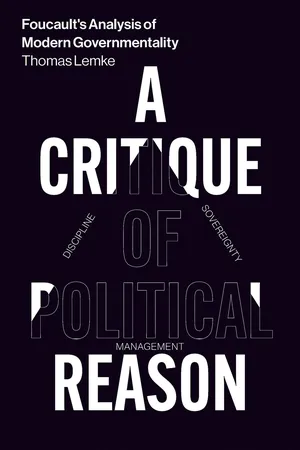
eBook - ePub
Foucault's Analysis of Modern Governmentality
A Critique of Political Reason
- 464 pages
- English
- ePUB (mobile friendly)
- Available on iOS & Android
eBook - ePub
Foucault's Analysis of Modern Governmentality
A Critique of Political Reason
About this book
Information
Part I
The Microphysics of Power
1
From the Archaeology of Knowledge to the Problem of Power
From its inception, Foucault presented his project as methodologically distinct from both traditional historiography and social criticism. He gave this new approach the programmatic name of archaeology. Thus, Histoire de la folie à l’âge classique1 investigated the history of madness and the institutionalization of psychiatry in terms of an ‘archaeology of silence’.2 In works that followed – Foucault’s book on illness and the emergence of clinical medicine, then his study of the life sciences, language and economy – the very titles announced the claim: Naissance de la clinique: une archéologie du regard médical,3 and Les mots et les choses: une archéologie des sciences humaines.4 Finally, in L’Archéologie du savoir,5 Foucault sought to define the theoretical profile of his endeavours and identify the specific terrain of research and conceptual innovations that an ‘archaeological method’ offers.
A look at these books makes it clear that Foucault’s concept of archaeology breaks with what the word traditionally conveys. His project does not dig for first beginnings, nor does it represent a philosophical search for hidden meaning. Archaeology does not attempt to ‘interpret’ historical material with regard to ‘causes’ at work ‘behind’ or ‘underneath’ it. The task is not to ‘discover’ the intellectual or material principle underlying social phenomena, either. On the contrary, it means casting doubt on the central hypotheses of history conceived in such a way. Archaeology takes aim at history viewed as a system of homogeneous relations constituting a net of causality, which then sets a pattern of derivation or analogy into motion. It rejects the hypothesis that a unified form of historicity exists, guaranteeing the same modes of transformation for economic structures and mentalities, politics and technology. Finally, archaeology denies the postulate that history breaks down into phases or sequences containing their own, inherent principle of coherence.6
Counter to conceptions of ‘total history’, Foucault presents archaeology as a form of ‘general history’. Archaeology no longer refers historical material to a dimension of hermeneutic depth that is supposed to grant it meaning. Instead, it ‘describes’ historical material in its ‘superficiality’, or ‘positivity’. That said, this change of orientation does not mean to give up on the idea of synthesizing varied forms of history in order to arrive at a ‘plurality of histories juxtaposed and independent of each other’; rather, the point is ‘to determine what form of relation may be legitimately described between these different series; what vertical system they are capable of forming; what interplay of correlation and dominance exists between them’.7
Foucault’s twofold refusal – to pluralize histories and renounce any attempt at explanation, on the one hand, or to pursue lines of derivation in order to achieve full and ‘saturated’ explanation, on the other – gives rise to a problem that also represents the condition for calling things into question in the first place: the problem of power. The ‘power question’ arises because archaeology does not trace historicity back to a single principle, although it does not renounce analysing causality either. But Foucault’s early works treat the matter implicitly; for the most part, it remains subordinate to another problem, which constitutes archaeology’s specific object: the problem of knowledge.8
The Problem of Knowledge
Archaeology does not stand alone in subjecting to critique the field of problems and investigation as articulated in traditional, historico-philosophical terms. It represents part of a complex, theoretical confluence whose contours emerged in confrontation with the traditional aims and methods of history and philosophy. Foucault’s project for a ‘general history’ bears the imprint, first, of efforts by scholars working in the context of the Annales journal to reorient historical study; second, anti-empiristical tendencies in the history of science contributed to historiographical approaches focused on identifying problems; finally, critical engagement with the hermeneutic tradition represents a solid component of the structuralism debate. Needless to say, these points of overlap and ‘vicinity’9 are matched by fundamental differences, which ensure the autonomy of Foucault’s archaeological project.
Like contributors to Annales, Foucault locates his theoretical undertaking between socio-economic history and the history of ideas. His methodological approach also works to counter the separation between material practices and immaterial ideas, which underlies traditional historiography; instead, it seeks to determine the ‘materialism of the incorporeal’.10 At the same time, however, Foucault rejected the concept of mentality that some proponents of the ‘new historiography’ endorsed.11 His ‘history of madness’ and ‘history of illness’ are not organized in terms of mentalities; instead, archaeology situates the field of investigation in the context of the nascent human sciences, which it analyses in terms of changing social and institutional practices. To do justice to this research interest, it is necessary to maintain critical distance from projects of the history of mentalities, which work towards a psychological understanding of historical problems.12
Foucault had to develop a different conception of his object of inquiry in order to free himself from psychological constrictions and situate collective dispositions and modes of behaviour, as well as changes within them, on a more fundamental level. This level is the knowledge (savoir) of a society, which provides the background both for ‘material practices’ and ‘ideological forms’; indeed, it is meant to encompass both poles. Foucault introduces savoir in contrast to connaissance to set his project apart from a subject-centred conception of knowledge. Unlike connaissance, savoir does not simply indicate the relationship between the subject (of cognition) and the (real) object; this relationship is not the precondition and point of departure, but itself the product of historical processes:13
In a society, different bodies of learning, philosophical ideas, everyday opinions, but also institutions, commercial practices and police activities, mores – all refer to a certain implicit knowledge (savoir) special to this society. This knowledge is profoundly different from the bodies of learning that one can find in scientific books, philosophical theories, and religious justifications, but it is what makes possible at a given moment the appearance of a theory, an opinion, a practice.14
French epistemology is characterized by rejecting the classical problematic for developing a critique of knowledge and an interest in processes of knowledge formation. That said, epistemology and archaeology differ in the questions they pose and how knowledge processes are conceptualized. If archaeology finds the ‘point of balance of its analysis in the element of connaissance’,15 epistemology stands at the ‘threshold of scientificity’16 and asks how this frontier is crossed: how concepts and metaphors are refined so that they finally achieve scientific status. Whereas Foucault takes as his point of departure a more comprehensive concept of knowledge, aiming to neutralize questions of validity, epistemology concerns ‘the opposition of truth and error, the rational and the irrational, the obstacle and fecundity, purity and impurity, the scientific and the non-scientific’.17
Archaeology and epistemology do not differ only in terms of the fields addressed; a further distinction concerns the rationalist constitution of the ‘discontinuity’ and ‘productivity’ of knowledge. In an epistemological framework, discontinuity refers to the break between ‘scientific’ and ‘everyday’ knowledge. The productivity of scientific insight is supposed to leave behind the ‘errors’ and ‘illusions’ of everyday understanding – ‘exterminating’ or ‘destroying’ them, and so on. As such, scientific knowledge proves productive to the extent that it breaks with the negativity of everyday understanding. In contrast, archaeology poses the question whether this line of demarcation between science and non-science can be maintained at all. Archaeology is based on the suspicion that the sharp opposition between science and non-science points to a rationalist position which cannot be taken for granted; instead, such a distinction represents the historical result of scientific developments.18
Foucault does not elaborate the concept of knowledge just to take distance from the psychologism inherent in the notion of mentality and epistemological rationalism. He also sets the concept apart from the ‘formalism’ of structuralism.19 On the one hand, he shares the critical view of constitutive subjectivity formulated by ‘structuralist’ semiology, psychoanalysis and ethnology, and he acknowledges that the problem holds ‘in terms not unlike those’ for the field of history.20 He also likens his archaeological projects to areas where structural analysis has charted its greatest successes: for instance, the psychoanalytic investigation of ‘the unconscious of science’21 or, alternatively, the ‘ethnology … of our rationality’.22 On the other hand, however, Foucault stresses that archaeology in no way seeks the ‘transfer to the field of history, and more particularly to the history of knowledge …, a structuralist method’.23
Foucault made this distancing gesture for good reason. Towards the end of the 1960s, he grew increasingly aware of the ambivalent status of the structuralist critique of autonomous subjectivity. On the whole, thinkers performing such a critique were not concerned with calling the human sciences into question so much as articulating the implicit and transparent rationality of the same. Even though this meant denouncing humanism as ‘ideology’, ‘dissolving’ standing notions of ‘man’ still served to guarantee the scientificity of the human sciences. On this score, Althusser’s24 rigorous distinction between bourgeois-humanist ideology and Marxist science overlapped with Levi-Strauss’s effort to elaborate an anthropology analogous to the natural sciences. Structuralists had no doubt about the role of knowledge or the status of science itself. The latter were conceived ‘neutrally’ – and therefore exempt from being called into question. This problem, however, is precisely what interested Foucault: the ‘birth of the human sciences’ and their articulations alongside ‘non-scientific’ social and institutional practices shaped Madness and Civilization, The Birth of the Clinic and The Order of Things.25
Many structuralist works of the period lacked appreciation for this problematic because they conceived of language as a homogeneous and closed system of meanings, which was supposed to be the same for everyone. In consequence, the assumption prevailed that linguistic utterances possess the same significance irrespective of context or speakers’ social positions. Research sought out the general structures underlying languages, myths, systems of kinship and so on. On the one hand, this meant – contra subject-centred history and concepts of continuous time and space – foregrounding structural determinants, ahistoricity and patterns that defy change. But, at the same time, on a deeper level, such projects demonstrated agreement with the humanism they combated inasmuch as they assumed the existence of an unchanging human nature and universal laws.26
The dualism underlying the separation between a linguistic system and concrete language use (langue/parole) – which opposes pure (suprahistorical) possibility to (historical) realization – leads to a deficient notion of historicity. It sets the realm of structure apart from a historical dimension where relations possible in combinatory terms are held in reserve, some of which are then realized in actual fact. In this light, the historical process represents a matter of spelling out an alphabet that is always already at hand, as if the latter were not subject to change, too: structure comes to stand outside of time and assume the role of an ‘unmoved mover’; by this logic, the ‘event’ stands as a particular instantiation of the general system, but the system itself is not analysed in its own unicity. On the basis of such juxtaposition of universal and anonymous linguistic rules, on the one hand, and historical and concrete language use, on the other, the investigative focus falls on general conditions of possibility and formal analysis.27 Foucault indicates that his position differs from structuralist efforts on this point: ‘Unlike those who are labelled “structuralists”, I am not really interested in the formal possibilities afforded by a system such as language’; instead, ‘language can be analysed in terms of its formal properties only on the condition of taking account of its concrete functioning’.28 He introduces t...
Table of contents
- Cover Page
- Halftitle Page
- Title Page
- Copyright Page
- Contents
- Preface to the English-language Edition
- Introduction: Paradoxes, Contradictions, Aporias: The Order of Discourse as the Discourse of Order
- Part I: The Microphysics of Power
- Part II: Governmentality
- Part III: Politics and Ethics
- Bibliography
- Notes
- Index
Trusted by 375,005 students
Access to over 1.5 million titles for a fair monthly price.
Study more efficiently using our study tools.
Frequently asked questions
Yes, you can cancel anytime from the Subscription tab in your account settings on the Perlego website. Your subscription will stay active until the end of your current billing period. Learn how to cancel your subscription
No, books cannot be downloaded as external files, such as PDFs, for use outside of Perlego. However, you can download books within the Perlego app for offline reading on mobile or tablet. Learn how to download books offline
Perlego offers two plans: Essential and Complete
- Essential is ideal for learners and professionals who enjoy exploring a wide range of subjects. Access the Essential Library with 800,000+ trusted titles and best-sellers across business, personal growth, and the humanities. Includes unlimited reading time and Standard Read Aloud voice.
- Complete: Perfect for advanced learners and researchers needing full, unrestricted access. Unlock 1.5M+ books across hundreds of subjects, including academic and specialized titles. The Complete Plan also includes advanced features like Premium Read Aloud and Research Assistant.
We are an online textbook subscription service, where you can get access to an entire online library for less than the price of a single book per month. With over 1.5 million books across 990+ topics, we’ve got you covered! Learn about our mission
Look out for the read-aloud symbol on your next book to see if you can listen to it. The read-aloud tool reads text aloud for you, highlighting the text as it is being read. You can pause it, speed it up and slow it down. Learn more about Read Aloud
Yes! You can use the Perlego app on both iOS and Android devices to read anytime, anywhere — even offline. Perfect for commutes or when you’re on the go.
Please note we cannot support devices running on iOS 13 and Android 7 or earlier. Learn more about using the app
Please note we cannot support devices running on iOS 13 and Android 7 or earlier. Learn more about using the app
Yes, you can access Foucault's Analysis of Modern Governmentality by Thomas Lemke, Erik Butler in PDF and/or ePUB format, as well as other popular books in Politics & International Relations & Communism, Post-Communism & Socialism. We have over 1.5 million books available in our catalogue for you to explore.