When he died of an AIDS-related condition in 1984, Michel Foucault had become the most influential French philosopher since the end of World War II. His powerful studies of the creation of modern medicine, prisons, psychiatry, and other methods of classification have had a lasting impact on philosophers, historians, critics, and novelists the world over. But as public as he was in his militant campaigns on behalf of prisoners, dissidents, and homosexuals, he shrouded his personal life in mystery.
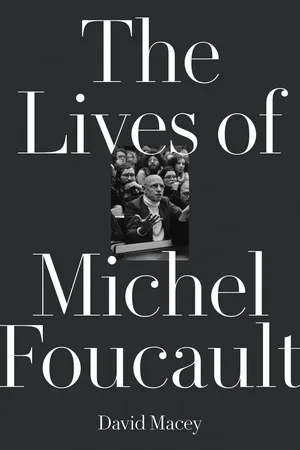
In The Lives of Michel Foucault - written with the full cooperation of Daniel Defert, Foucault's former lover - David Macey gives the richest account to date of Foucault's life and work, informed as it is by the complex issues arising from his writings. In this new edition, Foucault scholar Stuart Elden has contributed a new postface assessing the contribution of the biography in the light of more recent literature.
- 640 pages
- English
- ePUB (mobile friendly)
- Available on iOS & Android
eBook - ePub
The Lives of Michel Foucault
About this book
Information
Topic
PhilosophySubtopic
Philosopher Biographies1
PAUL-MICHEL
HER family was solidly respectable, well-established and well-connected.1 Anne Malapert was the daughter of Dr Prosper Malapert of Poitiers, a provincial city 300 kilometres to the southwest of Paris. He was a surgeon with a profitable private practice and taught anatomy in the university’s school of medicine. Prosper Malapert was a wealthy man, rich enough by the turn of the century to build a large white house near the railway station and within easy walking distance of the town centre. The house gave on to both the rue Arthur Ranc and the boulevard de Verdun and had a small garden to the rear, though, when Michel Foucault was a child, it contained rather more cement than greenery.
Prosper Malapert had two brothers: Roger and Paulin. Roger opted for a military career, rose to the rank of colonel and fought with distinction in the First World War at the head of a regiment which he had reputedly personally recruited among the apaches of Montmartre. Paulin studied philosophy, but never held a university post. In his own view, his chosen speciality was a further obstacle to his career; he was a characterologist, and suffered from the prestige attaching to the then dominant philosophy of Bergsonism, with its emphasis on the fluidity of ‘becoming’ rather than on the stability of character. Paulin Malapert’s career was spent in a Parisian lycée, but he published quite widely, producing a treatise on the theory of character, textbooks on psychology and philosophy and a study of Spinoza.2 He founded no school and achieved no great academic distinction. The academic honours went to his son-in-law, Jean Plattard, editor of standard editions of Rabelais and Montaigne and sometime lecturer at the University of Poitiers and then the Sorbonne.3
Anne Malapert married a young doctor, Paul Foucault, originally of Fontainebleau, but later resident in Poitiers. Born in 1893, he was the son and grandson of doctors, both called Paul. His grandfather was the dynasty’s deviant. Rather than treat the provincial middle classes, this Paul Foucault chose to work with the poor of Nanterre in the days when it was still a country village a few miles outside Paris. Little is known about him, other than that he died, as befits a médecin des pauvres who treated his patients at no charge, with only five francs in his pocket and, presumably, the world. His only bequest was a silver pen given to him by grateful patients, and that vanished in a burglary at the home of his great-grandson Denys. He did, however, achieve a degree of municipal recognition: Nanterre boasts a rue du Dr Foucault.
Like his father-in-law, Dr Paul Foucault taught at the medical school in Poitiers and eventually took over the Malapert practice in addition to his own. As a surgeon, Paul Foucault was at the top of the medical hierarchy and enjoyed much greater prestige than a mere doctor of medicine. He was a notable, with a social standing equal to that of a banker or a notary. He was one of a handful of surgeons in the city and an obstetrician whose patients were drawn mainly from the urban middle classes. His practice extended into rural areas and he was also consulted by the Benedictines at Ligugé, the famous abbey eight kilometres to the south of Poitiers, as well as by farmers and landowners. For a surgeon, the accumulation of income from a variety of sources and jealously guarded positions was the key to success, and Paul Foucault was successful. He worked long hours and, given the surgical and medical technology of the day, his professional activities involved a lot of physical effort, especially on rural calls. They also called for a certain talent for improvisation. A folding operating table was carried in the boot of one of the two cars he ran, and Dr Foucault’s driver could, if the need arose, act as an assistant anaesthetist. The surgeon was accustomed to the exercise of authority, both professionally and at home, and was not always an easy man to live with.
Anne Foucault was in many respects his match. A woman who knew her own mind and who was accustomed to having her own way, she ran with great efficiency a household of servants and was, with the help of a secretary, largely responsible for the management of her husband’s practice. Anne Foucault was no femme d’intérieur. Unusually for a woman in the provinces at this time, she could drive, and did so very competently. She was wealthy in her own right, and owned land. The Malapert home was Le Piroir, a large house built in the middle of the last century and standing in its own grounds at Vendeuvre-du-Poitou, some fifteen kilometres outside Poitiers. Le Piroir was approached down a drive flanked by two huge wellingtonias and an avenue of pollarded limes, but it was not of great architectural beauty and, being built of local limestone, had an unfortunate tendency to suffer from damp. Although large, Le Piroir was not, as has sometimes been claimed, known to local people as ‘the château’.4 Vendeuvre does have its château – the sixteenth-century château des Roches with its machicolated towers – but that was never in the possession of the Malaperts. It is revelatory of the values of the times, and of the provincial bourgeoisie, that, though no architect’s plans for Le Piroir survive – it was probably built by local masons – there do survive records of the purchase and sale of land and of boundaries.
The Foucaults were members of a prosperous bourgeoisie and enjoyed considerable prestige in Poitiers, a small town with a population of under 40,000 at the outbreak of the Second World War. They had little or no contact with the surviving aristocracy but retained rural connections through Le Piroir and the land attached to it. Land-ownership and agriculture provided the basis for Poitiers’s wealth. There was little industry, but this relatively rich stock-rearing region produced wine, asparagus and garlic. The town itself was quiet, and best known for its churches, especially Notre Dame La Grande which, with its splendid façade, is one of the best examples of romanesque sculpture in France. The glories of the university, a Renaissance foundation, were a thing of the past and it was now best known for its law faculty. The medical school was small and taught only the first three years of the degree course; further studies had to be pursued elsewhere. In political terms, the city was radical, meaning that it was dominated by the Parti Radical et Socialiste, which was neither radical nor socialist but moderately conservative. A countervailing political force was provided by fairly strong clerical influence. Outsiders found the town rather dull, and its inhabitants complacent, introverted and not particularly welcoming.
It was into this family and this milieu that Paul-Michel Foucault was born on 15 October 1926. Paul was the second of three children. His sister Francine was his elder by fifteen months, and his brother Denys was born five years after him. The three children bore a striking likeness to one another, and all had the same fair hair, the rather prominent nose and the bright-blue eyes that were to stare from the rimless glasses Foucault wore in so many photographs.
The tradition of the Foucault family was that an eldest son was always called ‘Paul’, and it was at his mother’s insistence that the child was called Paul-Michel. He referred to himself as Michel. For administrative purposes, and at school, he was Paul; for his adoring mother, he was always Paul-Michel. Other members used the same appellation, which could lead to some confusion, even in later years. His niece Anne Thalamy, for example, knew him as ‘Paul-Michel’ and addressed him as vous; to her husband, he was ‘Michel’, to be addressed with the informal tu.
Paul-Michel had a traditional middle-class upbringing. His family was nominally Catholic, but its Catholicism extended little beyond the celebration of rites of passage like baptism, first communion, marriage and burial. The children attended mass in the church of Saint-Porchair, but as often as not it was their grandmother and not their mother who took them. Such nominal Catholicism, combined with a measure of anti-clericalism, was not atypical of la France bourgeoise, with its contradictory heritage of Voltairean agnosticism and bien-pensant Catholicism. At least occasional attendance at mass was a social obligation, but the doctors and surgeons of the Third Republic were not, as a social group, noted for their piety. Even so, Paul-Michel took his first communion and was, for a while, a choirboy, despite his lack of musical ability. There is no record of any traumatic loss of faith on Paul-Michel’s part and it appears that he simply drifted away from his childhood religion. On the other hand, he retained a certain affection for the more camp aspects of organised religion, and once described the Catholic Church as ‘a superb instrument of power … completely woven from imaginary, erotic, carnal and sensual elements. It’s superb.’5
The family was never poor, and was becoming more prosperous during Paul-Michel’s early years. At the beginning of the 1930s, Paul and Anne Foucault bought, at low cost, land at La Baule and built a villa there. La Baule, which stands on a glorious sweep of sand seventeen kilometres from the port of Saint-Nazaire, was just beginning to develop as a holiday resort and had none of the aristocratic chic of, say, Normandy’s Deauville and Cabourg, which was the original for Proust’s Balbec. La Baule was primarily a resort for the middle classes of the industrial towns of Nantes and Saint-Nazaire. The Foucault villa, large enough to accommodate a family of five and servants, was to the south of the town in the area known as La-Baule-des-Pins, pines being one of the region’s great beauties, and not in the more fashionable streets near the casino. La Baule became the traditional site for family holidays in the summer, whereas the Easter holidays were normally spent at Le Piroir.
Foucault very rarely spoke of his childhood, and when he did so it was usually in very negative terms. He spoke, for instance, of coming from an ‘incredibly narrow-minded’ provincial background,6 but the class element in such comments was probably influenced by the disdain which so many Parisians, and especially Parisians by adoption, like Foucault, traditionally display for the so-called ‘French desert’. He was later to recall how the narrow-mindedness of his background imposed on him ‘the obligation of speaking, of making conversation with strangers … I often wondered why people had to speak.’7 The strangers in question were guests at his parents’ dinner parties. Entertaining was an important part of the life of Dr Foucault, whose social and professional interests merged imperceptibly, and the dinners he gave for colleagues and local notables were effectively business meetings. Although the children were expected to make polite conversation with visitors, they were also required to remain silent at dinner. The contradictory demands for polite intercourse and for silence were, naturally enough, a source of tension and irritation. In the considered view of Paul-Michel and his siblings, very formal dinners were preferable; on such occasions, they ate separately and in much more relaxed circumstances, safe from the demands and conventions of adult society.
Foucault’s family background may well have been narrow-minded in many ways, but it was also an immensely privileged background. The house in Poitiers, where cats and dogs were in permanent residence, was large enough to give each of the children a bedroom of their own. Paul-Michel, his sister and his brother naturally took everything for granted, but relatively few children in pre-war France were able to spend their summer holidays in a family villa by the sea. La Baule provided the traditional pleasures of long days on the beach, games of tennis and cycling excursions. Cycling and tennis were the only sports Paul-Michel enjoyed, and his enjoyment of the latter was somewhat spoiled by his short-sightedness. He was, on the other hand, a good cyclist and, as a teenager, regularly rode out to Le Piroir to visit his grandmother.
One holiday stands out in his sister’s memory. Shortly before the war, the family went on a skiing holiday in the Pyrenees with their cousins the Plattards. The children were not terribly enthusiastic, and Paul-Michel in particular complained about the cold. His mother, on the other hand, greatly enjoyed the week’s stay in a hotel; even on holiday at La Baule, she was the mistress of a house and responsible for all domestic arrangements. The stay in the hotel was a further index of prosperity. Even among the professional middle classes, it was more usual to spend holidays with relations or in private rented accommodation than in a hotel.
Family life in Poitiers was usually quiet. The Plattard children were slightly too old to be suitable company, and the Foucault family unit tended to be self-contained. The children had little contact with the older generation, their grandmother being the main exception. Great-uncles who were soldiers and who taught in Paris were distant figures and not real presences. Entertainment was largely home-made and long evenings at 10 rue Arthur Ranc were spent playing cards and word games, and listening to the radio. Commercial entertainment for children was a rarity. Poitiers did have cinemas but, although the 1930s was a golden age for the French cinema, few films were made specifically for children. Visits to the cinema were therefore not frequent and a trip to see Snow White and the Seven Dwarfs (1937), just before the outbreak of war, was something to be remembered for years. Trips to the theatre, on the other hand, were a regular occurrence. They did not introduce Paul-Michel to the heights of dramatic experience, as most of the performances he saw were by travelling companies playing a standard repertoire of Molière, Corneille and Racine to an unappreciative and often rowdy audience of school children.
Poitiers was not, of course, self-contained and was affected by events taking place on the world stage. Some of the rare childhood memories Foucault evoked in interviews are surprisingly political. He remembered the assassination of Austria’s Chancellor Engelbert Dollfuss in 1934, and the arrival of Spanish and Basque refugees fleeing the Civil War in 1936. He remembered playground fights and arguments with schoolfriends over the war in Ethiopia. Even as a boy, Foucault sensed that there was a threat to his personal and private existence. When he was ten or eleven, he was unsure whether he would remain French or grow up as a young German. School and home offered a sometimes stultifying safety, but the world outside was becoming increasingly dangerous as Paul-Michel entered adolescence. He was quite aware of the possibility that he might die in an air raid.8
On 1 September 1939, the Foucault family drove back to Poitiers from La Baule for the last time. There would be no more summer holidays on the coast for five or six years. France and Britain had declared war on Germany. In May 1940, the Maginot Line was outflanked. As France fell, her troops retreated southwards in disorder. Emergency medical units were set up in Poitiers to care for the wounded. Dr Paul Foucault was actively involved in their preparation and his wife’s organisational and managerial skills were a major factor in their successful operation.
Among the thousands fleeing Paris in panic was a young woman who was just completing her medical training. Jacqueline Verdeaux’s parents were friends of the Malapert family and, as a very young girl, she had been dandled on the knee of the scar-faced Colonel Malapert. In the spring of 1940, she found herself working as his nephew’s anaesthetist in the military hospital that had been rapidly improvised in a Jesuit school. She did not find Dr Foucault easy to work with. He had all the authority of a surgeon accustomed to heading a team of subordinates, and his behaviour in the operating theatre was that of a tyrant. Verdeaux was not in Poitiers for long, and moved south as the German armies advanced. She did, however, have time to renew a passing acquaintance with Paul-Michel, whom she had first glimpsed at his sister’s birthday party: a strangely quizzical presence, already in glasses, still in short trousers, and looking oddly out of place at a children’s party.9
By May–June, the British were evacuating their expeditionary forces from the beaches of Dunkirk. The French government had left Paris for the safety of Bordeaux. On 17 June, Marshal Pétain requested an armistice and informed France’s battered army that the time had come to cease fighting. Under the terms of the armistice, Poitiers was some thirty kilometres inside the occupied zone, and German soldiers patrolled the streets. Even the small village of Vendeuvre-du-Poitou had its German military presence. The house in La Baule was requisitioned as an officers’ billet. Official portraits of Pétain appeared in public buildings and schools and Paul-Michel, like every other boy and girl of his age, now began his school day by singing ‘Maréchal, nous voilà’. For the next four years, his childhood was lulled by official talk of ‘Fatherland, Labour, Family’ and of the new world of solidarity and sacrifice which was going to replace the ‘egotistical, individualist, bourgeois cultural world’.10 Much more sinister was the presence of the armed troops on the streets of Poitiers. In a rare allusion to these years, Foucault recalled the arrests,...
Table of contents
- Cover Page
- Halftitle Page
- Title Page
- Dedication
- Copyright Page
- Contents
- Acknowledgements
- Textual Note
- Introduction: ‘I, Michel Foucault…’
- 1. Paul-Michel
- 2. The Fox, the School and the Party
- 3. Carnival in Musterlingen
- 4. North
- 5. A History of Madness
- 6. Death and the Labyrinth
- 7. Words and Things
- 8. South
- 9. Vincennes
- 10. ‘A Place Where Thought Is Free’
- 11. ‘Intolerable’
- 12. The Professor Militant
- 13. The Archives of Pain
- 14. The Use of Pleasures
- 15. Dissident
- 16. The Dance of Death Begins
- 17. The Great, Stubborn Light of Polish Freedom
- 18. An Unfinished Life
- Afterword: Afterlives
- Notes
- Bibliography
- Other Works Consulted
- Index
Trusted by 375,005 students
Access to over 1.5 million titles for a fair monthly price.
Study more efficiently using our study tools.
Frequently asked questions
Yes, you can cancel anytime from the Subscription tab in your account settings on the Perlego website. Your subscription will stay active until the end of your current billing period. Learn how to cancel your subscription
No, books cannot be downloaded as external files, such as PDFs, for use outside of Perlego. However, you can download books within the Perlego app for offline reading on mobile or tablet. Learn how to download books offline
Perlego offers two plans: Essential and Complete
- Essential is ideal for learners and professionals who enjoy exploring a wide range of subjects. Access the Essential Library with 800,000+ trusted titles and best-sellers across business, personal growth, and the humanities. Includes unlimited reading time and Standard Read Aloud voice.
- Complete: Perfect for advanced learners and researchers needing full, unrestricted access. Unlock 1.5M+ books across hundreds of subjects, including academic and specialized titles. The Complete Plan also includes advanced features like Premium Read Aloud and Research Assistant.
We are an online textbook subscription service, where you can get access to an entire online library for less than the price of a single book per month. With over 1.5 million books across 990+ topics, we’ve got you covered! Learn about our mission
Look out for the read-aloud symbol on your next book to see if you can listen to it. The read-aloud tool reads text aloud for you, highlighting the text as it is being read. You can pause it, speed it up and slow it down. Learn more about Read Aloud
Yes! You can use the Perlego app on both iOS and Android devices to read anytime, anywhere — even offline. Perfect for commutes or when you’re on the go.
Please note we cannot support devices running on iOS 13 and Android 7 or earlier. Learn more about using the app
Please note we cannot support devices running on iOS 13 and Android 7 or earlier. Learn more about using the app
Yes, you can access The Lives of Michel Foucault by David Macey in PDF and/or ePUB format, as well as other popular books in Philosophy & Philosopher Biographies. We have over 1.5 million books available in our catalogue for you to explore.