This collection is the first of three volumes of the Complete Works devoted to the central theme of Rosa Luxemburg's life and work-revolution. Spanning the years 1897 to the end of 1905, they contain speeches, articles, and essays on the strikes, protests, and political debates that culminated in the 1905 Russian Revolution-one of the most important social upheavals of modern times.
Luxemburg's near-daily articles and reports during 1905 on the ongoing revolution (which comprises the bulk of this volume) shed new light on such issues as the relation of spontaneity and organization, the role of national minorities in social revolution, and the inseparability ofthe struggle for socialism from revolutionary democracy. We become witness to Luxemburg's effort to respond to the impulses, challenges, and ideas arising from a living revolutionary process, which in turn becomes the source of much of her subsequent political theory-such as her writings on the mass strike, her strident internationalism, and her insistence that revolutionary struggle never take its eyes off of the need to transform the human personality.
Virtually all of these writings appear in English for the first time (translated from both German and Polish) and many have only recently been identified as having been written by Luxemburg.
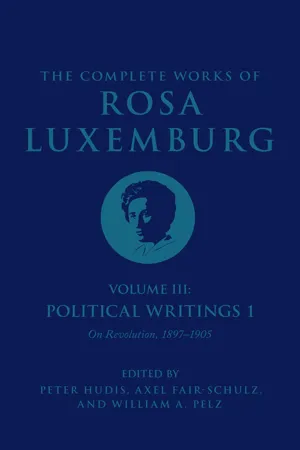
eBook - ePub
The Complete Works of Rosa Luxemburg Volume III
Political Writings 1, On Revolution 1897–1905
- 592 pages
- English
- ePUB (mobile friendly)
- Available on iOS & Android
eBook - ePub
The Complete Works of Rosa Luxemburg Volume III
Political Writings 1, On Revolution 1897–1905
About this book
Information
The Russian Year*
New year—new life! Many an individual on the threshold of a newly beginning year, reflecting on his or her life up until then, may resolve to become a different person. The classes that rule Germany, and the world, however, have no time for such reflections or resolutions. Nothing can therefore be further from the thoughts of a newly rising class and a new way of social thinking than to waste its good time with preaching morality to bourgeois society. In the new year, it [bourgeois society] will remain what it was in the old year. Time places no limits on bourgeois society’s spiritual and moral degeneration. And if a just and fair historian therefore will have to say about this bygone year that for official Germany it was a year of extreme disgrace, he will not be able to add the hope that somehow the coming year will remove the blot of that disgrace.
The year in Russia has taken its leave but the course being followed by Russia has not ended. The outstanding aspects that left the imprint of a Russian year on 1904 may express themselves in the coming year less prominently—but the system will remain as long as Russia remains what it is.
Thus, the Russo-Japanese War and the revolutionary movement in Russia are, properly speaking, for Germany, events of its own internal politics. It is to the great credit of this year not only that it has made a symbolic group out of a small element in the prisoner’s dock, with which the workers of all countries have shown their fraternal solidarity, but also it has revealed the natural foundation on which this fraternization firmly rests.†
Ever since the time when the revolutionary bourgeoisie celebrated the Greeks,‡ and later, when the young revolutionary journalist Karl Marx with breathless excitement described the Polish and Hungarian freedom struggle and recognized it as full of meaning for the future of all of Europe§—never since then has there been impressed so clearly on the consciousness of all politically thinking people how great is the significance of the major world-historical international connections, what significance they have for the future of each individual nation.
They’re being slain on Poland’s plains—France’s children!Torn from their hinges in Warsaw are the gates of Paris!*
That is how a German poet cried out to the world at that time! It is true in the same sense that on the battlefields of Manchuria and in the streets of Petersburg it is not only Russian and Japanese but world destinies, including the destinies of Germany, that are being decided.
If the backward looking observer directs his view toward narrow national conditions only, a brightly colored play of the most memorable figures passes before his eyes. The bloody nightmare of Southwest Africa,† the distressful state of the German empire’s financial system and the vain attempts to improve it,‡ the wild tumult in the House of Lords against the right to vote in the Reichstag elections,§ [Wilhelm von] Mirbach and the foul corruption in high circles.¶ And, as a counterpoint to all that, arbitrariness and violence against Poles and proletarians in legislative and administrative spheres, class justice, which truly is blind to the failings of more highly placed gentlemen but is vigilantly Argus-eyed when it comes to the slightest infractions by the little people. Soldiers who shoot at people who are running away are rewarded, but others who manfully defend the lives and honor of women against brutal attacks by drunken superiors are sent to jail for endless years.
But the eye sweeps away out into the world from the unbearably muggy premises of one’s own little house to see how the weather vanes are rattling in the Far East. The tyrant’s power has its limits! Anyone who in a moment of hopelessness had reason to doubt the truth of these promising words can now straighten up [and lift the head high].
And those fools who had believed that by shaking their fat fist they could put a stop to the powerful upsurge of an entire period of human development now become aware with surprise and horror when they see in the fate of tsarist despotism a distorted reflection of their own mirror image—and all the while, the Prussian minister of war* has the mindless gall, carried away with the mania for big numbers, [to call for more military spending] in order to justify a proposal in the German Reichstag [to make Germany] the biggest militarized state in the world, [at a time when tsarist Russia,] thanks to its inner rottenness, is displaying total and complete military incapacity. And while the same minister of war dares to proclaim that servile obedience is the guiding principle for the preservation of the state, this very same principle is experiencing defeats of the most painful kind in the waters of the Yellow Sea and the battlefields of East Asia.
What is in the works, and in obvious preparation, over there in East Asia is certainly not a victory of socialism, not even an actual total victory of democracy. However, on the field where we are accustomed to waging our battles, the field of ideas, the great events being played out on the world arena this past year have become our allies. Facts have demonstrated that logic is on our side. We who call ourselves revolutionaries have never conceived of that word in the narrow sense that one tends to use to designate “marching with pitchforks on the landlord’s castle.” It is not we who have called for violence; rather, we have tried to teach the ruling classes and have warned them all along that the means they resort to first and last in their politics, brutal violence, is powerless against great movements based on ideas. Physical conflict, which places men chest-to-chest against each other, and brings to the fore all the base aspects of their animal nature in the lower-lying recesses [of their psyches]—for us that has never been the ideal means for deciding great conflicts of interest. In all revolutionary struggles, since France won its liberty [in 1789 and after], for which the proletariat bears the least part of the responsibility, not one-tenth of the amount of human blood has been spilled which is now reeking on the altars of tsarist autocracy and capitalist “business interests.” Is the battle for Manchuria more important than the fight for the freedom of the peoples of the world?
But this furious war being waged between two nations in Asia has taught lessons to a third party. The weapons being directed against each other by the oppressor classes of these two nations are basically being aimed against those ruling classes themselves. In the political and social revolution, there stand opposed to these two competing neighbors a third, who will overcome both of them. The ruling classes of the Earth are going to extremes, ready in the event of war to march against each other armed to the teeth—but in the German Reichstag we must grant to the Chancellor the honor of having spoken at least one truth: that the real winner in any future war will be Social Democracy.
In the blind alley of such contradictions, bourgeois society has ended up in a position beyond all saving. While its ability to reason must tell it that nothing can be gained by employing brute force against the international workers’ movement, its crude yet unreasoning instinct for self-preservation forces it again and again to show its fist to the masses who are pressing ahead with calm certainty and confidence of victory. This further tells us that every long drawn-out armed conflict between two capitalist powers, while it may bring victory outwardly to one of the two, in fact must necessarily bring defeat to both inwardly, since each power feels itself compelled to pursue a policy which bears within itself the possibility of conflict of that very nature. Thus, they come to know the poison from which they will die and yet they cannot turn away from it.
The year 1904 produced no lasting great decisions, nor has it left behind a worthwhile political legacy for its successors. Germany has not succeeded in making any internal progress—all pending questions of military, trade, finance, and colonial policy have had to be postponed—nor has the last blow been struck in the arena of the war and the Russian constitutional movement. Thus, the output for this past year seems small to those who evaluate a past stretch of time only on the basis of smoothly completed facts. We, however, who are accustomed to learning from the passage of our comrade, History, have gained rich spiritual lessons. The past year has not been “Father Christmas” with a bagful of gifts, but it has been a good schoolmaster. It granted no wish, but it did awaken many hopes, lifted many spirits, and newly revived much confidence.
The small-town hopes and fears of those who see one year’s time as nothing more than a piece of their own petty human existence do not disturb us or frighten us. Neither utopian illusions nor considerations of Realpolitik will divert Social Democracy from the path on which it has been marching forward up until now. At year’s end, we have experienced the additional pleasure of seeing the Prussian section of our party united in a gathering making a pronouncement against reaction.* And this event of lasting significance easily consoles us for all the petty and repulsive attributes of the day. In the world of passing phenomena the grand, disciplined, Social Democratic workers’ movement will remain permanently as long as and until its function has been fulfilled with no leftover residue. Neither scorn and contempt nor cruel persecution nor inner chafing as a result of external pressure—none of these have been able to have any substantial inhibiting effect on the Social Democratic movement. Full of strength, it strides energetically over the threshold of the new year toward a future which will be its to possess in full.
The Uprising of the Petersburg Proletariat*
At the moment when we were preparing to send this issue of Czerwony Sztandar to the printer, from Petersburg there came news that struck the whole world like a thunderclap. In the capital of the tsar amazing things were happening. One hundred thousand workers walked off their jobs and headed toward the tsar’s palace, with the immediate aim of winning political freedom. At their head [were] striking workers from the armaments plants and shipyards, along with typesetters. Already the general strike had embraced 94,000 Petersburg workers, according to the official news, i.e., that of the government, but according to private sources the number was closer to 140,000. On Saturday, January 21, not a single publication containing news dispatches was appearing any longer in Petersburg, with the exception of one German-language newspaper and one small government publication, Pravitelstvenny Vestnik [The Government Herald].†
The beginning of this enormous movement‡ had its origin, as has been usual in revolutionary epochs of history, in a minor incident. In Petersburg in February 1904 there was established a legal workers’ association, approved by the minister of internal affairs, which set itself purely economic goals aimed at improving the daily lives of the workers.
At the head of this organization§ stood a certain Russian Orthodox priest, [Georgi] Gapon, who had earnestly dedicated himself to the workers’ cause. Recently at a giant metalworking plant, the Putilov Works, which employs more than 12,000 workers, four workers who belong to the above-named organization had suddenly been fired. The colleagues of the fired men demanded that the management of the company rehire them and responded to [the management’s] stubborn refusal with a general strike. At the same time, the strikers formulated a whole series of demands, consisting of twelve points at the top of which was the eight-hour workday; [next came] commissions, which would include workers’ representatives, for resolving labor disputes at the factories and standardizing wages, with a one-rouble minimum hourly wage for workmen and seventy kopecks for women workers; elimination of unpaid overtime, or else double pay for such work; and also, improvement of health conditions at the factory.
The strike, together with varied demands, spread like wildfire from the Putilov Works to other factories. By the 17 and 18 of this month [January], 174 factories were idle in Petersburg.
At the same time, the strike went from being a [purely] economic strike to a political one, and it grew from being just a local conflict to being an epoch-making event. There began daily open mass meetings of the strikers, at which uniformed police did not dare show up. There began discussions about the general situation for workers and about what their needs were. And thus, in a natural way, there came to the surface, there and then, what were the [actual] political interests of the working class in Russia [that included, above all,] the overthrow of the autocracy. In this way, the strikers arrived at their own political demands, as follows:
(1) Equality of all before the law,
(2) Inviolability of the person,
(3) Freedom of conscience and of belief [i.e., religion],
(4) Immediate release of all those imprisoned for “political” offenses,
(5) Freedom of the press,
(6) Convocation of a [Constituent] Assembly, consisting of representatives elected by the people, which would have the right to immediately end the [Russo-Japanese] war.
Further on, there came economic demands, above all, the eight-hour workday.
The above list of demands was signed, as of January 21, by 70,000 workers.
The striking workers decided to march with this list of demands to the tsar’s palace, at the same time delivering to him the following document:*
We, workers and residents of the city of St. Petersburg … have come to Thee, Sire, to seek justice and protection. We have become beggars; we are oppressed and burdened by labor beyond our strength; we are humiliated; we are regarded, not as human beings, but as slaves who must endure their bitter fate in silence. We … are being so stifled by despotism and arbitrary rule that we cannot breathe. Sire, we have no more strength! Our endurance is at an end. We have reached that awful moment when death is preferable to the continuation of intolerable suffering.Therefore, we stopped work and told our employers that we would not resume work until they complied with our demands. We asked for little. We desire only that which is indispensable to life, without which there is nothing but slavish labor and endless agony … All of this seemed illegal to our employers…Sire, there are many thousands of us here; we have the appearance of human beings but, in fact, neither we nor the rest of the Russian people enjoy a single human right … We have been enslaved, with the help and cooperation of Thy officials. Any one of us who dares to speak up in defense of the interests of the working class and the people is jailed or exiled … The entire people—workers and peasants—are at the mercy of [arbitrary rule by] the bureaucratic administration … Government by bureaucracy has devastated the country, has involved it in a horrible war, and is leading it further and further into ruin … We, the workers and the people, have no voice at all in determining how the huge sums extracted from us are spent … The people have no opportunity of expressing their desires and demands.[All this is not] in accordance with God’s...
Table of contents
- Cover Page
- Halftitle Page
- Title Page
- Copyright Page
- Dedication
- Contents
- Acknowledgments
- Editorial Foreword
- Introduction
- Abbreviations
- 1897
- 1899
- 1902
- 1904
- 1905
- Notes
- A Glossary of Personal Names
- Index
Trusted by 375,005 students
Access to over 1.5 million titles for a fair monthly price.
Study more efficiently using our study tools.
Frequently asked questions
Yes, you can cancel anytime from the Subscription tab in your account settings on the Perlego website. Your subscription will stay active until the end of your current billing period. Learn how to cancel your subscription
No, books cannot be downloaded as external files, such as PDFs, for use outside of Perlego. However, you can download books within the Perlego app for offline reading on mobile or tablet. Learn how to download books offline
Perlego offers two plans: Essential and Complete
- Essential is ideal for learners and professionals who enjoy exploring a wide range of subjects. Access the Essential Library with 800,000+ trusted titles and best-sellers across business, personal growth, and the humanities. Includes unlimited reading time and Standard Read Aloud voice.
- Complete: Perfect for advanced learners and researchers needing full, unrestricted access. Unlock 1.5M+ books across hundreds of subjects, including academic and specialized titles. The Complete Plan also includes advanced features like Premium Read Aloud and Research Assistant.
We are an online textbook subscription service, where you can get access to an entire online library for less than the price of a single book per month. With over 1.5 million books across 990+ topics, we’ve got you covered! Learn about our mission
Look out for the read-aloud symbol on your next book to see if you can listen to it. The read-aloud tool reads text aloud for you, highlighting the text as it is being read. You can pause it, speed it up and slow it down. Learn more about Read Aloud
Yes! You can use the Perlego app on both iOS and Android devices to read anytime, anywhere — even offline. Perfect for commutes or when you’re on the go.
Please note we cannot support devices running on iOS 13 and Android 7 or earlier. Learn more about using the app
Please note we cannot support devices running on iOS 13 and Android 7 or earlier. Learn more about using the app
Yes, you can access The Complete Works of Rosa Luxemburg Volume III by Rosa Luxemburg, Peter Hudis,Axel Fair-Schulz,William A. Pelz, George Shriver,Alicja Mann,Henry Holland in PDF and/or ePUB format, as well as other popular books in Politica e relazioni internazionali & Filosofia politica. We have over 1.5 million books available in our catalogue for you to explore.