eBook - ePub
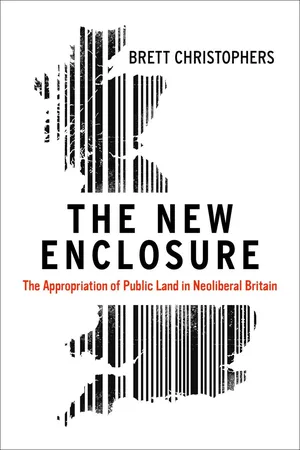
The New Enclosure
The Appropriation of Public Land in Neoliberal Britain
- 384 pages
- English
- ePUB (mobile friendly)
- Available on iOS & Android
eBook - ePub
About this book
Much has been written about Britain's trailblazing post-1970s privatization program, but the biggest privatization of them all has until now escaped scrutiny: the privatization of land. Since Margaret Thatcher took power in 1979, and hidden from the public eye, about 10 per cent of the entire British land mass, including some of its most valuable real estate, has passed from public to private hands. Forest land, defence land, health service land and above all else local authority land- for farming and school sports, for recreation and housing - has been sold off en masse. Why? How? And with what social, economic and political consequences? The New Enclosure provides the first ever study of this profoundly significant phenomenon, situating it as a centrepiece of neoliberalism in Britain and as a successor programme to the original eighteenth-century enclosures. With more public land still slated for disposal, the book identifies the stakes and asks what, if anything, can and should be done.
Information
CHAPTER 1
A Special and Finite Commodity:
Why Land and Landownership Matter
Why should we care who owns the land? Many, perhaps most, of us go about our daily lives without paying too much attention to the question of the ownership of the land we live, work, travel and play on. Who owns the park where I play football, the road I drive on, the site of the office or shop or factory I work in? I would wager that few people know the answer to any of these questions as they apply to their daily comings-and-goings. Perhaps the only space whose ownership we consistently do pay attention to (in fact, that we obsess about) is the domestic space: Do I own or rent the home I live in and the ground it sits on? But landownership, I want to argue, really matters, and not only where housing is concerned. We need to think much more closely about who owns the land. Indeed, we need to think more closely about what it even means to ‘own’ land. The idea that land can and should be owned is not a natural or timeless one, characteristic of all human societies and cultures. When, how and why did landownership become normalized, a taken-for-granted social convention that is so thoroughly ingrained, at least in Western societies, that we seldom notice, let alone question, its particularities?
In addressing the issue of why and how landownership matters, this chapter sets the stage for those that follow, where I offer a close and critical examination of the fate of public land in Britain in the neoliberal era. Why undertake that extended examination? Why spend so much time exploring what some might consider an intellectually and/or politically marginal concern? This chapter explains why, from first principles. Drawing on the work of influential thinkers and writers on land and landownership, whose insights have been gleaned from inquiry into wider histories of capitalist social formations, I show land’s theoretical significance. Political-economic theory, in particular, tell us that landownership does indeed make a difference: it is highly material to capitalist social and economic development. Hence the impetus to consider that materiality in a particular historical–geographical context.
Political-economic theory not only serves as a useful provocation. Perhaps more importantly, it also provides a helpful guide. This is not to say that it tells us exactly what we will find when we examine the empirical record: the case of land privatization in neoliberal Britain, as we will see, while strongly exhibiting some of the tendencies that political-economic theory associates more generally with private landownership and its increasing prevalence, exhibits other such tendencies much more weakly or not at all – it represents, like all empirical cases, a unique manifestation of wider, theorizable tendencies, expressing them in varying measures. The theory does nevertheless suggest what kinds of questions it might be most productive and important to ask of the empirical record. The theory discussed in this chapter therefore both inspires and informs the historical–empirical investigation in the rest of the book.
The chapter is divided in two parts. The first, shorter section answers the chapter’s most general question – Why does landownership matter? – at a generalised level. The second, also drawing on political-economic theory, answers a more focused question: Why should we be interested in the specific development – declining levels of public landownership, and a corresponding increase in private ownership – that the rest of the book describes for neoliberal Britain? What does the theory tell us about the respective characteristics and effects of public and private landownership? What does it say about the typical implications of land privatization? And what, crucially, does it offer up in terms of solutions to any perceived negative outcomes of privatization?
Why Landownership Matters
Sometimes we look to great ‘thinkers’ to tell us why things matter. That is what I will mostly be doing in this chapter; you will read lots about the ideas of famous political-economic theorists like Adam Smith, Karl Polanyi, Thomas Piketty, and others. But at other times people we do not necessarily perceive as ‘thinkers’ happen to cut to the chase far more successfully. A factory worker will naturally have privileged insight into the real workings of capitalist production. Similarly, a farm or council-house tenant will know much of what is most important about the social and economic relations entailed by landownership and use under capitalism, even if she does not use those terms. And the owner of the land will clearly have insight into those property relations, too.
To the extent that the privileges of landownership – and landownership, let us be very clear, is a privilege – are often exorbitant, landowners tend to be rather shy about publicly exulting in them and explaining how they arise. They tend to keep silent, preferring to remain in the shadows, quietly reaping their benefits, lest anyone threaten those benefits. But sometimes, in moments of unguardedness or hubris, they let things slip. They tell the world exactly how much landownership matters, and why. And one such moment, as Kevin Cahill has shown, occurred in 1881. Revelling in his own ownership of nearly 30,000 hectares, making him one of Britain’s largest landowners and richest men, the 15th Earl of Derby, Edward Stanley, explained the significance of landownership in terms as sharp, succinct and striking as any celebrated theorist has arguably ever managed:
The object which men aim at when they become possessed of land in the British Isles may, I think, be enumerated as follows. One, political influence; two, social importance, founded on territorial possession, the most visible and unmistakable form of wealth; three, power exercised over tenantry; the pleasure of managing, directing and improving the estate itself; four, residential enjoyment, including what is called sport; five, the money return – the rent.1
There you have it, more or less, in a nutshell.
In this section, therefore, I will take my initial cues from Stanley.1 What is the importance of landownership? It is primarily fivefold. In no particular order, it comprises: political influence; power; income; wealth; and pleasure. But it is not only those things. While I proceed from Stanley’s list, I fill in along the way some of the inevitable gaps that he left. One, for example, concerns the importance of land (and thus its ownership) as a place politically to protest. It is not surprising that the earl ignored this particular land use. As an extraordinarily privileged landowner, he had very little to protest about. Those excluded, on the other hand, by processes of enclosure, historical or contemporary, have not been so fortunate.
Land and political influence
In Western societies (albeit certainly not only those), political influence has often been tightly bound up with the land and its ownership. The feudal system of socioeconomic organization that preceded the transition to capitalism was in many respects a perfect fusion of landownership and politics. ‘Land, the pivotal element in the feudal order’, Polanyi wrote in The Great Transformation, ‘was the basis of the military, judicial, administrative, and political system’.2 It was the singular ‘thing’ around which politics was organized. And land’s significance to politics did not disappear with the advent of capitalism. It persisted, but in new forms. Political influence continued to be wielded disproportionately by landowners.
In many places this coupling was, and has since remained, overt and intimate. The landowners and the politicians (those holding office in government) were one and the same. Italy in the late nineteenth and early twentieth centuries represented a case in point. Dahlia Elazar describes the system then pertaining – nominally a liberal democracy – as ‘political feudalism’, in view of the ‘political hegemony of Italy’s propertied class’. The ruling Liberal Party essentially comprised a network of provincial governments dominated by landowning families. The majority of those serving in the Chamber of Deputies were thus landowners. ‘Leading members of the propertied class’, in short, ‘“composed virtually the whole body politic of the Italian nation”’, Elazar explains, citing Charles Maier.1 A comparable tangling of landownership and political power, as we shall see in the next chapter, also obtained (and endured much longer) in Britain – although there, the landowners’ party was not the Liberals but, emphatically, the Tories.
Political influence has also often been yoked to landownership at a further remove, whereby the right to vote in elections is dependent on such ownership. Britain once again represents a striking example. The extension of suffrage through the first (‘Great’), Second, Third and Fourth Reform Acts of 1832, 1867, 1884 and 1918 respectively was achieved in significant part by lowering the land and property ownership thresholds at which voting rights kicked in. Another famous example is the early United States. When the Constitution was ratified in 1788, suffrage required some form of property ownership, and typically a freehold claim, in nearly all the states. As Jacob Cogan notes, the importance of freehold was that it signified a permanent interest in the community.2 Landownership more generally was strongly associated with independence and moral virtue; it was central to the so-called Jeffersonian Myth.3 President John Adams, for instance, opined: ‘Such is the frailty of the human heart, that very few men, who have no property, have any judgment of their own.’4 Only the propertied, it followed, should get a vote. And although property restrictions on suffrage were phased out across most US states early in the nineteenth century, similar restrictions lasted considerably longer elsewhere – and not only in Britain. In Italy, they were not removed until 1911.5
Yet, even with the formal decoupling of suffrage from land or property ownership, such ownership has remained highly material to political influence. For one reason or another, in most Western societies it has continued to be the case that landowners influence elections, politicians and political decisions more than non-owners do. This disproportionate influence takes multiple forms. Landowners often represent a powerful and coordinated political lobby, with deep pockets and prominent patrons; no single event of the twentieth century, for instance, caused more concern to major Scottish landowners than the establishment of the Scottish Parliament in 1999, because, as Andy Wightman says, ‘they could no longer directly influence legislation in the way that their supporters in the House of Lords had been able to do’.1 More generally, politicians go out of their way not to alienate property owners, doing everything in their power, for example, to prevent land prices, and thus house prices, from falling. And they do so partly because they know that owners wield particular power at the ballot box. Owners typically vote more than non-owners do: in the 2011 Canadian federal election, for example, the proportions of home-owners and renters voting were 71 per cent and 54 per cent, respectively; in the 2008 US presidential election, they were 68 per cent and 52 per cent.2
Land and power
‘As land changes hands’, writes George Monbiot, ‘so does power.’3 Earl Stanley knew this well. And while the political influence occasioned by landownership is certainly one form of the power that ownership confers, it is not the only one. The land–power nexus is multiply constituted.
Perhaps the key point is that ownership of land confers power over both resources (those found on and under the land) and, in various ways, people and institutions (those who do not own the land). As an owner, one has the right to do with one’s land and its resources as one sees fit, although this right is normally circumscribed in various ways by the state – one example being the common requirement to secure permission, typically through a planning system, to develop the land. And one also has the right to dictate the parameters of others’ access to the land. Again, this right is sometimes circumscribed; in Sweden, where I live, for example, the traditional right of allemansrätten provides the public with certain rights to private land in the countryside – to travel across it, temporarily camp on it, and pick berries, mushrooms and some other plants from it. In general, however, landownership enables the owner to exclude people – to keep them off the land. And it provides the power to set the terms and conditions of permissible access and use.
This power of inclusion and exclusion is enormously consequential. The reason is obvious. We, as a society, need land for all sorts of reasons. We need it for leisure and pleasure (Stanley’s ‘residential enjoyment’ and ‘sport’), to which I return below. We need it as a place to exist politically: land provides space for collective, visible, political struggle and protest. We need land to live on – in other words, for shelter; and as I will show in this book, the availability (or otherwise) of land for housing is an issue of the utmost importance in contemporary Britain. And we need land to reproduce ourselves successfully as a society. This is not just a question of food production. It relates more broadly to the fact that land is an input, of varying degrees of significance, to almost all economic processes. Alongside labour and capital, it is what economists call a ‘factor of production’, one of the essential ingredients that makes productive economic activity – and hence social reproduction – possible in the first place.
All of this means that the power invested in landownership is momentous. In mediating terms of inclusion and exclusion, of access and use, landownership confers the very power to shape and facilitate, or alternatively constrain, the social, economic and political development of communities, regions and nations. The word ‘enclosure’, so often invoked with reference to landownership, specifically evokes closure and constraint, and that is the reason I use it. My argument is that the privatization of British public land since the early 1980s has actively closed down and constrained practices and possibilities of social, economic and political development. The power embodied in landownership, that is to say, has been mobilized in increasingly negative ways as the land has progressively been privatized. ‘Enclosure’ is precisely the negative operationalization of landed power.
But the word ‘enclosure’ more commonly refers to an earlier period of changes in the land-and-power nexus, especially in Britain (see Chapter 2). Concentrated in the period from the early eighteenth to mid nineteenth centuries, the enclosure movement in Britain demonstrates as strikingly as any episode in Western history the wide-ranging power that comes with controlling land. It saw the extinction of the traditional rights to access and use open fields and waste land enjoyed by ‘commoners’; the fields were literally enclosed, the included masses abruptly excluded. And with those rights, Britain’s commoners lost the very ability to sustain and reproduce themselves and their families that the land had traditionally afforded. They lost, in short, one of only two factors of production they had possessed. With access to the land denied to them, Britain’s millions of commoners now had only one factor remaining to them to deploy: their labour.
Land and income
What did Britain’s ejected commoners do? Stripped of their common-land rights, many, perhaps most, moved to the nation’s rapidly growing industrial cities and sold their labour to industrial capitalists, working for a subsistence wage in factories. For those who remained in the countryside, however, new relations to the land had to be forged. In his magnificent book Whigs and Hunters, the late E. P. Thompson described one outcome. Some people, such as the famous ‘Blacks’, resorted to poaching game, including deer from forestland, in defiance and in defence of their traditional use-rights. ‘What was at issue’, Thompson said, ‘was not lan...
Table of contents
- Cover Page
- Halftitle Page
- Title Page
- Copyright Page
- Dedication
- Contents
- List of Figures
- List of Abbreviations
- Acknowledgements
- Introduction
- Chapter 1: A Special and Finite Commodity: Why Land and Landownership Matter
- Chapter 2: Landownership in Britain: A Brief History
- Chapter 3: Discourses of Surplus and Efficiency: Preparing the Land for Sale
- Chapter 4: Carrots and Sticks: Privatizing the Land
- Chapter 5: False Promises: Land Privatization Outcomes
- Conclusion: Where Now?
- Notes
- Index
Trusted by 375,005 students
Access to over 1.5 million titles for a fair monthly price.
Study more efficiently using our study tools.
Frequently asked questions
Yes, you can cancel anytime from the Subscription tab in your account settings on the Perlego website. Your subscription will stay active until the end of your current billing period. Learn how to cancel your subscription
No, books cannot be downloaded as external files, such as PDFs, for use outside of Perlego. However, you can download books within the Perlego app for offline reading on mobile or tablet. Learn how to download books offline
Perlego offers two plans: Essential and Complete
- Essential is ideal for learners and professionals who enjoy exploring a wide range of subjects. Access the Essential Library with 800,000+ trusted titles and best-sellers across business, personal growth, and the humanities. Includes unlimited reading time and Standard Read Aloud voice.
- Complete: Perfect for advanced learners and researchers needing full, unrestricted access. Unlock 1.5M+ books across hundreds of subjects, including academic and specialized titles. The Complete Plan also includes advanced features like Premium Read Aloud and Research Assistant.
We are an online textbook subscription service, where you can get access to an entire online library for less than the price of a single book per month. With over 1.5 million books across 990+ topics, we’ve got you covered! Learn about our mission
Look out for the read-aloud symbol on your next book to see if you can listen to it. The read-aloud tool reads text aloud for you, highlighting the text as it is being read. You can pause it, speed it up and slow it down. Learn more about Read Aloud
Yes! You can use the Perlego app on both iOS and Android devices to read anytime, anywhere — even offline. Perfect for commutes or when you’re on the go.
Please note we cannot support devices running on iOS 13 and Android 7 or earlier. Learn more about using the app
Please note we cannot support devices running on iOS 13 and Android 7 or earlier. Learn more about using the app
Yes, you can access The New Enclosure by Brett Christophers in PDF and/or ePUB format, as well as other popular books in History & British History. We have over 1.5 million books available in our catalogue for you to explore.