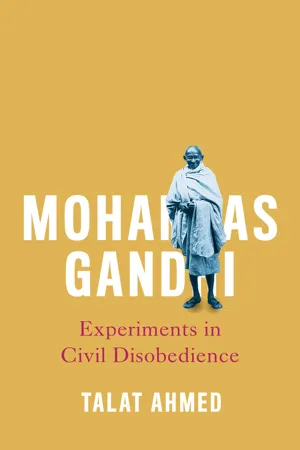
Mohandas Gandhi, icon of Indian liberation, remains an inspiration for anti-capitalists and peace activists globally. His campaigns for national liberation based on non-violence and mass civil disobedience were critical to defeating the power of the British Empire. This biography examines his campaigns from South Africa to India to evaluate the successes and failures of non-violent resistance. Seventy years after his death, his legacy remains contested: was he a saint, revolutionary, class conciliator, or self-obsessed spiritual zealot? The contradictions of Gandhi's politics are unpicked through an analysis of the social forces at play in the mass movement around him. Entrusted to liberate the oppressed of India, his key support base were industrialists, landlords and the rich peasantry. Gandhi's moral imperatives often clashed with these vested material interests, as well as with more radical currents to his left. Today, our world is scarred by permanent wars, racism and violence, environmental destruction and economic crisis. Can non-violent resistance win against state and corporate power? This book explores Gandhi's experiments in civil disobedience to assess their relevance for struggles today.
- 192 pages
- English
- ePUB (mobile friendly)
- Available on iOS & Android
eBook - ePub
About this book
Information
1
Early Life: 1869–93
A small insignificant princely state in north-western India seems an unlikely place from where the father of Indian nationalism might emerge. Yet it was precisely such a place that was home to Gandhi’s beginnings. Mohandas Karamchand Gandhi was born on 2 October 1869 into a middle-caste family of Modh banias, a trading and money-lending community who had a reputation for being thrifty and wily businessmen. His birthplace was the small town of Porbandar, in a semi-independent princely state – the Rana of Porbandar – on the south-west coast of Gujarat, where his father’s family had been diwans (prime ministers/advisers) to the princes and kings.1 Though clearly comfortable, his background was not aristocratic or upper class. He was not from a staunch nationalist family, like Jawaharlal Nehru, nor was he from the professional urban elite like Mohammad Ali Jinnah, founder of Pakistan. Though lacking a patrician background, Gandhi’s childhood was firmly middle class and middle caste. Caste is a hereditary form of social class by which Hinduism prescribed the division of labour in India through a hierarchical system that has led to the subjugation of millions of people for centuries. The Hindi term bania broadly translates as merchants and traditionally refers to an occupational community comprising traders, bankers, money-lenders and dealers in grains or spices, and in modern times, numerous commercial enterprises. It has evolved from the vaisyas caste, which is third in hierarchy of the traditional caste structure, where, to use the Hindu lexicon of the varna, the educated priestly brahmins provided religious legitimacy to the warriors and rulers – the kshatriyas at the top – and both groups together with the farmer and merchant vaisyas hold supposed superiority over the mass of toilers including peasants (the shudras).
Gandhi was the youngest of four siblings and the product of his father Karamchand’s fourth marriage. Karamchand had lost his first two wives whilst they were very young and each after giving birth to a daughter. Female mortality rates were high in provincial Porbandar and Karamchand would have felt obliged to marry again and produce sons, as was the custom and expectation across India and more globally. Sadly, for him his third marriage was childless and so Karamchand sought permission to take another wife, Putlibai, whom he married in 1857.2
The Princely State of Porbandar
Porbandar lies in the peninsula in western India and its coastline borders the Gulf of Kutch to the west, the Arabian Sea to the south and the Gulf of Khambhat to the south-east. The rest of the peninsula, chiefly in the east along the Gulf of Cambay, were districts ruled directly by the British as part of the Bombay Presidency. Instead of direct rule by the British, the Rana of Porbandar, with its capital as the harbour town of Porbandar, became a British Protectorate in 1809 and under the Raj, the princely state covered an area of 1,663 square kilometres comprising 106 villages with a population, in 1921, of over 100,000 people. It was not as opulent as Kashmir or Hyderabad states, but neither was it impoverished. It was one of the few princely states with a coastline, providing vital transportation links to the Arabian Peninsula and East and Southern Africa. Porbandar’s strategic geography made it quite central as a site of transnational migrations as historically, the sea provided great routes for trade, pilgrimage and diplomatic missions.
Porbandar was one of some two hundred small princely states. This backwater contained tiny kingdoms, the size of many contemporary Gulf States, which were ruled by local potentates who acknowledged British suzerainty in return for local sovereignty. As British Protectorates, they ceded responsibilities for defence, external affairs and communications, but exercised relative autonomy over civil and court governance. Two-fifths of India was comprised of such princely or ‘Native’ states. This region was home to a large number of communities, castes and settlements and the agency’s headquarters were at Rajkot, the town where the Political Agent used to reside and from where he reported to the Political Department office in Bombay.
As a princely state, Porbandar was ruled by a feudal despotic dynasty of Rajputs called Jethwas who claimed martial and spiritual lineage from a range of deities in the epic Ramayana. These Rajput Hindu states originated in the thirteenth century through a mixture of warfare and domination, but also through incorporation, adaptation and evolving claims of genealogy and kinship ritual. It is precisely because these were evolving social and political formations that they were judiciously incorporated into sixteenth-and seventeenth-century Mughal administration and military structures and later found accommodation with the British Empire.3 It is tempting to think that princely states were either mere puppets of British imperial domination or represented some indigenous autonomous entity. In reality, the truth lies somewhere in between. To be sure, they were feudal polities that exercised considerable power and enjoyed autonomy within their domains, able to discipline their ministers on the whim of the royal household. However, they did lose major privileges and the British and nationalist leaders were somewhat ambivalent in their dealings with princely states. British officials saw them as loyal military allies whilst denouncing them as autocrats; praised them as natural leaders of their subjects but also chided them as profligate playboys. Above all, the British envied, admired and took full advantage of their lavish hospitality. Likewise, Indian nationalists, initially pointed to native princely kingdoms as evidence of effective indigenous government. Some were happy to seek their financial backing for political organisations and collaborated with them during constitutional negotiations. However, they were also lambasted as – in the words of Nehru – ‘very backward … and in the feudal age’.4 What this ambivalence demonstrates is that indigenous polities were conveniently used for whatever purpose suited either the British or Indian nationalists.
In spite of feudal pretensions, princely states were not static. Long before Europeans arrived in India, dynamic processes of state formation and transformation had been under way as in any other part of the world. War, famine, invasion all contributed over several centuries and more to new and different political formations. Similarly, the onset of British rule affected developments within these semi-autonomous entities. As such, they constituted continuing processes of state formation right through to independence, when all were eventually incorporated into the successor states of India and Pakistan. The British had no clear policy, but officers acted pragmatically and/or opportunistically, depending on circumstances. The general pattern, however, was from treaties to subsidiary alliances to indirect rule. Consequently, an intellectual framework of indirect rule was constructed to provide legitimacy for British imperial rule within an indigenous framework.5 British officials felt keenly the need to produce documents which would explain what they had been doing and what precedents they could follow. As a result, imperial rituals such as the Assemblage of 1877 and the Durbars of 1903 and 1911 played a significant role as British officers attempted both to express and to create the desired political order. They wanted a ‘feudal hierarchy’ and to set the princes off as ‘natural’ leaders, who were to support the paramount power and benefit the imperial state economically.6 Accordingly, the process of compiling documents and forming legal arguments had the advantage of providing the imperial government with an inexpensive means of governing areas of relatively low agricultural productivity and often inaccessible populations.
As British rule deepened, it used a combination of co-option, repression and setting religious and ethnic groups off against each other – tactics varied according to situation and switched sides as to who was favoured at any particular time. British Orientalist constructions rooted in colonial sociology impacted on mapping and census-taking. The latter played a critical role in stimulating ethnic mobilisation in the production of censuses, gazetteers, religious writings and newspapers. But princes also contributed to ethnic mobilisation through patronage of caste histories and religious translations. Caste, religious and linguistic identities became more tightly defined in the princely states. Yet Porbandar, like most princely states, had been unscathed by the great revolt of 1857 – the high point of Indian resistance to British rule in the nineteenth century – and remained loyal to the East India Company and its feudatory elites. It was not until the late 1920s that local popular movements began to emerge with the formation of the All-India States Peoples’ Conference (AISPC).
Gandhi’s Family Background
Being born into a diwan family provided a certain status for the Gandhi clan and, though not wealthy, they were able to command respect and courtly airs from the local population. Growing up in a princely state resulted in Gandhi having very little contact with or experience of direct British imperial rule. This had the advantage in that it instilled a deep conviction in him that Indians could and should rule themselves. But it also shielded him from the full might of the empire and its oppressive state apparatus. A sense of family loyalty to the principality but also an independent spirit can be gleaned from Joseph Doke’s 1909 biographical sketch, as related to him by Gandhi in 1908–09. Gandhi’s grandfather, Uttamchand, was dismissed for apparently displeasing the Queen Regent, and obtained sanctuary in neighbouring Junagadh state. The Nawab7 here was astounded when Uttamchand gave a salute with his left hand, a sign viewed as disrespectful and punishable by death. But when asked to explain himself by the Nawab, the elder Gandhi replied, ‘in spite of all that he had suffered, he kept his right hand for Porbandar still.’ According to this story, the Nawab of Junagadh was impressed by Gandhi’s patriotism and continued to give him protection until the brouhaha blew over and Uttamchand was recalled to the Porbandar court.8
A similar story of bravery was recounted by Gandhi about his father, Karamchand. Like the grandfather, the father too had been dismissed by the Porbandar court and moved his family to Rajkot. All princely regents were subordinate to the British agent in Kathiawar agency and this could lead to ministers being dismissed under their orders. Karamchand had apparently heard a rude remark made by the British agent about his prince and took objection to it. The agent demanded an apology that Karamchand refused. His penalty was to be arrested and detained for a few hours. Such an affront to British authority was unthinkable in parochial Gujarat and caused much excitement. After a few hours, the agent relented and the apology waived.9
According to Doke’s account, both the grandfather and father displayed acts of great courage that were the epitome of what was to become ‘passive resistance’, and thus left a lasting impression upon the young Gandhi (see Figure 1).
Karamchand, though clearly a loving father, does appear to be quite a remote figure in Gandhi’s childhood. But family life also included people from other faith communities. Jain monks, family friends who were Muslim and Parsis, were all regular visitors to the Gandhi home and his father would ‘listen to them always with respect, and often with interest’. This Gandhi recalls is how ‘I got an early grounding in toleration for all branches of Hinduism and sister religions.’10
Gandhi’s mother Putlibai was a pious woman who though a caste Hindu, was part of the Pranami sect, a reforming tradition that fused aspects of Hindu mythology with Sufi Islam and aspects of emergent Sikhism. As well as providing a synthesising component, this sect baulked at traditional hierarchical religious dogma and placed great emphasis on charity and peaceful coexistence, as well as chastity and abstinence from meat, alcohol, tobacco and any other intoxicating drugs. She spent much of her time in observing fasts and prayers. Her comparative saintliness is emphasised repeatedly in Gandhi’s own account of his mother, as well as by Doke describing her as the ‘Holy of Holies’.11 Putlibai was keen to provide charitable support to the sick and needy and so she opened her house to ensure alms or a cup of whey were provided daily to any person in need. If anyone was ill, she was on hand to administer and look after them. Though these acts of charity appear to be applicable to all the community, and no discrimination was applied in terms of religion, interestingly, Doke’s warm and affectionate account only mentions her care applying to ‘Brahmin or Sudra’;12 the ‘untouchables’ – those landless agricultural labourers whose ...
Table of contents
- Cover
- Title
- Copyright
- Contents
- Illustrations
- Acknowledgements
- Glossary
- Maps
- Introduction
- 1. Early Life: 1869–93
- 2. South Africa and the Birth of Satyagraha: 1893–1915
- 3. The Champion of the Oppressed Returns: 1915–19
- 4. Nationalist Leader: 1919–29
- 5. Global Icon: 1929–39
- 6. Fascism, War, Independence and Partition: 1939–48
- Conclusion: Assassination and Legacy
- Notes
- Index
Trusted by 375,005 students
Access to over 1.5 million titles for a fair monthly price.
Study more efficiently using our study tools.
Frequently asked questions
Yes, you can cancel anytime from the Subscription tab in your account settings on the Perlego website. Your subscription will stay active until the end of your current billing period. Learn how to cancel your subscription
No, books cannot be downloaded as external files, such as PDFs, for use outside of Perlego. However, you can download books within the Perlego app for offline reading on mobile or tablet. Learn how to download books offline
Perlego offers two plans: Essential and Complete
- Essential is ideal for learners and professionals who enjoy exploring a wide range of subjects. Access the Essential Library with 800,000+ trusted titles and best-sellers across business, personal growth, and the humanities. Includes unlimited reading time and Standard Read Aloud voice.
- Complete: Perfect for advanced learners and researchers needing full, unrestricted access. Unlock 1.5M+ books across hundreds of subjects, including academic and specialized titles. The Complete Plan also includes advanced features like Premium Read Aloud and Research Assistant.
We are an online textbook subscription service, where you can get access to an entire online library for less than the price of a single book per month. With over 1.5 million books across 990+ topics, we’ve got you covered! Learn about our mission
Look out for the read-aloud symbol on your next book to see if you can listen to it. The read-aloud tool reads text aloud for you, highlighting the text as it is being read. You can pause it, speed it up and slow it down. Learn more about Read Aloud
Yes! You can use the Perlego app on both iOS and Android devices to read anytime, anywhere — even offline. Perfect for commutes or when you’re on the go.
Please note we cannot support devices running on iOS 13 and Android 7 or earlier. Learn more about using the app
Please note we cannot support devices running on iOS 13 and Android 7 or earlier. Learn more about using the app
Yes, you can access Mohandas Gandhi by Talat Ahmed in PDF and/or ePUB format, as well as other popular books in History & Historical Biographies. We have over 1.5 million books available in our catalogue for you to explore.