During combat, soldiers make life-and-death choices dozens of times a day. These individual decisions accumulate to determine the outcome of wars. This work examines the theory and practice of military ethics in counterinsurgency operations. Marcus Schulzke surveys the ethical traditions that militaries borrow from; compares ethics in practice in the US Army, British Army and Royal Marines Commandos, and Israel Defense Forces; and draws conclusions that may help militaries refine their approaches in future conflicts. The work is based on interviews with veterans and military personnel responsible for ethics training, review of training materials and other official publications, published accounts from combat veterans, and observation of US Army focus groups with active-duty soldiers. Schulzke makes a convincing argument that though military ethics cannot guarantee flawless conduct, incremental improvements can be made to reduce war's destructiveness while improving the success of counterinsurgency operations.
eBook - ePub
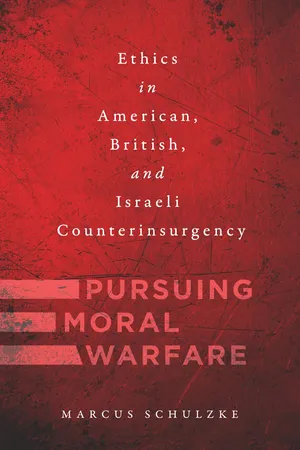
Pursuing Moral Warfare
Ethics in American, British, and Israeli Counterinsurgency
- 256 pages
- English
- ePUB (mobile friendly)
- Available on iOS & Android
eBook - ePub
About this book
Information
Publisher
Georgetown University PressYear
2019Print ISBN
9781626166585
9781626166578
eBook ISBN
9781626166592
1
The Emergence of Military Ethics
“In all wars throughout history, general orders have been given or personal decisions have been taken about who should be killed or spared, raped or respected, rendered destitute or protected, enslaved or freed.”1 Historically, “it is religious authorities and political power which have defined who can be killed or hurt.”2 This is why the just war tradition that is one of the dominant normative frameworks for evaluating wars arose from theological roots and was subsequently shaped by the early modern state formation process, during which time the morality of war was remapped onto more secular sources of authority.3 Changes in the conduct of war during the nineteenth and twentieth centuries prompted a radical normative shift. Religious and political authorities continued to shape the overall structure of norms related to war, but the audience changed. Individual soldiers at the lower and middle rungs of the military hierarchy took on greater importance as moral agents who could think and act with more autonomy. It became necessary to adjust ethical guidelines that previously spoke primarily to elites so they could apply broadly to everyone in uniform.
Military ethics, understood as a code of conduct that applies to all members of a military, emerged during the nineteenth century via efforts to delineate a military profession and to codify its rules; it only became widespread during the twentieth century.4 It is possible to find informal precedents for military ethics earlier than this, such as in chivalry and Bushido, but the decision to codify norms marks a turning point by signaling a commitment to apply more consistent and transparent standards. The demand for systematizing military ethics came from changes in how wars were fought, especially the increased complexity, mobility, and dispersion of armed forces. These changes required the devolution of authority to lower-ranking personnel and increased the extent to which soldiers acted without direct supervision.
The gradual formalization of military ethics over time and in response to a constellation of structural conditions that vary by country generated inconsistencies in the form and content of ethical systems cross-nationally—inconsistencies that I highlight throughout the book. The highest level of formalization came from the codification of some ethical precepts in the law of armed conflict (LOAC), and this is the basis for cross-national agreement in ethical systems. The LOAC forms the core of military ethics, but only covers some of the myriad dilemmas that soldiers may encounter, and even the meaning of the LOAC may vary slightly cross-nationally depending on what interpretations are privileged. The relationship between military ethics and the LOAC is, like the history of military ethics more broadly, constantly evolving as military institutions and the style of warfare change.
It is important to establish the historical origins of military ethics for several reasons. First, this shows that for much of modern history ordinary soldiers have been treated more as instruments obeying their commanders’ wishes than as moral actors in their own right. This explains why strategic corporals have come as such a shock in recent conflicts. Second, the historical development of military ethics helps to account for why many countries continue to show little interest in military ethics and why even countries that have pursued it (including the US, UK, and Israeli militaries) tend to give much less attention to the education of enlisted soldiers than to ethics education for officers. Finally, the history of military ethics demonstrates that normative constraints on war change in response to structural and cultural shifts.
The Historical Origins of Military Ethics
Before the nineteenth century, pitched battles were usually fought by armies that were relatively small and organizationally simple by modern standards, which permitted unified control by a single commander or a small group of them.5 Armies were rarely divided because this might upset centralized control and interfere with coordination—serious concerns in the time before telecommunications. When they were split, independent units were put under the supervision of trusted and loyal companions who could maintain control. Thus, commanders and their closest associates were ultimately responsible for conducting their armies according to the prevailing norms, and they exercised authority in ways that left little room for those in lower positions to make independent judgments.
The centralization of command and the use of mass formations limited soldiers’ opportunities for making independent moral decisions. They made choices, of course, and informal ethical guidelines were imposed along with associated punishments. Soldiers were autonomous and could decide to disobey their orders or to leave the ranks and act alone. There were also cases in which soldiers could venture beyond an officer’s reach, especially when raiding or foraging.6 Nevertheless, the scope of moral decision-making was circumscribed and the punishments for misconduct were harsh.7 In practice, this meant there was little need for armies to develop ethical systems that would apply to low- and mid-level soldiers. A general military ethics could even be threatening to the commanders whose authority might be undermined by subordinates’ independent actions.
The limited autonomy of ordinary soldiers was further constrained by early efforts at military professionalization during the seventeenth and eighteenth centuries. Professionalization was guided by reforms from military strategists like Maurice of Nassau and Gustavus Adolphus, for whom success in war was contingent on training masses of soldiers to perform routinized tactical maneuvers.8 Early professional soldiers underwent continual drill, with the goal of transforming them into integrated units that could operate as parts of a machine. Training was designed to condition soldiers to follow orders without stopping to consider the ethical implications.9 The unwavering discipline of militaries in the age of muskets allowed soldiers to execute precise maneuvers and to stand at attention while receiving volleys of enemy fire, but it depended on curtailing autonomy, which threatened soldiers’ status as ethical actors.
The rigid hierarchical control that characterized early professional armies began to break down during the nineteenth century. To some extent, this was a product of changing political sentiments. Members of popular armies with egalitarian ideologies like those of Revolutionary France or the US Army during the American Civil War loosened restrictions and removed some of the harsh penalties that soldiers of previous generations had endured.10 The most significant event in nineteenth-century military ethics was the introduction of the Lieber Code by the US Army in 1863. The Lieber Code formalized norms that had previously been maintained customarily and applied them consistently across the ranks.11 Although it was largely addressed to those in command positions, it showed a growing awareness that smaller units were acting independently or semi-independently when raiding, foraging, performing guard duty, skirmishing, or marching over rough terrain. By taking up subjects such as the treatment of prisoners, spies, deserters, and civilians as well as forbidding torture and uncivilized weapons, the Lieber Code provided a clearer account of soldiers’ individual rights and responsibilities as combatants.
The rise of military ethics was closely linked to the devolution of command authority—a process instigated by changes in military technology and organization. War in the late nineteenth and early twentieth centuries was characterized by rapid increases in “complexity, mobility, and dispersion”—factors that contributed enormously to the difficulties of controlling militaries.12 The complexity of war increased, with armed forces growing in size and with greater specialization of military occupations. As armies grew throughout the nineteenth century and into the early twentieth century and as the diversity of weapons in use required ever more elaborate logistical networks, militaries became more bureaucratized and compartmentalized. The result was that armies could no longer be controlled by a single leader, or even by a small team of trusted associates. Command itself had to undergo bureaucratization, leading to the proliferation of officers and subdivision of responsibility.13 These processes simultaneously elevated more soldiers to leadership positions, where they would have to make ethically significant policy decisions, and increased the opportunities for those outside of leadership positions to overcome ethical challenges independently.
During the early twentieth century, the means of maintaining control of subordinates led to still more complexity and further bureaucratization. Direct communication was superseded by more advanced communications technologies, from radios and telephones to computers and satellite imagery. Each new means of communication required its own technicians to maintain and operate, and each tended to increase the number of levels messages had to pass through, thereby ensuring that even as communications technologies facilitated command and control they did so while increasing organizational complexity.
In addition to disrupting commanders’ abilities to directly control their soldiers, the growing complexity of militaries generated a need for ethics to serve a unifying function. In large militaries, it is impossible for most combatants to know each other personally. This anonymity is a consequence of bureaucratization and is potentially disastrous for armed forces that may be ineffective and have low morale if soldiers lack confidence in their comrades and in their collective abilities. There must be trust between people whose lives depend on each other but who are not acquainted. Jonathan Shay perfectly captures how this challenge distances modern soldiers from those in ancient armies:
Compared to the modern soldier, the Homeric soldier hardly depended on others at all, and when he did it was upon comrades he knew personally and called on by name without technology to assist his own voice. He depended upon himself for his weapons and armor; his eyes and ears provided most of the tactical intelligence he required. He did not need to rely on the competence, mental clarity, and sense of responsibility of a chain of people he would never meet to assure that artillery or air strikes meant to protect him did not kill him by mistake.14
A unifying system of ethics is one way of countering the complexity of modern warfare and the anonymity that tends to go along with bureaucratization. Soldiers need an organizational ethos that can replace personal connections and build trust among those whose lives depend on each other. Formalized codes of conduct provide this by creating a single culture and a shared sense of purpose.
The second structural change responsible for the formalization of military ethics was the increased mobility of armed forces. It is hard to overstate how profoundly new technologies of mobility have altered warfare. Throughout the twentieth century, advances in weaponry and logistics made it possible to move resources farther and faster than ever before. Trains revolutionized movement in the Franco-Prussian War and American Civil War and then became vital logistical tools in the First World War and the Russian Civil War.15 During the Second World War, tanks, the use of motorized vehicles to move troops and supplies, more advanced ships, and aircraft dramatically increased the tempo of fighting, serving first as the centerpieces in Germany’s devastating blitzkrieg and then as the tools with which the Allies were able to overwhelm the Axis powers.
Combined arms tactics involving quick maneuvers by different types of units in the air, on land, and in the sea depend on careful coordination. And this in turn requires decentralized command and control as well as strong mutual trust between the military personnel acting in concert. The hierarchical model of military organization that prevailed in the past is giving way to more adaptable networked structures. This is a continuing process that is evident in ongoing conflicts as state armed forces decentralize in response to dynamic and evasive threats by nonstate actors.16 As with the growing complexity of war, increased mobility generates a need for decentralization. This places a greater burden on lower-level personnel to act independently and gives corporals strategic value.
Finally, the dispersion of militaries has been influenced by new technologies and the increasing scale of battlefields. In the late nineteenth century, the dense formations of the past were abandoned as machine guns, high explosives, and more powerful artillery wrought unprecedented destruction. French and German military theorists developed new tactical models based on dispersion, which others were quick to emulate after coming into contact with the instruments of modern warfare.17 The disruption was especially profound for the ground combat personnel who are my focus in this book. As Gwynne Dyer notes, “For the infantry, who fought shoulder to shoulder all through history, the world has been turned upside down . . . the battlefield has become a desperately lonely place, deceptively empty in appearance but bristling with menace, where he can expect neither direct supervision by his officer or NCO in combat, nor the comforting presence of a group of other men beside him.”18
Tactical innovations took a decisive turn toward dispersion near the end of the First World War. The German military’s use of small assault groups almost succeeded in breaking the stalemate on the Western Front, demonstrating the efficacy of this style of fighting and setting the tone for the aggressive, decentralized operations that characterized the blitzkriegs of the Second World War.19 With the dispersion and growing size of armed forces came the extension of military operations over massive geographical areas. Commanders became unable to directly oversee their subordinates, as they had done in earlier times, and had to delegate responsibilities down to the junior officers and noncommissioned officers who still participated in front-line combat.
As with the other structural changes during this period, dispersion gave soldiers greater autonomy. They had to internalize norms that could guide them even when they were not under close supervision from disciplinarians, and these norms had to be formalized to ensure consistency. The need for soldiers to think and act independently has grown as tactics have developed beyond the massed formations and well-ordered lines of the past to tactics of dispersion that empower units down to the squad level to fight without constant supervision. Training has correspondingly focused more on transforming soldiers’ character or teaching them rules of conduct that facilitate independent action, including independent moral reasoning.
Professionalism and Ethics
Military professionalism is closely linked to the structural changes in the conduct of war, as professionalization was required to produce the right kind of soldier for modern warfare. A central part of professionalism is the internalization of norms, which is meant to guarantee that individuals act according to collective interests. Asa Kasher reports that based on his experience as...
Table of contents
- Cover
- Half title
- Title
- Copyright
- Dedication
- Contents
- Acknowledgments
- Introduction
- Chapter 1
- Chapter 2
- Chapter 3
- Chapter 4
- Chapter 5
- Chapter 6
- Chapter 7
- Chapter 8
- Chapter 9
- Chapter 10
- Conclusion
- Appendix
- Notes
- Index
- About the Author
Trusted by 375,005 students
Access to over 1.5 million titles for a fair monthly price.
Study more efficiently using our study tools.
Frequently asked questions
Yes, you can cancel anytime from the Subscription tab in your account settings on the Perlego website. Your subscription will stay active until the end of your current billing period. Learn how to cancel your subscription
No, books cannot be downloaded as external files, such as PDFs, for use outside of Perlego. However, you can download books within the Perlego app for offline reading on mobile or tablet. Learn how to download books offline
Perlego offers two plans: Essential and Complete
- Essential is ideal for learners and professionals who enjoy exploring a wide range of subjects. Access the Essential Library with 800,000+ trusted titles and best-sellers across business, personal growth, and the humanities. Includes unlimited reading time and Standard Read Aloud voice.
- Complete: Perfect for advanced learners and researchers needing full, unrestricted access. Unlock 1.5M+ books across hundreds of subjects, including academic and specialized titles. The Complete Plan also includes advanced features like Premium Read Aloud and Research Assistant.
We are an online textbook subscription service, where you can get access to an entire online library for less than the price of a single book per month. With over 1.5 million books across 990+ topics, we’ve got you covered! Learn about our mission
Look out for the read-aloud symbol on your next book to see if you can listen to it. The read-aloud tool reads text aloud for you, highlighting the text as it is being read. You can pause it, speed it up and slow it down. Learn more about Read Aloud
Yes! You can use the Perlego app on both iOS and Android devices to read anytime, anywhere — even offline. Perfect for commutes or when you’re on the go.
Please note we cannot support devices running on iOS 13 and Android 7 or earlier. Learn more about using the app
Please note we cannot support devices running on iOS 13 and Android 7 or earlier. Learn more about using the app
Yes, you can access Pursuing Moral Warfare by Marcus Schulzke in PDF and/or ePUB format, as well as other popular books in Politics & International Relations & Ethics & Moral Philosophy. We have over 1.5 million books available in our catalogue for you to explore.