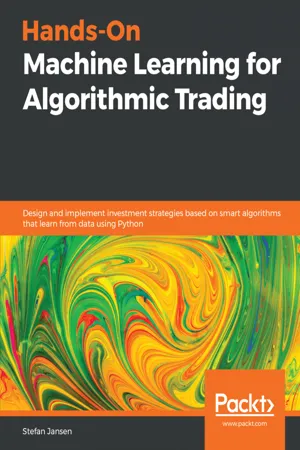
Hands-On Machine Learning for Algorithmic Trading
eBook - ePub

Hands-On Machine Learning for Algorithmic Trading

Design and implement investment strategies based on smart algorithms that learn from data using Python

  1. 516 pages
  2. English
  3. ePUB (mobile friendly)
  4. Available on iOS & Android
eBook - ePub

Hands-On Machine Learning for Algorithmic Trading

Design and implement investment strategies based on smart algorithms that learn from data using Python

About this book

Explore effective trading strategies in real-world markets using NumPy, spaCy, pandas, scikit-learn, and Keras

Key Features

  • Implement machine learning algorithms to build, train, and validate algorithmic models
  • Create your own algorithmic design process to apply probabilistic machine learning approaches to trading decisions
  • Develop neural networks for algorithmic trading to perform time series forecasting and smart analytics

Book Description

The explosive growth of digital data has boosted the demand for expertise in trading strategies that use machine learning (ML). This book enables you to use a broad range of supervised and unsupervised algorithms to extract signals from a wide variety of data sources and create powerful investment strategies.

This book shows how to access market, fundamental, and alternative data via API or web scraping and offers a framework to evaluate alternative data. You'll practice the ML workflow from model design, loss metric definition, and parameter tuning to performance evaluation in a time series context. You will understand ML algorithms such as Bayesian and ensemble methods and manifold learning, and will know how to train and tune these models using pandas, statsmodels, sklearn, PyMC3, xgboost, lightgbm, and catboost. This book also teaches you how to extract features from text data using spaCy, classify news and assign sentiment scores, and to use gensim to model topics and learn word embeddings from financial reports. You will also build and evaluate neural networks, including RNNs and CNNs, using Keras and PyTorch to exploit unstructured data for sophisticated strategies.

Finally, you will apply transfer learning to satellite images to predict economic activity and use reinforcement learning to build agents that learn to trade in the OpenAI Gym.

What you will learn

  • Implement machine learning techniques to solve investment and trading problems
  • Leverage market, fundamental, and alternative data to research alpha factors
  • Design and fine-tune supervised, unsupervised, and reinforcement learning models
  • Optimize portfolio risk and performance using pandas, NumPy, and scikit-learn
  • Integrate machine learning models into a live trading strategy on Quantopian
  • Evaluate strategies using reliable backtesting methodologies for time series
  • Design and evaluate deep neural networks using Keras, PyTorch, and TensorFlow
  • Work with reinforcement learning for trading strategies in the OpenAI Gym

Who this book is for

Hands-On Machine Learning for Algorithmic Trading is for data analysts, data scientists, and Python developers, as well as investment analysts and portfolio managers working within the finance and investment industry. If you want to perform efficient algorithmic trading by developing smart investigating strategies using machine learning algorithms, this is the book for you. Some understanding of Python and machine learning techniques is mandatory.

Tools to learn more effectively

Saving Books

Saving Books

Keyword Search

Keyword Search

Annotating Text

Annotating Text

Listen to it instead

Listen to it instead

Linear Models

The family of linear models represents one of the most useful hypothesis classes. Many learning algorithms that are widely applied in algorithmic trading rely on linear predictors because they can be efficiently trained in many cases, they are relatively robust to noisy financial data, and they have strong links to the theory of finance. Linear predictors are also intuitive, easy to interpret, and often fit the data reasonably well or at least provide a good baseline.
Linear regression has been known for over 200 years when Legendre and Gauss applied it to astronomy and began to analyze its statistical properties. Numerous extensions have since adapted the linear regression model and the baseline ordinary least squares (OLS) method to learn its parameters:
  • Generalized linear models (GLM) expand the scope of applications by allowing for response variables that imply an error distribution other than the normal distribution. GLM include the probit or logistic models for categorical response variables that appear in classification problems.
  • More robust estimation methods enable statistical inference where the data violates baseline assumptions due to, for example, correlation over time or across observations. This is often the case with panel data that contains repeated observations on the same units such as historical returns on a universe of assets.
  • Shrinkage methods aim to improve the predictive performance of linear models. They use a complexity penalty that biases the coefficients learned by the model with the goal of reducing the model's variance and improving out-of-sample predictive performance.
In practice, linear models are applied to regression and classification problems with the goals of inference and prediction. Numerous asset pricing models that have been developed by academic and industry researchers leverage linear regression. Applications include the identification of significant factors that drive asset returns, for example, as a basis for risk management, as well as the prediction of returns over various time horizons. Classification problems, on the other hand, include directional price forecasts.
In this chapter, we will cover the following topics:
  • How linear regression works and which assumptions it makes
  • How to train and diagnose linear regression models
  • How to use linear regression to predict future returns
  • How use regularization to improve the predictive performance
  • How logistic regression works
  • How to convert a regression into a classification problem
For code examples, additional resources, and references, see the directory for this chapter in the online GitHub repository.

Linear regression for inference and prediction

As the name suggests, linear regression models assume that the output is the result of a linear combination of the inputs. The model also assumes a random error that allows for each observation to deviate from the expected linear relationship. The reasons that the model does not perfectly describe the relationship between inputs and output in a deterministic way include, for example, missing variables, measurement, or data collection issues.
If we want to draw statistical conclusions about the true (but not observed) linear relationship in the population based on the regression parameters estimated from the sample, we need to add assumptions about the statistical nature of these errors. The baseline regression model makes the strong assumption that the distribution of the errors is identical across errors and that errors are independent of each other, that is, knowing one error does not help to forecast the next error. The assumption of independent and identically distributed (iid) errors implies that their covariance matrix is the identity matrix multiplied by a constant representing the error variance.
These assumptions guarantee that the OLS method delivers estimates that are not only unbiased but also efficient, that is, they have the lowest sampling error learning algorithms. However, these assumptions are rarely met in practice. In finance, we often encounter panel data with repeated observations on a given cross-section. The attempt to estimate the systematic exposure of a universe of assets to a set of risk factors over time typically surfaces correlation in the time or cross-sectional dimension, or both. Hence, alternative learning algorithms have emerged that assume more error covariance matrices that differ from multiples of the identity matrix.
On the other hand, methods that learn biased parameters for a linear model may yield estimates with a lowe...

Table of contents

  1. Title Page
  2. Copyright and Credits
  3. About Packt
  4. Contributors
  5. Preface
  6. Machine Learning for Trading
  7. Market and Fundamental Data
  8. Alternative Data for Finance
  9. Alpha Factor Research
  10. Strategy Evaluation
  11. The Machine Learning Process
  12. Linear Models
  13. Time Series Models
  14. Bayesian Machine Learning
  15. Decision Trees and Random Forests
  16. Gradient Boosting Machines
  17. Unsupervised Learning
  18. Working with Text Data
  19. Topic Modeling
  20. Word Embeddings
  21. Deep Learning
  22. Convolutional Neural Networks
  23. Recurrent Neural Networks
  24. Autoencoders and Generative Adversarial Nets
  25. Reinforcement Learning
  26. Next Steps
  27. Other Books You May Enjoy

Frequently asked questions

Yes, you can cancel anytime from the Subscription tab in your account settings on the Perlego website. Your subscription will stay active until the end of your current billing period. Learn how to cancel your subscription
No, books cannot be downloaded as external files, such as PDFs, for use outside of Perlego. However, you can download books within the Perlego app for offline reading on mobile or tablet. Learn how to download books offline
Perlego offers two plans: Essential and Complete
  • Essential is ideal for learners and professionals who enjoy exploring a wide range of subjects. Access the Essential Library with 800,000+ trusted titles and best-sellers across business, personal growth, and the humanities. Includes unlimited reading time and Standard Read Aloud voice.
  • Complete: Perfect for advanced learners and researchers needing full, unrestricted access. Unlock 1.4M+ books across hundreds of subjects, including academic and specialized titles. The Complete Plan also includes advanced features like Premium Read Aloud and Research Assistant.
Both plans are available with monthly, semester, or annual billing cycles.
We are an online textbook subscription service, where you can get access to an entire online library for less than the price of a single book per month. With over 1 million books across 990+ topics, we’ve got you covered! Learn about our mission
Look out for the read-aloud symbol on your next book to see if you can listen to it. The read-aloud tool reads text aloud for you, highlighting the text as it is being read. You can pause it, speed it up and slow it down. Learn more about Read Aloud
Yes! You can use the Perlego app on both iOS and Android devices to read anytime, anywhere — even offline. Perfect for commutes or when you’re on the go.
Please note we cannot support devices running on iOS 13 and Android 7 or earlier. Learn more about using the app
Yes, you can access Hands-On Machine Learning for Algorithmic Trading by Stefan Jansen in PDF and/or ePUB format, as well as other popular books in Computer Science & Artificial Intelligence (AI) & Semantics. We have over one million books available in our catalogue for you to explore.