Earthquakes are a huge global threat. In thirty-six countries, severe seismic risks threaten populations and their increasingly interdependent systems of transportation, communication, energy, and finance. In this important book, Louise Comfort provides an unprecedented examination of how twelve communities in nine countries responded to destructive earthquakes between 1999 and 2015. And many of the book's lessons can also be applied to other large-scale risks.
The Dynamics of Risk sets the global problem of seismic risk in the framework of complex adaptive systems to explore how the consequences of such events ripple across jurisdictions, communities, and organizations in complex societies, triggering unexpected alliances but also exposing social, economic, and legal gaps. The book assesses how the networks of organizations involved in response and recovery adapted and acted collectively after the twelve earthquakes it examines. It describes how advances in information technology enabled some communities to anticipate seismic risk better and to manage response and recovery operations more effectively, decreasing losses. Finally, the book shows why investing substantively in global information infrastructure would create shared awareness of seismic risk and make postdisaster relief more effective and less expensive.
The result is a landmark study of how to improve the way we prepare for and respond to earthquakes and other disasters in our ever-more-complex world.
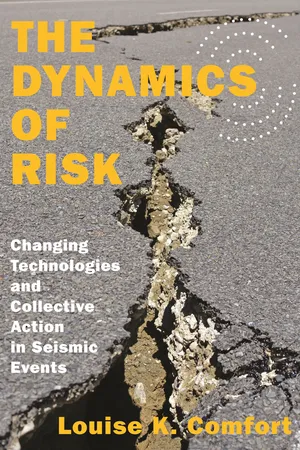
eBook - PDF
The Dynamics of Risk
Changing Technologies and Collective Action in Seismic Events
- 335 pages
- English
- PDF
- Available on iOS & Android
eBook - PDF
About this book
Information
Publisher
Princeton University PressYear
2019Print ISBN
9780691165370
9780691165363
eBook ISBN
9780691186023
Table of contents
- Cover Page
- Title Page
- Copyright Page
- Contents
- List of Figures
- List of Tables
- Preface
- 1: Redefining Risk on a Global Scale
- 2: Risk in Complex Systems
- 3: Assessing Risk in Complex Systems: Data, Methods, and Measurement
- 4: Risk in Practice
- 5: Toward an Auto-adaptive System: The 2013 Lushan County, China, Earthquake
- 6: Operative Adaptive Systems: 1999 Duzce, Turkey; 2009 Padang, Indonesia; 2011 Tohoku, Japan; and 2015 Nepal Response and Recovery Systems
- 7: Emergent Adaptive Systems: 1999 Marmara, Turkey; 1999 Chi Chi, Taiwan; 2005 Pakistan; and 2008 Wenchuan, China, Earthquake Response Systems
- 8: Nonadaptive Systems: 2001 Bhuj, Gujarat, India, Earthquake; 2004 Sumatra, Indonesia, Earthquake/Tsunami; and 2010 Haïti Earthquake Response Systems
- 9: Evolving Patterns of System Response
- 10: The Logic of Resilience
- Appendix I: Tables of Transactions by Classes of Adaptation
- Appendix II: Sources of Electronic Data, 2013 Lushan Earthquake
- Notes
- References
- Index
Trusted by 375,005 students
Access to over 1.5 million titles for a fair monthly price.
Study more efficiently using our study tools.
Frequently asked questions
Yes, you can cancel anytime from the Subscription tab in your account settings on the Perlego website. Your subscription will stay active until the end of your current billing period. Learn how to cancel your subscription
No, books cannot be downloaded as external files, such as PDFs, for use outside of Perlego. However, you can download books within the Perlego app for offline reading on mobile or tablet. Learn how to download books offline
Perlego offers two plans: Essential and Complete
- Essential is ideal for learners and professionals who enjoy exploring a wide range of subjects. Access the Essential Library with 800,000+ trusted titles and best-sellers across business, personal growth, and the humanities. Includes unlimited reading time and Standard Read Aloud voice.
- Complete: Perfect for advanced learners and researchers needing full, unrestricted access. Unlock 1.5M+ books across hundreds of subjects, including academic and specialized titles. The Complete Plan also includes advanced features like Premium Read Aloud and Research Assistant.
We are an online textbook subscription service, where you can get access to an entire online library for less than the price of a single book per month. With over 1.5 million books across 990+ topics, we’ve got you covered! Learn about our mission
Look out for the read-aloud symbol on your next book to see if you can listen to it. The read-aloud tool reads text aloud for you, highlighting the text as it is being read. You can pause it, speed it up and slow it down. Learn more about Read Aloud
Yes! You can use the Perlego app on both iOS and Android devices to read anytime, anywhere — even offline. Perfect for commutes or when you’re on the go.
Please note we cannot support devices running on iOS 13 and Android 7 or earlier. Learn more about using the app
Please note we cannot support devices running on iOS 13 and Android 7 or earlier. Learn more about using the app
Yes, you can access The Dynamics of Risk by Louise K. Comfort in PDF and/or ePUB format, as well as other popular books in Politics & International Relations & Geopolitics. We have over 1.5 million books available in our catalogue for you to explore.