- 442 pages
- English
- PDF
- Available on iOS & Android
eBook - PDF
About this book
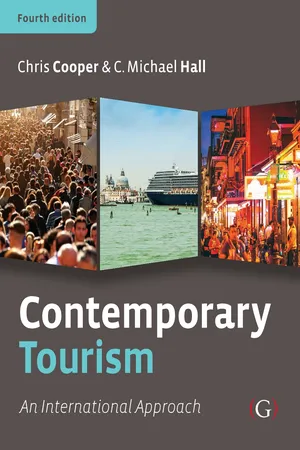
The study of tourism and indeed the tourism industry is changing constantly. Now in its fourth edition, Contemporary Tourism: an international approach presents a new and refreshing approach to the study of tourism, considering issues such as overtourism, advances in AI and its impacts, waste management and environmental crisis, the sharing economy and Airbnb, the tourist experience and product development. In particular, it highlights the ongoing threats and opportunities faced by the tourism industry today, and discusses the related management strategies, illustrating the potential implications for the patterns and flow of tourism in the future.
Divided into five sections, each chapter has a thorough learning structure including chapter objectives, examples, discussion points, self-review questions, checklists and case studies. URL links in the form of QR codes are heavily present throughout the text so that users of both hard and electronic formats can have direct links to up to date, authoritative and annotated sources of information. Cases are both thematic and destination-based and always international. They are used to emphasise the relationship between general principles and the practice of tourism looking at areas such as business and special interest tourism and the role of technology. The five sections cover: Contemporary Tourism Systems; The Contemporary Tourist; The Contemporary Tourist Destination; The Contemporary Tourism Industry; and Tourism Futures.
New to this edition:
* New material on latest issues such as the international response to overtourism; waste management and environmental change; and the impact of AI/robotics on tourism human resources;
* Brand new and updated case studies and readings throughout;
* Substantial support for both students and teachers, both within the text itself and via web-based student and instructor resources.
ABOUT THE AUTHORS
Chris Cooper is Professor in the School of Events, Tourism and Hospitality at Leeds Beckett University in the UK.
Professor C Michael Hall is Professor of Marketing at the University of Canterbury in New Zealand; Docent, University of Oulu, Finland and Visiting Professor at Linnaeus University, Kalmar, Sweden.
Information
Publisher
Goodfellow PublishersYear
2018Print ISBN
9781911396772
9781911396765
Edition
4eBook ISBN
9781911396789
Table of contents
- 1 Contemporary Tourism Systems
- 2 Contemporary Tourism Product Markets
- 3 Contemporary Tourists, Tourist Behaviour and Flows
- 4 Contemporary Tourism Marketing
- 5 Delivering the Contemporary Tourism Product: the Destination
- 6 Governing the Contemporary Tourism Product: The Role of the Public Sector and Tourism Policy
- 7 Consequences of Visitation at the Contemporary Destination
- 8 Planning and Managing the Contemporary Destination
- 9 Marketing and Branding the Contemporary Destination
- 10 The Scope of the Contemporary Tourism Sector
- 11 The Tourism Industry: Contemporary Issues
- 12 Supporting the Contemporary Tourism Product – Tourism Service Management
- 13 Tourism in the 21st Century – Contemporary Tourism in an Uncertain World
- I Index
- Figure 1.1: Locating the tourism experience and tourism product
- Figure 1.2: The geographical tourism system
- Figure 1.3: The tourism value chain: Simplified international value system
- Figure 1.4: The characteristics of tourism in relation to time, distance, boundaries and description of purpose of travel (after Hall, 2003)
- Figure 1.5: Understanding the nature of contemporary tourism
- Figure 2.1: The tourism product market. Source: Cooper, Scott and Kester (2005)
- Figure 2.2: From commodities to experiences. Source: CTC, 2011, Tourism Australia, 2012
- Figure 2.3: Australia’s Experience Hierarchy. Source Tourism Australia, 2012
- Figure 2.4: The Tasmanian experience concept. Source Tourism Tasmania (2002)
- Figure 2.5: A sociocognitive market system (Source: Rosa et al., 1999)
- Figure 2.6: An extended model of high-risk leisure consumption. Source: Celsi et al. (1993)
- Figure 2.7: The environment of product market interactions.
- Figure 3.1: Continuum of idealized attributes of mass and alternative tourism. After Hall ,1998, 2008
- Figure 3.2: Food tourism as special interest tourism (Hall & Sharples, 2003: 11)
- Figure 3.3: The construction of mobility biographies and life courses (after Hall 2003)
- Table 3.8: Instrumental and experiential motivations in tourist travel behaviour
- Table 3.9: Active and passive implications of intrinsic motivations on components of tourist behaviour
- Table 4.1: Translating the marketing orientation into action
- Table 4.2: Degrees of product ‘newness’
- Table 4.3: A framework for service redesign
- Table 4.4: Approaches to corporate social responsibility. Source: Hall and Brown (2012)
- Table 5.1: Place attributes of urban districts and quarters
- Table 5.2: Key tourism resource indicators for New Orleans and Louisiana pre- and post- Hurricane Katrina
- Table 5.3: Leisure and Business Travel to New Orleans 2003-2010
- Table 6.1: Policy matrix: Roles of government in tourism and policy types
- Table 6.2: Frameworks of governance and their characteristics, consumers and producers. Source: After Hall 2008, 2009, 2011a
- Table 6.3: Modes of governance and reasons for their failure
- Table 7.1: Perceived impacts of tourism on destinations identified in tourism literature since the 1960s.
- Table 7.2: FIFA requirements for government guarantees and infrastructure technical requirements for a World Cup (abridged)
- Table 7.3: Reasons for being in favour of or against World Cup bid
- Table 8.1: Notions of governance, decision-making and planning interventions. Source: After Hall 2013, 2014
- Table 8.2: Timelines for traditions of tourism planning. Source: After Hall 2008
- Table 8.3: Protected areas managed by Metsähallitus. Adapted from Metsähallitus (2012).
- Table 8.4: Metsähallitus Principles for Sustainable Nature Tourism,
- Table 8.4: Low, middle and high road regional competitiveness strategies
- Table 9.1: Definitions of the process and the outcome of destination marketing
- Table 9.2: Destination image and marketing actions. Source UNWTO (2006)
- Table 9.3: Jain’s matrix of strategic action. Source: Cooper (1995), based on Jain (1985)
- Table 10.1: Mapping tourism enterprises onto various SIC and country approaches
- Table 11.1: Approaches to defining small tourism firms. Source: Morrison et al. (2010)
- Table 11.2: Organisational structures and entrepreneurial characteristics. Source: Goffee and Scase (1983) and Shaw and Williams (1990)
- Table 12.1: Main online holiday rental listing services in New Zealand (October 2015)
- Table 12.2: Comparison of the product-centric and customer-centric approaches
- Table 13.1: Tourism’s contribution to global environmental change
- Table 13.2: Operator actions and needs with respect to climate change events on the Great Barrier Reef. Source: AMPO 2006
- Table 13.3: Foresight scenarios
- Table 13.4: Most promising travel and tourism emissions mitigation measures identified by the WEF. Source: WEF (2009b)
- Case study 1.1: Using a tourism systems approach to understand the environmental impact of tourism: ecological footprint analysis
- Case 1.2: Womad Festival and Travel Regulation
- Case study 1.2: US National Household Travel Survey
- Case study 2.1: Tourism Tasmania’s ‘experience product’ strategy
- Case study 2.2: Market-shaping behaviour in adventure tourism product markets: skydiving
- Case study 3.1: Icelandic tourism and recovery from crisis
- Case Study 3.2: Trains, planes and automobiles: Thanksgiving travel in the USA
- Case Study 4.1: Using social media and big data as a research tool
- Case Study 4.2: Accor Hotels and sustainability leadership for the sector
- Case study 5.1: The Maxwell Street Market, Chicago
- Case study 5.2: SoHo, urban redevelopment and place branding
- Case study 5.3: Hurricane Katrina and New Orleans tourism
- Case study 6.1: Øresund: ‘One Destination, Two Countries’
- Case study 6.2: World Heritage and issues of multilevel governance
- Case study 7.1: Economic impact of the Football World Cup
- Case study 7.2: The climate impact of international travel by Swedish residents, and transport taboos
- Case study 7.3: Tourism in Italy: The Sistine Chapel and Venice
- Case study 8.1: Planning for tourism in Finland’s national parks
- Case Study 8.2: Making destinations more walkable for tourists
- Case study 9.1: Marketing tourism cities in the twenty first century
- Case study 9.2: Positioning Barbados for European long haul markets
- Case study 10.1: Mapping the contemporary tourism industry onto the SIC system
- Case study 10.2: The way forward for TSAs
- Case Study 11.1 Disruptive Innovations: Airbnb and the Sharing Economy
- Case study 11.2: From Human Resources (HR) to Robot Resources (RR)?
- Case 12.1 Online holiday rental booking agencies in New Zealand
- Case study 12.2: Disney as a customer-centric firms
- Case study 12.2: Intercontinental Hotels Group – an evolution to a strategic approach to HRM
- Case study 13.1: Tourism entrepreneur attitudes to climate change
- Case Study 13.2 Tourism and transition management in Norway
Trusted by 375,005 students
Access to over 1.5 million titles for a fair monthly price.
Study more efficiently using our study tools.
Frequently asked questions
Yes, you can cancel anytime from the Subscription tab in your account settings on the Perlego website. Your subscription will stay active until the end of your current billing period. Learn how to cancel your subscription
No, books cannot be downloaded as external files, such as PDFs, for use outside of Perlego. However, you can download books within the Perlego app for offline reading on mobile or tablet. Learn how to download books offline
Perlego offers two plans: Essential and Complete
- Essential is ideal for learners and professionals who enjoy exploring a wide range of subjects. Access the Essential Library with 800,000+ trusted titles and best-sellers across business, personal growth, and the humanities. Includes unlimited reading time and Standard Read Aloud voice.
- Complete: Perfect for advanced learners and researchers needing full, unrestricted access. Unlock 1.5M+ books across hundreds of subjects, including academic and specialized titles. The Complete Plan also includes advanced features like Premium Read Aloud and Research Assistant.
We are an online textbook subscription service, where you can get access to an entire online library for less than the price of a single book per month. With over 1.5 million books across 990+ topics, we’ve got you covered! Learn about our mission
Look out for the read-aloud symbol on your next book to see if you can listen to it. The read-aloud tool reads text aloud for you, highlighting the text as it is being read. You can pause it, speed it up and slow it down. Learn more about Read Aloud
Yes! You can use the Perlego app on both iOS and Android devices to read anytime, anywhere — even offline. Perfect for commutes or when you’re on the go.
Please note we cannot support devices running on iOS 13 and Android 7 or earlier. Learn more about using the app
Please note we cannot support devices running on iOS 13 and Android 7 or earlier. Learn more about using the app
Yes, you can access Contemporary Tourism by Chris Cooper,C Michael Hall in PDF and/or ePUB format, as well as other popular books in Business & Hospitality, Travel & Tourism Industry. We have over 1.5 million books available in our catalogue for you to explore.