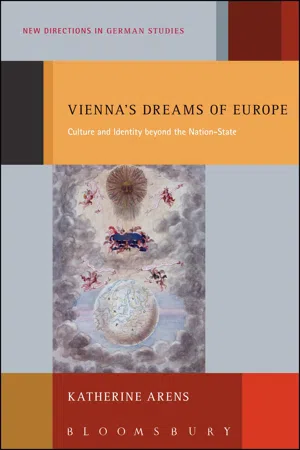
Vienna's Dreams of Europe puts forward a convincing counter-narrative to the prevailing story of Austria's place in Europe since the Enlightenment. For a millennium, Austrian writers have used images of Europe and its hegemonic culture as their political and cultural reference points. Yet in discussions of Europe's nation-states, Austria appears only as an afterthought, no matter that its precursor states-the Holy Roman Empire, the Austrian Empire, and Austria Hungary-represented a globalized European cultural space outside the dominant paradigm of nationalist colonialism. Austrian writers today confront reunited Europe in full acknowledgment of Austro-Hungary's multicultural heritage, which mixes various nationalities, ethnicities, and cultural forms, including ancestors from the Balkans and beyond.
Challenging standard accounts of 18th- through 20th-century European imperial identity construction, Vienna's Dreams of Europe introduces a group of Austrian public intellectuals and authors who have since the 18th century construed their own public as European. Working in different terms than today's theorist-critics of the hegemonic West, Katherine Arens posits a political identity resisting two hundred years of European nationalism.
- 336 pages
- English
- ePUB (mobile friendly)
- Available on iOS & Android
eBook - ePub
About this book
Information
Part One
An Austrian Imperial Europe
The Habsburg territories of the late eighteenth and nineteenth centuries were the seat of an empire that had existed for over 800 years, at the heart of the geopolitical shifts that would soon form modern Europe.
Under Charles V as the Holy Roman Emperor, the House of Habsburg in 1520 had held the largest empire in the world (ruling properties including New Spain). Europe’s electors, however, forced a split in the house, creating an Austrian branch of the house, which continued the family’s almost unbroken possession of the throne of the Holy Roman Empire. Yet that Empire had been under attack since the Protestant Reformation, and so Habsburg culture had already been dislocated within Europe, at the outbreak of the Thirty Years War (1618), when the court shifted its seat from Prague to Vienna. Its fortunes declined even more precipitously, as the Spanish branch of the family gradually died out, a process culminating with the 1700 death of Charles II, Spain’s last Habsburg ruler, and the ensuing War of the Spanish Succession.
At the same time, the leadership of germanophone culture was called into question by the Seven Years War (1756–63). Prussia hoped to profit from the comparative weakness of Austria and the Holy Roman Empire, as it sought to expand and to consolidate territories into something more like a modern nation-state.1 The results of this conflict between Prussia and Austria redrew the maps of Europe and the world, but it did not facilitate the emergence of a united or centralized germanophone cultural sphere: the Peace of Paris gave England the French possessions in Africa, India, and North America; the Peace of Hubertusburg gave Silesia to Prussia and guaranteed the borders of Prussia and Austria. In consequence, an alternate set of political and social forces, the specter of a German empire under Prussia (and hence Protestant) opposing the Catholic Holy Roman Empire under the Habsburgs, materialized to reconfigure the space of Central European identity in other ways, as traditional alliances dividing Catholic and Protestant princes took on new financial and political urgency under pressure from the great colonial powers of England, France, and Russia.2
The house of Habsburg was saved by the Pragmatic Sanction of 1713, which allowed for female succession to the throne. This resolution was also accidentally prescient: at the death of Charles VI, he left only a female heir: Maria Theresa. When it came down to her actually inheriting these extensive European holdings, France, Prussia, Saxony, and Bavaria objected to the proclamation they had once supported, leading to the War of the Austrian Succession in 1740, a world war that was to last until 1748, and the Treaty of Aix-la-Chapelle.
Ultimately, Maria Theresa and the House of Habsburg survived as a continuous entity, losing Silesia to Prussia. She also managed to reclaim the throne of the Holy Roman Empire for her husband, Francis 1, in 1745, by bartering a conquered Bavaria back to its traditional ruling family. The House of Habsburg (now officially Habsburg-Lothringen, since Francis was of the House of Lorraine) was again the center of a successful dynasty. Vienna had become the imperial seat only at the start of the Thirty Years War in 1618, after the Defenestration at Prague signaled the need to move the government out of Bohemian territories. With Habsburg power now reasserted, Vienna was poised to evolve into a European capital city and culture center.
The story of “modern” Austrian culture begins in that Vienna, a city entangled with recurring political and cultural threats—from France, Prussia, and Russia, in turn. These empires were all bent on expansionism into traditional Habsburg territories but would achieve these goals only with the end of World War I.
Historic Austria’s first major milestone of its modern era came in the second generation after Maria Theresa’s long reign (1740–80). Her two sons succeeded her on the throne, first Joseph II (1765–90, originally as co-regent of Austria with his mother) and then Leopold II (originally Grand Duke of Tuscany, then Holy Roman Emperor from 1790 to 1792). Leopold’s son Francis assumed the throne and then became Francis II of the Holy Roman Empire. Yet the Holy Roman Empire’s days were numbered once Napoleon declared himself Emperor and began to consolidate his new European Empire, and so, as Napoleon’s imperialist politics led to the destruction of the Holy Roman Empire in 1806, Francis was declared Emperor of Austria in 1804 (now Francis I), a throne he held until 1835. Surviving these geopolitical transitions was achieved in no small part because one of Maria Theresa’s daughters was Marie Antoinette of France, and one of Francis’ daughters was the Marie Louise married to Napoleon.
The Habsburgs of the eighteenth and nineteenth centuries typically had many children and married them off well, following traditions back to the later Middle Ages. “AEIOU” was the house’s unofficial device, introduced by Frederick II (1415–94), and variously interpreted as:
1Alles Erdreich Ist Österreich Untertan: All the world is subject to Austria.
2Austria erit in orbe ultima: Austria will be in the world to the end.
3Austriae est imperare orbi universo: Austria is to rule over the whole world.
This “Austrian” culture around 1800 still had such imperial claims and saw itself as part of Europe, a player among the great powers. What that meant to the citizens of this empire, however, was quite different than the “imperial ideas” present in absolutist Russia, enlightened absolutist, militarist and largely Protestant Prussia, Catholic France (to say nothing of the older empires centered on England or Spain, whose ruling dynasties were replaced by foreign families). Most critically, the Habsburg court was in Vienna, and in many ways part of Vienna. That court played a role in public culture in ways that courts in Versailles, Potsdam, or St. Petersburg were not because of their distance from city centers, and that a constitutional monarchy with a foreign ruling family like England’s Hanoverians could not be.
Most particularly, Vienna’s court and public shared many spaces, some sponsored by the court and others emerging as commercial ventures. The most important theater, the Burgtheater, supported itself by presenting performances to the court, then repeating them for the general public, for example. Ballet, opera, and serious theater were cultivated there, and not just as playgrounds or brothels for the rich and titled (as was all too often the case in Paris and St. Petersburg; Italy’s various capitals may have been exceptions to this rule). Many music performances in Mozart’s era were subscription concerts, held in noble houses but not quite as socially restricted as salons often were—the events were ticketed. Just as importantly, public theaters existed outside the old city walls, not as subject to regulation or patronage as were London’s—there were no moments of iconoclasm in Vienna to shut theater doors, and the tickets were priced for the groundlings as well as the elite. Critically, these theaters were not only popular, they cultivated performers and playwrights who would enter the “Austrian canon,” not just passing entertainments; their directors looked to Europe’s theaters for inspiration and material, and their audiences expected the best in comedy and music.
Let us now turn to that public space as represented by its most visible participants, especially in Vienna, and acknowledged as a site for public speech about the state of their own culture: the state minister and theater censor Joseph von Sonnenfels (1732–1817), professor turned literat; the civil servant and dramatist Franz Grillparzer (1791–1872); actor–playwright in the comic traditions, Johann Nestroy (1801–62); and writer, painter, and school superintendent Adalbert Stifter (1805–68). These names form the canon of Austrian greats of the long nineteenth century, constant reference points for all later Austrian culture through today.
Outside their cultural homeland, however, and particularly in the history-writing about “German” literature that dominates scholarship since World War II, these authors are all too often dismissed as naïve and apolitical because they accept voices from beyond their respective Austrias without calling definitively for revolution, as playwrights from Schiller to Hebbel would. None the less, these texts remain hallmarks for the public voice and public space of Viennese and Austrian culture, real or imagined, from their creation up through today, because they document the existence of, or at least their authors’ hopes for, a public capable of exercising critical capacities and judging their own and their nation’s place on Europe’s stage. Sonnenfels, Grillparzer, Nestroy, and Stifter were not interested in acting as harbingers for a future, more utopian version of the nation they lived in. Instead, their voices call for public discussions about culture and politics on a European historical scale, finding in such discussions hopes for a more engaged, enlightened public discussion about shared lives, historical memories, and present experiences.
Notes
1The great powers (Austria, France, Russia, and the Reichsfürsten) allied against the upstart (Prussia, aided by England, and Hannover). But then Russia pulled out of the coalition because Elizabeth II died; England pulled back from full support of its allies; and Austria’s long two centuries of military defeat began after it failed to vanquish Prussia’s armies and partition its territories.
2The definitive history of Austria is Robert A. Kann’s A History of the Habsburg Empire, 1526–1918 (1980). A brief treatment of the situation is Joachim Whaley, “Die Habsburgermonarchie und das Heilige Römische Reich im 18. Jahrhundert.”
OneLetters to the Ruling Class: The Public Spaces of Enlightenment
In a famous letter to Friedrich Nicolai, Gotthold Ephraim Lessing expressed his frustration about freedom of thought in his Berlin:
For once, let someone in Berlin try to write about things as freely as Sonnenfels had written in Vienna; let someone try to tell the elegant Court Rabble the truth, as he had done; let someone appear in Berlin to raise his voice for the rights of the oppressed, against plunder and despotism, as now is happening even in France and Denmark: and you will soon experience which European land is the most enslaved up to the present day.1
Lessing here points to a fact all too often ignored in German cultural history, and which the case of Austria brings to the fore: that the age of Enlightenment and revolution came to various germanophone regions under different circumstances, into different social structures, and with different results for what has come to be called the public sphere and its institutions.2 In the late eighteenth century, Austria was already part of a different Europe than were Prussia and other germanophone regions.
After the Protestant Reformation, the germanophone world received the Enlightenment late for very pragmatic reasons: almost two centuries of wars.3 Like Lessing, many authors of the second half of the eighteenth century understood that working in Protestant Prussia with its new military status and its salon-driven culture meant something very different than working in an increasingly bureaucratized Catholic Vienna with a conscious cultural relationship to Europe.4 Neither Berlin nor Vienna had the urban culture that had supported and disseminated the Enlightenment in France and England. Home of the Habsburg chancellery only since 1618, Vienna would emerge as a major city only after Napoleon; Berlin’s salons lay apart from the court,5 which had moved to Potsdam. Both Habsburg and Hohenzollern rulers, moreover, used censorship to achieve their aims. Lessing’s reference to Joseph von Sonnenfels thus signals how world politics remained a potent force in the dissemination of Enlightenment ideals in Prussia and Austria as rival public spheres.
Beyond its political significance, the connection between the two intellectuals is, in fact, more significant than Lessing’s off-hand remark might at first suggest. Between 1759 and 1765, Gotthold Ephraim Lessing began the seminal series of Briefe, die neueste Literatur betreffend (Letters Concerning the Most Recent Literature). In 1768 and 1769, the Austrian bureaucrat and court official Joseph von Sonnenfels (1733–1817),6 acknowledging his debt, took the form over to offer his own parallel set of letters on culture, his Briefe über die wienerische Schaubühne (Letters on the Viennese Stage), just at the time he saw an advertisement for the Hamburgische Dramaturgie. These two sets of aesthetic letters, one each directed at B...
Table of contents
- New Directions In German Studies
- Volumes in the series
- Title
- Contents
- Acknowledgements
- Introduction: Austria as a Challenge to Europe
- Part 1: An Austrian Imperial Europe
- 1 Letters to the Ruling Class: The Public Spaces of Enlightenment
- 2 Extending Europe’s Enlightenment: Why Grillparzer Resists Weimar
- 3 Revolution from the Prompter’s Box: Rewriting Public Dreams of Political Morality
- 4 Eclipses, Floods, and Biedermeier Catastrophes: Public Spaces in extremis
- Part 2: At the Margins of Europe, In the Heart of Europe
- 5 Hofmannsthal’s European Revolution: Recapturing a Space for Common Culture
- 6 Schnitzler and the Space of Public Discourse: The Politics of Decadence in fin de siècle Vienna
- 7 Kasperl and the Wiener Gruppe: artmann, Bayer, and Handke
- 8 A New Balkan Challenge: The Reemergence of Austria’s Europe
- Afterword: Austria as Europe? The Art and Science of the Post-National Culture
- Bibliography
- Index of Names
- Copyright
Trusted by 375,005 students
Access to over 1.5 million titles for a fair monthly price.
Study more efficiently using our study tools.
Frequently asked questions
Yes, you can cancel anytime from the Subscription tab in your account settings on the Perlego website. Your subscription will stay active until the end of your current billing period. Learn how to cancel your subscription
No, books cannot be downloaded as external files, such as PDFs, for use outside of Perlego. However, you can download books within the Perlego app for offline reading on mobile or tablet. Learn how to download books offline
Perlego offers two plans: Essential and Complete
- Essential is ideal for learners and professionals who enjoy exploring a wide range of subjects. Access the Essential Library with 800,000+ trusted titles and best-sellers across business, personal growth, and the humanities. Includes unlimited reading time and Standard Read Aloud voice.
- Complete: Perfect for advanced learners and researchers needing full, unrestricted access. Unlock 1.5M+ books across hundreds of subjects, including academic and specialized titles. The Complete Plan also includes advanced features like Premium Read Aloud and Research Assistant.
We are an online textbook subscription service, where you can get access to an entire online library for less than the price of a single book per month. With over 1.5 million books across 990+ topics, we’ve got you covered! Learn about our mission
Look out for the read-aloud symbol on your next book to see if you can listen to it. The read-aloud tool reads text aloud for you, highlighting the text as it is being read. You can pause it, speed it up and slow it down. Learn more about Read Aloud
Yes! You can use the Perlego app on both iOS and Android devices to read anytime, anywhere — even offline. Perfect for commutes or when you’re on the go.
Please note we cannot support devices running on iOS 13 and Android 7 or earlier. Learn more about using the app
Please note we cannot support devices running on iOS 13 and Android 7 or earlier. Learn more about using the app
Yes, you can access Vienna's Dreams of Europe by Katherine Arens in PDF and/or ePUB format, as well as other popular books in Letteratura & Critica letteraria tedesca. We have over 1.5 million books available in our catalogue for you to explore.