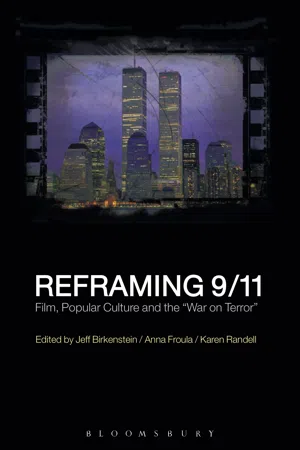
eBook - ePub
Reframing 9/11
Film, Popular Culture and the "War on Terror"
- 256 pages
- English
- ePUB (mobile friendly)
- Available on iOS & Android
eBook - ePub
Reframing 9/11
Film, Popular Culture and the "War on Terror"
About this book
September 11th, 2001 remains a focal point of American consciousness, a site demanding ongoing excavation, a site at which to mark before and after "everything" changed. In ways both real and intangible the entire sequence of events of that day continues to resonate in an endlessly proliferating aftermath of meanings that continue to evolve. Presenting a collection of analyses by an international body of scholars that examines America's recent history, this book focuses on popular culture as a profound discursive site of anxiety and discussion about 9/11 and demystifies the day's events in order to contextualize them into a historically grounded series of narratives that recognizes the complex relations of a globalized world. Essays in Reframing 9/11 share a collective drive to encourage new and original approaches for understanding the issues both within and beyond the official political rhetoric of the events of the "The Global War on Terror" and issues of national security.
Information
(Re)Creating Language
CHAPTER 1
Fear, Terrorism, and Popular Culture
We learn about the world and how the world is run through the mass media and popular culture. Indeed, the state of a citizenry’s worldview can be gleaned by its dominant news sources. This is becoming more apparent with foreign policy and international affairs.1 Mass media information provides a context of meanings and images that prepare audiences for political decisions about specific actions, including war. This chapter draws on qualitative document analysis2 to illustrate how news reports and popular culture depictions about the “War on Terror” (WOT) were grounded in a discourse of fear, as well as familiar cultural images that proclaimed the moral and social superiority of the United States. Moreover, the “crisis” of the 9/11 attacks was artfully constructed through news accounts as the “world has changed” and that future survival would depend on giving up many basic civil liberties, particularly “privacy.” These messages were folded into the previous crime-related discourse of fear, which may be defined as the pervasive communication, symbolic awareness, and expectation that danger and risk are central features of everyday life.
News media and popular culture depictions of the US reaction to terror attacks reflect a culture and collective identities steeped in marketing, popular culture, consumerism, and fear. The military-media complex managed press releases and cultivated news sources to produce terrorism scenarios that were reflected in national agendas and everyday life. The attacks on the United States on September 11, 2001, were defined in the news media and popular culture as an assault on American culture, if not civilization itself.3 These definitions were aligned with a broad context and a preexisting discourse of fear, which is discussed below, along with symbolic images of “Arabs” as the “Other,” or marginalized outsiders who are threats to personal and national security.4
Fun with Terrorism and Fear
War and conflict are the stuff of superheroes and run-of-the-mill politicians. Popular culture’s engagement of audiences’ emotions and aspirations to be extraordinary, “in the know,” and relevant—in the face of bureaucratic everyday routines—promotes identification with narratives and tales of tragedy, overcoming adversity, and rising to defeat enemies. It is ironic—and very important—that during the Iraq War one of the most important sources of news for younger people was The Daily Show with Jon Stewart, a comedic parody on the news of the day, mixed with truly informative insights from selected authors, who would discuss their more reflective take on issues of the day, including foreign policy, imperialism, and faux concern with fear.
Fear is the foundation for much of the dominant narrative of the last 50 years.5 Notwithstanding the long relationship in the United States between fear and crime, the role of the mass media in promoting fear has become more pronounced since the United States “discovered” international terrorism on September 11, 2001. The dominant “story” since the attacks of 9/11 was the “WOT.” The American news media, and especially network TV news organizations, chose not to present important contextual and background information about the Middle East, and especially Iraq, because it was not consistent with other news themes, nor was it as entertaining. Threats to invade other countries—the “axis of evil”—that included Iraq, were part of an effort to “defend” the United States from future attacks. This broad story included US retaliation, the hunt for al-Qaeda leaders (e.g., Osama bin Laden), and plans to attack countries and “outlaw regimes” that supported or harbored terrorists. Implementing these programs involved invading Afghanistan and expanding the US military presence throughout the world. Other adjustments were made in foreign policy, military budgets, domestic surveillance, and attacks on civil liberties.6
Fear and terrorism became broad symbols that encompassed consumption and international intervention.7 Previous analysis of numerous news reports pertaining to terrorism shows that citizens’ concerns about victims of 9/ll attacks were joined by politicians and advertisers, who marketed and framed fear and dread of terrorism as part of a national identity that was commensurate with personal caring and community.8 The meaning of terrorism expanded from a tactic to also mean an idea, a lifestyle, and ultimately, a condition of the world. News reports contributed to this broad definition of terrorism as a condition. A key source for this news theme was the Project for the New American Century (PNAC).
Terrorism and the Project for the New American Century
Key policymakers had long considered invading Iraq.9 Planned for nearly ten years, bringing about a “regime change” in Iraq was part of a complex plan for the United States to become the hegemon, including withdrawing from—if not negating—certain treaties (e.g., nuclear test ban) and becoming more independent of the United Nations.10 The most detailed coverage of the history of the PNAC and its role in shaping US foreign policy was David Armstrong’s 2002 essay in Harper’s:
The plan is for the United States to rule the world. The overt theme is unilateralism, but it is ultimately a story of domination. It calls for the United States to maintain its overwhelming military superiority and prevent new rivals from rising up to challenge it on the world stage. It calls for dominion over friends and enemies alike. It says not that the United States must be more powerful, or most powerful, but that it must be absolutely powerful.11
The US invasion of Iraq was justified, in the main, by claims that Saddam Hussein possessed “weapons of mass destruction” (WMD), was in league with the terrorists who attacked the US, and that he was likely to place these weapons at the disposal of other terrorists.12 It took less than a year for the world to learn that none of these assertions were true, and indeed, there was strong evidence that members of the Bush administration were quite aware that such WMDs did not exist.13
Vice President Dick Cheney knew for two decades that Iraq was a prime target. He knew this because he was part of a group that drew up a blueprint for US world domination: PNAC.14 On the fifth anniversary of the 9/11 attacks, Vice President Cheney made it very clear that the Iraq War did not hinge mainly on the existence of WMDs. Cheney stated on Meet the Press:
The world is much better off … It was the right thing to do, and if we had to do it over again, we’d do exactly the same thing … The people obviously are frustrated because of the difficulty, because of the cost and the casualties … You cannot look at Iraq in isolation. You have to look at it within the context of the broader global war on terror …. Any retreat by the United States would indicate to the terrorists that the “US has lost its will” in the war against terrorism and would damage US credibility.15
Given such emphasis, it is perhaps no surprise that six years after the invasion of Iraq one-third of the American people still believed that Saddam Hussein was involved.16 Well into 2009, conservative politicians, including Dick Cheney when he was out of office, would chide newly elected President Obama for not keeping us safe.
The Iraq War was informed by PNAC efforts and the resulting propaganda campaign to convince the American people that attacking Iraq was tantamount to attacking “terrorists” and others who threatened the United States.17 Many members of the PNAC joined the Bush administration and became credible claims-makers, who constructed the frames for shaping subsequent news reports. Among the members who signed many of the proclamations laying the foundation for a new American empire18 were former and current governmental officials, including: Elliot Abrams, William Bennett, Jeb Bush, Dick Cheney, Steve Forbes, Donald Kagan, Norman Podhoretz, Dan Quayle, Donald Rumsfeld, and Paul Wolfowitz.
The PNAC emphasized changing American foreign policy to become a hegemon and police its international interests as a new kind of benevolent American empire.19 This would include expanding the military, withdrawing from major treaties, as well as engaging in preemptive strikes against those who would threaten US interests. These messages were carried by the mass media for months leading up to the invasion of Iraq.20 Indeed, with the exception of a few critical reports about the rush to war and the role of the PNAC by National Public Radio (NPR) and the Public Broadcasting Service’s Frontline, there were virtually no analytical pieces about the rush to war.21 The support by the mainstream media was consistent with the way that the “Arab CNN”—Al Jazeera—would be characterized several years later:
… Arab journalists said Al Jazeera’s seeming willingness to toe the Saudi line was proof that there still were no truly independent media outlets in the region. “The Arab media today still play much the same role as the pre-Islamic tribal poets, whose role was to praise the tribe, not tell the truth,” said Sulaiman al-Hattlan, a Dubai-based media analyst and the former editor in chief of Forbes Arabia.22 In 1992, the United States was well on its way to justifying an attack on Iraq when Dick Cheney and others, who would occupy positions in the Bush administration eight years later, drafted the Defense Planning Guidance document. Making a pitch for a threatened military budget in 1992, Colin Powell told the House Armed Services Committee that the United States
required “sufficient power” to “deter any challenger from ever dreaming of challenging us on the world stage.” To emphasize the point, he cast the United States in the role of street thug. “I want to be the bully on the block,” he said, implanting in the mind of potential opponents that “there is no future in trying to challenge the armed forces of the United States.”23
The upshot was that the goal was “to prevent the reemergence of a new rival.”24
When the plan was leaked to the press, it went through several changes, with new drafts suggesting that the US would act in concert with allies, when possible. The First Gulf War came and went, President George Bush was not reelected, and many of the co-authors and supporters of the plan left office for think tanks, businesses, and various publications. The plan, with revisions, was promoted repeatedly during the next decade, even though some members were out of office for as much as eight years, and was in full swing one month before the infamous 9/11 attacks. Ultimately, the plan was oriented to freeing the US from several alliances and treaties that limited military and weapons planning and testing, including the 1972 anti-ballistic missile treaty, and several nuclear nonproliferation treaties.25 Other global and environmental agreements were also avoided or broken, including those designed to protect the environment and limit pollution (e.g., the United Nations’ Kyoto Protocol, ratified or signed by 209 countries).
As news sources, cabinet members, presidential advisors, journalists, and publishers, the PNAC played a major role in leading the US to war with Iraq. Political decision-makers quickly adjusted propaganda passages, prepared as part of the PNAC, to emphasize domestic support for the new US role in leading the world. Most of the Gulf War coverage originated from the White House and the federal government.26 Network news shows were quite consistent with guests who supported the war. An analysis by Fairness & Accuracy in Reporting (FAIR) of network news interviewees one week before and one week after Secretary of State Colin Powell addressed the United Nations about Iraq’s alleged possession of WMDs found that two-thirds of the guests were from the United States with 75 percent of these being current or former government or military officials. Only one—Senator Kennedy—expressed skepticism or opposition to the impending war with Iraq.27
As noted previously, the PNAC received very little news media coverage prior to the invasion of Iraq, even though it was part of the “public record” in government documents and had been briefly mentioned in several newspaper and radio reports in the late 1990s.28 Only a few newspaper articles dealt with PNAC six mont...
Table of contents
- Cover
- Title Page
- Contents
- Acknowledgements
- Foreword
- Introduction
- SECTION I (RE)CREATING LANGUAGE
- SECTION II VISIONS OF WAR AND TERROR
- SECTION III PROPHETIC NARRATIVES
- Afterword
- Contributors
- Bibliography
- Index
- eCopyright
Trusted by 375,005 students
Access to over 1.5 million titles for a fair monthly price.
Study more efficiently using our study tools.
Frequently asked questions
Yes, you can cancel anytime from the Subscription tab in your account settings on the Perlego website. Your subscription will stay active until the end of your current billing period. Learn how to cancel your subscription
No, books cannot be downloaded as external files, such as PDFs, for use outside of Perlego. However, you can download books within the Perlego app for offline reading on mobile or tablet. Learn how to download books offline
Perlego offers two plans: Essential and Complete
- Essential is ideal for learners and professionals who enjoy exploring a wide range of subjects. Access the Essential Library with 800,000+ trusted titles and best-sellers across business, personal growth, and the humanities. Includes unlimited reading time and Standard Read Aloud voice.
- Complete: Perfect for advanced learners and researchers needing full, unrestricted access. Unlock 1.5M+ books across hundreds of subjects, including academic and specialized titles. The Complete Plan also includes advanced features like Premium Read Aloud and Research Assistant.
We are an online textbook subscription service, where you can get access to an entire online library for less than the price of a single book per month. With over 1.5 million books across 990+ topics, we’ve got you covered! Learn about our mission
Look out for the read-aloud symbol on your next book to see if you can listen to it. The read-aloud tool reads text aloud for you, highlighting the text as it is being read. You can pause it, speed it up and slow it down. Learn more about Read Aloud
Yes! You can use the Perlego app on both iOS and Android devices to read anytime, anywhere — even offline. Perfect for commutes or when you’re on the go.
Please note we cannot support devices running on iOS 13 and Android 7 or earlier. Learn more about using the app
Please note we cannot support devices running on iOS 13 and Android 7 or earlier. Learn more about using the app
Yes, you can access Reframing 9/11 by Jeff Birkenstein,Anna Froula,Karen Randell in PDF and/or ePUB format, as well as other popular books in Social Sciences & Film History & Criticism. We have over 1.5 million books available in our catalogue for you to explore.