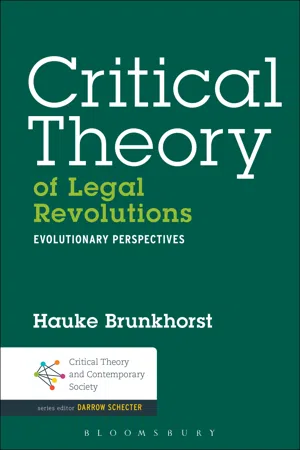
This unique work analyzes the crisis in modern society, building on the ideas of the Frankfurt School thinkers. Emphasizing social evolution and learning processes, it argues that crisis is mediated by social class conflicts and collective learning, the results of which are embodied in constitutional and public law.
First, the work outlines a new categorical framework of critical theory in which it is conceived as a theory of crisis. It shows that the Marxist focus on economy and on class struggle is too narrow to deal with the range of social conflicts within modern society, and posits that a crisis of legitimization is at the core of all crises. It then discusses the dialectic of revolutionary and evolutionary developmental processes of modern society and its legal system.
This volume in the Critical Theory and Contemporary Society by a leading scholar in the field provides a new approach to critical theory that will appeal to anyone studying political sociology, political theory, and law.
- 416 pages
- English
- ePUB (mobile friendly)
- Available on iOS & Android
eBook - ePub
About this book
Information
1
The evolutionary significance of revolution
Introduction
Everything is evolution. Revolutions and collective normative learning processes are also evolutionary processes. Evolution never stops. But while evolution is, in a rough distinction, a process beyond plan and control, revolutions and (revolutionary and non-revolutionary) normative learning processes are specific kinds of evolutionary developments which not only proceed automatically as blind natural occurrences (naturwüchsig), but also express and perform our plans, intentions and ideas. Revolution is itself an evolutionary advance, in particular of the evolution of modern societies, even if it may have some forerunners that are premodern.
Like most theories of society, the critical theory of Karl Marx is an evolutionary theory. Yet even if Marx in his historical research clearly distinguished the historical analysis of class struggles from the functional logic of the capitalist system, he did not make much of this distinction systematically. In systematic concerns, his representation of the history of class struggles ultimately assimilates the normative developmental logic of the ‘history of class struggles’ to the functional adaptation of the economic system to its environment. The reason is that Marx did not distinguish systematically between work and interaction.1 Therefore, Marx cannot explain the take-off of social evolution (I). Even if Marx in his historical essays understood the great European revolutions as legal revolutions, he retained a schema of basis and superstructure that reduced the basis to the economic system. It is not the schema that is the problem. All theories of society distinguish between basis and superstructure. For instance, Durkheim distinguishes the system of social division of labour from the collective consciousness of society; Parsons distinguishes the energy of a system (basis) from its ability to codify, organize and collect information (superstructure); Habermas distinguishes system (basis) and lifeworld (super-structure), and furthermore, the material (basis) from the symbolic lifeworld (superstructure) and Luhmann distinguishes the societal structure from the semantics of society. The problem with Marx is not the schema ‘basis vs. superstructure’, but his conceptual decision to give the economic system a kind of causal priority over all the other social systems, spheres of value and the whole superstructure. Therefore, he cannot develop a sufficient understanding of the normative peculiarity of revolution and the role of law as a ‘pacemaker’ of evolution that constrains blind evolutionary adaptation normatively (II).2 The most important of these normative legal constraints are constitutions. Constitutions are evolutionary universals. As universals they have a functional and a practical side. They are functional advances as well as practical mindsets (III).3 Constitutionalism presupposes a functionally differentiated legal system, and hence modern society. The last section gives a brief discussion of the internal relations between functional differentiation, crisis and social struggle in the evolution of modern society (IV).
I The power of the negative: The take-off of social evolution
Fifteen years before Darwin’s book On the Origin of Species (1859) was published, the epistemological implications of evolutionary theory were already made explicit in an unpublished manuscript by Marx and Engels that appeared much later under the title The German Ideology. From the middle of the eighteenth century onwards, evolutionary theory developed together with, and for a long time not really differently from, emerging modern historical scholarship and the (idealist) philosophy of history. Marx and Engels, at the end of the pre-Darwin period of evolutionary theory, summarized the results of the first hundred years of evolutionary theory in one short sentence: ‘We know only a single science, the science of history.’4 The short statement that there is only one field of study, namely the study of history, has the epistemological implication that evolution overall is an empirical fact with a transcendental meaning. The meaning of ‘transcendental’ is ‘x being constitutive for y’ (or x limits the knowledge of y, and by limiting it enables the knowledge we have of y). Because everything is evolution, evolution is a quasi-transcendental fact that is constitutive for the reflexive knowledge of evolution that is itself part of evolution.
(1) Work, interaction and the growth of communicative negativity
There is only one evolution. But there are first different levels in the emergence of evolution: ‘One can look at history from two sides and divide it into the history of nature and the history of men.’ The two sides are ‘inseparable’, are ‘dependent on each other’, but have different evolutionary histories.5 The evolution of evolution has led to the distinction between natural and social evolution. Therefore, Engels later called his and Marx’s theory historical materialism.6 In social evolution, so Parsons argues from a state of scientific knowledge a hundred years later, ‘(the) “gene” has been replaced by the “symbol.”’7 Yet this argument, in a nutshell, was already presupposed by Marx and Engels, the disciples of Hegel.8 Human beings are learning to invent and use their means of production through social interaction:
Men . . . themselves begin to distinguish themselves from animals as soon as they begin to produce their means of subsistence. . . . The way in which men produce their means of subsistence . . . must not be considered simply as being the production of the physical existence of the individuals. Rather it is . . . a definite form of expressing their life. . . . As individuals express their life, so they are. What they are, therefore, coincides with their production, both with what they produce and with how they produce. . . . This production . . . presupposes the intercourse [Verkehr] of individuals with one another.9
Social evolution begins with the socially learned cooperative use of instruments: ‘The production of life . . . as a social relationship’ consists in ‘the co-operation of several individuals, no matter under what conditions, in what manner and to what end’.10 Co-original with the social production of life is the production of communicative variation (consisting in the symbolic distinction between old and new needs) that finally leads to the take-off of social evolution. Marx and Engels call this take-off the first historical act: The ‘satisfaction of the first need . . . leads to new needs; and this production of new needs is the first historical act’.11
Henceforth, for Marx, the driving mechanism of social evolution is the symbolically mediated growth of productive forces. But Marx also considers another driving mechanism, namely, class struggle. He understands class conflicts as conflicts between social groups that are caused by the social structure of society. At the beginning of the Communist Manifesto, he and Engels assert: ‘The history of all hitherto existing society is the history of class struggles.’12 Similar ideas on the evolutionary role of conflict were developed later by American pragmatists such as John Dewey.13 As all historical essays and studies of Marx and Engels show, class contest is about material as well as about ideal interests.14 But when he switches from the history of class struggles to the theory of society, Marx connects class struggle and the growth of productive forces in a way that eliminates class struggle as an independent evolutionary mechanism of change. Instead, he reduces the role of class struggle to that of a ‘midwife’ (Marx) of the unfettering of all productive forces. In the orthodox reading, the growth of productive forces (which leads to new symbolic expressions of ever new needs) is, therefore, the source of variation, and class conflict is the mechanism of selection that is re-stabilized by the relations of production. Therefore, Marx must explain the take-off of social evolution by the capacity to work. Work and technology, instrumental and strategic actions are learnt through social interaction. However, the learning of instrumental and strategic know-how is not specific to social evolution. Not only human beings, but also computers, great apes or students of law and economics can be involved successfully in communicative interactions of learning instrumental and strategic know-how. They all are able to learn socially. The actors of strategically restricted communication (like the homo economicus in game theory) learn cooperation with others for the single purpose of getting more for themselves at the end of the day. This is not due to the egoistic or greedy motivation of the actor, but to the strategically restricted system of communication. Marx already observed this in his basic distinction between the real-abstract personification of economic categories (which is related in strategic interaction with other existing categories) and the concrete person (and his or her altruistic or egoistic motivations). But, furthermore, learning ‘instrumental actions from others socially’ must be distinguished from learning to follow reciprocally binding norms and the evolution of systems of such norms.15 Strategically restricted communication can never lead to the take-off of social evolution because the variety pool of negative communication does not grow quickly enough to reach the critical mass needed. Even the reciprocal use of symbols and reflexive symbols that replace other symbols (a=b) is not sufficient for the take-off of social evolution. Neither purposive rationality, that is, the ability to make practical inferences, nor the use of a universal language of binary codes that allows for identical transformations of meaning between different signs (propositionally differentiated language) can explain the take-off of social evolution. Such a language can exist as a medium of learning socially from others in groups of humans and other primates, of economists and computers, without causing social evolution. We cannot exclude that the strategically restricted use of language will once lead to a new form of evolution that is emancipated from genetic predetermination and ...
Table of contents
- Cover-Page
- Half-Title
- Series
- Title
- Contents
- Acknowledgements
- General introduction
- 1 The evolutionary significance of revolution
- 2 Class conflict and the co-evolution of cosmopolitan and national statehood
- 3 Legal revolutions
- Epilogue
- Index
- Copyright
Trusted by 375,005 students
Access to over 1.5 million titles for a fair monthly price.
Study more efficiently using our study tools.
Frequently asked questions
Yes, you can cancel anytime from the Subscription tab in your account settings on the Perlego website. Your subscription will stay active until the end of your current billing period. Learn how to cancel your subscription
No, books cannot be downloaded as external files, such as PDFs, for use outside of Perlego. However, you can download books within the Perlego app for offline reading on mobile or tablet. Learn how to download books offline
Perlego offers two plans: Essential and Complete
- Essential is ideal for learners and professionals who enjoy exploring a wide range of subjects. Access the Essential Library with 800,000+ trusted titles and best-sellers across business, personal growth, and the humanities. Includes unlimited reading time and Standard Read Aloud voice.
- Complete: Perfect for advanced learners and researchers needing full, unrestricted access. Unlock 1.5M+ books across hundreds of subjects, including academic and specialized titles. The Complete Plan also includes advanced features like Premium Read Aloud and Research Assistant.
We are an online textbook subscription service, where you can get access to an entire online library for less than the price of a single book per month. With over 1.5 million books across 990+ topics, we’ve got you covered! Learn about our mission
Look out for the read-aloud symbol on your next book to see if you can listen to it. The read-aloud tool reads text aloud for you, highlighting the text as it is being read. You can pause it, speed it up and slow it down. Learn more about Read Aloud
Yes! You can use the Perlego app on both iOS and Android devices to read anytime, anywhere — even offline. Perfect for commutes or when you’re on the go.
Please note we cannot support devices running on iOS 13 and Android 7 or earlier. Learn more about using the app
Please note we cannot support devices running on iOS 13 and Android 7 or earlier. Learn more about using the app
Yes, you can access Critical Theory of Legal Revolutions by Hauke Brunkhorst in PDF and/or ePUB format, as well as other popular books in Politics & International Relations & Essays in Politics & International Relations. We have over 1.5 million books available in our catalogue for you to explore.