'Honorable Mention' 2016 PROSE Award - Education Theory
Today, community colleges enroll 40% of all undergraduates in the United States. In the years ahead, these institutions are expected to serve an even larger share of this student population. However, faced with increasing government pressure to significantly improve student completion rates, many community colleges will be forced to reconsider their traditional commitment to expand educational opportunity. Community colleges, therefore, are at a crossroads. Should they focus on improving student completion rates and divert resources from student recruitment programs? Should they improve completion rates by closing developmental studies programs and limiting enrollment to college-ready students? Or, can community colleges simultaneously expand educational opportunity and improve student completion?
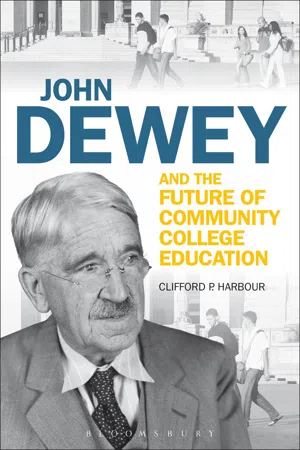
In John Dewey and the Future of Community College Education, Cliff Harbour argues that before these questions can be answered, community colleges must articulate the values and priorities that will guide them in the future. Harbour proposes that leaders across the institution come together and adopt a new democracy-based normative vision grounded in the writings of John Dewey, which would call upon colleges to do much more than improve completion rates and expand educational opportunity. It would look beyond the national economic measures that dominate higher education policy debates today and would prioritize individual student growth and the development of democratic communities. Harbour argues that this, in turn, would help community colleges contribute to the vital work of reconstructing American democracy.
John Dewey and the Future of Community College Education is essential reading for all community college advocates interested in taking a more active role in developing the community college of the future.
- 240 pages
- English
- ePUB (mobile friendly)
- Available on iOS & Android
eBook - ePub
John Dewey and the Future of Community College Education
About this book
Information
PART ONE
The context
1
The contemporary community college
Introduction
Community colleges are a major force in American higher education and the numbers bear this out. In 2013, there were 1,132 community colleges operating in the United States and 986 of these were public, state-funded institutions (AACC, Community College Fact Sheet, 2014). Another 31 colleges were Native American tribal colleges and the remaining 115 were private nonprofit or independent institutions. Community colleges are located in every state in the nation. They operate in the commonwealths of Puerto Rico and the Northern Marina Islands and also in the territories of Guam and American Samoa. California, the largest state in the nation, as measured by population, currently has 114 community colleges in its state community college system. Rhode Island, the smallest state in the union as measured by area, has one community college, with five campuses. Within almost every state, community colleges serve urban, suburban, and rural areas and, accordingly, they vary considerably by size and service area.
In this chapter, I describe contemporary community colleges in general terms. I describe their internal organization and their student population. I also discuss the institution’s mission and describe the general parameters for funding these colleges. After completing this introduction, I sharpen our focus on the Completion Agenda and its significance for community colleges in particular. Finally, I outline the conventional history of the community college. This history, like many family histories, overstates the positive and understates the negative. Putting this conventional history on the table, however, will help highlight the importance of other developments which I turn to in Chapters 4, 5, 6, and 7.
The community college—organization and culture
Public community colleges are typically governed by a board of trustees. In some states, board members are elected. In others they are appointed, often by the governor. The board hires the college president and this person is responsible for leading the institution and managing the delivery of all instructional programs and services. The president is also responsible for hiring, developing, promoting, and firing the college’s administrators, faculty, and staff. Community college presidents usually hold a terminal degree (usually the Doctor of Education, Ed.D.) and they lead a team of senior administrators who have responsibility for different divisions in the college. Typically, a senior administrator, or vice president, is responsible for one of the following major areas at the college: instructional services (credit programs in the university transfer and occupational program areas), adult and continuing education (noncredit programs in adult and community service areas), student development (admissions, registration, student records, financial aid, and counseling), and administrative services (the business office, human resources, and facilities).
Full-time community college faculty usually have a 5–5 teaching load. This means that they teach 5 three-credit courses each semester. The traditional faculty contract, which covers an academic year, requires full-time teaching for both the fall and spring semesters. This teaching load is usually much heavier than that assigned to full-time faculty at other colleges and universities. At most of these institutions, faculty typically teach 3–2, 2–2, or even 2–1. A substantial majority of the faculty employed by 4-year colleges and universities hold a terminal degree (usually the doctor of philosophy degree, Ph.D.). Most faculty employed by a community college hold a master’s degree (master of arts or master of science, M.A. or M.S.) although some only have a bachelor’s degree (bachelor of arts or bachelor of science, B.A. or B.S.). Others, especially those teaching in the occupational program areas, sometimes only hold a sub-baccalaureate degree.
Another important difference between community college faculty and faculty teaching at a 4-year college or university is that community college faculty do not have a research and scholarship assignment. Most permanent faculty working at these other institutions must carry out research and scholarship and then publish their findings, although these responsibilities vary greatly from one institution to the next. Still, even a minimal responsibility for research and scholarship usually provides a professor with a greater degree of autonomy in his work. This is because the selection of research and scholarship projects is left to the professor. Community college instructors do not have this responsibility and therefore they also enjoy slightly less independence in their work.
An important consequence of these differences is that the academic culture at a community college tends to be quite different from that found at other colleges and universities. Although there are always exceptions, generally speaking, the culture at a community college tends to focus more intensely on teaching and learning. As a result, the community college campus culture tends to be somewhat less concerned with discipline or field identity. That is, community college faculty will identify as a historian or nurse or accountant. But, they usually identify more strongly with their institution, the community college. Faculty at 4-year colleges and universities, on the other hand, tend to think otherwise. That is, because they conduct at least some research and scholarship in their discipline or field, they usually identify more strongly with their discipline or field than with their institution. This difference in campus culture is one reason why community college instructors tend to be more responsive to institutional change. Their primary loyalty is to the college and not their discipline or field.
The community college student population
There are four important considerations to note when examining college student enrollments and the community college student population. First, student enrollments at community colleges have increased significantly during the last 30 years (1979–2009). But they have remained a relatively constant share of the total undergraduate student population (public and private) (Knapp et al. 2011; Snyder and Dillow 2011). In 1979, the nation’s total undergraduate enrollment was just under 10 million and 41 percent of this population or 4 million were community college students. In 2009, American community colleges enrolled about 7.2 million students in credit courses or about 40 percent of the total undergraduate student population, which was 17.7 million. These figures show that although community college enrollments increased significantly from 1979 to 2009 (by approximately 45 percent), the institution’s share of the total undergraduate population has remained relatively stable.
Second, when considering the national community college student population, other details become significant (Knapp et al. 2011; Snyder and Dillow 2011). In 2009, community colleges enrolled 48 percent of the nation’s African American undergraduate population and 58 percent of the Hispanic undergraduate population. Community colleges also enrolled 44 percent of the Asian/Pacific Islander student population and 50 percent of the Native American undergraduate population. Also, 46 percent of community college students receive some form of financial aid (federal, state, or institutional). These figures only confirm what many community college faculty and staff already know. That is, nationwide, community colleges enroll a disproportionate and higher share of minority students and students from low-income families when compared to 4-year colleges and universities.
Third, the enrollment of community college students—as part of the overall undergraduate population—varies significantly from state to state (Horn and Radwin 2012). So, for example, in states like Florida, North Dakota, South Dakota, and West Virginia, community colleges enroll less than 20 percent of the state’s undergraduates. But, in states like California, Mississippi, New Mexico, and Wyoming, community colleges enroll more than 50 percent of the state’s undergraduate student population. The reasons for these differences vary from state to state and they are usually the consequence of institutional and state history.
Fourth, student enrollment patterns are changing across higher education and this is also the case at community colleges. For instance, in the 1960s and 1970s, the dominant transfer pattern was one-way, that is, from the community college to the university or 4-year college. But there are an increasing number of post-baccalaureate reverse transfers (PBRTs) enrolling at community colleges. PBRTs are students with B.A. or B.S. degrees pursuing further study at a community college. Other enrollment patterns becoming more prevalent today are swirling and double-dipping (De los Santos and Sutton 2012; McCormick 2003). Swirling is the term used to describe students moving back and forth between two or more institutions to acquire courses needed for a degree. Double-dipping is how we refer to students enrolled concurrently at two or more institutions. These new enrollment patterns are posing serious challenges for all higher education institutions. When students enroll at two or more institutions while completing their college degree, no single institution has the ability to guide a student to completion. And, carrying this point forward, no single institution can be fairly credited or blamed for a student’s success or failure.
What is noteworthy about these four considerations is this. Even though student enrollment patterns are unique in every state and at every campus, when viewed from a national perspective, community college student enrollments are increasing at a steady clip. And, these institutions continue to serve a disproportionate share of students from underrepresented minority and low-income populations. However, because student enrollment patterns are more varied than they were in the past, community colleges have less influence and control over their students. If state funding and federal financial aid programs become conditioned by student completion rates, this will pose serious challenges to all institutions, but especially community colleges, given the students they serve.
The community college mission
The traditional community college mission has three components and each is grounded in a philosophy of expanding educational opportunity (Cohen and Brawer 2008). The first is a commitment to open access. This commitment is reflected in the community college’s “open door” admissions policy, its relatively low tuition, and the convenient delivery of courses and programs. Under the open door admissions policy, students are admitted to the college if they graduated from high school or passed the GED exam. Admission is not conditioned on a student’s receiving a “minimum score” on standardized college tests (e.g., SAT or ACT). Nor do students need to produce a record of good high school grades. However, even when students have graduated from high school or passed the GED exam, they are usually required to take a placement test that assesses their ability in reading, writing, and mathematics. Students who cannot perform at college level on the placement test are usually required to refresh their skills or build them (if they were never acquired in high school) with developmental courses. The open door admissions policy ensures that any adult with the capacity to learn will be admitted to the college. But, then, if necessary, the student will be assigned to an educational program or curriculum to help develop the skills needed before beginning college level work.
Another dimension of open access is delivery of instructional programs and services at relatively low cost. At community colleges, the tuition and fees charged are typically less than those charged by public colleges and universities. And community college tuition and fees are much less than that charged by almost all private institutions (non profit and for-profit). For example, in 2011, the average published tuition and fees for full-time undergraduate students attending private non-profit institutions was $28,500. Similarly, the tuition and fees for full time, in-state undergraduate students attending a public university was $8,244. The tuition and fees for full time, in-state students enrolled at a community college was $2,963 (Baum and Ma 2011).
Finally, the commitment to open access is also exhibited through development of a course schedule that accommodates the needs of working adults. Typically, community colleges offer many programs on day and evening schedules. Similarly, community colleges demonstrate their commitment to access when they establish branch campuses and outreach centers so students can attend classes without traveling great distances. The relatively quick adoption of online learning at community colleges has been due in large measure to the institution’s interest in providing greater access to students.
The second component of the community college mission is the commitment to deliver a “comprehensive” curriculum. When community college leaders say they are delivering a comprehensive curriculum, they usually mean their college offers three kinds of educational programs. First, they enroll students in 2-year associate in arts (A.A.) and associate in science (A.S.) degree programs. Students enrolled in these programs complete college level, credit-bearing courses and then transfer to a 4-year college or university where these transfer courses are used to satisfy the requirements of a bachelor’s degree. Second, community colleges offer college-level, 1 and 2-year vocational programs. Students completing coursework for a 1-year program are awarded a certificate. Students completing a 2-year vocational program receive the associate in applied science (A.A.S.) degree. Community colleges award these credentials in a wide range of vocational areas, including architectural drafting, business administration, network administration, criminal justice, electronic engineering technology, nursing, respiratory technology, landscape technology, paralegal studies, and real estate sales. Students completing certificates and A.A.S. programs are expected to transition directly into the workforce with only limited on-the-job training. Third, community colleges offer a wide range of noncredit programs where students take (a) precollege, noncredit developmental courses in reading, writing, and mathematics to prepare for college level work, (b) noncredit adult education courses to acquire basic literacy skills (e.g., English as a Second Language), (c) short-term self-enrichment courses (e.g., photography, painting, and gardening), or (d) customized short-term training courses which are often marketed to employers.
The third component of the traditional mission is a commitment to serve the educational needs of the community where the college is located. This means that even though all community colleges offer a wide range of instructional programs, they tailor these to meet the educational needs of the communities they serve. Additionally, these institutions serve their communities by working closely with public schools, employers, the Chamber of Commerce, nearby higher education institutions, and nonprofit community groups (e.g., United Way).
As I mentioned earlier, the mission, or at least parts of it, are inscribed in state legislation that guides the operation of community colleges. However, local community college governing boards often adopt “missions statements” that incorporate the legislation and then provide a more detailed account of the institution’s purpose. Mission statements are often prominently displayed on institutional websites, college catalogs, and other documents. The community college mission serves as a directive to the institution and its employees.
At this point, it is important to further clarify the difference between the institutional mission and an institution’s normative vision. There are two important differences. First, as previously mentioned, in public higher education, authorities outside and above the institution set the institutional mission. An institution’s mission can be debated and even challenged by the members of the organization. But, at the end of the day, the mission is established by the state legislature and governing authorities. A normative vision, on the other hand, is a matter of debate whether this occurs in formal or informal settings. It articulates the values and priorities that people in the college are asked to embrace. Second, an institution’s mission helps distinguish it from other organizations. In the case of community colleges, the mission helps distinguish these institutions from 4-year colleges and universities. But the purpose of a normative vision is not to distinguish an institution from other related organizations. The purpose is to articulate the values and priorities that will guide the college.
At many community colleges, the institutional mission has become the de facto normative vision. That is, the values and priorities that guide faculty and staff coincide with the directi...
Table of contents
- Cover-Page
- Half-Title
- Series
- Title
- Contents
- Preface
- Introduction
- PART ONE The context
- PART TWO The evolution of the community college
- PART THREE Dewey on education, democracy, and community
- Bibliography
- Index
- Copyright
Trusted by 375,005 students
Access to over 1.5 million titles for a fair monthly price.
Study more efficiently using our study tools.
Frequently asked questions
Yes, you can cancel anytime from the Subscription tab in your account settings on the Perlego website. Your subscription will stay active until the end of your current billing period. Learn how to cancel your subscription
No, books cannot be downloaded as external files, such as PDFs, for use outside of Perlego. However, you can download books within the Perlego app for offline reading on mobile or tablet. Learn how to download books offline
Perlego offers two plans: Essential and Complete
- Essential is ideal for learners and professionals who enjoy exploring a wide range of subjects. Access the Essential Library with 800,000+ trusted titles and best-sellers across business, personal growth, and the humanities. Includes unlimited reading time and Standard Read Aloud voice.
- Complete: Perfect for advanced learners and researchers needing full, unrestricted access. Unlock 1.5M+ books across hundreds of subjects, including academic and specialized titles. The Complete Plan also includes advanced features like Premium Read Aloud and Research Assistant.
We are an online textbook subscription service, where you can get access to an entire online library for less than the price of a single book per month. With over 1.5 million books across 990+ topics, we’ve got you covered! Learn about our mission
Look out for the read-aloud symbol on your next book to see if you can listen to it. The read-aloud tool reads text aloud for you, highlighting the text as it is being read. You can pause it, speed it up and slow it down. Learn more about Read Aloud
Yes! You can use the Perlego app on both iOS and Android devices to read anytime, anywhere — even offline. Perfect for commutes or when you’re on the go.
Please note we cannot support devices running on iOS 13 and Android 7 or earlier. Learn more about using the app
Please note we cannot support devices running on iOS 13 and Android 7 or earlier. Learn more about using the app
Yes, you can access John Dewey and the Future of Community College Education by Clifford P. Harbour in PDF and/or ePUB format, as well as other popular books in Education & Adult Education. We have over 1.5 million books available in our catalogue for you to explore.