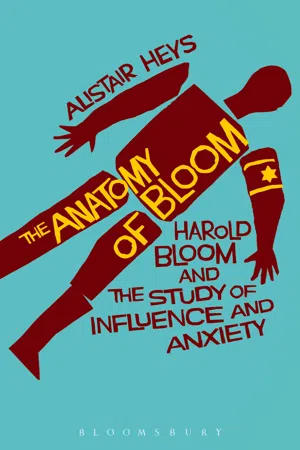
Here at last is a comprehensive introduction to the career of America's leading intellectual. The Anatomy of Bloom surveys Harold Bloom's life as a literary critic, exploring all of his books in chronological order, to reveal that his work, and especially his classic The Anxiety of Influence, is best understood as an expression of reprobate American Protestantism and yet haunted by a Jewish fascination with the Holocaust.
Heys traces Bloom's intellectual development from his formative years spent as a poor second-generation immigrant in the Bronx to his later eminence as an international literary phenomenon. He argues that, as the quintessential living embodiment of the American dream, Bloom's career-path deconstructs the very foundations of American Protestantism.
- 292 pages
- English
- ePUB (mobile friendly)
- Available on iOS & Android
eBook - ePub
About this book
Information
1
The Scene of Instruction
Erich Auerbach once told Hartman a story of a violinist forced to leave Germany and wishing to take up his profession in America: “Alas, his violin no longer emitted the same ‘tone’ in the new country.”1 My task in this section is not only to detect the timbre of the “violin” that Bloom plays upon, but also to distinguish it from the writings of genealogically related critics in the Yale string section. The starting point is hence Bloom’s championing of the Protestant poetry of the Romantics in the teeth of fierce opposition from the New Critics, or the School of Eliot. The critical followers of Eliot preferred Metaphysical poetry (for instance, Donne’s image of the well-wrought urn) to what the Romanticist M. H. Abrams identified as an expressive kind of displaced Protestant individualism and its lighthouses. Bloom names his precursor proper as Frye; therefore, it is necessary to briefly measure the amplitude of his influence on Bloom and then proceed to an extrapolation of the Scene of Instruction. I shall argue that the Scene of Instruction opposes a form of deconstruction to holistic urns, and that Bloom’s phraseology owes something to Derrida’s Scene of Writing, or, as John Ellis writes, it is “impossible for Derrida and his followers to see themselves as other than, first and foremost, iconoclasts.”2 Yale Deconstruction has to be seen as somewhat Jewish in orientation, not least because Bloom, Hartman, and Derrida were all Jewish, but also because, as Miller suggests, deconstruction resembles the Hebraic temple/labyrinth binary. In this respect, I cannot avoid recapitulating the scandal caused by the revelation that de Man had written collaborationist newspaper articles during the war, including the unsettling anti-Semitic piece, “Les Juifs dans la littérature actuelle.” In cautious mitigation, I argue that de Manian deconstruction was anti-totalitarian and that his autobiography of critical works remains ironically undecidable as a maze of seashells. My deliberation on Yale deconstruction is followed by an analysis of Bloom’s ill-starred relationship with what he christens the School of Resentment. The latter phrase seems a nebulous name for what, in The Western Canon, Bloom describes as a motley collection of theorists: “surrounded by professors of hip-hop; by clones of Gallic-Germanic theory; by ideologues of gender and of various sexual persuasions; by multiculturalists unlimited, I realize that the Balkanization of literary studies is irreversible.”3 Balkanization is here a metaphor for the dense tangled forest of modern literary studies; thus, the ending of my narrative meditates upon the thorny question of what is worthy of study and what is not and therefore the topic of the secular canon that displaced the religious canons of Christian and Jewish Scripture that in turn replaced the Jewish Temple.4
Bloom’s definition of the canon is Jewish and his method of judgment as to what is canonical would seem agonistic; he collates these two ideas under the umbrella term “western revisionism”: “the deep split between the fact that its religion and its morality are Hebraic-Christian, and its cognition and aesthetics—and therefore its dominant imaginative forms—are Greek.”5 In Literary Revisionism and the Burden of Modernity, Jean-Pierre Mileur provides a lucid discussion of the teleology of Bloom’s Judeo-Christian definition of tradition. My argument differs from his interest in tracing the genealogy of the modernist critical sensibility in the respect that I am more concerned with the extent to which Bloom escapes the tentacles of historical over-determination. Granted that this concern means examining just how religious Bloom’s literary criticism is, Mileur’s interests and mine pleasingly overlap: “the demon haunting the enlightened mind is religion as a response to the secular mind’s own archaic demons, demons which can no longer be acknowledged as such because they are aspects of an outmoded religious sensibility.”6 In terms of Bloom’s critical oeuvre, Anglo-Catholic mimesis is subjected to iconoclasm (thought of as a consequence of the Second Commandment) and which Protestant process leads to the internalization of consciousness, although Bloom finds esoteric Jewish models to figure this phenomenon. In Kabbalah and Criticism, Bloom revises his already well-developed assault upon the New Critics into a manifesto that reductively lists risible Anglo-Catholic reading habits:
1. There is the religious illusion, that a poem possesses or creates a real presence.
2. There is organic illusion, that a poem possesses or creates a kind of unity.
3. There is the rhetorical illusion, that a poem possesses or creates a definite form.
4. There is the metaphysical illusion, that a poem possesses or creates meaning.7
In actual fact, Bloom’s attack on the New Critical desire to find formalistic or organic unity in poems implicitly targets Coleridge’s interpretation of Shakespeare as an explicit nature deeper than consciousness, which quasi-religious insight affirms the absolute in the sphere of art: “By likening the work of art to a living organism, Coleridge does justice to the impression the work may give us, but he ‘does not express the process by which that work was produced’.”8 The result is wholeness not in vision or conception but in an inner feeling of totality and absolute being, the illusionary holistic wisdom of which Bloom urges should be held “against the formalist criticism that continued in Coleridge’s absolute spirit,” and we might add because it breaks the affective fallacy.9 Bloom’s agon with Coleridge (and his theories of organic unity, as mediated through I. A. Richards and his reception by T. S. Eliot, John Crowe Ransom, W. K. Wimsatt, Allen Tate, Robert Penn Warren et al.) is ultimately an attack on German Romanticism. In particular, Bloom references the New-Critical dogma that the meaning of an object was to be found only in the critical object itself; he links mimetic criticism that was dependent upon readerly accuracy, or as Coleridge puts it, the different throughout a base radically the same, to the thing-in-itself.10 There is an organic loop to Coleridge’s contemplative criticism, “the very powers which in men reflect and contemplate, are in their essence the same as those powers which in nature produce the objects contemplated,” and a religious dimension, since these powers were named by the Pythagoreans and Anaxagoras “the Nous (the Logos or the Word of Philo and St. John).”11 Coleridge thought that poetry had a logic of its own that he exemplifies with specific reference to the great men of English letters: “It would be scarcely more difficult to push a stone out from the pyramids with the bare hand than to alter a word, or the position of a word, in Milton or Shakespeare.”12 It should be remembered that in Judaic theology one describes the process of building, not the Temple itself; therefore, Bloom deconstructs in a Jewish fashion the Coleridgean idiom of practical criticism from the position of the Second Commandment.
De Man compliments Bloom on “debunking the humanistic view of literary influence as the productive integration of individual talent within tradition,” and yet without tradition art is not possible, or as Ernst Robert Curtius argues, “tradition is a vast passing away and renewal.”13 Thus, it is important to examine the closeness of Eliot’s “Tradition and the Individual Talent” to Bloom’s belated thought and, in particular, “We dwell with satisfaction upon the poet’s difference from . . . his immediate predecessors.”14 The concomitant observation has a touch of Bloom about it: “the most individual parts of his work may be those in which the dead poets, his ancestors, assert their immortality most vigorously.”15 The main influence on Eliot’s famous adage I adduce to be Shakespeare, who is said to be above his age and therefore impersonal as concerns the characters that populate his literary creations: “the more perfect the artist, the more completely separate in him will be the man who suffers and the mind which creates.”16 Life was real as toothache to the bard. His catalyzing conceptual faculties that created so many characters appear as pure unreactive platinum to the gentlemanly Eliot. Eliot writes of the metaphysical unity of soul and unreactively scorns any supposed sense of sublimity, but Bloom’s theories attack organic unity and are Longinian. Bloom conceives of poets as wrestling with the centrality of Shakespearean influence, while Eliot idealizes the Tudor Rose. Eliot praises an escape from personality, Bloom, the clash of titanic personalities, the triumph of the self. Monuments of unageing intellect form an “ideal order” for Eliot, which Platonism Bloom dismisses as statist, since Nietzschean poets fight for freedom, as Eliot himself points out, anxiety is the handmaiden of creativity.17 Eliot is often the whipping boy of Bloomian aesthetics because, not content with directing his fiercest criticisms at Blake and Shelley, he denied the influence of Whitman and Tennyson: “Notoriously, he asserted that his precursors were Dante and Baudelaire. . . . But that is the usual poetic spiel: the central forerunners of The Waste Land are Whitman’s ‘When Lilacs Last in the Dooryard Bloom’d’ and Tennyson’s ‘Maud: A Monodrama’.”18 Eliot was advised by Ezra Pound to remove “phantasmal gnomes” from The Waste land because said angels of earth were a throwback to Romantic thought, but Bloom’s criticism contains gnomic wisdom; he complains that Eliot was the Anglo-Catholic vicar of Neo-Christianity and “there remains his anti-Semitism, which is very winning, if you happen to be an anti-Semite, if not, not.”19 Despite repudiating Hamlet as an aesthetic failure and yet being haunted by it, Eliot advises that works of literature should be “measured by each other,” and this insight is entirely consonant with Bloom’s comparative Judaic definition of the word “canon” as a measuring rod.20
Frye, the Protestant preacher, was more to Bloom’s taste than Anglican-convert Eliot: “his blend of Protestant Dissent and Platonism is securely allied to what remains strongest in our poetic tradition.”21 Thus, Bloom has nostalgias aplenty for the age of Frye: “Frye . . . charmed me by calling Eliot’s critical vision the Great Western Butterslide, in which a large blob of Christian, Classical, and Royalist butter melted down and congealed at last into The Waste Land.”22 But Bloom confesses “that his Methodist Platonism was very different from my Jewish Gnosticism” and relates how he fell in love with Fearful Symmetry absorbing Frye’s anatomy “in ways I no longer can apprehend.”23 He notes that Frye disliked the idea of the anxiety of influence: “His Myth of Concern saw literature as a benignly cooperative enterprise, Frye blinded himself to the agonistic element in Western tradition that has been chronicled from Longinus through Burckhardt and Nietzsche down to the present.”24 Bloom gives as an example that “Frye . . . saw Blake as attempting to ‘correct’ Milton . . . which is to repeat Blake’s idealistic self-deception.”25 Bloom thinks Frye irenic, and his own temperament bellicose; Anatomy of Criticism finds archetypes in common, whereas The Anxiety of Influence discovers concealed agons. Bloom talks of Frye’s archetypes as symmetries; in his review of The Visionary Company, Robert Preyer notices that the reader’s attention is directed to “a tissue of correspondences, analogies, analogues.”26 In The Visionary Company, Bloom borrows what Frye called the Orc Cycle and used it as an archetype with which to link all the canonical Romantic poets. At this point in his career, Bloom is still close to the archetypal criticism of his precursor as described in Anatomy of Criticism where Frye writes, “we could get a whole liberal education by picking up one conventional poem, Lycidas for example, and following its archetypes through literature.”27 Because all the microcosms of literary works cohere in the encompassing macrocosm as individual manifestations of the total order of words, Frye’s Christian Platonism is quite manifest: “Anagogically, then, the symbol is a monad, all symbols being united in a single infinite and eternal verbal symbol which is, as dianoia, the Logos.”28 Frye locates the central archetype of Lycidas as that of Orpheus and then catalogues the Orphic with the Christian myth since “the study of archetypes is the study of literary symbols as parts of a whole.”29 Bloom recalls that Frye apprehended him as a “Judaizer of Blake” and that he read Fearful Symmetry, until it became “part of me,” which nicely captures the indebtedness of Bloom, as well as his revisionary swerve away from the Protestantism of his precursor.30
Bloom states that Frye’s precursors were Milton and Blake; the uneasy dialectic of father and son makes for a pithy start when attempting to define the Orc Cycle. Frye writes that Blakean desire ...
Table of contents
- Cover-Page
- Half-Title
- Dedication
- Title
- Contents
- Acknowledgments
- Preface
- Introduction: Bloom’s Gnosis
- 1 The Scene of Instruction
- 2 Bloom and Derrida
- 3 Bloom and De Man
- 4 Bloom and New Historicism
- 5 Bloom and Judaism
- 6 Bloom and Protestantism
- Notes
- Index
- Copyright
Trusted by 375,005 students
Access to over 1.5 million titles for a fair monthly price.
Study more efficiently using our study tools.
Frequently asked questions
Yes, you can cancel anytime from the Subscription tab in your account settings on the Perlego website. Your subscription will stay active until the end of your current billing period. Learn how to cancel your subscription
No, books cannot be downloaded as external files, such as PDFs, for use outside of Perlego. However, you can download books within the Perlego app for offline reading on mobile or tablet. Learn how to download books offline
Perlego offers two plans: Essential and Complete
- Essential is ideal for learners and professionals who enjoy exploring a wide range of subjects. Access the Essential Library with 800,000+ trusted titles and best-sellers across business, personal growth, and the humanities. Includes unlimited reading time and Standard Read Aloud voice.
- Complete: Perfect for advanced learners and researchers needing full, unrestricted access. Unlock 1.5M+ books across hundreds of subjects, including academic and specialized titles. The Complete Plan also includes advanced features like Premium Read Aloud and Research Assistant.
We are an online textbook subscription service, where you can get access to an entire online library for less than the price of a single book per month. With over 1.5 million books across 990+ topics, we’ve got you covered! Learn about our mission
Look out for the read-aloud symbol on your next book to see if you can listen to it. The read-aloud tool reads text aloud for you, highlighting the text as it is being read. You can pause it, speed it up and slow it down. Learn more about Read Aloud
Yes! You can use the Perlego app on both iOS and Android devices to read anytime, anywhere — even offline. Perfect for commutes or when you’re on the go.
Please note we cannot support devices running on iOS 13 and Android 7 or earlier. Learn more about using the app
Please note we cannot support devices running on iOS 13 and Android 7 or earlier. Learn more about using the app
Yes, you can access The Anatomy of Bloom by Alistair Heys in PDF and/or ePUB format, as well as other popular books in Literature & North American Literary Criticism. We have over 1.5 million books available in our catalogue for you to explore.