eBook - ePub
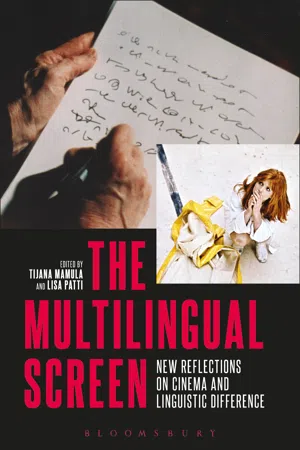
The Multilingual Screen
New Reflections on Cinema and Linguistic Difference
- 392 pages
- English
- ePUB (mobile friendly)
- Available on iOS & Android
eBook - ePub
The Multilingual Screen
New Reflections on Cinema and Linguistic Difference
About this book
The Multilingual Screen is the first edited volume to offer a wide-ranging exploration of the place of multilingualism in cinema, investigating the ways in which linguistic difference and exchange have shaped, and continue to shape, the medium's history. Moving across a vast array of geographical, historical, and theoretical contexts-from Japanese colonial filmmaking to the French New Wave to contemporary artists' moving image-the essays collected here address the aesthetic, political, and industrial significance of multilingualism in film production and reception. In grouping these works together, The Multilingual Screen discerns and emphasizes the areas of study most crucial to forging a renewed understanding of the relationship between cinema and language diversity. In particular, it reassesses the methodologies and frameworks that have influenced the study of filmic multilingualism to propose that its force is also, and perhaps counterintuitively, a silent one. While most studies of the subject have explored linguistic difference as a largely audible phenomenon-manifested through polyglot dialogues, or through the translation of monolingual dialogues for international audiences-The Multilingual Screen traces some of its unheard histories, contributing to a new field of inquiry based on an attentiveness to multilingualism's work beyond the soundtrack.
Information
Part I
Theories
1
Translating the Academe: Conceptualizing the Transnational in Film and Media
Masha Salazkina
This chapter seeks to position the turn toward a foregrounding of translation practices in film and media studies that has emerged in the last decade as a way to illuminate the broader intellectual and epistemological stakes of doing transnational research. Beyond its literal meaning, the emphasis on translation draws attention to the transcultural nature of the epistemological processes inherent in the constitution of our film and media objects of study, therefore requiring better frameworks for understanding both the circulatory networks that serve to comprise these objects, and a conceptualization of cultural and linguistic translation as such. The relation of translation to circulation is not that of form to content; rather, I argue that they can best be seen as standing in a compensatory and interdependent relationship, and that attention to the notion of translation can most productively address the phenomena of the circulatory systems of media in the age of neoliberal globalism and in our scholarly practices. Despite their division, both frameworks, circulation and translation, address the radical changes in reality pointed to by transnational cultural theory, which, in turn, puts in question the continued existence, even, of rigid disciplinary boundaries and common institutional practices. I propose the concept of contact zones in relation to knowledge production as a useful hermeneutic for understanding the intersection between the conceptual frameworks of circulatory networks and translation processes, each of which is equally important.
First, I begin by situating this proposition of translation as a key orienting paradigm for transnational scholarship by considering how the current historical conditions of our academic institutions are insufficiently responding to the proliferation of multilingual and geographically heterogeneous objects of study (throughout the chapter, I primarily refer to the universities in North America—although I believe that this critique extends equally to Europe and the United Kingdom).1 While these developments demand corresponding theoretical and practical apparatuses to accommodate them, an increasing corporate-globalizing logic in the universities in practice often cuts off opportunities for their development.
It is evident to everyone in academia today that the terms transnational and interdisciplinary have acquired a certain amount of political and cultural cachet. They appear in job descriptions, calls for journal articles and manuscripts, funding agency guidelines and international policy papers related to social sciences and the humanities fields, from history and sociology to political science, and are particularly prominent in the newer academic fields such as security, peace and conflict resolution, to, indeed, cultural and film and media studies. Such indications of institutionalization make many in the academy suspicious of the very project of making academic knowledge production less bound to specific geographic entities and disciplines. Many justifiably fear that such a move simply masks the downsizing of the university and the gradual loss of academic autonomy by individual departments (whether disciplinary or area-based) and ideologically justifies developments resulting from greater corporatization of the universities rather than any academically or intellectually driven agenda. The image of a university with one department of Transnational Cultural Studies begins to seem less and less unlikely as we watch the merger of Language and Literature programs under Modern Languages, and of Film Studies, Media Theory, Comparative Literature and Cultural Studies under one administrative umbrella. Administratively reducing humanist inquiry in the university, these developments also minimize new hires and limit the decision-making autonomy of the faculty, especially in the long term, allowing for a more flexible academic labor force—and therefore, efficient from a corporate point of view—and a greater say for administration in dictating the areas in which hires can be made.
However serious this threat may be, using it as a critique of the transnational turn in scholarship and greater interdisciplinarity has the effect of throwing the baby out with the bath water. While it is plainly necessary to debate how to best understand and practice transnationalism in our scholarship, the dangers of embracing the “wrong kind” of transnationalism are currently far surpassed by the institutional barriers that shape and determine the very conditions of possibility for such research and practice. And while in film and media studies we have come a long way in the process of eliminating the old geopolitical assumptions of the discipline that gave the Euro-American perspective an imperial centrality, we still have a long way to go.2
One of the ways we might adjust the persistently Anglo-centric response to multilingual and interdisciplinary scholarship is with the replacement of the liberal humanist notion of the universal—to which the scholar’s truth aspired—by the migratory, which itself demands a stronger emphasis on translation, both as a scholarly practice and as a conceptual paradigm within our field. Given this set of historical determinations, transnational scholarship finds itself in need of new conceptual categories, which would not only map out networks and their infrastructures, but also help explain the dynamics of movement across the various borders and the forms of both cognition and collaboration that such movement entails.
The notion of a contact zone was originally developed by Mary Louise Pratt in her book Imperial Eyes: Travel and Transculturation, in which she defines it as
… the space of colonial encounters, the space in which peoples geographically and historically separated come into contact with each other and establish ongoing relations, usually involving conditions of coercion, radical inequality, and intractable conflict… .
By using the term “contact” I aim to foreground the interactive, improvisational dimensions of colonial encounter so easily ignored by diffusionist accounts of conquest and domination. A “contact” perspective emphasizes how subjects are constituted in and by their relations to each other. [It stresses] copresence, interaction, interlocking understanding and practices, often within radically asymmetrical relations of power.3
Pratt’s notion has been used widely to discuss different kinds of transcultural encounters shaped by the logic of (post)colonial and global circulation.4 Appropriately, however, it was originally introduced by Pratt in the context of a professional presentation at the Modern Language Association as early as 1991, in her discussion of literacy and language learning in the academy.5 In the last twenty-five years, the idea of contact zones has been influential in a variety of disciplines, from geography to anthropology, as well as literary and cultural studies. It therefore seems only apt to apply this notion to academic practices and spaces at large—where translation takes place shaped by institutional power relations. While I return to the discussion of academia as a contact zone in the conclusion of this chapter, I now turn to examine the way that translation studies has productively entered the field of film and media scholarship.
The translational turn in film and media studies
The actual practices of translation—whether literary, linguistic or transmedial—have recently begun to receive scholarly attention in film and media studies. More importantly, we are beginning to see scholarship that focuses on translation and interpreting practices as constitutive of film production, exhibition and circulation, rather than separate processes that befall cinema after it has already been made. John Mowitt’s Re-takes: Postcoloniality and Foreign Film Languages in 2005 became one of the first major concentrated efforts to bring postcolonial debates into the realm of the language practices specific to the cinematic apparatus, and in 2007, Abé Mark Nornes’ landmark study Cinema Babel: Translating Global Cinema inaugurated a new direction in the discipline, inspiring and supporting a wealth of new research.6 The focus of this work ranges from oral commentaries providing, among other things, cultural and ideological translations of images of the screen (a practice that was common throughout silent film exhibition, but has continued well into the sound era, especially at festival sites and in various forms of nontheatrical exhibition world-wide) to the variety of approaches to dubbing and subtitling of films in both official and informal circulation, to the importance of the translations of film theory and criticism for the development of film cultures world-wide.
In what is both a critical summary of such approaches and its most conceptually developed and concise example, Nataša Ďurovičová, in her co-edited volume World Cinemas, Transnational Perspectives (2009), proposes a new account of film history placing the process of translation at its center.7 She uses the term translatio, which she chooses for its rich imperial legacy (referring to the notion of the transfer of political rule and knowledge), to underscore the myth of ideological neutrality that adheres to translation, as it connotes, in the broad tradition, semantic equivalence and transparency of communication. Ďurovičová’s translatio instead emphasizes the necessarily uneven power structure involved in the transfer. It also serves to demarcate the difference between the empirical practice and the symbolic operation entailed—so, translatio in Ďurovičová’s work refers specifically to a methodology that would provide scholars with “the social and political ground rules for text transfer from one to another set of cultural circumstances, attentive to the non-identity and asymmetry in which it is inevitably implicated.” What is at stake here, as Ďurovičová makes clear, is a conceptual tool that would enable a better understanding of the geopolitical and institutional power relations that constitute cinematic practice:
The aim of redefining the pervasive and inescapable work of cinematic translation as a field of translatio is to draw attention to the politics of these uneven flows of exchange, and further, to argue that translation should be studied as an integral layer of spatial figuration superimposed onto and hovering over both the cinematic institution and the representational field of the screen in which specific emergent transnational formations then can become apparent.8
This shift to a broader understanding of translation necessitates a more varied set of methodologies—no longer limited to textual analysis, or bound by a single historical context of the transactions. This requires a “film history in which the pervasive linguistic displacement and the accompanying media transposition foreground mainstream narrative films in its non-identical form, attending to their circulation, transport or transfer rather than only to their ideal textual form.”9
Translation here is broadened to include a set of practices—industrial, discursive, artistic, labor and social/communal—which both enable and disrupt the social, cultural, and political hierarchies and relations of power through their heterogeneity. Translatio is, in essence, kidnapped, wrenched away from its old imperial function and turned into a new critical tool to approach this apparatus. It is a metaphorically guerilla action, and lends a certain insurgent connotation to its practice. Building on Nornes’ and Ďurovičová’s formulation of tra...
Table of contents
- Cover
- Title
- Contents
- Acknowledgments
- Introduction
- Part I Theories
- 1 Translating the Academe: Conceptualizing the Transnational in Film and Media
- 2 Seven Types of Multilingualism: Or, Wim Wenders Enfilms Pina Bausch
- 3 Post-anthropocentric Multilingualism in Contemporary Artists’ Moving Image: An Interview with T.J. Demos
- 4 Cinephilia as Multilingualism in The Artist (2011) and Blancanieves (2012)
- Part II Aesthetics
- 5 The Gift of Languages: Notes on Multilingualism in Experimental Cinema
- 6 Exile and the “Languages” of Color: 1960s European Cinema, Multilingualism and Ontological Hesitation
- 7 “The Word in Pasolini’s Cinema”
- 8 West African Francophone Cinema and the Mysteries of Language: From Ideological Struggle to Aesthetic Shudder
- Part III Histories
- 9 Language in Motion: The Sign Talk Films of Hugh Lenox Scott and Richard Sanderville
- 10 Poorly Timed Campaigns: Versions, Dubbing, Subtitles
- 11 The Multilingual New Wave
- 12 Language and National Identity in New Tunisian Cinema: Moufida Tlatli’s The Silences of the Palace (1994) and Férid Boughedir’s A Summer in La Goulette (1996)
- 13 Cinema of Reindividuation and Cultural Extraterritoriality: “Chinese” Dialect Cinemas and Regional Politics
- Part IV Politics
- 14 Empire, Language, and Nationhood: Japanese Colonial Cinema in Korea and Manchuria
- 15 Star Talk: Anna May Wong’s Scriptural Orientalism and Poly-phonic (Dis-)play
- 16 Out of Many, One: The Dual Monolingualism of Contemporary Flemish Cinema
- 17 Multilingualism and Indigenous Cinema in Northeast India: The Case of Kokborok Language Films
- 18 Programming Latin American Cinema in the United States: An Interview with Carlos A. Gutiérrez
- Contributors
- Index of Names and Titles
- Copyright
Trusted by 375,005 students
Access to over 1.5 million titles for a fair monthly price.
Study more efficiently using our study tools.
Frequently asked questions
Yes, you can cancel anytime from the Subscription tab in your account settings on the Perlego website. Your subscription will stay active until the end of your current billing period. Learn how to cancel your subscription
No, books cannot be downloaded as external files, such as PDFs, for use outside of Perlego. However, you can download books within the Perlego app for offline reading on mobile or tablet. Learn how to download books offline
Perlego offers two plans: Essential and Complete
- Essential is ideal for learners and professionals who enjoy exploring a wide range of subjects. Access the Essential Library with 800,000+ trusted titles and best-sellers across business, personal growth, and the humanities. Includes unlimited reading time and Standard Read Aloud voice.
- Complete: Perfect for advanced learners and researchers needing full, unrestricted access. Unlock 1.5M+ books across hundreds of subjects, including academic and specialized titles. The Complete Plan also includes advanced features like Premium Read Aloud and Research Assistant.
We are an online textbook subscription service, where you can get access to an entire online library for less than the price of a single book per month. With over 1.5 million books across 990+ topics, we’ve got you covered! Learn about our mission
Look out for the read-aloud symbol on your next book to see if you can listen to it. The read-aloud tool reads text aloud for you, highlighting the text as it is being read. You can pause it, speed it up and slow it down. Learn more about Read Aloud
Yes! You can use the Perlego app on both iOS and Android devices to read anytime, anywhere — even offline. Perfect for commutes or when you’re on the go.
Please note we cannot support devices running on iOS 13 and Android 7 or earlier. Learn more about using the app
Please note we cannot support devices running on iOS 13 and Android 7 or earlier. Learn more about using the app
Yes, you can access The Multilingual Screen by Tijana Mamula, Lisa Patti, Tijana Mamula,Lisa Patti in PDF and/or ePUB format, as well as other popular books in Media & Performing Arts & Film History & Criticism. We have over 1.5 million books available in our catalogue for you to explore.