eBook - ePub
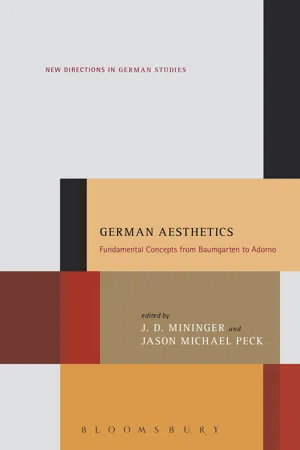
German Aesthetics
Fundamental Concepts from Baumgarten to Adorno
- 240 pages
- English
- ePUB (mobile friendly)
- Available on iOS & Android
eBook - ePub
German Aesthetics
Fundamental Concepts from Baumgarten to Adorno
About this book
German Aesthetics provides English-speaking audiences with accessible explanations of fundamental concepts from the German tradition of philosophical aesthetics. Organized with the understanding that aesthetic concepts are often highly contested intellectual territory, and that the usage and meanings of terms often shift within historical, cultural, and political debates, this volume brings together scholars of German literature, philosophy, film studies, musicology, and history to provide informative and creative interpretations of German aesthetics that will be useful to students and scholars alike.
Information
OneImagination
The ascent of both “imagination” and “imaginary” as keywords in the eighteenth century comes simultaneously with a marked change in their meanings. By the early nineteenth century, “imagination” had become the central term of a theory of subjectivity with far-reaching aesthetic, psychological, and anthropological ramifications. Samuel Taylor Coleridge, for example, regards genius as the effect of a “synthetic and magical power, to which we have exclusively appropriated the name of imagination.”1 It is the imagination, Coleridge contends, that “brings the whole soul of man into activity, with the subordination of its faculties into each other, according to their relative worth of dignity.”2 Such remarks assume the imagination to be a precondition for the psychological and ethical completion of a person; for the “spirit of unity, that blends, and (as it were) fuses, each into each,”3 is a characteristic both of an artwork and of a subject that experiences itself as unified.
It is no coincidence that authors adhering to the “modern” concept of a creative imagination simultaneously advance a theory of subjectivity that stresses its constructed nature. Again Coleridge states that the subject “becomes a subject by the act of constructing itself objectively to itself; but which never is an object except for itself, and only so far as by the very same act it becomes a subject.”4 He insists that the subject is always already split and that only because of this split can it construct “itself objectively to itself.” In other words, a subject can constitute itself as an individual only on the basis of a mirror relationship. This relationship of reflection that the subject establishes to itself as an object is a visual one. Thus it follows also that modern notions of subjectivity often make use of visual terms such as eye, mirror, and image, which again land us back in the domain of the imagination, for which these terms are likewise central. The above propositions raise a significant question: what is the relationship between the modern conception of subjectivity as visual and that of the imagination?
Until the concept of imagination or fancy was valorized in the eighteenth century, it had often been excluded from what “really” constituted humanity, because of its supposed corporeal, as opposed to spiritual or intellectual, nature. Indeed, the imagination was not only compromised by its relegation to the body, but condemned as the antithesis of the spirit; it was held responsible for bodily deformations and formlessness in general. Not only was the imagination as a corporeal phenomenon morally suspect, but also its equivalences, images.
The historically overdetermined complex of related terms like body, eye, image, imagination, sensuality, and earth has been investigated predominantly in connection with Christianity’s well-known animosity to the image. As a material object, the image is not adequate to represent God. Consequently, Christians are admonished, as by Lactantius around 300, “not to adore images because they are made of earth.”5 A half-century later, the religious pedagogue Ambrose ascribes a pernicious influence to the imagination, because if “deceived by the imagination, [the soul] turns to matter, and is glued to the body,”6 whereas the perfect soul despises all that is corporeal: “the imagination, opposed to truth, is a matter of our weakness.”7 Gianfrancesco Pico della Mirandola yields to the pressure of this tradition when, in his Liber de imaginatione [On the Imagination] of 1500, the first study devoted entirely to the imagination, he feels compelled to vehemently repudiate his subject matter:
He who strives to dominate phantasy persists in that dignity in which he was created and placed, and by which he is continually urged to direct the eye of the mind towards God, Father of all blessings … . But he who obeys the dictates of the perverted sense and deceitful imagination, at once loses his dignity, and degenerates to the brute.8
These citations may serve as representative for a two thousand-year tradition in which the imagination was not only deemed morally degenerate due to its ontological distance from the origin or center of being, but held responsible for human deviations like malformations, tumors, monstrosities.
However, by the end of the eighteenth century, the imagination is recuperated through an aesthetic discourse that constructs the imagination as the seat of the creative act, or, as Friedrich Schiller writes to Christian Gottfried Körner in a letter dated February 28, 1793: “Language places everything before the understanding, and the poet brings everything before the imagination. Poetry wants intuitions, language only gives [it] concepts.”9 The creative power of the imagination depends, as much as the understanding, on its power of distance. However, whereas the understanding proceeds conceptually, the imagination proceeds intuitively (anschaulich). The imagination is no longer a power that can recall “ideas” through mental images, rather it now creates images out of itself. Reflection now bears in imagining a totality. In assessing the transformation the imagination goes through in the late eighteenth century, what becomes apparent for thinkers such as Kant, Fichte, Hegel, and the early Romantics is that the imagination does not merely behold, it also reflects on the relationship of the distance between the subject and (aesthetic) object.
In this new conceptualization of the imagination, Immanuel Kant forms a middle-point between the prohibition of the imagination exhibited by the earlier, predominantly Christian writers and the new aesthetic discourse that develops around the positive qualities of the imagination. The contrast between the older and newer pathologies of the imagination lies in the underlying difference that Kant, in the context of a discussion regarding the poetic imagination, defines as the difference between imaginatio affinitas and imaginatio plastica. In his polemic against the imaginatio affinitas, Kant describes it as “the sensory productive faculty of affinity based on the shared lineage of ideas from each other.”10 Kant uses a comparison which, in the interest of disciplining it, illuminates the history of the imagination’s meaning(s):
In social conversation people sometimes leap from one subject to another, quite different one, following an empirical association of ideas ...This desultoriness is a kind of nonsense in terms of form, which disrupts and destroys a conversation. Only when one subject has been exhausted and a short pause follows can we properly launch another subject, if it is interesting. A lawless, vagrant imagination so disconcerts the mind by a succession of ideas having no objective connection that we leave a gathering of this kind wondering whether we have been dreaming.11
Crucially, in this passage Kant discusses this denunciatory example regarding social conversation in a chapter concerning the power of poetizing, i.e. the “poetic imagination.” Like so many other aesthetic theorists of the eighteenth century, Kant tends to detect in the poetic imagination a desire for work which comes from a vaguely perceived similarity under signs and things (or between a work of art and its mimetic reality) and possibly endangered by the bourgeois project of logic.
In the Critique of Pure Reason, Kant defines the imagination somewhat traditionally, as: “the power of presenting an object in intuition even without the object’s being present.”12 He expands this definition, which had been in use since antiquity, through the concept of the productive imagination:
Now, all our intuition is sensible; and hence the imagination, because of the subjective condition under which alone it can give to the concepts of understanding a corresponding intuition, belongs to sensibility. Yet the synthesis of the imagination is an exercise of spontaneity, which is determinative, rather than merely determinable, as is sense; hence this synthesis can a priori determine sense in terms of its form in accordance with the unity of apperception.13
Kant understands the opposition between reproductive and productive imagination as an opposition between imaginatio affinitas and imaginatio plastica and underscores this distinction as a cultural-political one.
The concept of the productive imagination is developed to a greater degree in the Critique of Judgment. In this work, Kant understands the imagination “not taken as reproductive, where it is subject to the laws of association, but as productive and spontaneous [....]”(§22).14 The most significant transcendental function of the producti...
Table of contents
- New Directions in German Studies
- Volumes in the series:
- Dedication
- Title
- Contents
- Acknowledgments
- Introduction J. D. Mininger and Jason Michael Peck
- 1 Imagination Jochen Schulte-Sasse
- 2 Judgment Vivasvan Soni
- 3 Beauty Paul Guyer
- 4 Sublime David Martyn
- 5 Mimesis Christian Sieg
- 6 Feeling: On Werther Stanley Corngold
- 7 Irony Michel Chaouli
- 8 Listening Mirko M. Hall
- 9 Ethics Jason Michael Peck
- 10 Absolute Music Sanna Pederson
- 11 The End of Art Eva Geulen
- 12 Allegory J. D. Mininger
- 13 Value A. Kiarina Kordela
- 14 God is Dead Silke-Maria Weineck
- 15 Tragedy/Trauerspiel Ian Balfour
- 16 Saying/Showing Fabian Goppelsröder
- 17 Nothingness Kenneth Haynes
- 18 Messianism Peter Fenves
- 19 Mediation/Medium James A. Steintrager and Rey Chow
- 20 Truth Kai Hammermeister
- 21 Uncanny Thomas Pepper
- 22 Mood/Attunement Darío González
- 23 Film Johannes von Moltke
- 24 Montage/Collage Patrizia McBride
- 25 Normality Jürgen Link
- 26 Ugly Richard Leppert
- 27 Shudder Karyn Ball
- 28 Committed Art Andrew Lyndon Knighton
- Bibliography
- Notes on Contributors
- Index
- Copyright
Trusted by 375,005 students
Access to over 1.5 million titles for a fair monthly price.
Study more efficiently using our study tools.
Frequently asked questions
Yes, you can cancel anytime from the Subscription tab in your account settings on the Perlego website. Your subscription will stay active until the end of your current billing period. Learn how to cancel your subscription
No, books cannot be downloaded as external files, such as PDFs, for use outside of Perlego. However, you can download books within the Perlego app for offline reading on mobile or tablet. Learn how to download books offline
Perlego offers two plans: Essential and Complete
- Essential is ideal for learners and professionals who enjoy exploring a wide range of subjects. Access the Essential Library with 800,000+ trusted titles and best-sellers across business, personal growth, and the humanities. Includes unlimited reading time and Standard Read Aloud voice.
- Complete: Perfect for advanced learners and researchers needing full, unrestricted access. Unlock 1.5M+ books across hundreds of subjects, including academic and specialized titles. The Complete Plan also includes advanced features like Premium Read Aloud and Research Assistant.
We are an online textbook subscription service, where you can get access to an entire online library for less than the price of a single book per month. With over 1.5 million books across 990+ topics, we’ve got you covered! Learn about our mission
Look out for the read-aloud symbol on your next book to see if you can listen to it. The read-aloud tool reads text aloud for you, highlighting the text as it is being read. You can pause it, speed it up and slow it down. Learn more about Read Aloud
Yes! You can use the Perlego app on both iOS and Android devices to read anytime, anywhere — even offline. Perfect for commutes or when you’re on the go.
Please note we cannot support devices running on iOS 13 and Android 7 or earlier. Learn more about using the app
Please note we cannot support devices running on iOS 13 and Android 7 or earlier. Learn more about using the app
Yes, you can access German Aesthetics by J. D. Mininger, Jason Michael Peck, J. D. Mininger,Jason Michael Peck in PDF and/or ePUB format, as well as other popular books in Literatura & Crítica literaria alemana. We have over 1.5 million books available in our catalogue for you to explore.