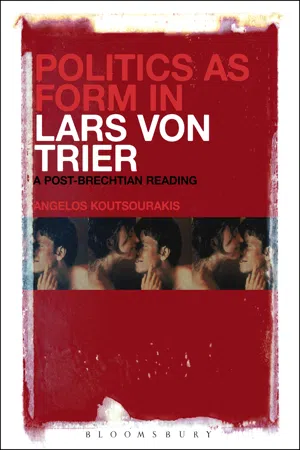
- 264 pages
- English
- ePUB (mobile friendly)
- Available on iOS & Android
eBook - ePub
About this book
This is the first study that employs a materialist framework to discuss the political implications of form in the films of Lars von Trier. Focusing mainly on early films, Politics as Form in Lars von Trier identifies recurring formal elements in von Trier's oeuvre and discusses the formal complexity of his films under the rubric of the post-Brechtian. Through an in depth formal analysis, the book shows that Brecht is more important to von Trier's work than most critics acknowledge and deems von Trier a dialectical filmmaker. This study draws on many untranslated resources and features interviews with Lars von Trier and his mentor, the great Danish director Jørgen Leth.
Information
1
From Brechtian to Post-Brechtian Cinema:
Lars von Trier and the Post-Brechtian
Lars von Trier and the Post-Brechtian
Brecht on the film medium
Exam Question: | What in your opinion has Brecht to offer to a person who wants to make a movie? |
Fassbinder: | The Verfremdungseffekt, which in movies can be applied in a variety of ways. |
In an interview with Peter Schepelern for the Danish magazine EKKO, von Trier outlined his understanding of political cinema arguing that an object can be understood as political given that one analyzes its subject from multiple viewpoints. As he said, “Hvis det er politisk, så er det jo for mig analyserende. Både psykologisk analyserende, men også politisk analyserende. Det er at stille spørgsmål til både den ene og den anden holdning og meget gerne forsvare de holdninger, jeg ikke selv har” (If a film is political, then it is analytical. Analytical both on the psychological and on the political level. It is a matter of questioning a position and its conflicting one and I am very happy to defend a position that goes against my own one) (cited in Schepelern 2005a). In the same interview, von Trier explained that part of the politics of his films is that he shows things in an extreme way and lets the audience deal with them. “Dér kan man godt tale om Verfremdung, fordi jeg hiver historien så langt ud, at alle kan se, hvad den er bygget af” (This is my Verfremdungseffekt, because I pull the story so far that everyone can see what is made of) (Schepelern 2005a). These comments are heuristic to understanding von Trier’s post-Brechtian aesthetic. Yet, in accounting for the question “what is post-Brechtian cinema” and how can we position von Trier in the post-Brechtian, one needs to go back to Brecht’s own film essays, to shed some light on the very term “Brechtian,” which is at times used inadvertently by film scholars.
One of the reasons lies in the fact that Brecht’s reception on the part of the 1970s film theory did not focus considerably on his film fragments, but mainly on his theater theory. Brecht’s film writings are concerned with finding ways of politicizing the medium by means of formal experimentation, as well as by criticizing cinema as an institution. Certain aspects of his cinematic writings, such as the representation of the individual, the aesthetics of interruptibility, the loose dramaturgy, and his dissatisfaction with the commodification of cinema, are crucial to our understanding of a post-Brechtian cinema, which employs formal experimentation and proceeds to criticize the institution of cinema. The politicization of form aims at liberating thinking out of a motionless understanding of social reality and presenting crises and contradictions, but unlike Brechtian orthodoxy it does not offer clear-cut suggestions on how to overcome the impasse. Put simply, questions are valorized over answers so as to provide an excess of negativity, which intends to make the audience productive.
Brecht as a modernist was fascinated by the film medium and its potential to offer representations of reality that could encourage critical reflection on the part of the audience. One of the aspects of the medium that he considered to be revolutionary was its ability to do away with character psychology and show the individual as representative of his or her social role. Influenced by Marx’s theoretical antihumanism, Brecht saw the individual as the product of the historical and social circumstances as opposed to the bourgeois concept of “human essence.” According to Marx, a theory of subjectivity cannot allow for a scientific investigation of human relationships and lapses into an abstract humanism. But such an abstract humanism fails to see the individual as a historical emergent and as a producer of history (Marx and Engels 1970, 47).
One of the aims of Brecht’s Verfremdungseffekt is to demonstrate the individual’s dependence on processes that defy his or her self-determination. For Brecht, cinema could show the individual as historically defined in a more effective way than the theatrical and literary dramaturgy. As he explains, in contrast to bourgeois drama’s and novel’s psychologically driven characters, cinema presents socially motivated type characters. Consequently, the audience cannot dissociate the portrayed characters from their historical and social positions:
For the theatre for instance, the cinema’s treatment of the person performing the action is interesting. To give life to the persons, who are introduced purely according to their functions, the cinema uses available types who encounter specific situations and assume in them particular attitudes. All motivation from within the character is excluded; the person’s inner life never provides the principal cause of action and seldom its principal result; the person is seen from the outside. (2001, 164)
From these comments, one can see that Brecht draws his conclusions from early cinema’s experiments, which treated characters as types motivated by their social functions and not by psychology. Equally important is to acknowledge Brecht’s interest in the Russian avant-garde and in particular in Eisenstein’s cinema. Martin Walsh suggests that Brecht’s meeting with the Russian director in Berlin in 1929 was crucial for the formulation of his film and theater theory too (1981, 16). Indeed, Eisenstein’s paradigm partially fits into Brecht’s perception of the cinema as a medium that does away with psychological motivation. Eisenstein’s concept of the dialectical conflict created by the juxtaposition between seemingly unrelated materials and his prioritization of actions and historical events that surpass the characters might be the type of cinema that Brecht had in mind.
Early cinema’s portrayal of type characters was also influential in Brecht’s valorization of a gestic acting as opposed to a dramatic one. For Brecht, the social Gestus can offer simplification, through an exposition of attitudes that minimize psychological traits. Gestus assists in the depiction of the individual as the product of forces and laws that cannot be discerned in the phenomenology of human relations. According to Brecht, a gestic acting is concerned with showing an action (“Gestus des Zeigens”), that is, quoting it rather than imitating it. This acting activates the audience’s critical faculties and allows them to reflect on the characters’ attitudes. Of paramount importance in Brecht’s favoring of a gestic acting was Charlie Chaplin’s depiction of characters in his films. As Wolfgang Gersch explains, Brecht saw in Chaplin a tendency to isolate generalized rather than individual patterns of behavior. “Auf diese Weise war es Brecht möglich, Simplizität zu konstatieren, die er als Prinzip der Filmdramaturgie verallgemeinerte” (It was thus possible for Brecht to establish simplicity, which he describes as a generalized principle of film dramaturgy) (1975, 42).
Brecht considered Chaplin as an actor who did away with past dramatic traditions based upon the imitation of feelings. His acting placed emphasis on the very process of creating a character. By shifting the emphasis from the act of imitation to that of showing the act of showing, Chaplin presented characters who were motivated by their social roles and conditions. In effect, Chaplin’s acting corresponded with Brecht’s Marxist conviction that the individual is changeable and not fixed. In the same manner that Chaplin’s acting demonstrated the process of creating a character and his or her actions, Brecht thought of film as a medium that had the potential to represent dramatic actions and include the very process of copying them. Thus, film could turn into a nonempathetic medium given that the focus would be on actions over characters’ psychology. “In fact the film demands external action and not introspective psychology …. For the cinema the principles of non-Aristotelian drama (a type of drama not depending on empathy, mimesis) are immediately acceptable” (2001, 171).
This quotation reveals Brecht’s utopian view of the medium and his belief that certain formal principles can lead to the production of radical effects. By valorizing actions—and it is important to note that Brecht implies social actions rather than dramatic plot as an end in itself—over psychological interpretations of characters, cinema could become a means of teaching historical awareness. The prerequisite for this effect is that the medium adopt an external point of view that de-individuates the narrative and focuses on the social processes and their changeability. By implication, Brecht aspired to make the act of representation more complex so as to encourage responses on the part of the audience. In encouraging the audience to reflect on the filmic material, Brecht thought that the viewers would be able to see the historicity of human relationships and the very falsity of their “naturalization” on the part of the bourgeois society.
Brecht’s understanding of cinema as a medium that could analyze social relations aimed at stimulating the audience’s capacity for action in the social sphere. One important document that offers some practical examples of his predilection for external actions at the expense of conventional character-based dramaturgy is the film Kuhle Wampe, or Who Owns the World? [Kuhle Wampe, Oder: Wem Gehört Die Welt? (Bertolt Brecht, Slatan Dudow, Ernst Ottwald:1932)]. Kuhle Wampe tells the story of a German working-class family in Berlin and raises questions regarding the rise of unemployment in Germany during the 1930s. The film consists of four independent parts that are interrupted by musical compositions accompanied by images of factories and council houses. It is an object immensely influenced by Eisenstein’s intellectual montage and, as Marc Silberman observes, the montage sequences in the film interrupt the narrative with material that does not serve diegetic purposes. Story development is minimized in favor of a loose sequence of episodes that deconstruct dramatic actions. This deconstruction aims at linking dramatic actions with the social conditions of their construction (2009, 321).
As a result, characters are shown as representatives of their social roles and not as individuals with unchanged psychological traits. Emblematic of Brecht’s interest in identifying the social drive in the characters’ behavior is a scene portraying Franz’s suicide, the youngest member of the Bönike family. What precedes this incident is a family argument regarding the son’s inability to find work. Tired of the lack of prospects, the boy decides to end his life. The camera remains immobile focusing on the character, while the lack of extra-diegetic music heightens the grotesque atmosphere. A different frame follows and shows a banner hung in the kitchen wall saying, “Don’t blame the morning that brings hardship and work. It is wonderful to care for those one loves.” This banner juxtaposes a capitalist ethic into a working-class environment, with the purpose of demonstrating the oppressed’s complicity in their oppression. Later on, the boy approaches the window in a very “clinical” manner—as if it is part of an everyday routine—and takes off his watch. While preparing to jump from the window he is careful enough not to damage the family’s flowers.
The mechanical approach toward the portrayal of the suicide fails to establish empathy for the victim. The filmic treatment of the material draws upon Brecht’s concept of Gestus, which aimed at connecting an inner attitude with the outside social reality. In this scene the camera becomes “gestic” and as Silberman points out, “The camera here becomes the ideal instrument for looking from the outside” (1995, 43). To “look from the outside” stands for connecting the personal with the political via a method that does not portray suicide as a personal tragedy, but as a phenomenon that can be understood historically. This passage of the film summarizes some of the fundamental Brechtian tenets, such as the valorization of social forces over characters and the detached portrayal of dramatic actions, which intend to identify the social laws that regulate one’s actions.
As maintained by Brecht, certain formal choices make the cinematic medium more effective with regard to the minimization of character-based dramaturgy and produce a fragmented form that de-individuates actions and reveals their social/historical significance. Thus cinema’s political effectiveness lies in its ability to create a fragmentary diegetic pattern. This preference for an incomplete and episodic narrative served the purpose of preventing the audience from being carried away by the plot. This episodic form could freeze the actions and give the viewer time to ponder on the represented social relationships and the contradictions introduced by the narrative. His argument is reminiscent of his point in the “Notes to Mahagonny,” in which he explains that the episodic form of the epic theater expects the audience to stand outside and question the portrayed events instead of adopting an empathetic attitude. The following quotation clarifies Brecht’s perception of the cinema as a medium that benefits from an episodic/paratactic style.
Film obeys the same laws as static art. It is essentially static and must be treated as a series of tableaux. Its effect must arise from the clear interruptions, which would otherwise just be common errors. The tableaux must be so composed that they can be taken in at a single glance like a sheet of paper, but yet they must withstand separation into details so that every detail corresponds in the larger scheme with the centre. (2001, 7)
Underlying Brecht’s preference for arranging a film as a series of tableaux is his conviction that this visual style leads to a formal abstraction that renders the represented reality enigmatic. In this way, the audience’s critical faculties are aroused and the viewer is confronted with material that she or he has to either conform or dispute.
Brecht’s emphasis on an aesthetics of interruptibility by means of a succession of fragments/tableaux aims at confronting the viewers with images of reality, in which they are asked to recognize themselves and see, at the same time, reality as a construct (Silberman 2009, 321). The collection of different fragments brings together contradictions that are offered to the audience to be resolved. This attitude of detachment could make the audience doubt the images’ veracity and negate the stereotypical perception of representation as reproduction of a seemingly unified reality. Evidently, this argument draws upon the Marxist rejection of empiricism, according to which the outward appearance of social phenomena does not offer an understanding of their historical/social significance. Thus, Brecht distinguished between the reproductive and the productive use of the medium. The former paradigm is keen on reproducing the empirical reality, whereas the latter is more interested in showing that what appears as “real” is subject to transformation, because reality is socially constructed. As such, a productive use of the medium presupposed the presentation of a familiar reality in a way that it would appear strange and changeable.
The productive method is predicated upon a process of selecting fragments of reality and of showing, at the same time, this very process of assembling. In this way, the relationship between the profilmic material and its reproduction is made evident and the final cut does not appear as an uncritical portrayal of the empirical reality. The key principle of the constructive method is “montage,” a term Brecht employs in his theater writings too. Montage stresses representational discontinuity and serves the role of isolating moments that can reveal aspects of reality which are not necessarily visible. As Brecht says:
The film image is limited by its frame, everything which is inside of this frame takes on dimensions and a significance which is relative to this frame and does not exist outside of it. In other words, the frame limits and delimits a field which determines a number of geometric, architectonic and plastic relations which do not exist in reality. At least, by limiting certain relations which in reality are lost among an infinity of others since reality is not limited by a frame, it underlines them. (cited in Mueller 1987, 483)
In Brecht’s view, montage is a formal element that reinforces the productive over the reproductive use of the medium, a point which was very influential in the post-1968 film theory.
In many respects, this preference for the fragment indicates an interest in the process over the product. Montage operates as a means of interrupting the diegetic flow, in order to enact questions that go beyond the film’s dramaturgy. Of particular interest in Brecht’s theory is the connection between montage and his concept of the gestic acting, which has been acknowledged by Roswitha Mueller (1987, 477). Neither of the practices is content with the reduplication of reality; both are interested in the very process of interruption, with the view to preventing the audience from being absorbed by the story development. With this in mind, it is important to understand that for Brecht, what matters most is the productive interruption of the dramatic narrative and not montage in itself, as it was mistakenly understood by the 1970s film theory. I shall return to this in Chapter 3, where I discuss the ways von Trier employs a film practice that pushes forward Brecht’s concept of Gestus. The distancing effects are achieved by a film style that does not employ montage sequences, but long-takes that focus on the actors’ performances. The produced gestures create clashes between the diegetic and the metalevel and reveal unforeseen connections between the bodies.
Brecht’s writings on film are infused with enthusiasm over the new medium and its potential to create complex representations of reality. Yet Brecht is busy identifying “intrinsic properties” in film, without taking into account the fact that the medium is also subject to historical transformations. As a modernist, he was fascinated by the possibilities offered by technological development. However, his initial enthusias...
Table of contents
- Cover
- Half Title
- Title Page
- Contents
- Preface and acknowledgments
- Notes to the text
- Introduction: Looking back
- 1. From Brechtian to Post-Brechtian Cinema: Lars von Trier and the Post-Brechtian
- 2. Historical Fragments in the Europa Trilogy
- 3. The Primacy of the Apparatus
- 4. Dogville and Manderlay: Experimentation and Dialectical Negations
- Epilogue: Dialogue with the “Dissensual” Past
- Appendix
- Manifestoes
- Bibliography
- Index
- Imprint
Trusted by 375,005 students
Access to over 1.5 million titles for a fair monthly price.
Study more efficiently using our study tools.
Frequently asked questions
Yes, you can cancel anytime from the Subscription tab in your account settings on the Perlego website. Your subscription will stay active until the end of your current billing period. Learn how to cancel your subscription
No, books cannot be downloaded as external files, such as PDFs, for use outside of Perlego. However, you can download books within the Perlego app for offline reading on mobile or tablet. Learn how to download books offline
Perlego offers two plans: Essential and Complete
- Essential is ideal for learners and professionals who enjoy exploring a wide range of subjects. Access the Essential Library with 800,000+ trusted titles and best-sellers across business, personal growth, and the humanities. Includes unlimited reading time and Standard Read Aloud voice.
- Complete: Perfect for advanced learners and researchers needing full, unrestricted access. Unlock 1.5M+ books across hundreds of subjects, including academic and specialized titles. The Complete Plan also includes advanced features like Premium Read Aloud and Research Assistant.
We are an online textbook subscription service, where you can get access to an entire online library for less than the price of a single book per month. With over 1.5 million books across 990+ topics, we’ve got you covered! Learn about our mission
Look out for the read-aloud symbol on your next book to see if you can listen to it. The read-aloud tool reads text aloud for you, highlighting the text as it is being read. You can pause it, speed it up and slow it down. Learn more about Read Aloud
Yes! You can use the Perlego app on both iOS and Android devices to read anytime, anywhere — even offline. Perfect for commutes or when you’re on the go.
Please note we cannot support devices running on iOS 13 and Android 7 or earlier. Learn more about using the app
Please note we cannot support devices running on iOS 13 and Android 7 or earlier. Learn more about using the app
Yes, you can access Politics as Form in Lars von Trier by Angelos Koutsourakis in PDF and/or ePUB format, as well as other popular books in Media & Performing Arts & Film Direction & Production. We have over 1.5 million books available in our catalogue for you to explore.