In African American fiction, Richard Wright was one of the most significant and influential authors of the twentieth century. Richard Wright in a Post-Racial Imaginary analyses Wright's work in relation to contemporary racial and social issues, bringing voices of established and emergent Wright scholars into dialogue with each other.
The essays in this volume show how Wright's best work asks central questions about national alienation as well as about international belonging and the trans-national gaze. Race is here assumed as a superimposed category, rather than a biological reality, in keeping with recent trends in African-American studies. Wright's fiction and almost all of his non-fiction lift beyond the mainstays of African-American culture to explore the potentialities and limits of black trans-nationalism. Wright's trans-native status, his perpetual "outsidedness" mixed with the "essential humanness" of his activist and literary efforts are at the core of the innovative approaches to his work included here.
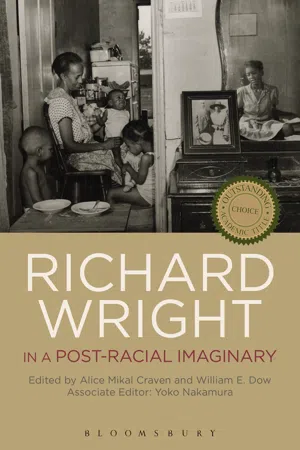
eBook - ePub
Richard Wright in a Post-Racial Imaginary
- 240 pages
- English
- ePUB (mobile friendly)
- Available on iOS & Android
eBook - ePub
Richard Wright in a Post-Racial Imaginary
About this book
Information
Part One
Wright as Global Intellectual and Racial Reformer
1
After Modernism: Richard Wright Interprets the Black Belt
University of Massachusetts, Amherst
When one attempts to come to grips with the work of Richard Wright through Native Son, it is crucial to remember that he was a Communist throughout this portion of his career. Of course, Wright’s engagement with the Communist Party of the United States of America (CPUSA) through the 1930s and into the early 1940s is well known and well documented—though, even now, following Wright’s own account in the portion of Black Boy originally published posthumously as American Hunger, the emphasis is often on Wright’s conflicts with national and local Chicago and New York CPUSA leaders and policies. No doubt such conflicts were real even if they did not always follow the chronology set out by Wright in his narrative. However, while nearly all the significant black poets, playwrights, and fiction writers of the 1930s and early 1940s (with the notable exception of Zora Neale Hurston) had some close connection with the Communist Left, Wright was one of the very few to publicly advertise his membership in the CPUSA (and regularly attend CPUSA branch or club meetings) during that era.
In part, Wright’s public association with the CPUSA and its cultural sphere was practical, providing him with venues for literary apprenticeship, intellectual development, publication, audience, publicity, networks of distribution, contacts in “mainstream” publishing, and so on. The ideological positions of the CPUSA and the Comintern on the “National Question” and the subsidiary “Negro Question” and the Communist commitment to “Negro Liberation,” particularly in the 1930s, also attracted Wright. However, it was not necessary for Wright to join the CPUSA and publicly declare his membership in order to gain the practical benefits or ideological inspiration of association with the CPUSA. Again, relatively few black artists and intellectuals made such a declaration during the 1930s and 1940s. To this day, we are not entirely sure if such artists as Langston Hughes, Sterling Brown, Paul Robeson, Countee Cullen, Robert Hayden, and Gwendolyn Bennett ever formally joined the CPUSA despite their association with the Communist Left—and in some cases, such as that of Brown, there is evidence they did not despite their Left sympathies. Others who did join, such as Margaret Walker and Frank Marshall Davis, kept their membership (though not their affiliation with the Left generally) quiet so that it is only in the relatively recent past that confirmation of their membership was discovered.
Wright, despite his recorded reluctance to spend the bulk of his writing skills and time on the writing of leaflets and pamphlets, was someone who had a commitment to practical, organizational politics. Otherwise, why formally join and why attend branch meetings, even meetings of branches of the “Artists Section,” which were largely devoted to nuts-and-bolts political activity? He was, then, an artist whose work, to paraphrase Marx’s famous dictum, was designed to help people understand the world, specifically the world of African Americans during the Great Depression, with the purpose of changing it.
The problem for Wright, then, was how to render the emotional, psychological, spiritual, material, and cultural reality of African Americans whose history in North America was peculiar from the rise of the peculiar institution of slavery to the triumph of Jim Crow segregation to the racialization of urban space, particularly the creation of the black ghetto (which was a comparatively recent phenomenon as Wright began his literary career). On what resources does one draw to make the journey from the Black Belt of the South to the Black Belt of the South Side vivid in a way that allows people to see avenues of group solidarity (as opposed to individual sympathy) while recognizing the special conditions of African American life in the United States? How do such pressing issues for the Left as the rise of fascism resonate or reconcile with the concerns, cultures, and psychologies of Black Belts North and South, urban and rural?
If one takes the suspicion or even rejection of universalisms of various sorts to be a hallmark of postmodernism, then Wright was certainly no postmodernist in the early portion of his career. He had a fascination with various sorts of universalist, one might say totalizing, ways of understanding, representing, and ultimately transforming reality. However, Wright also recognized the limitations of these approaches, including Marxism, for representing reality convincingly to people in the United States in ways that would potentially motivate large numbers of Americans to change the world. As a result, in creating what Lawrence P. Jackson calls his “Chicago realism,” Wright drew on a wide range of resources from an equally wide spectrum of disciplines, movements, genres, and media, including sociology, modernist poetry and fiction, naturalist fiction and drama, Gothic literature, proletarian literature (particularly the work of his fellow Chicagoan James Farrell), romantic literature edging into protoexistentialism (and later a more direct engagement with existentialism), popular culture (especially the horror film with its link to the Gothic tradition), and, of course, Marxism (particularly the variant associated with the Comintern and the CPUSA).
Modernity (like modernism) is, of course, an extraordinarily elastic term. After all, Stephen Greenblatt has recently traced what he calls a “swerve” toward modernity to Poggio Bracciolini’s discovery of a manuscript of Lucretius’s De rerum natura in 1417. However, if we understand US modernity to turn on the rise of the United States as the world’s premiere industrial power and an increasingly important international political force in the late nineteenth and early twentieth centuries, then the advent of the legal and extralegal system of Jim Crow segregation followed by the racialization of urban space in a more and more urbanized society are fundamental constitutive elements of this modernity. As such scholars as Michael North, Geoffrey Jacques, David Chinitz, Aldon Nielsen, and Ann Douglas have shown, the rise of Jim Crow and the racialized geography of the US city did much to shape literary modernism in the United States with its complicated parasitical but often adversarial relationship to modernity in the first three decades of the twentieth century.
In that sense, Wright, particularly in his early novels Lawd Today! (finished in the mid-1930s, but not published until 1963) and Native Son (published in 1940), can be seen as writing after modernism, if not postmodern in the usual usage of what can also be a very elastic term. While an endpoint for modernism is much debated, by the 1930s, Wright had access to and a good sense of the spectrum of modernism, including English language modernists of various stripes and nationalities as well as Central and Eastern European modernists and protomodernists, many of whose works (like those of Franz Kafka and Nikolai Gogol) were only beginning to become widely accessible (or, in the case of Gogol, accessible again) in English during the 1930s.
The modernist protagonist that Wright inherits is a person who has fallen out of society, has no roots, and is a sort of luftmensch. He or she is alienated from his or her work; has no god, no traditional values; and is a city dweller (if often born in the country) lost in the impersonal and bewildering landscape of rationalized grids of buildings (as in Baudelaire’s Paris), bureaucracies, and authorities that are at one time impossibly distant and frighteningly (and inexplicably) present. Family ties, when present, instead of being a source of strength, are often chains or a deforming pressure (as was the case for Kafka’s Gregor Samsa). Very often such protagonists are intense consumers of popular culture in various forms and media, a culture that serves as school, comfort, and the medium of dreams and an emotional life (as with Fitzgerald’s Jay Gatsby who expresses his love for Daisy Buchanan through the display of shirts). Like Stephen Dedalus in James Joyce’s Ulysses, these figures generally are shown to have a history, but it is one they are desperately trying to forget and/or leave far behind, generally with only limited success as the repressed history returns in various forms.
Wright’s early protagonists, such as Jake Jackson in Lawd Today! and Bigger Thomas in Native Son, are often cast from this modernist mold. This connection is emphasized by the title of the final section of Lawd Today!, “Rats Alley,” taken from T. S. Eliot’s The Wasteland, which also provides an epigraph for the section. In Native Son, Bigger’s desires, fears, hungers, dreams, fantasy life, and plans of action are a compound of mass culture, of B-films, newsreels, pulp magazines, and dime novels, of The Gay Woman, Trader Horn, and true crime magazines. Bigger, though born in the South, has not the least emotional or intellectual investment in the culture, the spiritual life, or the social values of his mother, who is a true product of the rural South despite her migration to and residence in the South Side of Chicago. He is leader of a gang and has a girlfriend, Bessie Mears, who is similarly, if more passively, estranged from her Southern roots. But despite what might appear to be a considerable social network, he is alienated from Bessie, whom he eventually rapes and murders, and the members of his gang. While Bigger’s isolation and his saturation by mass culture products in most respects serve the purposes of social control by the ruling class, they also incite an insatiable hunger and an uncontrollable fear that result in the death of Mary Dalton, a child of the ruling elite (and the owners of the Thomas family’s kitchenette apartment) on the individual level and threaten social disorder on a larger scale, much like that of the ending of Nathanael West’s Day of the Locust—or the neo-modernist Invisible Man by Ralph Ellison, for that matter. And, as Brannon Costello points out, Jackson is much the same sort of multiply alienated black urbanist modernist subject adrift in a sea of mass culture with its fears, dreams, and hungers—though Costello draws too hard a line between the “typical” proletarian literature protagonist and Jackson, using Mike Gold as the familiar whipping boy of Communist orthodoxy.1 In fact, Wright’s work is much indebted to the writings of such proletarian writers as Farrell, Nelson Algren, William Attaway, John Fante, Jack Conroy, and, indeed, Gold himself in Jews without Money, which often feature “ethnic” protagonists lost in the city, cut off, or at least increasingly remote from older cultural roots and from an older generation whose “Old Country” or “Down Home” sensibilities and values have no real hold on them. One might add here that much of Wright’s attraction to such nineteenth-century Russian writers as Gogol and Dostoevsky is in no small part due to their treatments of the existential crises of peasant, middling estate functionaries, and small landowners (or their children) who migrate to the metropolis of Petersburg, the modern Russian city built on the unstable land of marshes on the Gulf of Finland by Peter the Great. Perhaps it might be more accurate to say that Wright and many of these “proletarian” writers, including Gold, do not so much object to modernism as such, but to what they perceive as those reactionary elements of modernism and neomodernism in, say, the work of T. S. Eliot or Vanderbilt’s Agrarians, which seem to promote some sort of atavistic dream of a return to an earlier organic society, whether the Old South or the Holy Roman Empire, often espousing a virulent racism, anti-Semitism, and sympathy with fascism in one form or another. Having said that, though, Wright’s protagonists, like Eliot’s Prufrock or the speaker(s) of The Wasteland or Jean Toomer’s Kabnis in Cane for that matter, hunger for some sort of rootedness, some sort of larger meaning or context however deformed that hunger might be by the limited and limiting lexicon of mass culture. That might even lead the black subject to imagine what might seem to us a counterintuitive vision of a black Hitler, as Bigger does in Native Son:
He liked to hear of how Japan was conquering China; of how Hitler was running the Jews to the ground; of how Mussolini was invading Spain. He was not concerned whether these acts were right or wrong; they simply appealed to him as possible avenues of escape. He felt that some day there would be a black man who would whip the black people into a tight band and together they would act and end fear and shame. He never thought of this in precise mental images; he felt it; he would feel it for a while and then forget. But hope was always waiting somewhere deep down in him.
(Early Works 551)
Such mass culture dreams, even or perhaps especially those of Hitler and Mussolini caught on newsreels, can, Lacan-style, never really satisfy, but lead to another act generated by hunger, desire, and fear, culminating in individual self-destruction or mass violence. Of course, African Americans are not the only ones imprisoned by such dreams. The screaming mob that calls for Bigger’s death in the third section of Native Son is caught in a mass culture dream of black male mo...
Table of contents
- Cover
- Title Page
- Copyright
- Contents
- Foreword Amritjit Singh
- Acknowledgments
- Introduction Alice Mikal Craven and William E. Dow
- Part 1 Wright as Global Intellectual and Racial Reformer
- Part 2 The Pursuit of Sovereignty in Wright’s Political and Artistic Odyssey
- Part 3 Wright’s Other Destinies: Gothicism and the Neo-Baroque
- Part 4 Richard Wright’s Sweet Airs: Experiments with Performance Genres
- Part 5 Transnational Shifts: Silence and Sentiment
- Contributors
- Index
- Copyright
Trusted by 375,005 students
Access to over 1.5 million titles for a fair monthly price.
Study more efficiently using our study tools.
Frequently asked questions
Yes, you can cancel anytime from the Subscription tab in your account settings on the Perlego website. Your subscription will stay active until the end of your current billing period. Learn how to cancel your subscription
No, books cannot be downloaded as external files, such as PDFs, for use outside of Perlego. However, you can download books within the Perlego app for offline reading on mobile or tablet. Learn how to download books offline
Perlego offers two plans: Essential and Complete
- Essential is ideal for learners and professionals who enjoy exploring a wide range of subjects. Access the Essential Library with 800,000+ trusted titles and best-sellers across business, personal growth, and the humanities. Includes unlimited reading time and Standard Read Aloud voice.
- Complete: Perfect for advanced learners and researchers needing full, unrestricted access. Unlock 1.5M+ books across hundreds of subjects, including academic and specialized titles. The Complete Plan also includes advanced features like Premium Read Aloud and Research Assistant.
We are an online textbook subscription service, where you can get access to an entire online library for less than the price of a single book per month. With over 1.5 million books across 990+ topics, we’ve got you covered! Learn about our mission
Look out for the read-aloud symbol on your next book to see if you can listen to it. The read-aloud tool reads text aloud for you, highlighting the text as it is being read. You can pause it, speed it up and slow it down. Learn more about Read Aloud
Yes! You can use the Perlego app on both iOS and Android devices to read anytime, anywhere — even offline. Perfect for commutes or when you’re on the go.
Please note we cannot support devices running on iOS 13 and Android 7 or earlier. Learn more about using the app
Please note we cannot support devices running on iOS 13 and Android 7 or earlier. Learn more about using the app
Yes, you can access Richard Wright in a Post-Racial Imaginary by William E. Dow,Alice Mikal Craven,Yoko Nakamura in PDF and/or ePUB format, as well as other popular books in Literature & Literary Criticism. We have over 1.5 million books available in our catalogue for you to explore.