- 328 pages
- English
- ePUB (mobile friendly)
- Available on iOS & Android
eBook - ePub
About this book
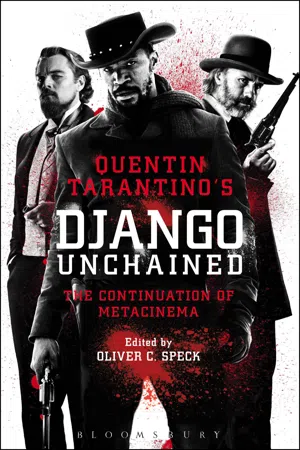
Django Unchained is certainly Quentin Tarantino's most commercially-successful film and is arguably also his most controversial. Fellow director Spike Lee has denounced the representation of race and slavery in the film, while many African American writers have defended the white auteur. The use of extremely graphic violence in the film, even by Tarantino's standards, at a time when gun control is being hotly debated, has sparked further controversy and has led to angry outbursts by the director himself. Moreover, Django Unchained has become a popular culture phenomenon, with t-shirts, highly contentious action figures, posters, and strong DVD/BluRay sales. The topic (slavery and revenge), the setting (a few years before the Civil War), the intentionally provocative generic roots (Spaghetti Western and Blaxploitation) and the many intertexts and references (to German and French culture) demand a thorough examination. Befitting such a complex film, the essays collected here represent a diverse group of scholars who examine Django Unchained from many perspectives.
Information
PART ONE
Cultural Roots and Intertexts: Germany, France, and the United States
1
Dr. “King” Schultz as Ideologue and Emblem: The German Enlightenment and the Legacy of the 1848 Revolutions in Django Unchained
Robert von Dassanowsky
Austrian actor Christoph Waltz embodied a negative take on Austria’s troubled postimperial identity and relationship with Nazism as the identity shifting SS officer Hans Landa in Tarantino’s Inglourious Basterds (2009). The director creates an intertextuality with that film through Waltz’s character in his Django Unchained (2012) in order to create a Tarantinian dialectic that moves between the German-speaking world and the United States in the nineteenth and twentieth centuries. Waltz’s Dr. “King” Schultz, a German immigrant dentist and thus a member of the emerging Biedermeier,1 bourgeois intelligentsia, recreates himself as an American bounty hunter. It is the removal of “bad teeth” on a social level, but also represents the ease of identity re-creation in the antebellum. While it is known that Tarantino creates extended backstories for his characters which are only suggested in their actions on screen, Django Unchained, while less populated and intricate than the narrative of Inglourious Basterds, represents a much more theoretically complex characterization by actor Christoph Waltz. This chapter will examine the possible ideology of Tarantino’s Dr. “King” Schultz and how the character’s actions reveal his past and represent the first part of the director’s allohistorical filmic exploration of the collisions of humanism and social Darwinism as they reverberate from post-Napoleonic Europe to pre–Civil War America, and eventually (back) to fascist Europe.
It has been speculated that Tarantino wanted to help “redeem the Germans a little after his last picture, Inglourious Basterds, depicted the brutal nature of the Holocaust.”2 Far more than just echoing Roberto Rossellini’s creation of Germania Anno Zero (1948) to show the plight of postwar Germany and balance out the negative images of the German occupation of Italy in Roma citta aperta (1945) and Paisan (1946), and because the central character of Inglourious Basterds is an Austrian not a German (and a focal part of the national identity clichés that rise and fall throughout the film), there is a more complex structure that binds Tarantino’s Bastards with Django beyond making up for the image of the “bad Germans.” The simplistic binary of good and evil Tarantino borrows from B-movies, exploitation films, and Hollywood propaganda film is, after all, his unique style.
Unlike the reaction to Inglourious Basterds which, beyond opinion and basic review, gave rise to informed and critical analysis of the film on blog sites, Django Unchained inspired little critical blogging beyond the opinion piece. U.S.-based blogs particularly suggested some anxiety, even irritation at Tarantino’s treatment of American history in the iconoclastic way he had looked at Europe. One of the more informed blogs that set up the intertext between the films through the development of racist ideology and the director’s questioning of the relationship between culture, control, and dehumanization was from Michael J. Anderson:
The incontrovertibly major Inglourious Basterds indeed provides a point of departure in almost every sense, beginning with its ontological status as an object of psychic historical revision: where Inglourious Basterds provides a fantastic, contingent counter-reality in which Jews and members of the cinematic colony bring about the destruction of the Third Reich, in an orgiastic final act explosion of extreme cartoon violence, Django Unchained gives agency to the victims of the Trans-Atlantic slave trade, whether it is the unshackled slaves in the opening set-piece, Django in his role as homicidal bounty-hunter, or the latter in his final, ruthless, John Woo-coded devastation of Candieland (which will include slavers and complicit whites and blacks alike). Django Unchained also responds to and revises Inglourious Basterds’ negative Germanic archetype, with former film Nazi Waltz recast as the “good guy.” At the same time, the World War II film’s heroic Americans are now cast as their villainous, slave-owning ancestors in what will prove the first of Django Unchained’s many provocations.3
Waltz’s King Schultz, the film’s enlightened and moral center, bears more than a passing resemblance in name and visage to Carl Schurtz (1829–1906), the young history student whose doctoral studies were interrupted by the 1848 Revolution in the German Confederation. Joining one of the many student movements that called for a democratic system, Schurtz fought in clashes with the Prussian army. After the failure of the 1848 revolts, he fled to Switzerland and then returned to the Confederation at the risk of death, to rescue a compatriot. He lived in France and England before coming to the United States, where he joined the Republican Party and was subsequently appointed Ambassador to Spain by President Lincoln. Having influenced Spain not to side with the Confederacy and returning to the United States at onset of the Civil War, he was made Union Brigadier General. After the war, he became the first German-born American to be elected to Senator. Schurtz was reform-minded and staunchly anti-imperialistic. He opposed President Grant’s attempt to annex the Dominican Republic in 1869, and enabled arms sales to the French during the Franco-Prussian War. He also rejected President McKinley’s desire to annex land following victory in the Spanish American War. Despite these anti-imperialistic beliefs, he was supportive of Anglo-American superiority. He had not only been strongly involved with Lincoln’s anti-slavery campaign, but he also supported state’s rights and therefore dismissed national laws protecting African American civil rights under Reconstruction. In his later role as Secretary of the Interior under President Hayes, he attempted to mediate the racist attitudes toward Native Americans and clean up corruption as head of the Indian Affairs Office, but repression continued in the maintenance of the reservation system and Schurtz later aimed for assimilation. He is commemorated widely as perhaps the most important German American in U.S. political history and as a positive force in Native American Affairs, for undertaking civil service reforms and in his later years as a New York newspaper editor and independent political gadfly.4
Schurtz was by far the most prominent German “Forty-Eighter” in the United States. The term refers to Europeans (Germans, Austrians, Irish, French, Hungarians, Poles) who united against the post-Napoleonic era of reaction (the Metternich System) to demand democratic governments and protection of civil rights in the mass movements that resulted in the pan-European revolutions of 1848. For Germans, there was an additional, most important demand—the unification of Germany. The emergent middle class and new political movements (constitutional monarchists, republicans, nationalists, and Marxists) all supported the revolutions and mourned the strengthening of reactionary forces in its failure. The European revolts began as the February Revolution in France, which toppled King Louis Philippe, and then spread throughout Europe, but the movements were crushed within the year, with massive loss, casualties, and exile.
One of the most remarkable events in the German Confederation was the establishment of the Frankfurt National Assembly or Parliament, with its over 400 delegates composed of intellectuals, professors, teachers, middle-class merchants, physicians, and even members of the nobility. The future of what would be a unified Germany (with or without Austria) and what its political form should be (various versions of monarchy or republic) was central to the Assembly’s work, but so were the concepts of a document of basic rights. The Assembly ultimately offered the Prussian King the crown as reigning dynasty over a constitutionally united German Empire. It was rejected, and the Assembly was disbanded by military intervention. Reforms that had been passed earlier in several German states in the Confederation were rescinded in a wave of reaction and repression. Fearing long imprisonment or even execution, many “Forty-Eighters”—like Carl Schurtz or Tarantino’s fictional emblem of this past, Dr. “King” Schultz—fled to the United States.
Schultz, or the education and the revolution
While we never learn the true first name of Dr. Schultz, his nickname “King” is part of the complex and reflective dualism that runs through Tarantino’s Basterds and Django films. Tarantino’s American history suggests a whimsical genealogical link with the future Dr. [Martin Luther] King, just as Django’s bride, the slave who has taken on her German mistress’ surname as “von S[c]haft,” also suggests she is a possible ancestor of the 1970s Blaxploitation film hero John Shaft. A more political reflection might be that “King” may have been a nickname won as an ironic moniker of his leadership in a revolt, or as a staunch anti-monarchist. Along with the fantasy of a Brunhilde von Schaft (misspelled and demythologized as “Broomhilda von Shaft”), a slave “inheriting” a name of (fictional) German nobility, Tarantino’s “name game” reflects the growing rejection of royalty and the nobility as “racially” (later biologically) superior in Europe, from the French Revolution to the revolutions of 1848. Tarantino avoids giving Schult...
Table of contents
- Cover
- Halftitle Page
- Title Page
- Contents
- Introduction: A Southern State of Exception
- Part One: Cultural Roots and Intertexts: Germany, France, and the United States
- Part Two: Philosophy Unchained: Ethics, Body Space, and Evil
- Part Three: Questions of Race and Representation: What Is a “Black Film”?
- Works Cited
- Notes on Contributors
- Index
- Imprint
Trusted by 375,005 students
Access to over 1.5 million titles for a fair monthly price.
Study more efficiently using our study tools.
Frequently asked questions
Yes, you can cancel anytime from the Subscription tab in your account settings on the Perlego website. Your subscription will stay active until the end of your current billing period. Learn how to cancel your subscription
No, books cannot be downloaded as external files, such as PDFs, for use outside of Perlego. However, you can download books within the Perlego app for offline reading on mobile or tablet. Learn how to download books offline
Perlego offers two plans: Essential and Complete
- Essential is ideal for learners and professionals who enjoy exploring a wide range of subjects. Access the Essential Library with 800,000+ trusted titles and best-sellers across business, personal growth, and the humanities. Includes unlimited reading time and Standard Read Aloud voice.
- Complete: Perfect for advanced learners and researchers needing full, unrestricted access. Unlock 1.5M+ books across hundreds of subjects, including academic and specialized titles. The Complete Plan also includes advanced features like Premium Read Aloud and Research Assistant.
We are an online textbook subscription service, where you can get access to an entire online library for less than the price of a single book per month. With over 1.5 million books across 990+ topics, we’ve got you covered! Learn about our mission
Look out for the read-aloud symbol on your next book to see if you can listen to it. The read-aloud tool reads text aloud for you, highlighting the text as it is being read. You can pause it, speed it up and slow it down. Learn more about Read Aloud
Yes! You can use the Perlego app on both iOS and Android devices to read anytime, anywhere — even offline. Perfect for commutes or when you’re on the go.
Please note we cannot support devices running on iOS 13 and Android 7 or earlier. Learn more about using the app
Please note we cannot support devices running on iOS 13 and Android 7 or earlier. Learn more about using the app
Yes, you can access Quentin Tarantino's Django Unchained by Oliver C. Speck in PDF and/or ePUB format, as well as other popular books in Media & Performing Arts & Film Direction & Production. We have over 1.5 million books available in our catalogue for you to explore.