eBook - ePub
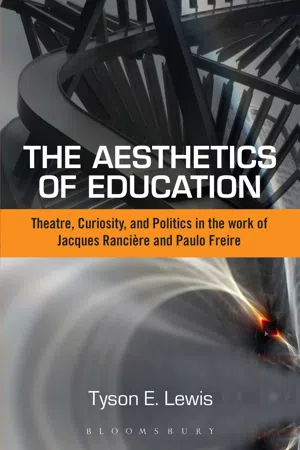
The Aesthetics of Education
Theatre, Curiosity, and Politics in the Work of Jacques Ranciere and Paulo Freire
- 192 pages
- English
- ePUB (mobile friendly)
- Available on iOS & Android
eBook - ePub
The Aesthetics of Education
Theatre, Curiosity, and Politics in the Work of Jacques Ranciere and Paulo Freire
About this book
This innovative book examines the aesthetic event of education. Extending beyond the pedagogy of art or art appreciation, Tyson E. Lewis takes a much broader view of aesthetics and argues that teaching and learning are themselves aesthetic performances. As Jacques Ranciere has recently argued, there is an inherent connection between aesthetics and politics, both of which disrupt conventional distributions of who can speak and think. Here, Lewis extends Ranciere's general thesis to examine how there is not only an aesthetics of politics but also an aesthetics of education. In particular, Lewis' analysis focuses on several questions: What are the possibilities and limitations of building analogies between teachers and artists, education and specific aesthetic forms? What is the relationship between democracy and aesthetic sensibilities? Lewis examines these questions by juxtaposing Ranciere's work on universal teaching, democracy, and aesthetics with Paulo Freire's work on critical pedagogy, freedom, and literacy. The result is an extension and problematization of Ranciere's project as well as a new appreciation for the largely ignored aesthetic dimension of Freire's pedagogy of the oppressed.
Information
Chapter One:
Fundamentally, Althusserianism is a theory of education, and every theory of education is committed to preserving the power it seeks to bring to light.
—Rancière, Althusser’s Lesson
Warren Montag (2003) begins his book on the infamous French Marxist Louis Althusser with an overview of the uses (and abuses) of Althusser’s work in the social sciences and in literary studies. In the former, there is an avoidance of Althusser’s actual writings for cursory summaries that reduce his positions to mere caricatures. In terms of the latter, there is a certain anxiety concerning Althusser’s pre-Deleuzian rejection of totalization beyond temporary historical conjunctions. Montag’s overview is insightful, and we can easily extend his critique of Althusserian scholarship into the discipline of educational theory as well. In this field, Althusser is also reduced to a representative of structuralist criticism which lacks a clear theory of agency (Giroux 2001) or to a totalitarian theorist of state control (Hill 2005). Thus education, like the broader field of social sciences, has not read Althusser “to the letter.” In this chapter, I will turn to one of Althusser’s most ardent critics, his former student Rancière, in order to evaluate his philosophical and pedagogical polemic against Althusser. This reading will allow me to reposition the relationship between Rancière and Althusser in a way that sheds light on the radical break between the student and his former teacher as well as certain continuities that tie them together. If Rancière’s denunciation of Althusser is part political and part pedagogical, it is precisely Althusser’s later focus on the aleatory event as well as theatre that enables us to read them together not as combatants but rather as strange travelers on the unfamiliar road of democratic events. Rather than a simple break with Althusser, a more nuanced understanding of the complex relationship between former student and former teacher reveals how (a) stultification is not monolithic but rather highly complex and differentiated, containing important fissures where a democratic excess emerges awaiting to be verified, and (b) even the most stultifying of discourses reveals a certain opening to democratic possibilities. In conclusion, a reevaluation of this particular relation between student and teacher will enable us not simply to further Rancière’s own project but also to provide a new role for Althusser in educational philosophy.
Althusser’s Pedagogies
In an interview on politics and aesthetics with Peter Hallward, Rancière reflects on his relationship with his former teacher. Here Rancière makes two interesting observations concerning Althusser as a teacher: a) “Althusser was seductive” (2003b, 194) while at the same time “Althusser taught very little” (194). The obvious question becomes: if Althusser taught very little, what exactly made him so seductive? Obliquely, Rancière seems to argue that it was not Althusser’s philosophical expertise that seduced but rather his pedagogical tact—his ability to create a certain passionate attachment to expertise itself. Rancière remembers: “Our roles as pioneers put us in a position of authority, it gave us the authority of those who know, and it instituted a sort of authority of theory, of those who have knowledge in the midst of a political eclecticism” (2003b, 195). In sum, during his tutoring sessions and graduate seminars, Althusser overtly taught very little content, but he was nevertheless highly seductive, teaching a certain distribution of the senses and of the passions surrounding the myth of philosophical expertise. Students, at least according to Rancière, were taught to organize the sensible around the fulcrum of the authority of theory, thus producing a new partitioning between logos and pathos that conferred a certain aura of knowledge to the work of the academic scholar. Unlike Rancière’s theory of universal teaching which creates a passion for equality, Althusser’s pedagogical practice creates a passion for hierarchical divisions of thinking and speaking. Stated differently, this is a contest of two passions: a hierarchical passion that institutes inequalities versus a democratic passion that interrupts the institution of inequalities.
What is interesting to note is that Althusser’s pedagogical practice does not completely coincide with Rancière’s depiction of the master explicator. For Rancière, the master explicator’s main function is to “transmit his knowledge to his students so as to bring them, by degrees, to his own level of expertise” (1991, 3). The act of the master explicator thus revolves around the question of distances which he “deploys” and “reabsorbs” “in the fullness of his speech” (Rancière 1991, 5). Once this distance is introduced between teacher and student, an intolerable paradox is introduced whereby all explication transforms into stultification. The result: “… the child who is explained to will devote his intelligence to the work of grieving: to understanding, that is to say, to understanding that he doesn’t understand unless he is explained to. He is no longer submitting to the rod, but rather to a hierarchical world of intelligence” (Rancière 1991, 8). The explicator speaks, and it is his/her emphasis on the control of speech that creates the hierarchy of intelligences upon which expertise rests. Thus the explicator functions to institute a difference of intelligences through the incantation of esoteric knowledge that only he/she has access to and which testifies to a gap or distance between expert and student that can never be fully overcome. The result is an intellectual dependency on the master explicator for the answer. This dependency produces a grieving period on the part of the student who will perpetually see him or herself as inferior, as a mere lack or gap. As Rancière summarizes, in Althusser’s criticism of “the old materialists” (such as Bentham or Owen), he actually embodies their pedagogical logic: “its was the point of view of a superior class that takes in charge the surveillance and the education of individuals by reserving for itself the ability to dictate every determining circumstance: the use of time, the distribution of space, the educational planning” (2011b, 5). In other words, Althusser’s goal is more educational than political: “the restoration of the ‘old materialism,’ the materialism of educators, of those who think for the masses and who develop theses for ‘scientific understanding’” (2011b, 11).
Yet in Rancière’s depiction of Althusser’s pedagogy, he says very little (i.e. there is silence instead of speech), and the students are left to construct the answers for themselves. In this sense, the classroom Rancière sketches might at first blush resemble a form of “universal teaching” wherein “each ignorant person could become for another ignorant person the master who would reveal to him his intellectual power” (1991, 17). Etienne Balibar also remembers the care which Althusser took with his students in preparing them for the aggrégation and the “intellectual freedom” (2009a, n.p.) of his famous seminars. Because of this intellectual freedom, his students were given the opportunity to utilize their own wills in order to realize their individual powers. If this process involved grieving on the part of the student, Rancière and Balibar give no evidence. In fact, it would seem the opposite. The students were actively encouraged to use the wills to produce something new and thus to empower themselves. While such a situation might initially appear to resemble a horizontal equality of intelligences, this is not the case. Indeed, Althusser’s students were given certain freedoms, but this denies the education of the passions, the aesthetic dimension of Althusser’s pedagogy, which fosters an attachment to expertise rather than equality through a subtle form of seduction—seduction for the allure of theory as a tool for maintaining a hierarchy of intelligences. Rancière recalls, “Treated like heirs to the throne by our professors, we had no objections to the ‘pedagogic relation’; the winners of a fiercely selective competition, trained to compete from very early on, we could not but look upon the critique of individualism and the calls for collective work groups as the reveries of illiterate minds” (2011b, 41). While there is an equality of intelligences assumed here, this is not an equality of all for all, but rather only for those who have a certain relation to theory. Thus Althusser remains an expert without being an explicator (he said very little), and in turn, his pedagogy is a form of universal teaching that nevertheless operates under the sign of inequality through the equality of intelligences. The result is not grievance through dependency but rather passion through seduction. If Rancière’s book The Ignorant Schoolmaster: Five Lessons in Intellectual Emancipation argues for the overturning of intellectual inequality in the master’s practice through acts of universal teaching, then his own analysis misses another problematic, one which is extremely subtle but which nevertheless reinforces inequality all the same: the seduction of the student by the allure of expertise itself. Thus there is perhaps room for a sixth lesson here: a lesson that shifts the problematic from intelligence to will, and from will to aesthetic passions. In short, equal intelligence is not enough to secure universal teaching—it must be accompanied by a redistribution of the passions.
But this is only one side of Rancière’s critique of Althusser. The other side deals more directly with his written pedagogy. It is Althusser’s words (what he said rather than what he did not say) that concerns Rancière. And it is here that Rancière’s caricature of Althusser begins to approximate his depiction of the master explicator. Rather than seduction and passion for expertise, Althusser’s words operate to constitute intellectual hierarchization by “correct questions” which are written and controled by the expert. In the chapter titled “Althusser, Don Quixote, and the Stage of the Text” in his book The Flesh of Words: The Politics of Writing (2004a), Rancière performs an ingenious deconstruction of Althusser’s symptomal reading method. In particular, he highlights a passage in the text in which Althusser argues that symptomal reading exposed the suppressed “dotted lines” of a text (the absent signifiers that structured the text in their very absence). It is worthwhile summarizing Rancière’s analysis of the metaphor of the dotted line in full:
Dotted lines or ellipses, we know in fact to what genre of books they belong: elementary textbooks. In these books, the dotted lines are there for the missing words, words that the student must restore in a sentence left incomplete. These dotted lines that summon the right answer themselves assume the place of another procedure of knowledge: that of the answer to the teacher’s question. They are there to verify that the student knows his lesson and knows how to apply what he has been taught. This is a pedagogical procedure that is more elegant than asking questions. The teacher puts the finishing touches to his work by disappearing into dotted lines. If he can disappear into them, of course, it is because he knows all the questions and all the answers. Thus he can absent the word, the word to be found that says that the pedagogue knows and that the student will know. Dotted lines are, strictly speaking, the presence of the teacher in his absence … (2004a, 134)
If the project of symptomal reading is to reveal gaps or epistemological breaks in the text, the metaphor of the dotted line drawn from elementary school reveals instead a continuity that is secured by asking the right questions at the right time in order to reveal the correct answer. Scholarship as the production of new concepts becomes conflated with a simplistic model of pedagogy wherein the teacher tests the student through fill-in-the-blank exercises that have certain predetermined answers. This method of scholarship as pedagogy “rules out answers to questions never asked” (Rancière 2004a, 135), reducing the task of reading to simple verification of existing questions that are latent within the text. Such verification remains dependent on the teacher who orchestrates the production of knowledge through a control over the appearance of “proper questions.” What is created is a specific community of scientists, a community encircled by a specific field of knowledge defined by the dotted lines of the pedagogue. This is a community of inclusion and exclusion, a community grounded in the principle of consensus where every dotted line has a proper place and a corresponding proper answer to be verified by the expert who knows in advance.
This depiction of Althusser’s project as an elementary-school pedagogy masquerading as scholarship is echoed throughout many of Rancière’s texts, including The Ignorant Schoolmaster. It is not a great leap from the depiction above to Rancière’s notion of the master explicator who stultifies students by creating a perpetual distance between ignorance and intelligence. What exactly does the master explicator stultify? The production of new questions, questions unanticipated by the teacher who controls the reading of the text by inserting dotted lines where they did not previously exist for the sole purpose of testing the intelligence of the student. As Rancière summarizes, “An opinion, the explicators respond, is a feeling we form about facts we have superficially observed. Opinions grow especially in weak and common minds, and they are the opposite of science, which knows the true reasons for phenomena. If you like, we will teach you science” (1991, 45). Instantly in the erection of science, the explicator creates a hierarchy of knowledge about the world as well as a structure of dependency between student and teacher. Science submits language to the rule of law by providing an answer key to our questions. The offering “If you like, we will teach you science” is thus deceptive. In the pedagogical invitation to liberate the self from the veil of opinion, the master explicator produces a new dependency, a new distance that can never be fully overcome. In fact, the gesture of “goodwill” is actually a paranoid attempt to verify the superiority of the expert over those ruled by mere opinion. The first lesson learned concerns the inferiority of some and the superiority of others, and thusly, the need to overcome inferiority through reliance on the expert.
The same aporia of goodwill is found in Althusser’s famous seminar titled “Philosophy and the Spontaneous Philosophy of the Scientists” from 1967. As Pierre Macherey argues, the general intent of the course was to open philosophy up to a wider audience beyond the exclusivity of professional philosophers, or to use Macherey’s phrase, to effect a “displacement [of philosophy] onto new terrains where it would become accessible, and in the first place audible, to non-specialists” (2009, 14). For Macherey, the discontent with academic elitism led Althusser and his cohort of students to undertake a “pedagogical form of a discourse of initiation” (2009, 15) that would liberate philosophy from its own field by reaching out across disciplines to a wider audience of non-philosophers and scientists. The result would be a new notion of philosophy as a tool for demarking “‘true’ sciences from would be sciences and to distinguish their de facto ideological foundations from the de jure theoretical foundations” (Althusser 1990, 92). Although this is a pedagogical form of a discourse of initiation which opens philosophy up to a non-philosophical audience, we must remember Rancière’s worry: it is in the very gesture of initiation into science that the distance between student and teacher is produced, and that inequality manifests in the very gesture of equality that initiation signifies. As William S. Lewis aptly points out (2005), while Althusser’s seminars as well as his complex and highly sophisticated writings open themselves up to charges of Leninist vanguardism, Althusser engaged in public lectures and wrote texts put together explicitly for popular audiences. It is in his intentionally public pedagogy that Althusser’s stultification takes on another valence. Here, the problematic of initiation is that it appears as a form of non-hierarchical teaching that teaches nothing but inequality through the dependency it fosters in the master. In The Ignorant Schoolmaster, Rancière calls this the Republican paradox of “public pedagogy” (1991, 131). Republicans believe in equality but not in the equality of intelligences. Through time and patience, public pedagogy will “little by little, progressively, attenuate the deficiency caused by centuries of oppression and obscurity” (Rancière 1991, 131). The problem is precisely a perpetual “infantilization” or dependency of the public on professional explication in the very gesture which is meant to affirm equality.
So what is Althusser’s fear? Rancière speculates “Althusser’s enterprise, however, is marked through by the dread of the Marxist intellectual, the dread of the intellectual fallen prey to politics: not to make ‘literature’; not to address letters without addressee; not to be Don Quixote, the fine soul who fights against windmills; not to be alone, not to be the voice of one crying out in the wilderness, an activity by which one loses one’s head, literally as well as figuratively” (2004a, 137). To avoid the madness of Don Quixote and thus the madness of literature, Althusser “must protect the communal cloth, the thick cloth of knowledge made of questions and answers that insures that in the final analysis, the questions asked by the ‘Marxist’ are the right questions to which the ‘Communists’ put up with being the orphan answers, one must protect the cloth against any tear, any dropped stitch” (Rancière 2004a, 137–8). A pedagogy of initiation protects the expert’s community by ensuring a certain consensus that gathers around fixed questions and answers determined in advance by the one-who-knows. The point is not to ask new questions but rather to extend the familiar hand of particular questions to the unanointed or uninitiated. To insure the connection between flesh and word, pedagogue and student, intellectual and audience, Althusser’s texts become overtaken with what Rancière calls “Brechtian pedagogism” (Rancière 1991, 141) in the form of personified concepts and concepts that speak. In other words, his texts become dramatic stagings modeled on Brechtian theatre. These pedagogical-theatrical characters (SPS, PPI and PP2, etc.) function to fill the stage of theory with prescripted conflicts masquerading as “spontaneous” manifestations of a “real life” drama between classes. The goal of this pedagogical-theatrical performance is, as Rancière observes, “to prevent any exit from the stage before the denouement, and also to keep people from coming onstage at the wrong time, people we’re supposed to meet only at the denouement. Cordoning off the (wrong) exits is the condition for theater to use the logic that can open the right one. That is the second consequence: symptomal reading becomes a movement that closes the ways out to liberate at last the only way out, the encounter with reality” (1991, 143). In a paradoxical twist, it is in the very movement of denouncing the myth of ideology through symptomal reading that this very process reintroduces the myth of the “great book of history” (1991, 144). In other words, the very struggle against madness through the dramaturgy of the text results in a kind of madness wherein the symptoms that symptomal reading attempted to dispel return with full force. The result: the master becomes mad, the student full of grievances, and the world effectively stultified.
Although Rancière’s reading is decisive, there is an interesting detail with which he does not directly deal—a detail that creates an interesting asymmetry between Althusser’s oral pedagogy and his written pedagogy. For Rancière, Althusser’s pedagogical project of initiation concerns the paradoxical move wherein equality of intelligence must be presupposed in order for infinite dependency on the expert and his/her discourse to be assured. Thus...
Table of contents
- Cover
- Title
- Contents
- Acknowledgement
- Introduction: The Aesthetics of Education
- Chapter One: From Stultification to Emancipation: Althusser avec Rancière
- Chapter Two: Aesthetic Forms: Teaching, Theatre, and Democracy
- Chapter Three: Aesthetic Forms: Teaching, Theatre, and Democracy
- Intermission: Equality, Freedom, and Emancipation: A Case for Pedagogical Dramaturgy
- Chapter Four: The Aesthetics of Curiosity
- Chapter Five: The Knowledge of Ignorance
- Chapter Six: The Future of the Image in Critical Pedagogy
- Chapter Seven: Freire's Last Laugh
- Conclusion: Death and Democracy in Education: Freire's Easter Revisited
- Bibliography
- Index
- eCopyright
Trusted by 375,005 students
Access to over 1.5 million titles for a fair monthly price.
Study more efficiently using our study tools.
Frequently asked questions
Yes, you can cancel anytime from the Subscription tab in your account settings on the Perlego website. Your subscription will stay active until the end of your current billing period. Learn how to cancel your subscription
No, books cannot be downloaded as external files, such as PDFs, for use outside of Perlego. However, you can download books within the Perlego app for offline reading on mobile or tablet. Learn how to download books offline
Perlego offers two plans: Essential and Complete
- Essential is ideal for learners and professionals who enjoy exploring a wide range of subjects. Access the Essential Library with 800,000+ trusted titles and best-sellers across business, personal growth, and the humanities. Includes unlimited reading time and Standard Read Aloud voice.
- Complete: Perfect for advanced learners and researchers needing full, unrestricted access. Unlock 1.5M+ books across hundreds of subjects, including academic and specialized titles. The Complete Plan also includes advanced features like Premium Read Aloud and Research Assistant.
We are an online textbook subscription service, where you can get access to an entire online library for less than the price of a single book per month. With over 1.5 million books across 990+ topics, we’ve got you covered! Learn about our mission
Look out for the read-aloud symbol on your next book to see if you can listen to it. The read-aloud tool reads text aloud for you, highlighting the text as it is being read. You can pause it, speed it up and slow it down. Learn more about Read Aloud
Yes! You can use the Perlego app on both iOS and Android devices to read anytime, anywhere — even offline. Perfect for commutes or when you’re on the go.
Please note we cannot support devices running on iOS 13 and Android 7 or earlier. Learn more about using the app
Please note we cannot support devices running on iOS 13 and Android 7 or earlier. Learn more about using the app
Yes, you can access The Aesthetics of Education by Tyson E. Lewis in PDF and/or ePUB format, as well as other popular books in Education & Education General. We have over 1.5 million books available in our catalogue for you to explore.