- 304 pages
- English
- ePUB (mobile friendly)
- Available on iOS & Android
eBook - ePub
About this book
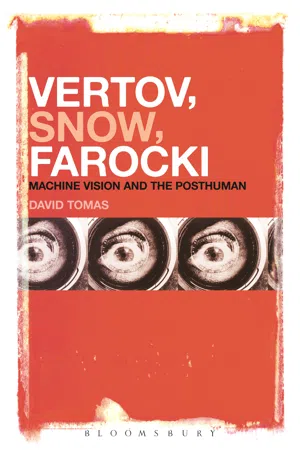
Vertov, Snow, Farocki: Machine Vision and the Posthuman begins with a comprehensive and original anthropological analysis of Vertov's film The Man With a Movie Camera. Tomas then explores the film's various aspects and contributions to media history and practice through detailed discussions of selected case studies. The first concerns the way Snow's La Région Centrale and De La extend and/or develop important theoretical and technical aspects of Vertov's original film, in particular those aspects that have made the film so important in the history of cinema. The linkage between Vertov's film and the works discussed in the case studies also serve to illustrate the historical and theoretical significance of a comparative approach of this kind, and illustrate the pertinence of adopting a 'relational approach' to the history of media and its contemporary practice, an approach that is no longer focused exclusively on the technical question of the new in contemporary media practices but, in contrast, situates a work and measures its originality in historical, intermedia, and ultimately political terms.
Information
Part I
Threshold
When a Ritual Process Speaks of Machine Vision and Cyborg Prototypes: A Film Document, Circa 1929
Our eyes, spinning like propellers, take off into the future on the wings of hypothesis.
Dziga Vertov
1
Manufacturing Vision and the Posthuman Circa 1929: Kino-Eye, The Man with a Movie Camera, and the Perceptual Reconstruction of Social Identity
The Man with a Movie Camera (Chelovek s kinoapparatom), a six-reel silent film, was released in 1929 under the auspices of the Ukrainian Film and Photography Administration (VUFKU). As credited on the film, Vertov was the “author-supervisor of the experiment,” Elizaveta Svilova, his wife, the editor or montage assistant, and his brother, Mikhail Kaufman, the chief cameraman.1 Vertov considered the film to be a major statement of the “Kinoks” principles of nonfiction filmmaking which would oppose a kinomatic world—a world as seen and reproduced by Vertov’s new mode of cinematographic observation/manufacture, christened “Kino-Eye”—to the world as seen by the imperfect human eye.2 The Man with a Movie Camera was Vertov’s most ambitious visual statement of Kino-Eye method—not only “a practical result” but also, and most importantly, “a theoretical manifestation on the screen” (Vertov “The Man with a Movie Camera” (1928), 1984: 83).3 Finally, in keeping with its artifactual status as manufactured object, it was also considered a “film-object” (1984: 83). Moreover, Vertov adopted an unusual strategy of setting the parameters of The Man with a Movie Camera’s reception by proclaiming in its short, polemical on-screen introductory manifesto that it should be treated as both a theoretical and practical statement of film method. In doing so, he redirected the film’s function away from fictionally based entertainment toward a didactic educational purpose of promoting precise sociopolitical objectives (framed by a Soviet political and ideological program) based on a reflexive analysis of film production’s place in a world animated by industrial processes and systems of transportation/communication.
Annette Michelson has described the The Man with a Movie Camera as a “meta-cinematic celebration of filmmaking as a mode of production and . . . a mode of epistemological inquiry” in which a “‘world of naked truth’ is, in fact, the space upon which epistemological inquiry and the cinematic consciousness converge in dialectical mimesis” (1990: 19, 1972: 63). This space, whose specific social topography remains unexplored in this cogent description of the film’s unique revolutionary status, is, perhaps, best defined in its own terms, namely, as a new product of a social/observational system of manufacture that was designed specifically and purely for kinomatic (Kino-Eye based) communication with all that this implied from political/formal viewpoints. It was, accordingly, a product, but also manifesto and manual for producing films based on a hierarchic division of observational labor that functioned as a social technology for manufacturing kinomatic forms of knowledge. It is this social technology which articulates the complex thematic armature consisting of a day in the life of the compositely constructed Soviet city depicted in The Man with a Movie Camera; and it is this technology that provides the basic material (film footage) for the construction of a visual channel (or kinomatic route) to achieve one of the film’s principal educational objectives: a perceptually induced revolutionary conversion of the consciousnesses of both producers and spectator/audience; a strategy of conversion that was based on a “communist decoding of the world” (Vertov “The Essence of Kino-Eye” (1925), 1984: 50). Finally, it is this technology that also embodied an ethnographic-like analysis of its own conditions of historical existence insofar as they were “exposed” in terms of a finely calibrated self-consciousness of the (the film’s) social, economic, and political integration in an industrial society.
However, The Man with a Movie Camera achieved this objective in a curious way for such an avowedly revolutionary visual experience. The film’s structure replicates in its overall organization and transformative social function the tripartite symbolic architecture of a traditional rite of passage ceremony. Although there is no evidence to suggest that Vertov was aware of the sociocultural significance of this type of ritual, he was certainly aware of the existence of similar rituals in his society: he did depict socially sensitive events such as birth, marriage, and death that are widely subject to rites of passage mediation in many societies in his film.4 The Man with a Movie Camera presented these ritually mediated social events in a new way since they were portrayed as taking place under the aegis of a new revolutionary sociocultural agenda, and through a cinematic medium of representation where old and new were critically juxtaposed and where socially sensitive events were often promoted in a new light (expedited civil marriage and divorce procedures) or associated with traditional prerevolutionary customs and systems of belief (private forms of bereavement). However, while Vertov’s film clearly presented its juxtapositions and associations through the optic of its own revolutionary agenda and the distinctive spatiotemporal characteristics and perceptual dictates of its cinematic language, its structure mimics a rite of passage ritual, and this is where the particular “anthropological” interest of the film lies. For this structure allows one to analyze the film in a different way and it also provides a panhuman frame of reference for new questions concerning its logic, function, and symbolic content which complicates, in a significant way, the reading of its revolutionary content and objectives. Moreover, insofar as The Man with a Movie Camera is predicated on this ritual structure, it sensitizes the viewer to the existence of similar processes and functions in other films, notably in Snow’s La Region Centrale and De La and, in a different form, in Farocki’s Eye/Machine trilogy and Counter-Music.
There has been no systemic attempt to examine The Man with a Movie Camera from a more general “anthropological” point of view, that is, as a social symbolic product of a particular society, culture, historical epoch, and, in Vertov’s case, revolutionary political agenda.5 This is surprising, since his work has dual ethnographic value. First, as a contemporary record of the vision, issues, stakes, and methodologies that were implicated in the development of a new kind of society. Second, as the product of a new method of looking and recording (movie camera) and an innovative way of seeking out, organizing, and presenting the visual images produced by movie cameras (Kino-Eye, montage editing). When coupled with the fact that The Man with a Movie Camera’s basic structure corresponds to the tripartite organization of a rite of passage ritual, these ethnographic characteristics place the film in a unique sociohistorical position, not only as a politically grounded cultural document but also as a specifically crafted technologically based symbolic process. But this is not all. Since the film also shares common symbolic properties and functions with other ritual processes that mediate essential events of a transitional sociobiological and cosmic nature such as birth, marriage, and death, as well as important seasonal and cosmic transitions that are associated with the planting and harvesting of crops, its structure raises questions about the relationship between its panhuman status and its specifically engineered sociopolitical objectives. The Man with a Movie Camera is, in other words, the individual product of a collective revolutionary agenda that has been cast in a collective ritual form.
However, given the material nature, sociocultural and political content of the film, it is clear that the transition it mediates is very different from a traditional rite of passage, and this is where the particular interest of the film and Vertov’s practice lie. For death, birth and natural cycles are articulated through the film’s structure and language with prerevolutionary social models, and the “birth” of a Soviet consciousness rooted in a progressive Soviet society whose industrial and technological trajectory of development would ultimately, in the context of Vertov’s Kino-Eye theory, take it beyond the world of natural forces and cycles of human existence. This ritualized cycle of death and birth involved the filmmaker and kinoks, who were also subject to the film’s process of transformation and who could also emerge as more mature and refined (knowledgeable and sophisticated) revolutionary products (practitioners). Thus as an audience “lived” through the process of transformation, that the film proposed, they would also realize that they were watching the product of a group of people who had already passed through a similar process. These unusual characteristics pointed to The Man with a Movie Camera’s unique capacity to function as a visual model to produce unconventional (experimental) ritually based sociopolitically informed practices and counter-practices (in the case of its comparative analysis of residual bourgeois behavior). For here was a film—a visual work—that operated in a significantly different fashion from other films when considered from the viewpoint of its thematic content, visual structure, sociopolitical ambitions and ritual functions; and this is where its significance as a historical reference and model for contemporary visual practices lies, even though the historical, political, economic, institutional, and artistic conditions for the production of visual works of this kind have mutated to the extent that they might no longer be feasible in Vertov’s terms.
The Man with a Movie Camera continues to serve as an example of a work that prioritizes method and historical reflexivity. In other words, the necessity of addressing the conditions of its own historico-political existence over the seductive pleasures of “entertainment”—what Vertov understood as standardized forms of fiction that were devoid of critical social content. It is precisely the overdeterminism of The Man with a Movie Camera’s historical “message,” its utopian political and technological ambitions, its historical failure and therefore the impossibility of attaining those ambitions, and yet its clairvoyance in regard to the kind of society that they could lead to, that makes the film so important as ethnographic document, and reference for a visual practice. If this kind of film is no longer possible, because of technological and political transformations that have displaced its principal axis of historical reference, then it is important to keep its example and lessons (both positive and negative) in mind, and to use it as a reference in a search for counter-practices and alternative models of human visual activity that can be imagined into practical existence under current sociocultural and economic regimes. One particularly important, politically and socially ambivalent path of human development has taken place by way of machine vision and its relationship to the posthuman, a relationship that The Man with a Movie Camera addressed in an unprecedented and spectacularly clairvoyant fashion.
What are The Man with a Movie Camera’s rite of passage characteristics? In the following pages, I will present a case for considering film and photography as rites of passages. I will analysis The Man with a Movie Camera’s rite of passage features. I will then explore the novel “social technology of observation” that served as the film’s foundation and, finally, I will describe how this rite of passage and its technology of observation are implicated in the production of new social identities, in particular a prototype for a collective posthuman identity. During the course of this discussion, I will have occasion to comment on some possibilities and questions that are raised by this anthropological approach to Vertov’s kinomatic theory and practice. This chapter will then serve as a frame of reference for the subsequent analyses of La Region Centrale and De La in Chapters 2–7; while the question of surveillance and the posthuman raised by Snow’s and Vertov’s films will serve as frames of reference for a final discussion of Farocki’s Eye/Machine trilogy and his Counter-Music.
Photographic and cinematic rites of passage
i) What is a rite of passage?
Rites of passage ceremonies are dedicated socio-symbolic passageways for the movement of human beings and groups of human beings between distinct social categories or stages where these movements are considered, from a social point of view, to be dangerous, traumatic, or destabilizing because they represent situations or conditions of transient existence that are “in between” and therefore “outside” of existing social structures. These rites are most often linked to the symbolic mediation of such socially problematic and ambiguous biological processes as birth, puberty, and death.6 They have also been associated with major seasonal or cosmic transitions and important social events such as marriage. Processually structured, institutionally mediated educational programs such as one finds in universities, whose disciplines are dedicated to producing specialized, socially productive adult members of a society, are key examples of a powerful contemporary rite of passage. In one way or another, collective education and its transformative impact on the individual is at the heart of such ritual processes.
Rites of passage are normally composed of three distinct zones of ritual/symbolic activity: a rite of separation, a liminal stage, and a rite of reincorporation. Each zone of activity is devoted to precise transformations and objectives such as the separation of an individual (also known as an “initiand”) from normal social activity, his/her introduction to the body of knowledge, symbolic processes and activities that the rite of passage is engaged with (in terms of its specific social mandate), and the initiand’s reintroduction into society in his or her new state and/or stage of social existence. The initiand passes through these zones and is subject to physical and/or symbolic manipulation and transformation in each of them. In traditional rites of passage rituals, these operations and procedures can take the form of cleansing rites, physical ordeals, marking such as tattooing and scarification, or various kinds of surgical interventions such as male or female circumcision that are used to physically alter the body in order that it bears visible attributes of a new collectively acknowledged social condition, status, or rank. They can also include a stage of symbolic death. The presentation of “secret” knowledge about an initiand’s new conditions of social existence (manhood or womanhood) or functions (warrior) can also take place during these rites, in particular during the liminal stage (Richards 1956; Turner 1977). The ritual process is designed to “transport” the initiand from one social position (adolescent/pubescent) to another (woman/man, warrior, married) or condition of existence (life) to another bodily state (death) through a collective process of socio-symbolic and physical manipulation/transformation. The British anthropologist Edmund Leach published a schema of the ritual’s basic structure that conveniently displayed its transformative logic and its elementary relationship to social space and time (Leach 1976: 78). Figure 1.1, which is based on Leach’s original, has been modified in order to present the various synonyms that have been used to identify the ritual process’ three stages.
The schema demonstrates how the rite of passage’s stages are structured in relation to a tripartite spatiotemporal logic and it illustrates how this logic is at the basis of the separation of social beings from society and their reintroduction back into society. As this diagram suggests, the central portion of the ritual is designed to maintain the initiand in a condition of existence that is most often considered to be “outside” of society. This condition can be represented by the initiand’s spatial removal from a specific physical location such as a family house or village.7 Sometimes the initiand is considered to be in a condition of death...
Table of contents
- Cover
- Title
- Introduction
- Part I Threshold—When a Ritual Process Speaks of Machine Vision and Cyborg Prototypes: A Film Document, Circa 1929
- Part II Enigma of the Central Region—A Microhistory of Machine Vision and Posthuman Consciousness, Circa 1969–72
- Part III The Public Deployment of Machine Vision and the Programmed Materialization of the Posthuman in Collective Social Space, Two Early-Twenty-First Century Video Documents
- Notes
- Bibliography
- Index
Trusted by 375,005 students
Access to over 1.5 million titles for a fair monthly price.
Study more efficiently using our study tools.
Frequently asked questions
Yes, you can cancel anytime from the Subscription tab in your account settings on the Perlego website. Your subscription will stay active until the end of your current billing period. Learn how to cancel your subscription
No, books cannot be downloaded as external files, such as PDFs, for use outside of Perlego. However, you can download books within the Perlego app for offline reading on mobile or tablet. Learn how to download books offline
Perlego offers two plans: Essential and Complete
- Essential is ideal for learners and professionals who enjoy exploring a wide range of subjects. Access the Essential Library with 800,000+ trusted titles and best-sellers across business, personal growth, and the humanities. Includes unlimited reading time and Standard Read Aloud voice.
- Complete: Perfect for advanced learners and researchers needing full, unrestricted access. Unlock 1.5M+ books across hundreds of subjects, including academic and specialized titles. The Complete Plan also includes advanced features like Premium Read Aloud and Research Assistant.
We are an online textbook subscription service, where you can get access to an entire online library for less than the price of a single book per month. With over 1.5 million books across 990+ topics, we’ve got you covered! Learn about our mission
Look out for the read-aloud symbol on your next book to see if you can listen to it. The read-aloud tool reads text aloud for you, highlighting the text as it is being read. You can pause it, speed it up and slow it down. Learn more about Read Aloud
Yes! You can use the Perlego app on both iOS and Android devices to read anytime, anywhere — even offline. Perfect for commutes or when you’re on the go.
Please note we cannot support devices running on iOS 13 and Android 7 or earlier. Learn more about using the app
Please note we cannot support devices running on iOS 13 and Android 7 or earlier. Learn more about using the app
Yes, you can access Vertov, Snow, Farocki by David Tomas in PDF and/or ePUB format, as well as other popular books in Media & Performing Arts & Film & Video. We have over 1.5 million books available in our catalogue for you to explore.