eBook - ePub
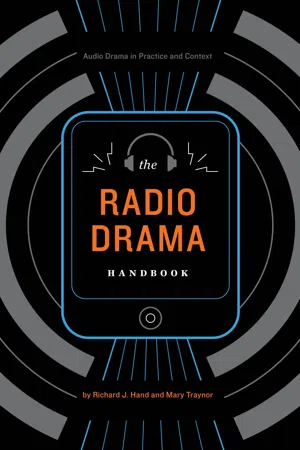
The Radio Drama Handbook
Audio Drama in Context and Practice
- 240 pages
- English
- ePUB (mobile friendly)
- Available on iOS & Android
eBook - ePub
About this book
Combines both theory and practice to lead, stepwise, to a full understanding of radio drama form. Perfect for Undergraduate radio courses, MA radio production courses, and radio drama writing courses.
Information
Part 1
A contextual guide to radio drama
1
A history of radio drama
Introduction
Why should we be interested in radio drama? Aren’t its limitations blatantly obvious? Isn’t radio what people had before television arrived: a TV which gives us nothing to look at? What is the point of a performance if you can’t even see the actors? In playing the devil’s advocate, Hugh Chignell goes as far as to argue that radio drama is a ‘contradiction’: ‘How is it possible in such a visual age for “invisible” drama, drama without faces or scenery to exist?’ (Chignell, 2009, p. 26). No one could fail to notice that we are surrounded by screens and visuals. That is what defines the advanced technological culture of the contemporary world: screens on our walls; on our desks; in our pockets; everywhere we look screens are always within sight.
These opinions are probably felt by many people, but at the same time it is true to say that sound is more important than people realize. Because it is literally invisible, sound is all too easy to ignore. Yet as much as people love to use their televisions and computers and mobile phones and portable game consoles, they also do other things: they drive, they do household chores, they exercise, they read and write, they sometimes even close their eyes . . . And when they do these things they often listen. Whether it is on their prized iPod or high-tech phone or on a radio they take for granted, they listen: it might be music, it might be news or sports broadcasting, it might be a variety of talk shows and phone-ins. But for some people it can be stories: audio books and even, yes, radio drama.
Sound
Before we look at radio drama specifically, let us consider the importance of sound. Even in the visual media, sound is not only more complex than what literally ‘meets the eye’, it is critically important. A favorite test of this is to watch a horror movie with the volume turned to mute. The carefully crafted sequences that manipulate our sense of foreboding and suspense become, with the sound off, little more than an edited succession of images. You can literally ‘see the join’. Put the volume back up and you realize that the music, sound effects, voices, other utterances and mysterious noises have a calculated effect to frame the story, drive the action and sweep us along in the experience. Indeed, some people even say that although they closed their eyes in a movie theatre during a particularly scary sequence, it did not help because they could still hear everything. In fact, it might have made things even worse. After all, as one of the most influential producers in the history of US broadcasting (both on radio and television), Himan Brown puts it,
The key to radio drama is sound – is imagination – is what you can do by stirring somebody. You can’t do that with television. You can show them the pictures and say ‘This is what it is’. But so what? So you sit there like a dummy and accept the car crashes but you can’t add anything to it. There’s nothing bloodier than the blood you see in your imagination. What are they gonna do? Pour a lot of ketchup on the television screen? It’s still bloodier in your own mind. (quoted in Hand, 2006, p. 36)
In a similar spirit, Robert Arnold (executive director of Chatterbox Audio Theater) argues that ‘Audio challenges the imagination in ways that video cannot. All the CGI in the world cannot create a vista more beautiful or a monster more terrifying than the one you imagine’ (Arnold, 2010). Our own imaginations are the most powerful medium of all. Perhaps sound can even provide a shortcut to the deepest realm of our imagination? The formal term for this is anamnesis, which has been described as
An effect of reminiscence in which a past situation or atmosphere is brought back to the listener’s consciousness, provoked by a particular signal or sonic context. Anamnesis, a semiotic effect, is the often involuntary revival of memory caused by listening and the evocative power of sounds. (Augoyard and Torgue, 2005, p. 21)
Certainly, for many people, anamnesis can be extremely powerful or, indeed, resonant: songs and melodies, snatches of rhymes or lines from stories and poems can be evocative conduits to memory and feelings. Sometimes it is these auditory things more than the obvious – photographs or even locations – that can surprise us with their emotional potency. In Edward Bond’s stage play The Sea (1973), the character Willy talks about the death of his close friend Colin: ‘You’re supposed to forget what they look like very soon. It comes as a shock. But it’s hard to forget the voice. You suddenly hear that twenty years later’ (Bond, 1978, p. 145). The human voice has extraordinary importance to the communicative beings that we are. The inherent power of the acoustic and the aural was made even more profound with the invention of a piece of technology that seemed quite miraculous to many in the generation that saw its inauguration . . . radio.
The invention of radio
It may come as a surprise, but it is difficult to put a precise date on the invention of radio. This is because the technology emerges out of an international mixture of theoretical physics, practical experimentation and commercial interests. For instance, let us consider the Scottish physicist James Clerk Maxwell (1831–79), a pioneer in the area of electromagnetism. As Lewis Coe writes, Maxwell contended that ‘there might be electromagnetic waves that were similar to light waves’ (Coe, 1996, p. 4) and managed to prove it through advanced mathematics. Maxwell was purely a theoretician, and his ideas were explored and expanded in a laboratory context by the German physicist Heinrich Hertz (1857–94), who built equipment that functioned as an apparatus to produce and detect radio waves. The Italian inventor Guglielmo Marconi (1874–1937) was fascinated by Hertz’s experiments and saw their potential for creating a practical communications system. Although Marconi would eventually be awarded the Nobel Prize for physics, it is worth noting that he was not a pioneer in the way that Maxwell and Hertz had been. What Marconi did brilliantly was develop and improve the experiments of Hertz and others in order to create a fully operational and commercially viable system of wireless technology. In this regard, Susan Merrill Squier considers Marconi’s visit to the Unites States to broadcast the America’s Cup yacht race in 1899, during which he demonstrated the potential of ‘wireless telegraphy’, to be immensely important (Merrill Squier, 2003, pp. 10–11). However, much of Marconi’s research and development was undertaken in Britain, which was far more interested in the potential of wireless technology than Marconi’s home nation, Italy.
The fact that the invention of radio cannot be credited to one person is most evident in numerous controversies and contestations. Other figures, including the British physicist Oliver Lodge (1851–1940), the Serbian-born inventor Nikola Tesla (1856–1943) and many other scientists and entrepreneurs, became embroiled in the arguments – and sometimes court cases – surrounding the inauguration and development of radio technology. Or, to put it more progressively, many people were part of the creation of radio and its phenomenal rise.
Wireless
For many at the beginning of its history (not least through Marconi’s demonstrations), what we understand as radio was known as wireless telegraphy, which became shortened to ‘wireless’, a name that captures the sense of miracle that it represented. This new technology did not need to be wired in like the other monumental nineteenth-century inventions that had changed the world, the telegraph and the telephone. Lewis Coe informs us that the term ‘wireless’ was officially replaced by the word ‘radio’ at an international conference in Berlin in 1906 (Coe, 1996, p. 3), and although the usage of ‘wireless’ to mean radio has disappeared from American English, to this day many people in Britain still understand and use the term. Interestingly, we have lived through another global epoch that has stood in awe and wonder at the term ‘wireless’ once again with the explosion of mobile-phone and wireless-internet technology.
As well as instituting the name ‘radio’ for this revolutionary technology, the Berlin conference in 1906 also agreed on another term that would have far-reaching implications. The same conference agreed that ‘SOS’ in Morse code should be recognized as the international distress call (Coe, 1996, p. 16). Morse code is a system of ‘dots’ and ‘dashes’ that represent letters of the alphabet and numbers. It had been developed for the telegraph system, but effortlessly moved into radio technology. The fast-developing technology of radio was seen as particularly beneficial when it came to its potential in sending Morse code messages, especially with regard to ships. However, this system was rather ad hoc until a particularly infamous event. Although synonymous with catastrophe, the sinking of the Titanic in April 1912 had the immediate consequence of regulating ships’ radio equipment and practice. That is not so say that radio was not in operation on the Titanic: although over 1500 passengers died after the ship hit an iceberg, it is true to say that if it was not for the distress signal sent by the Titanic’s radio operators, the loss of life would have been even greater.
Eventually, radio progressed from being a wireless conduit for Morse code, and voice transmission became possible. It was this development that would make the future success of broadcasting and mass communication unmistakably clear. As with the history of radio as a whole, there were sporadic experiments and lukewarm successes with voice broadcasting. Nevertheless, radio was initially a pastime for amateurs, hobbyists who had the time and interest to explore the ‘airwaves’. As Filson Young recalls, in the early days of radio broadcasting ‘Hardly anybody took it seriously; it was regarded either as a hobby or a science . . . as flying once was’ (Young, 1933, p. 1). This is a powerful parallel: for us, it is extraordinary to think that human-powered flight was once seen as a slightly eccentric pastime and that radio had the same place until people gradually recognized its potential.
Radio broadcasting
A key figure in the development of radio broadcasting is David Sarnoff (1891–1971), who worked for the American Marconi Company and, in 1916, pronounced a momentous ambition: ‘I have in mind a plan of development which would make radio a “household utility” in the same sense as the piano or phonograph’ (quoted in Maltin, 2000, p. 2). It was this concept that would develop radio from being a hobby or an ‘emergency’ device (what we might call now a ‘health and safety’ utility) into a cultural form. Another important person in this regard is the amateur radio enthusiast Frank Conrad (1874–1941), who from around 1912 began experimenting with radios, eventually broadcasting music and the spoken word from his own self-made station in Pennsylvania. Conrad worked for the Pittsburgh-based Westinghouse Electric Company, which noticed the interest their employee’s hobby was garnering. It was clear that the idea of a radio station was an extremely viable initiative. The company established the KDKA station, which started broadcasting in November 1920 with a signal strong enough to be ‘heard throughout the United States under nighttime conditions’ (Coe, 1996, p. 26). KDKA was a huge success, and numerous other stations rapidly emerged across the nation. In the United Kingdom, the British Broadcasting Company started broadcasting in November 1922, before it evolved into the British Broadcasting Corporation in 1926. The international rise of radio was somewhat uneven, but nevertheless many nations saw the appeal of radio broadcasting and embraced the technology with passion in the 1920s. Interestingly, and perhaps surprisingly given our sense of its ubiquity in our own time, the rise of television was a more staggered process in comparison. Although some nations, such as the United States, the United Kingdom, Germany and France, launched television in the 1920s and 1930s and returned to it with enthusiasm after the hiatus dictated by the Second World War, some nations were more reticent about this visual technology. For instance, although South Africa inaugurated radio broadcasting in 1923, it did not introduce television broadcasting until 1976.
To return to early radio, more important than any inventors, official stations or national policy regarding radio broadcasting was one particular individual: the radio listener. It was the demand of individual listeners that dictated and determined the incredible rise of radio and its phenomenal popularity. Probably a key ingredient to this is a simple invention: the crystal set radio. Factory-made radios powered by electricity were extremely expensive, although David Sarnoff’s development of the ‘Radiola’ unit in the early 1920s would gradually push prices down. Nevertheless, even in the 1920s, many households did not have electricity at all. However, anyone had the potential to be a radio listener. At negligible cost, enthusiasts were able to buy, or even make, crystal sets for themselves. A crystal set was yet another miracle for many in an age of technological wonders: simply constructed using copper wire and a crystal detector, it required no power source, as it ran on the radio waves that it received through its antenna. Although too weak to be heard through a speaker, the crystal set could be heard through an earphone. An entire generation was converted to the wonders of radio in this way, picking up broadcasts from across the nation on these tiny inventions. If you could afford an expensive electricity-powered radio, you were fortunate, but the crystal set meant that money need not be an obstacle for participating in the burgeoning radio age. A similar leap forward happened a generation later with the invention of transistor radios in the 1950s. These portable, battery-powered radio receivers became phenomenally popular starting in the 1960s: these small and affordable radios allowed people to listen to broadcasts wherever they were and had a massive impact on broadcasting and audience, especially in relation to youth culture. The affordability of the crystal set and the transistor radio was an essential aspect to their rise and the accompanying sense of democracy. This factor contrasts very distinctly with the rise of another form of media: televisions would always be more expensive compared to the genius of the crystal set and the transistor radio. Moreover, televisions use so much power they are usually dependent on a main electricity supply. Interestingly, radio sets continue to be comparatively affordable, not least when ethical concerns have forced the issue: the British inventor Trevor Baylis (born in 1937) patented the wind-up radio in 1989. This device utilizes a hand-cranked electric generator which powers the radio receiver. Baylis developed this with a specific social purpose: to educate and disseminate information about AIDS in the developing world, especially Africa. The wind-up radio was designed to be portable and affordable. However, it is important to note that Baylis did not invent the hand-cranked electric generator: once again, we have the example of an inventor who took existing technology and saw its social and cultural potential.
Radio content
Once radio broadcasting commenced, the next question was one of content. The earliest days of radio broadcasting meant that stations were ‘on air’ for short periods at a time, just a few hours a day. However, the on-air time increased in response to what the audience enjoyed listening to or wanted to hear. Music was important and popular from an early time, and there was spoken word content used for news and sports results. The radio boom was immensely exciting, but it developed so quickly that it was somewhat disorientating, not dissimilar to the rapid expansion of the internet in more recent times. Radio waves were not a tangible commodity as such: who owned them? How do you regulate them? How do you control them? As Gerald Nachman puts it, the ‘argument still rages over whose air – or cyberspace – it is, anyway’ (Nachman, 1998, p. 19).
The impact of radio was felt through a cultural shift. Isolated communities could at last be ‘in the loop’; news of current affairs and other events could be spread instantaneously; thousands of miles and disparate voices could be connected in an instant. The immediacy of radio broadcasting meant, perhaps, that everything had the potential to be ‘dramatic’ – not just the obviously dramatic genres. This is evident in the case of ‘breaking news’. In 1927, Charles Lindbergh’s departure and return on his historic transatlantic flight was captured on radio. The two world championship boxing matches between Joe Louis and the German boxer Max Schmeling at Yankee Stadium in the 1930s also became the stuff of modern legend. Schmeling was a German heavyweight boxer indelibly – yet completely unfairly – linked with the Nazi regime. In June 1936, Schmeling defeated the African-American boxer Louis (‘The Brown Bomber’), which Hitler capitalized on as a victory for Aryan superiority. In June 1938 the fighters met in a rematch. This contest held significance beyond being merely a sports event, thanks, in large part, to radio. According to Hugh Chignell, ‘it is estimated that two thirds of all radio sets were tuned to hear Joe Louis defeat Max Schmeling’ (Chignell, 2009, p. 53). Maya Angelou vividly captures the significance of the event in I Know Why the Caged Bird Sings (1969). Angelou sets the scene of the local community gathering in a store in the small town of Stamps, Arkansas, well over a thousand miles away from the event itself:
Th...
Table of contents
- Cover
- Half-Title
- Part 1: A contextual guide to radio drama
- Part 2: A practical guide to radio drama
- Appendix: Writing effective radio ad copy: Six steps to successful radio commercials by Rik Ferrell
- Works cited
- Websites
- Radio and audio plays: A selection
- Filmography
- Index
- eCopyright
Trusted by 375,005 students
Access to over 1.5 million titles for a fair monthly price.
Study more efficiently using our study tools.
Frequently asked questions
Yes, you can cancel anytime from the Subscription tab in your account settings on the Perlego website. Your subscription will stay active until the end of your current billing period. Learn how to cancel your subscription
No, books cannot be downloaded as external files, such as PDFs, for use outside of Perlego. However, you can download books within the Perlego app for offline reading on mobile or tablet. Learn how to download books offline
Perlego offers two plans: Essential and Complete
- Essential is ideal for learners and professionals who enjoy exploring a wide range of subjects. Access the Essential Library with 800,000+ trusted titles and best-sellers across business, personal growth, and the humanities. Includes unlimited reading time and Standard Read Aloud voice.
- Complete: Perfect for advanced learners and researchers needing full, unrestricted access. Unlock 1.5M+ books across hundreds of subjects, including academic and specialized titles. The Complete Plan also includes advanced features like Premium Read Aloud and Research Assistant.
We are an online textbook subscription service, where you can get access to an entire online library for less than the price of a single book per month. With over 1.5 million books across 990+ topics, we’ve got you covered! Learn about our mission
Look out for the read-aloud symbol on your next book to see if you can listen to it. The read-aloud tool reads text aloud for you, highlighting the text as it is being read. You can pause it, speed it up and slow it down. Learn more about Read Aloud
Yes! You can use the Perlego app on both iOS and Android devices to read anytime, anywhere — even offline. Perfect for commutes or when you’re on the go.
Please note we cannot support devices running on iOS 13 and Android 7 or earlier. Learn more about using the app
Please note we cannot support devices running on iOS 13 and Android 7 or earlier. Learn more about using the app
Yes, you can access The Radio Drama Handbook by Richard J. Hand,Mary Traynor in PDF and/or ePUB format, as well as other popular books in Social Sciences & Creative Writing. We have over 1.5 million books available in our catalogue for you to explore.