There are a variety of theoretical and methodological approaches to researching how film spectators make sense of film texts, from the film text itself, the psychological traits and sociocultural group memberships of the viewer, or even the location and surroundings of the viewer. However, we can only understand the agency of film spectators in situations of film spectatorship by studying actual spectators' interactions with specific film texts in specific contexts of engagement.
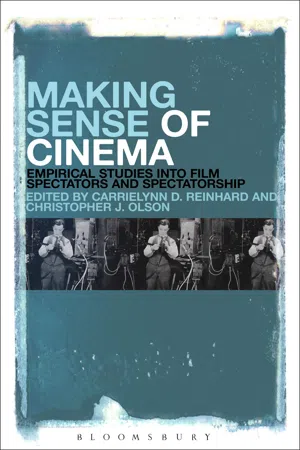
Making Sense of Cinema: Empirical Studies into Film Spectators and Spectatorship uses a number of empirical approaches (ethnography, focus groups, interviews, historical, qualitative experiment and physiological experiment) to consider how the film spectator makes sense of the text itself or the ways in which the text fits into his or her everyday life. With case studies ranging from preoccupations of queer and ageing men in Spanish and French cinema and comparative eye-tracking studies based on the two completely different soundscapes of Monsters Inc. and Saving Private Ryan to cult fanbase of the Lord of the Rings Trilogy and attachment theory to its fictional characters, Making Sense of Cinema aligns this subset of film studies with the larger fields of media reception studies, allowing for dialogue with the broader audience and reception studies field.
eBook - ePub
Making Sense of Cinema
Empirical Studies into Film Spectators and Spectatorship
- 288 pages
- English
- ePUB (mobile friendly)
- Available on iOS & Android
eBook - ePub
Making Sense of Cinema
Empirical Studies into Film Spectators and Spectatorship
About this book
Information
Table of contents
- Cover
- Title Page
- Contents
- List of Figures
- List of Tables
- List of Contributors
- Acknowledgments
- 1 Introduction: Empirical Approaches to Film Spectators and Spectatorship, CarrieLynn D. Reinhard and Christopher J. Olson
- 2 Spectatorship in Public Space: The Moving Image in Public Art, Annie Dell’Aria
- 3 The Festival Collective: Cult Audiences and Japanese Extreme Cinema, Jessica Hughes
- 4 Transnational Investments: Aging in Les Invisibles (Sébastien Lifshitz, 2012) and Its Reception, Darren Waldron
- 5 Preferred Readings and Dissociative Appropriations: Group Discussions Following and Challenging the Tradition of Cultural Studies, Alexander Geimer
- 6 “Legolas, He’s Cool … and He’s Hot!”: The Meanings and Implications of Audiences’ Favorite Characters, Martin Barker
- 7 In Search of the Child Spectator in the Late Silent Era, Amanda C. Fleming
- 8 Seeing, Sensing Sound: Eye-Tracking Soundscapes in Saving Private Ryan and Monsters, Inc., Andrea Rassell, Sean Redmond, Jenny Robinson, Jane Stadler, Darrin Verhagen and Sarah Pink
- 9 Seeing Animated Worlds: Eye Tracking and the Spectator’s Experience of Narrative, Craig Batty, Adrian Dyer, Claire Perkins and Jodi Sita
- 10 Focalization, Attachment, and Film Viewers’ Responses to Film Characters: Experimental Design with Qualitative Data Collection, Katalin Bálint and András Bálint Kovács
- 11 Making Sense of the American Superhero Film: Experiences of Entanglement and Detachment, CarrieLynn D. Reinhard
- 12 Indexing the Events of an Art Film by Audiences with Different Viewing Backgrounds, Sermin Ildirar
- 13 Exploring the Role of Narrative Contextualization in Film Interpretation: Issues and Challenges for Eye-Tracking Methodology, Thorsten Kluss, John Bateman, Heinz-Peter Preußer and Kerstin Schill
- 14 Conclusion: A Methodological Toolbox for Film Reception Studies, Christopher J. Olson
- Index
- Index A
- Index B
- Copyright
Trusted by 375,005 students
Access to over 1.5 million titles for a fair monthly price.
Study more efficiently using our study tools.
Frequently asked questions
Yes, you can cancel anytime from the Subscription tab in your account settings on the Perlego website. Your subscription will stay active until the end of your current billing period. Learn how to cancel your subscription
No, books cannot be downloaded as external files, such as PDFs, for use outside of Perlego. However, you can download books within the Perlego app for offline reading on mobile or tablet. Learn how to download books offline
We are an online textbook subscription service, where you can get access to an entire online library for less than the price of a single book per month. With over 1.5 million books across 990+ topics, we’ve got you covered! Learn about our mission
Look out for the read-aloud symbol on your next book to see if you can listen to it. The read-aloud tool reads text aloud for you, highlighting the text as it is being read. You can pause it, speed it up and slow it down. Learn more about Read Aloud
Yes! You can use the Perlego app on both iOS and Android devices to read anytime, anywhere — even offline. Perfect for commutes or when you’re on the go.
Please note we cannot support devices running on iOS 13 and Android 7 or earlier. Learn more about using the app
Please note we cannot support devices running on iOS 13 and Android 7 or earlier. Learn more about using the app
Yes, you can access Making Sense of Cinema by CarrieLynn D. Reinhard, Christopher J. Olson, CarrieLynn D. Reinhard,Christopher J. Olson in PDF and/or ePUB format, as well as other popular books in Media & Performing Arts & Film & Video. We have over 1.5 million books available in our catalogue for you to explore.