- 248 pages
- English
- ePUB (mobile friendly)
- Available on iOS & Android
eBook - ePub
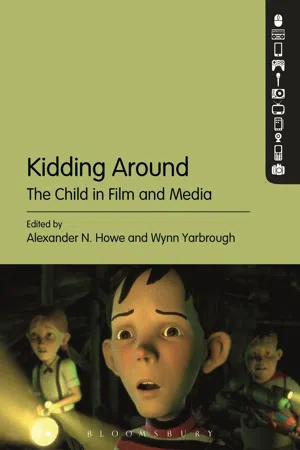
About this book
Kidding Around: The Child in Film and Media is a collection of essays generated by a conference of the same title held at the University of the District of Columbia. The works gathered examine a variety of children's media, including texts produced for children (e.g., children's books, cartoons, animated films) as well as texts about children(e.g., feature-length films, literature, playground architecture, parenting guides). The primary goal of Kidding Around is to analyze and contextualize contested representations of childhood and children in various twentieth- and twenty-first-century media while accounting for the politics of these narratives. Each of the essays gathered offers a critical history of the very notion of childhood, at the same time as it analyzes exemplary children's texts from the twentieth and twenty-first centuries. These chapters depart from various methodological approaches (including psychoanalytic, sociological, ecological, and historical perspectives), offering the reader numerous productive approaches for analyzing the moments of cultural conflict and impasse found within the primary works studied. Despite the fact that today children are one of the most coveted demographics in marketing and viewership, academic work on children's media, and children in media, is just beginning. Kidding Around assembles experts from this inchoate field, opening discussion to traditional and non-traditional children's texts.
Information
Part One
Rites of Passage and Impasse
1
Betwixt and Between: The Child in M. Night Shyamalan’s Films
University of Maryland, Baltimore County
At Apartment 16B at the Cove, Cleveland Heap rocks back and forth, loudly chomping down on a chocolate chip cookie and sipping a glass of milk, which leaves a mustache on his upper lip. He leans back on the living room sofa and slowly curls into the fetal position—hands tucked between his knees, one leg innocently flailing loosely in the air like a child ready for bedtime—and sweetly asks his young friend Young-Soon Choi, “Tell her it’s a beautiful story. Are there any parts that might be good to hear?”1 Young Su translates off screen in the background to her mother. After a moment of observing Mr Heap’s childlike transformation, the camera cuts to the women who are sitting across the coffee table, giggling. The performance allows Mr Heap full access to the Eastern bedtime story about Narfs, sea nymphs who visit the Earth to inspire their vessel or human counterpart. Days earlier, Mr Heap encountered Story, a young nymph who has been sent to enthuse the work of a young writer who lives in the complex. But, now out of the water, Story is stranded at the complex, unable to return home because of the wolf-like Scrunts who threaten to attack. It is only in accessing this child-like innocence and unquestioning imagination and faith in the legend of Narfs, and in themselves and their identities and roles in this story-turned-reality, that the tenants of the Cove can work together to find resolution in the tale and to safely return Story home to her Blue World.
The significance of youth to Shyamalan’s narrative, Lady in the Water (2006), quickly takes shape: deriving from Victorian sentiments, the child here may not only be read as innocent victim who fleshes out the gloom, sadness, and violence of the world, but also as a free-spirited, emotional dreamer who is capable of both seeing hope and walking towards it. For Philip Davis, the nineteenth-century child offered “an unconsciousness at the very root of human existence … [and] gave access to a realm of feeling and imagination prior to both the jadedness of ageing and the skepticism of the times.”2 This also rings true for the child figures in M. Night Shyamalan’s films, which are often constructed like fairytales themselves or whose plots are shaped by characters recovering myths and folklore. Within the layers of magic and the journey of his characters unfolds a moral story. Through Mr Heap and his adult company, we encounter both magical and innocent images of the child within Story; her vessel, Vick Ran and his sister; and even the neighborhood boy Joey Dury, who acts as “The Interpreter,” a reader of signs via a cupboard full of cereal boxes. We observe the film’s adult characters perform childlike mannerisms and activities in an effort to learn and understand the construct of the fairytale in which they are now a part.
Despite their unique insights into the world around them and their often-demure personalities, the child figures here are complicated with their links to evil and danger. For instance, it is clear from her appearance that Story does not belong in this world and is, in fact, the cause of the disruption in these tenants’ lives. Moreover, in an intimate conversation in the bathroom between Story and Vick, the audience finds out that Vick’s fate ultimately leads to his premature and violent death. Still, the journey of, or perhaps even through, youth as told by Shyamalan may be read as cathartic for some characters. Some become conscious of the flaws in their own relationships and community at large and reconnect to them, and Mr Heap himself is allowed the opportunity to finally grieve the death of his family. But, the larger question remains open at the end of his films: do these characters really gain a new sense of freedom and peace or do the laws and narratives to which these characters are bound only further limit and obstruct?
In his book Charles Dickens in Cyberspace, Jay Clayton reveals how contemporary American culture is inherently linked to Romanticism, and nineteenth-century Britain in general. The multimodal, “undisciplined culture” shared by Romanticism and postmodernism is what interests Clayton. While he examines the blurred boundaries of technology, hard sciences, humanities, and popular culture by looking at the past, it may be said that Shyamalan’s films blend or blur cinematic genres of science fiction, horror, and suspense and reconceptualize the contemporary from the past. (This may be seen in how Shyamalan’s style as a director is shaped by these genres, but also how each film uses past events and memories to shape its narrative arc.) But thematically, the films also address an undisciplined culture in the sense that they reveal breaks or gaps in social order. For Shyamalan, the figure of the child is key in shoring up these gaps and ultimately serves as a vehicle through which constructs are visible and understood by the child’s adult counterparts (and his audiences). Here, the image of child is grounded, yet more dynamic than its Victorian precursors. They are ambiguous, no longer tied to archetypes of victim or villain. Elizabeth Tucker traces the evolution of nine archetypes of the child in folklore studies from the nineteenth century to the present—“the savage child,” “the secret-keeping child,” “the magic-making child,” “the cerebral child,” “the taboo-breaking child,” “the monstrous child,” “the bubble-wrapped child,” “the creative, conservative child,” and “the evolving child.”3 Shyamalan’s portraits of the child blend, blur, the characteristics defining each of these categories. Collier extends this by highlighting how the film’s narrative itself also blurs genre: “the film, in the process of veering repeatedly from supernatural thriller to period romance to fairy tale to political allegory, thematizes the quite relevant, and contemporary, political question of the ethics of deliberate fictiveness and myth-making in governance.”4 Within the increasingly fragmented and paradoxical cultural logic extent in contemporary culture, the child represents a contagious element in culture, an antinomian impulse that simultaneously leads towards the refusal of law and, with this new awareness, towards the recodification of it. By demonstrating how the social works, Shyamalan’s child allows the chance to see how it can also unwork—and an opportunity for each of us to consider how we look at the world and why.
Ideologically, the horror and science fiction genres are oriented towards a description of some otherness, of something beyond that which mainstream society conceives as conventional. This may be seen in terms of the visually realizing of an alternate culture or social order or by depicting images of the grotesque or monstrous and then questioning how this process or image affects the boundaries of past conceptions of what it means to be human. In particular, these genres make existentialist inquiries concerning mortality, ethics, and purpose that aid finding an individual’s place in the world. But this introspective journey usually begins with a physical investigation of an unknown or mysterious force. Alien identities are very much a part of popular culture, and, while their portraits span from angelic and protecting to monstrous and life-threatening, fear and angst are often the initial human reactions to the “inhuman.”
Aliens—foreigners from beyond this world—are indeed commonplace to M. Night Shyamalan’s films, whose cinematographic style and mise-en-scène also owe much to the aforementioned genres. Initially distinguishing themselves as the binary opposite to these “other” creatures, Shyamalan’s protagonists and audiences simultaneous explore and reconstruct the uncanny identity of these alien figures together. However, it is not the protagonists’ expeditions, but rather the visions of their child protégés that provide access to the awareness and understanding of this otherness. In fact, it is the child (and his or her kinship with this Other), not the existence or construction of the otherworldly alien identities, which raise the larger questions concerning the meaning of life and the universe. Without the existence or intervention of these perceptive children, this investigative process might never take place. By depicting the child as contagious sage, Shyamalan reveals the child as a critical component in the construction of ideology.
Children of the Victorian Age, we are the people who fear contagion, restrained by a cultural logic marked by “panic about the social body” and obsessed by purity and danger. Foucault remarks that “in order to see perfect disciplines functioning, rulers dreamt of a state of plague … [T]he image of plague stands for all forms of confusion and disorder.”5 While Foucault sees this plague as an attempt to control the masses, in a different context, Mary Douglas discusses the way that a cultural obsession with pollution ideas makes possible a shoring up of social structures when political or moral authority is weak.6 Similarly, Julia Kristeva has argued that when paternal structures of social authority are in crisis, a focus upon “abjection” and defilement occurs in a kind of return of fundamental cultural anxieties.7 It might be said, then, that the topic of contagion offers the possibility of a resolution of vexing questions of law, morality, social order and some revelation to larger universal concepts of authority, power, and knowledge.
Perhaps stemming from a nineteenth-century, Dickensian model, early films depict children in a romantic setting as natural innocents victimized in a harsh and inhumane world. Foucault might then argue that such a figure was a perfect excuse to establish and implement laws designed to “protect” the child. Cinematically, this traditional image was later corrupted, shifting into the cherubic child’s converse: a monstrous and demonic creature creating chaos and disorder. In her book Children Without Childhood, Marie Winn chronicles the cinematic development of the image of the child:
In the sixties a new sort of child appeared in motion pictures; from a sweet, idealized Shirley Temple or Margaret O’Brien poppet, the movie child grew into a monster. First came … a prepubescent killer in The Bad Seed in 1956. Then, in Village of the Damned (1962), sweet faced children turned out to be malevolent beings from outer space. The trend accelerated in the late sixties and early seventies, culminating in the appearance of a spate of satanic juveniles on movie screens. Rosemary’s Baby was the first, a mild exercise in horror compared to The Exorcist, which featured … a darling little girl transformed just at puberty, into a ravening, sexually rapacious, and murderous creature.8
Whether envisioned as angelic or demonic, the child is a compelling motif in cinema capturing the capabilities of human emotion and creativity. In the case of a film like The Exorcist, audiences are filled with compassion and sentimentality towards the suffering child and infected with fear of the demons possessing her, a fear that what attacks the child may be transmitted to us all. The popularity of the film also reveals the human fascination with the monstrous, the unknown, and the “spectacle of suffering.”9 While Shyamalan’s child certainly descends from both models, the figure remains detached from the antecedent examples of horror and sci-fi, occupying a space that neither qualifies it as the passive victim nor as the monstrous attacker. Whereas Regan in The Exorcist transforms from one model to the other, Shyamalan’s central child exists in a limin...
Table of contents
- FC
- Half title
- Title
- Contents
- Acknowledgments
- Introduction: Representations and Renegotiations: Childhood and Its Uses Wynn Yarbrough and Alexander N. Howe
- Part 1 Rites of Passage and Impasse
- Part 2 Childhood as Text
- Part 3 Disney and Its Progeny
- Conclusion: Criticism and Multicultural Children’s Films Iris Shepard and Ian Wojcik-Andrews
- Notes on Contributors
- Index
- Copyright
Trusted by 375,005 students
Access to over 1.5 million titles for a fair monthly price.
Study more efficiently using our study tools.
Frequently asked questions
Yes, you can cancel anytime from the Subscription tab in your account settings on the Perlego website. Your subscription will stay active until the end of your current billing period. Learn how to cancel your subscription
No, books cannot be downloaded as external files, such as PDFs, for use outside of Perlego. However, you can download books within the Perlego app for offline reading on mobile or tablet. Learn how to download books offline
Perlego offers two plans: Essential and Complete
- Essential is ideal for learners and professionals who enjoy exploring a wide range of subjects. Access the Essential Library with 800,000+ trusted titles and best-sellers across business, personal growth, and the humanities. Includes unlimited reading time and Standard Read Aloud voice.
- Complete: Perfect for advanced learners and researchers needing full, unrestricted access. Unlock 1.5M+ books across hundreds of subjects, including academic and specialized titles. The Complete Plan also includes advanced features like Premium Read Aloud and Research Assistant.
We are an online textbook subscription service, where you can get access to an entire online library for less than the price of a single book per month. With over 1.5 million books across 990+ topics, we’ve got you covered! Learn about our mission
Look out for the read-aloud symbol on your next book to see if you can listen to it. The read-aloud tool reads text aloud for you, highlighting the text as it is being read. You can pause it, speed it up and slow it down. Learn more about Read Aloud
Yes! You can use the Perlego app on both iOS and Android devices to read anytime, anywhere — even offline. Perfect for commutes or when you’re on the go.
Please note we cannot support devices running on iOS 13 and Android 7 or earlier. Learn more about using the app
Please note we cannot support devices running on iOS 13 and Android 7 or earlier. Learn more about using the app
Yes, you can access Kidding Around by Alexander N. Howe,Wynn Yarbrough in PDF and/or ePUB format, as well as other popular books in Scienze sociali & Scienze della comunicazione. We have over 1.5 million books available in our catalogue for you to explore.