eBook - ePub
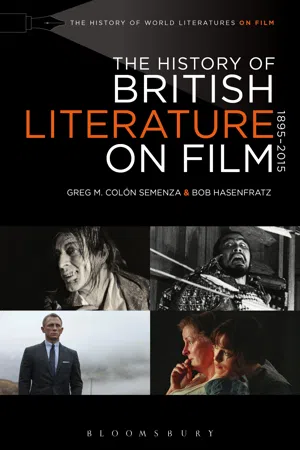
The History of British Literature on Film, 1895-2015
- 488 pages
- English
- ePUB (mobile friendly)
- Available on iOS & Android
eBook - ePub
The History of British Literature on Film, 1895-2015
About this book
From The Death of Nancy Sykes (1897) to The Hobbit: The Battle of the Five Armies (2014) and beyond, cinematic adaptations of British literature participate in a complex and fascinating history. The History of British Literature on Film, 1895-2015 is the only comprehensive narration of cinema's 100-year-old love affair with British literature. Unlike previous studies of literature and film, which tend to privilege particular authors such as Shakespeare and Jane Austen, or particular texts such as Frankenstein, or particular literary periods such as Medieval, this volume considers the multiple functions of filmed British literature as a cinematic subject in its own right-one reflecting the specific political and aesthetic priorities of different national and historical cinemas. In what ways has the British literary canon authorized and influenced the history and aesthetics of film, and in what ways has filmed British literature both affirmed and challenged the very idea of literary canonicity? Seeking to answer these and other key questions, this indispensable study shows how these adaptations emerged from and continue to shape the social, artistic, and commercial aspects of film history.
Information
1
Attractions, tricks, and fairy tales: Visual and theatrical culture in the Brit-Lit film, 1896–1907
In 1897, The Phonoscope, a trade magazine “devoted to Scientific and Amusement Inventions Appertaining to Sight and Sound,” took a breathless moment to imagine the future of motion pictures in an interview with its hero, Thomas A. Edison.1 In a flight of science fiction fancy, Edison thinks of future motion pictures as a kind of titanic simulcast: “The Wizard Says we Will Sit in a New York Theatre and Enjoy a London Play.” Though the longest films in 1897 lasted considerably less than five minutes, Edison was able to envision a technology “capable of transferring an entire play to a big screen of a city theatre,” combining the kinetoscope with the phonograph:
The stage of the New York theatre is entirely cleared, even the scenery being removed. A huge white sheet is stretched from the flies to the stage. It covers the stage completely, like an immense white curtain. The regular drop curtain rolls down over it. Behind the white curtain are placed a number of phonographs, with immense vibrating horns, capable of multiplying sound one hundred times. One of these phonographs is for each actor. If there be ten players in the cast, then ten phonographs are arranged behind the curtain. Each is loaded with the dialogue of that particular player. In the gallery, out of sight of the audience, is a huge kinetoscope, containing hundreds of yards of film, upon which is the whole play, actors, costumes, scenery, and everything. The theatre is then darkened. Suddenly there is a flash of electric light and the curtain goes up on the first act. There it is, as perfect as life. You don’t realize you are looking at a white curtain. You see what looks like a real stage. It is the picture of a stage of a London theatre. There are the scenery, the houses, the trees and pathways. The chairs look so real that you would almost dare to sit in them, and even natural colors are reproduced.2
The thought of representing a “real stage” seems at first bizarre since film’s capacity to capture reality and to frighten early audiences with onrushing trains or amaze it with lapping ocean waves or street scenes was so often touted. Oddly, in Edison’s imagination, film’s documentary realism makes it ideal to capture staged facsimiles of reality: “the scenery, the houses, the trees, the pathways.” What a strange desire to reproduce reproduction. Looked at another way, though, Edison’s fantasy reveals that early film looked to the theater as the medium it aspired to imitate. In fact, Edison’s futuristic fantasy suggests that at this early point in the development of film, it was really the representational and narrative techniques of the stage rather than the novel or short story that provided immediate models and aspirations for filmmakers. Adding another layer of complication, though, the nineteenth-century stage itself turned to the literary novel, short story, and poem as sources for its theatrical adaptations.
In fact, two of the most common assumptions about literary adaptations on film are flatly wrong for the first decade of moviemaking. First, probably because of the short format of early films and the initial absence of intertitles, filmmakers seemed to have almost no concern at all with fidelity to the literary text. Instead, the earliest adaptors tended to choose the most melodramatic moments from literary classics that had wide currency on the stage or in popular culture and weaved them together with great creative freedom. Second, the notion that early filmmakers turned to literature as a way of gaining cultural legitimacy for their art is—with one exception that we know of—an extremely misleading assumption until the middle years of the nickelodeon era—well past 1905. Instead of comparing early films like Death of Nancy Sykes (1897) or King John (1899) to products of the “uplift” movement in the following decade (see below, pp. 72–94), it actually makes more sense to compare them to boxing movies like the Leonard-Cushing Fight (1894) that reconstructed in a studio key moments from the biggest matches. Like them, the earliest Brit-Lit adaptations were restagings of memorable events and thus participated in a documentary impulse as much as a literary one. These adaptations are partly “actualities,” in other words, films of live, newsworthy, or “actual” events.
Adaptations from literary sources in the earliest period of motion-picture history represent a minority of subjects that ranged from actualities, factory scenes, images of speeding locomotives, short comedies, dancing women, strong men, boxing matches, travel clips, and war reports, among others.3 It is possible, in fact, that these adaptations weren’t adaptations in the conventional sense at all in that they didn’t make it to celluloid because of a conscious desire on the part of producers to render literature in a visual form. In the late 1890s, popular theater and films were at their closest points of contact: not only did many early literary films record performances from the popular stage, but early films were often shown on vaudeville and music hall stages as one of a series of acts. One of the leading historians of early film, Charles Musser, writes that “the Edison films from this period [1894–95] provide a remarkable record of New York–based popular performances: circus performers, boxers, strongmen, dancers, scenes from musical comedies, revues and farces, as well as members of Buffalo Bill’s Wild West Show.” He goes on to say categorically that “the relationship between motion pictures and performance culture was profound and the two practices overlapped, interpenetrated and even merged on almost every level.”4 A great many early films are so directly connected to prior stage adaptations of literary sources that they might be best thought of as adaptations of adaptations and, in some cases, adaptations of adaptations of adaptations, in short, as cinematic palimpsests. As will emerge in what follows, these earliest representations of subjects from British literature can almost always be thought of as actualities or even advertisements: they documented and promoted popular stage shows of the late 1890s mainly in New York and London, often starring prominent performers from the popular or legitimate stage.5
Ever since Eisenstein suggested that film pioneer D. W. Griffith invented montage on the model of Dickens’s fiction,6 most students of literary adaptation have looked to the novel as the master narrative form in direct dialogue with movies.7 But in an important article from the late 1980s, Rick Altman pointedly calls out scholars for their seemingly willful denial of the theatrical origins of early film adaptations:
By and large, critics have ignored the influence of theatrical adaptations. Eisenstein provides information on the stage source of Griffith’s Cricket on the Hearth, yet he never attributes any importance to the existence of a theatrical intermediary. Many other critics follow precisely the same logic; they identify the dramatic version from which the film author directly borrowed, but assume that little is to be gained by comparing the film to an ephemeral and undistinguished stage adaptation. More often, critics blithely postulate a direct connection between a film and the novel from which it is ostensibly drawn, when even minimal research clearly identifies a dramatic adaptation as an important direct source for the film. … It is easy enough to demonstrate the debt that early cinema owes to theatrical adaptations.8
We wish we could report that Altman’s call inspired a wave of new research, but on the whole adaptation studies has remained doggedly dedicated to the text-to-film case study (see above, pp. 8–9). As recently as 1997, theater historian David Mayer descried the way that film historians view the nineteenth-century stage as an exhausted and feeble institution which passed on its cultural energy to film in a kind of tag team pass over. He argues that we should complicate simplistic teleologies that ignore the demonstrable influence of theater history on early film.9 Fortunately, several film historians like Musser, Elaine Bowser, Tom Gunning, and Andre Gaudreault have effectively situated early film in the rich ecosystem of late Victorian popular entertainment. Nonetheless, Altman and Mayer’s calls to take theatrical culture seriously and trace specific adaptations through their stage intermediaries, regardless of how “ephemeral and undistinguished,” have not been taken up very seriously.
* * *
This chapter will trace the emergence of the Brit-Lit film, beginning with the earliest one-shot adaptations, which depict the most spectacular or melodramatic moments from larger literary narratives. After situating the first Brit-Lit adaptation, Death of Nancy Sykes (1897), in a rich context of spectacular adaptation, we will consider a number of other early one-shot films. Next, we will examine the emerging multi-shot narrative films that began to be produced around 1902. Directors like Cecil Hepworth, Robert W. Booth, George Albert Smith, and George Méliès turned to literary sources to construct more complicated, multi-shot films like Scrooge, or, Marley’s Ghost (UK, Booth, 1902), Gulliver’s Travels (France/US, Méliès, 1902), A Trip to the Moon (France/US, Méliès, 1903), and Alice in Wonderland (UK, Hepworth, 1903)—not for the prestige of their source texts or any cultural or educational uplift they might provide, but as fit subjects for “trick films,” which could exploit the magic of special effects: the double exposure, substitution shot, and so forth. The majority of these films adapted children’s texts which already enjoyed a rich history of visual interpretation, whether in theatrical adaptations or in book illustrations. Finally, we consider briefly the vogue for adapting more classic Brit-Lit texts at the close of the period. Throughout, we argue that early adaptors turned to narrative sources belonging to late nineteenth-century visual culture, more than literary or narrative culture.
1 Early cinema: Focus on spectacle or storytelling?
Since the pivotal Brighton Conference on early film in 1978,10 historians of what used to be called “Primitive Cinema” have argued forcefully against defining early cinema as a mere preparation for the narrative feature films that emerged decisively around 1915,11 challenging researchers to investigate the diverse films of this period on their own terms. Two scholars in particular, Gunning and Gaudreault,12 have championed a different view of movies in their first two decades, which form what they call the “cinema of attractions.” Though films from 1896 through to the rise of multi-reel films are not necessarily antinarrative, Gunning and Gaudreault argue, they share with other popular entertainments of the time (including fairground shows, vaudeville, and magic acts—that is, “attractions”) a desire to produce a sense of wonder and amazement through dramatic visual spectacle. Thus such films aim for a different effect than the classic narrative film, which relies on conventions of shooting and editing that signal narrative cohesion and progress. In fact, Gaudreault and Gunning use the phrase “monstrative attraction” to stress that the basic component of the cinema of attractions has to do with visual, not necessarily narrative power. In a coauthored essay, they show how the cinema of attractions functioned on the level of the individual shot:
Each shot is implicitly understood as an autonomous and autarkic unity and the potential connection between shots, when there is more than one, is restricted to a minimum. Where there is pluri-punctuality [films with more than one shot], the film resembles an “aggregate of shots,” where each in its turn sets off the system of monstration [display], without setting off the process of narration...
Table of contents
- Cover-Page
- Half-Title
- Series
- Title
- Dedication
- Contents
- List of Figures
- Acknowledgments
- Introduction
- 1 Attractions, tricks, and fairy tales: Visual and theatrical culture in the Brit-Lit film, 1896–1907
- 2 “Crude, Vicious, and Lascivious Entertainments”: The rise of the Brit-Lit feature film, 1907–20
- 3 Internationalizing the Brit-Lit film: Hollywood and the world film market, 1920–27
- 4 Sound, studios, and censorship: The Brit-Lit film, 1927–39
- 5 The empire strikes back: Britain’s reclamation of Brit-Lit, 1939–57
- 6 Traditions and revolutions: The Brit-Lit film, 1957–79
- 7 The Brit-Lit film after film, 1979–2015
- Notes
- Bibliography
- Flim Index
- General Index
- Copyright
Trusted by 375,005 students
Access to over 1.5 million titles for a fair monthly price.
Study more efficiently using our study tools.
Frequently asked questions
Yes, you can cancel anytime from the Subscription tab in your account settings on the Perlego website. Your subscription will stay active until the end of your current billing period. Learn how to cancel your subscription
No, books cannot be downloaded as external files, such as PDFs, for use outside of Perlego. However, you can download books within the Perlego app for offline reading on mobile or tablet. Learn how to download books offline
Perlego offers two plans: Essential and Complete
- Essential is ideal for learners and professionals who enjoy exploring a wide range of subjects. Access the Essential Library with 800,000+ trusted titles and best-sellers across business, personal growth, and the humanities. Includes unlimited reading time and Standard Read Aloud voice.
- Complete: Perfect for advanced learners and researchers needing full, unrestricted access. Unlock 1.5M+ books across hundreds of subjects, including academic and specialized titles. The Complete Plan also includes advanced features like Premium Read Aloud and Research Assistant.
We are an online textbook subscription service, where you can get access to an entire online library for less than the price of a single book per month. With over 1.5 million books across 990+ topics, we’ve got you covered! Learn about our mission
Look out for the read-aloud symbol on your next book to see if you can listen to it. The read-aloud tool reads text aloud for you, highlighting the text as it is being read. You can pause it, speed it up and slow it down. Learn more about Read Aloud
Yes! You can use the Perlego app on both iOS and Android devices to read anytime, anywhere — even offline. Perfect for commutes or when you’re on the go.
Please note we cannot support devices running on iOS 13 and Android 7 or earlier. Learn more about using the app
Please note we cannot support devices running on iOS 13 and Android 7 or earlier. Learn more about using the app
Yes, you can access The History of British Literature on Film, 1895-2015 by Greg M. Colón Semenza,Bob Hasenfratz in PDF and/or ePUB format, as well as other popular books in Media & Performing Arts & Literary Criticism. We have over 1.5 million books available in our catalogue for you to explore.