- 160 pages
- English
- ePUB (mobile friendly)
- Available on iOS & Android
eBook - ePub
About this book
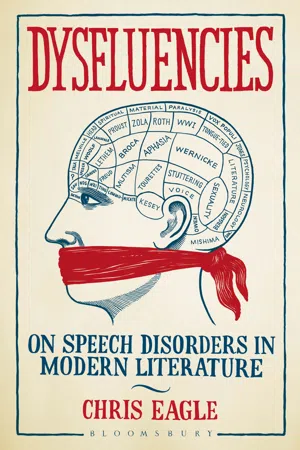
Dysfluencies is the first comprehensive study of how speech disorders are portrayed in modern literature. Tracing the roots of this interaction between literary practice and speech pathology back to the rise of aphasiology in the 1860s, Dysfluencies examines portrayals of disordered speech by writers like Zola, Proust, Joyce, Melville, and Mishima, as well as contemporary writers like Philip Roth, Gail Jones, and Jonathan Lethem. Dysfluencies thus speaks directly to the growing interest at present, both in popular culture and the Humanities, regarding the status of the Self in relation to speech pathology. The need for this type of study is clear considering the number of prominent writers whose works foreground disorders of speech: Melville, Zola, Kesey, Mishima, Roth, et al. Moreover, thinkers like Freud, Bergson, and Jakobson were similarly concerned with the implications of language breakdown. This volume shows this concern began with the rise of neurology and aphasiology, which challenged spiritual conceptions of language and replaced them with a view of language as a material process rooted in the brain. Dysfluencies traces the history of this interaction between literary practice and speech pathology, arguing that works of literature have responded differently to the issue of language breakdown as the dominant views on the issue have shifted from neurological (circa 1860s to 1920s) to psychological (circa 1920s to 1980s), and back to neurological during the so-called "decade of the Brain" (the 1990s).
Information
1
Aphasia and Neurology in Zola and Proust
“There is no case on record – at all events, I have never come across it – of a hero or heroine in a novel possessing a disagreeable voice.”
– Arthur Lovell, Beauty of Tone in Speech and Song (1904)
“la vieille paralytique”
In his 1889 monograph De L’aphasie et de ses diverses formes, the professor of medicine Désiré Bernard singled out Emile Zola as the sole example to date of a writer of fiction who had portrayed the condition of aphasia with any degree of clinical accuracy: “If a place ought to be reserved in this study for Letters, one would have to mention above all M. Emile Zola who, as early as 1867, portrayed an aphasic in the moving pages of Thérèse Raquin, with a perfect understanding of what he was describing.”1 This favorable assessment of the depiction of language loss in the story of Madame Raquin raises familiar questions about the more general role that scientific and medical discourses play throughout Zola’s corpus. In terms of this study, Bernard’s remark raises two other more specific questions: first, about the awareness Zola would have actually possessed of aphasiology during the year he spent composing his first major novel and second, whether the character Madame Raquin can in fact be properly termed “aphasic.” To address these questions, I will examine two portrayals of language loss by Zola, the case of Madame Raquin and a second case of apoplexy and language loss from Zola’s 1886 novel La Terre.
Désiré Bernard’s passing reference to Zola comes in a footnote to the second chapter of De L’aphasie, in which he offers the polemical overview of aphasiology for which his study is remembered if at all today. Bernard’s polemical ire is directed at those revisionist medical writers such as the American neurologist William Hammond who, in the wake of Broca, had gone searching throughout Western history for prior evidence of aphasia being mentioned across the disciplines, in the works of philosophers like Plato and Sextus Empiricus, historians like Thucydides, grammarians like Suetonius, poets like Homer and Goethe, even the prophet Isaiah.2 While Bernard does not deny that, “there have been aphasics as long as man has spoken and his brain has been prone to disease,” he insists at the same time that any talk of aphasia per se prior to Broca’s 1861 discovery was absurd since before then, “a total obscurity reigned over the alterations of language, as much in the clinical descriptions as in the nosologies.”3 In other words, for Bernard along with many of his contemporaries, aphasia as such simply did not exist until the discovery that lesions to the third frontal convolution of the left hemisphere consistently resulted in diverse forms of language loss. For the same reason, the Aphasic, either as a clinical or social category, could not exist yet either. In his historical study of aphasiology Lost Words, L. S. Jacyna notes the following in reference to Bernard’s remarks on Zola: “It was only after Broca had described the condition that it became possible for aphasia to possess a textual existence. If one were to seek a true account of the condition in imaginative literature, it was necessary to look to writing in the modern, post-1861 period.”4 From this vantage point, Bernard’s crediting of Zola with the first accurate literary portrayal of aphasia takes on a much greater significance, one in which the character of Madame Raquin could even be said to signal a new period in the history of the Novel where the neurological conception of language crossed for the very first time over into literature. If this were true, if Madame Raquin could be called “literature’s first Aphasic,” this would require of course that the textual existence of Zola’s “old paralyzed woman” [vieille paralytique] be fully informed by a post-1861 view of the cerebral site of language as well as the cerebral cause of language loss.5 But for reasons that will become clear over the course of this chapter, the depiction of Madame Raquin’s paralysis and language loss does not ultimately bear this out, and it is not until slightly later, in 1886, that we find Zola depicting language loss in a distinctly post-Broca way.
What makes Bernard and Jacyna’s assumption problematic from the start is the total absence of any biographical evidence that Zola, prior to composing Thérèse Raquin, was familiar with Broca’s case studies or with their reception in the medical circles of 1860s Paris. In his correspondence, Zola makes no mention of Broca or of his phrenological precursors Gall and Bouillaud. Nor is there any evidence in the years following, as Zola progresses through the Rougon-Macquart series, of a familiarity with the second wave of aphasiologists like Carl Wernicke, Adrien Proust (whose influence on his son I will discuss later in this chapter), et al. Although Zola does make occasional references in his letters to the work of Jean-Martin Charcot, Charcot’s studies of aphasia were not conducted until long after the completion of Thérèse Raquin (circa 1883–84).6 In the “case” of Madame Raquin, the symptoms that Désiré Bernard calls aphasic are nowhere in the novel referred to in those terms. Rather, the onset of Madame’s health troubles is described more in line with the autopathography of Samuel Johnson, as a slowly progressive paralysis that first diminishes mobility in her lower limbs and gradually works its way upward to the vocal organs:
Little by little paralysis was coming over Madame Raquin, and they foresaw the day when she would be chair ridden, powerless in body and mind. The poor old soul was beginning to mutter disconnected phrases, her voice was failing, and her limbs one after another were becoming useless.7
Madame is consistently referred to thereafter as “the paralyzed woman” [la paralytique], and her eventual language loss several months after the onset of her bodily paralysis is treated as the culmination of this immobility in the speech organs:
Paralysis, which for months past had been creeping through her limbs, ever on the point of striking, seized her by the throat and pinioned her body. One evening, as she was quietly talking to Thérèse and Laurent, she stopped in the middle of a sentence, open-mouthed, gaping, feeling as if she were being strangled. She tried to shout for help but could only utter raucous sounds. Her tongue had turned to stone. Her hands and feet had stiffened. She was struck dumb and motionless [Elle se trouvait frappée de mutisme et d’immobilité].8
Although the term “aphasic” appears nowhere in the novel, we see here that Madame Raquin’s loss of speech is explicitly referred to as a case of mutism. Traditionally, mutism has been associated with either diminished intelligence (idiocy) or deafness. As we noted in the Introduction, Broca’s main objective in coining the term “aphemia” was to differentiate the cerebral impairment of the language faculty from conditions with which they were confused, in particular, mutism and paralysis of the speech organs. In Zola’s descriptions of Madame Raquin, however, her language loss is directly associated with both of these conditions. Her lips are described in paralytic terms as “twisted and inert” [tordues et inertes].9 Likewise, her tongue has “turned to stone” [devenue de pierre], feels “cold against her palate” [froide contre son palais], and in the end falls “quite dead” [bien morte].10 In terms of the dichotomy established in the Introduction, then, her language difficulties are clearly a matter of the tongue and throat, not of the brain. What is portrayed here is a breakdown of speech, not of the language faculty as such, something which contradicts Désiré Bernard’s “diagnosis” of Madame Raquin as the first aphasic character in modern fiction.11 This is not meant to argue of course that Madame does or does not suffer from aphasia, but simply that Zola’s emphasis on paralysis and mutism means her language loss is still being portrayed (and most likely understood) in a pre-Broca sense. In terms of its place in the history of portrayals of speech pathology, Thérèse Raquin therefore stands in a more transitional moment, one where the discourse of neurology is already prevalent but that of aphasiology has not yet been fully assimilated into popular discourse.
“nervous being”
While there may be no direct evidence that Zola was familiar with the most current aphasiological theories at the time, the more general influence of mid-nineteenth-century positivism and biological science on Zola’s early writings has been well documented.12 It has also been more firmly established that the theory of heredity in Doctor Prosper Lucas’ Traité philosophique et physiologique de l’hérédité naturelle (1850) and, most importantly, the methods of experimental physiology in Claude Bernard’s Introduction à l’étude de la médicine expérimentale (1865) both had a direct impact on the radically new novelistic method that Zola developed for Thérèse Raquin. In his Preface to the second edition of the novel, Zola mixes various medical and scientific discourses to explicate his new method. His stated aim is to banish the customary psychological categories of character, motivation, personality, etc. around which the Novel was traditionally organized. Instead, he claims to perform the strictest study possible of “temperaments and not characters” with equal attention paid to the role of heredity and environment in modifying what he refers to as the human organism.13
Above all, in his Preface, Zola borrows liberally from the discourses of neurology and physiology, stressing that he has chosen to study these particular organisms because his protagonists, Thérèse and Laurent, are “completely dominated by their nerves and blood,” respectively.14 In his Introduction to the novel, Hénri Mitterand points out that terms like nerves, neurosis, and neurology were already in widespread use as early as 1845 due to a burgeoning interest in the pathology of the nervous system. The popularization from 1840 to 1870 of neurological and physiological terms in dictionaries like Landais, Bescherelle, and Larousse means, according to Mitterand, that “the link is very quickly established, in this domain, between the experts, the popularisers, the essayists, the critics and the novelists. . . . Anatomy, scalpel, physiology, analysis, hysteria, neurosis, dissection, erethism, are the buzzwords [maître-mots] of 1860.”15
The popularization of the discourse of aphasia, on the other hand, happened much more gradually. The relatively slower assimilation of aphasiological terminology into popular discourse was due in part to the debates in the 1860s within the nascent field of aphasiology over which term best described this new pathology. Broca, as we know, considered a number of different terms (alogia, alalia, aphasia, aphemia, etc) to categorize the related forms of language loss his patients exhibited, however, the coinage he eventually chose (aphemia) was soon overtaken by Trousseau’s preferred term (aphasia). In his 1864 letter to Trousseau, Broca objected to this because of a philosophical sense the word aphasia still carried in the 1860s, a sense which is now completely obsolete. The earliest known usage of “aphasia” was by the Stoic Sextus Empiricus, who used the word as a philosophical term to signify “a condition of mind, according to which we neither affirm nor deny anything.”16 This sense of aphasia as the antonym to phatic speech in propositional logic was anything but archaic by the 1860s. In fact, it persists as the primary definition in the Larousse dictionary of 1866 (the year before Thérèse Raquin was written), in which “aphasia” is defined as follows: “Indecision, one’s state of mind in the case of questionable judgment” [Indécision, état de l’esprit dans le cas de jugement problématique].17 It is not until the 1890 supplement of Larousse that the medical sense of aphasia as “loss of speech” [perte de la parole] supplants the philosophical sense and becomes the primary definition. Somewhat surprisingly, the 1863 dictionary of Broca’s colleague Emile Littré also contains no entry for aphasia or aphemia, and it is not until the 1892 supplement of Littré that aphasia is finally defined in specific relation to the work of Broca as the “abolition of articulated language despite the faculty of expression remaining intact” [abolition du langage articulé malgré la persistence de la faculté d’expression].18 Thus, to borrow Mitterand’s formulation, terms like aphasia and aphasic, aphemia and aphemic, alalia, aphonia, agraphia, etc. simply did not have the same level of popular currency that the buzzwords of neurology did when Zola was writing Thérèse Raquin.
It comes as little surprise then that Thérèse Raquin is saturated not with the terms of aphasiology but with a more strictly neurological vocabulary of nerves and nervousness. The “nervous energy” [énergie nerveuse] that permeates Zola’s novel comes mainly from his monotonous use of the keywords “nerves” and “nervous.”19 Nerves in Thérèse Raquin are variously described as rebellious, strained, terrified, stiffened, shattered, etc. They are said to stretch and give way, to threaten, dominate, and irritate the characters, and the three members of the novel’s central love triangle are constantly searching for ways to calm or ease their strained nerves. Zola further expands this neurological texture of his novel by including different cognates of the root-word “nerve,” making Thérèse and Laurent so “enervated” [s’énervait] by the horror of Camille’s death that the “enervations of the crime” [énervements du crime] ultimately produce in them an “acute neurosis” [névrose aiguë].20 The adjective “nervous” is applied over two-dozen times throughout the course of the novel to numerous mental, emotional, or physical states ranging from nervous joy to nervous anguish. Moreover, the twitchy bodily movements generated by their nervous existence include an assortment of nervous shivers, shakes, and contractions. Following the murder of Camille in Chapter 12, the remaining 20 chapters are almost entirely concerned with Laurent’s and Thérèse’s unsuccessful efforts to settle what Zola refers to as their “nervous being” [être nerveux].21 The intended effect of this neural vocabulary, of course, was to take what the Novel had traditionally treated as higher mental and moral states (soul, passion, conscience, etc.) and reduce them to what Zola believed were at root purely physiological manifestations (nerves, blood, flesh, etc).
Many critics have pointed out that Zola’s study of the temperaments of the principal characters in Thérèse Raquin adheres closely to the medieval theory of humors with its four types of temperaments (sanguine, melancholic, lymphatic, and bilious). Camille, whose “ill-health had impoverished his blood,” rendering him sickly and weak as a child, exhibits a lymphatic disposition.22 Thérèse is forced to grow up in the sterile environment of Camille’s room and coddled by her aunt Madame Raquin as if she too were a sick child. She is even given the same medicines her cousin takes, but this “enforced invalidism” fails to weaken the “boiling” African blood which she inherits from her mother, a native beauty from Oran.23 When she is later compelled to marry her cousin Camille, Thérèse displays an “external ...
Table of contents
- Cover-Page
- Half-Title
- Dedication
- Title
- Contents
- Acknowledgments
- Introduction: The Neurolinguistic Turn
- 1 Aphasia and Neurology in Zola and Proust
- 2 Speech Disorders and Shell Shock in World War I Writing
- 3 Stuttering and Sexuality in Woolf, Melville, Kesey, and Mishima
- 4 Stuttering, Violence, and the Politics of Voice in Robert Graves, Philip Roth, and Gail Jones
- 5 Tourettic Speech in Jonathan Lethem’s Motherless Brooklyn
- Conclusion: On Speech Disorders in Theory
- Notes
- Bibliography
- Index
- Copyright
Trusted by 375,005 students
Access to over 1.5 million titles for a fair monthly price.
Study more efficiently using our study tools.
Frequently asked questions
Yes, you can cancel anytime from the Subscription tab in your account settings on the Perlego website. Your subscription will stay active until the end of your current billing period. Learn how to cancel your subscription
No, books cannot be downloaded as external files, such as PDFs, for use outside of Perlego. However, you can download books within the Perlego app for offline reading on mobile or tablet. Learn how to download books offline
Perlego offers two plans: Essential and Complete
- Essential is ideal for learners and professionals who enjoy exploring a wide range of subjects. Access the Essential Library with 800,000+ trusted titles and best-sellers across business, personal growth, and the humanities. Includes unlimited reading time and Standard Read Aloud voice.
- Complete: Perfect for advanced learners and researchers needing full, unrestricted access. Unlock 1.5M+ books across hundreds of subjects, including academic and specialized titles. The Complete Plan also includes advanced features like Premium Read Aloud and Research Assistant.
We are an online textbook subscription service, where you can get access to an entire online library for less than the price of a single book per month. With over 1.5 million books across 990+ topics, we’ve got you covered! Learn about our mission
Look out for the read-aloud symbol on your next book to see if you can listen to it. The read-aloud tool reads text aloud for you, highlighting the text as it is being read. You can pause it, speed it up and slow it down. Learn more about Read Aloud
Yes! You can use the Perlego app on both iOS and Android devices to read anytime, anywhere — even offline. Perfect for commutes or when you’re on the go.
Please note we cannot support devices running on iOS 13 and Android 7 or earlier. Learn more about using the app
Please note we cannot support devices running on iOS 13 and Android 7 or earlier. Learn more about using the app
Yes, you can access Dysfluencies by Chris Eagle in PDF and/or ePUB format, as well as other popular books in Literature & Literary Criticism. We have over 1.5 million books available in our catalogue for you to explore.