eBook - ePub
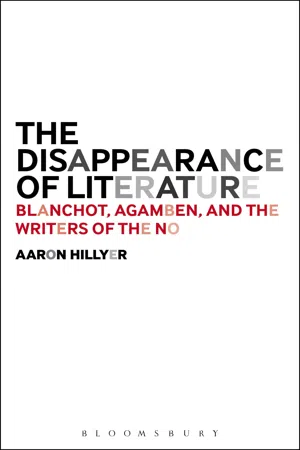
The Disappearance of Literature
Blanchot, Agamben, and the Writers of the No
- 160 pages
- English
- ePUB (mobile friendly)
- Available on iOS & Android
eBook - ePub
About this book
In this book Aaron Hillyer considers the implications of Maurice Blanchot's strange formulation: "Literature is heading to its essence, which is its disappearance." This quest leads Hillyer to stage a dialogue between the works of Blanchot and Giorgio Agamben. Despite being primary points of reference for literary theory, no significant critical work has examined their "literary" writings together. The Disappearance of Literature initiates this new trajectory through readings of Blanchot's The Unavowable Community and Agamben's The Open, two short books that harbor their most enigmatic writings. A series of related concepts-study, community, mysticism, and friendship-emerges from this pairing, and, Hillyer argues, forms the basis of a new vein of contemporary literature found in the novels and hybrid fictions of Enrique Vila-Matas, Anne Carson, and Cesar Aira.
Information
1
Blanchot and Agamben on Désoeuvrement
At the onset of The Open, Agamben partially revises an earlier criticism of Bataille to show how his Acephale community glimpsed a privileged mode of being in its flirtations with death on the outskirts of Paris, while war was in full swing throughout Europe. However, for Agamben, this group, as shown in its plan to subject one of its members to death, was ultimately only able to bring to light the problematic nature of sovereignty, the ways it consigns its subjects to the possibilities of death or any conceivable treatment. To go beyond the politics of sovereignty, and more fully develop the implications of the modality perhaps only briefly registered by Bataille’s group of friends, Agamben latches onto an element of Heidegger’s ontology that can also easily be traced in the ontology Blanchot deploys in The Unavowable Community. This element is the mode of existence that gives rise to the collective movement of thought in the forward dawning or unfolding of the world. In Agamben’s engagement with Heidegger’s conception of “the open,” we can see a variation of Blanchot’s notion of anguished, mystical collectivity that he develops in the name of “the unavowable community.” But, just as Agamben’s use of Heidegger’s concept is accompanied by a critique of the aspect of the German philosopher’s thought that is still complicit with metaphysics and sovereignty, he also seeks to distance himself from the same part of Blanchot’s thought. The structure of this book mimics the structure and narrative progression of The Unavowable Community. Both works take up Bataille at the onset, which leads the authors through a pursuit of similar ontological themes and the same type of confrontation with the law, which both seek to overcome via a concept of désoeuvrement. This term has proved to be difficult for translators but could very roughly be rendered as “unworking” or, possibly, in the term that Anne Carson deploys to refer to Simone Weil’s use of a similar concept, “decreation.” Agamben, for his part, leaves the term in its original French. His use of it allows him to posit a mode of being “outside of being,” just as it allows Blanchot to claim that the “community of those who have no community” leads one outside of ontology.
***
Both writers ultimately inflect the concept of désoeuvrement toward a consideration of the political, ontological, and literary implications of sexual fulfillment. This is where a key difference emerges that gives rise to Agamben’s critique of Blanchot, muted and delicate though it is, to the extent that Blanchot is never explicitly mentioned. This difference lies in a disagreement over the barrier that separates the sacred from the profane. Certain mystical tendencies in Blanchot’s work (not all), as well as the possible influence of Bataille, lead him to conserve an idea of the sacred, which must surely seem in bad taste to Agamben, for whom no concept is more dear than that of ‘profanation,’ of returning all the objects, texts, gestures, etc., that have become part of the capitalist spectacle back to the sphere of common use, as well as eliminating all the ways in which human bodies are consecrated at the altar of sovereignty so that human life may be separated from animal life in every citizen-subject, the better to violently seize the latter in case it cannot be assimilated into the juridical–political order. To maintain the realm of the sacred in any form is, for Agamben, to be unwittingly aligned with the politics of totalitarianism and death camps. While Blanchot otherwise directs a prolific amount of writing toward breaking down the barriers that separate the high from the low, the sacred from the profane—which may be why Agamben’s critique remains muted—the sacred nonetheless seeps through in The Unavowable Community, where it is transcribed onto the female body via his notion of the “absolutely feminine.” Valorizing the relationship between two lovers found in Duras’ The Malady of Death, Blanchot writes: “It is a surprising relationship which revokes everything one may have said about it, and which shows the indefinable power of the feminine over what wants to, or believes it can, stay foreign to it.”1 The woman, in this relational scheme, assumes the place Blanchot normally assigns to the image. Her beckoning is what provokes the encounter that jars the man loose from his subjective moorings in an ecstatic experience and opens the space of his empty subjectivity for the collective, the unavowable community.2 However, the final stamp of the encounter written by Duras is, in Blanchot’s reading, tinged with the appearance of the sacred at the peak of sexual experience. Through his possibly covert reading of The Unavowable Community, Agamben distances himself from this aspect of Blanchot’s text. He does so by relating Benjamin’s discussion of sexual fulfillment to Titian’s depiction of the postcoital scene in Nymph and Shepherd (1513–14). The image of love and sexuality found there rejects the traditional notions of the couple and of legalism in these spheres, notions that Blanchot, however, cannot escape when, following Duras, he inscribes a “contractual agreement (marriage, money)” into this relationship that beckons the unavowable community.3
***
As in Bataille’s Acephale group, community in the passage at issue from Blanchot here is founded on sacrifice, on a woman’s availability for any treatment, even death: “You know you can dispose of her in whatever way you wish, even the most dangerous.”4 While “sacrifice” is one of many terms that takes on multiple strategic meanings in Bataille’s texts, here, in Blanchot’s iteration, it harbors something of what would later appear under the term “naked life” in Agamben’s work, in the sense that it alludes to a momentary excess of lack (a “halo” for Agamben) that escapes any predication and does not desire an end to its insufficiency, its lack, its constant disappearance. Rather, the being that recognizes its own insufficiency, its “common” existence or withdrawal into the preindividual dimension of itself, strives to deepen this condition by seeking its own contention via exposure to some other that “puts it into play,” in the words of Blanchot, that calls it into question insofar as it is a substantial, egoistic, individual. In The Unavowable Community, we therefore find this admonition against self-criticism, in order to remember the communal impulse:
If human existence is an existence that puts itself radically and constantly into question, it cannot of itself alone have that possibility which always goes beyond it, for then the question would always be lacking a question (self-criticism being clearly only the refusal of criticism by the other, a way to be self-sufficient while reserving for oneself the right to insufficiency, a self-abasement that is a self-heightening).5
Blanchot continues his reading of Bataille in the first half of this book by articulating sacrifice in terms of this movement of contestation in language, bound up with the other, in which the subject is somewhat violently removed from itself. He cites Bataille’s words in Theorie de la Religion: “to sacrifice is not to kill, but to abandon and to give.”6 For Blanchot, this sacrifice, gift, or abandonment is framed in terms of a disappearance that does not block community but becomes its condition; the way community can avoid stasis in its continual contestation and rebirth, its “absolute” movement of unfolding and becoming new, which is also its movement of destruction and negation:
ultimately, there is nothing to give or to give up and that time itself is only one of the ways in which this nothing to give offers and withdraws itself like the whim of the absolute which goes out of itself by giving rise to something other than itself, in the shape of an absence. An absence which, in a limited way, applies to the community whose only clearly ungraspable secret it would be. The absence of community is not the failure of community: absence belongs to community as its extreme moment or as the ordeal that exposes it to its necessary disappearance.7
The moment of ecstasy sought by Blanchot and Bataille, the “ordeal” that induces disappearance, is an abject immersion in the impersonal. However, under the regime of legal sovereignty, in the death camps as in the everyday life of the citizen in the state of exception, naked life (or “sacrificed life” in Bataille’s fraught terminology) subsists in too close a proximity to actual death. We can be killed if our naked manifestation triggers the whim of sovereignty or its pervasive extension in the sovereign police force. Thus, any articulation of naked life that emphasizes its phase of absolute abjection without attending to how it can break loose from it risks complicity with the sacrifice of such life at the altar of the state, rather than nourishing the ecstatic sacrifice of the self that could be the catalyst of an oscillation that founds community and ethics.
However aligned these writers may explicitly be on the importance of this oscillation, elements of Bataille’s wartime writings and Blanchot’s inscription of them in The Unavowable Community, in Agamben’s view, threaten oscillation in its nascent moments by founding it on what can easily be menacing and overwhelming: the death of someone else. Aiming to base the form of contested community on what calls us into question most radically, Blanchot and Bataille both posit another’s death as this source—not my own consciousness of anticipating death, but my actual being-with another as she dies. As Blanchot writes, “To remain present in the proximity of another who by dying removes himself definitively, to take upon myself another’s death as the only death that concerns me, this is what puts me beside myself, this is the only separation that can open me, in its very impossibility, to the Openness of a community.”8 This a paraphrase of Bataille’s words, from Le Pas Au-dela: “A man alive, who sees a fellow-man die, can survive only beside himself.”9 Most writing that that takes Bataille’s Inner Experience as its point of departure, including Bataille’s own later texts themselves, seems to want to replace this central role assigned to one’s witnessing another’s death with another experience: namely that of reading, writing, and speaking. The structure of language itself mimics the ontological structure of witnessing another’s death; it bears the same type of juissance that carries the subject and the community beyond themselves. Thus, the underlying strategy of Agamben’s work on community, as well as that of much of what we find in Blanchot and Bataille, consists in transferring the abject anguish and strange ecstasy involved in witnessing another’s death onto the literary concept or the work of literature itself, in intensifying the process of disappearance already at work in a certain strain of writing. To keep the idea of community necessarily tied to the experience of one’s death, or at least to one’s contractual openness to it, is to risk isolating the subject in this impersonal realm of displacement wrought by another’s death, the experience of which harbors the capacity to paralyze and incapacitate the individual as much as to inspire community. Thus, Blanchot’s image of the prone woman subject to death, as though part of a certain “eucharistic sacrifice,” may still resemble too closely the experience of actual death posited by Bataille at the heart of community. Because of this, it has the capacity to halt the oscillation needed for the mode of community sought by these writers.
For Agamben, an important category of naked life that pushes our understanding of the term further than the absolute abjection we sometimes find in Blanchot’s Unavowable Community and Bataille’s wartime writings can be found in the legal terminology of homo sacer. Though many of Agamben’s critics, including Jacques Rancière and Antonio Negri, see this figure as too invested in a notion of death and abjection to be substantially different from that found in the Acephale experiment, another reading is possible. Homo sacer, this being that can be killed but not technically sacrificed or murdered by the state, because it stands outside the predication of the bios of the law, does begin to harbor something of a political and ethical subjectivity precisely because of this. However, Agamben’s development of this term in his voluminous Homo Sacer series often includes a reminder of what may be sometimes missing in Bataille and Blanchot: that it can in no way maximize this type of freedom by always remaining absolutely passive, always keeping its zöe in abeyance, which Blanchot indicates is a trait of the “absolutely feminine.” For Agamben, recognizing the ways that human life is split between zöe and bios is beneficial not just as a mapping operation, but also because it functions as a paradigm for the two poles of subjectivity, genius and ego, the impersonal and the individual. However, for Agamben, the subjective relationship between the two poles is one of absolutely incessant oscillation: “Man is thus a single being with two phases; he is a being that results from the complex dialectic between a part that has yet to be individuated and lived and another part that is marked by fate and individual experience.”10 In the next chapter we will examine a warning that Agamben extends to those who would dwell too long in the impersonal element, thus halting the oscillation that characterizes immanent experience in this scheme, those who would let themselves be shaken and traversed by Genius to the point of falling apart. And yet the image we see accentuated at the end of Blanchot’s book, of the sacred body of the woman, is an eternally fixed image of the vulnerability of zöe, without the infusion of an oscillation that could move it toward politics and ethics.11 For Agamben, this is the danger of the sacred: its isolation in the population of the nation, in individual beings that are wholly consigned to it by the law, beyond the law, enables the situation whereby these same beings are subject to any possible treatment. Thus, an ontological schema that posits a belonging to the sacred merely highlights the problem of sovereignty, without moving beyond it. Agamben bluntly directs this critique toward Bataille in Notes on Politics: “To have mistaken such a naked life separate from its form, in its abjection, for a superior principle—sovereignty or the sacred—is the limit of Bataille’s thought, which makes it useless to us.”12
***
With this critique in mind, we can turn to the final sections of The Open, where we find an image in the place in the text, the discussion of sexual fulfillment, which corresponds to the spot in Blanchot’s book where he renders the image of abject, naked life in absolute sexual vulnerability. If we continue to consider the possible textual parallels between The Open and The Unavowable Community, then this is where Agamben comments on the sacred “absolute femininity” that marks a division between him and Blanchot, by juxtaposing it with Titian’s painting, in which he finds an image of sexual fulfillment that has been emptied of every sacred element. In the nineteenth chapter of The Open, Agamben tries to unravel the enigma of the two figures depicted in Titian’s painting, which he describes in this way:
The two figures are represented in the foreground, immersed in a dark country landscape; the shep...
Table of contents
- Cover-Page
- Half-Title
- Dedication
- Title
- Contents
- Introduction: Writing of the No
- 1 Blanchot and Agamben on Désoeuvrement
- 2 The (Para)Ontology of Disappearance
- 3 The Potential of Study
- 4 Toward a Constellation of Literature’s Disappearance
- 5 Anne Carson and the Study of Mysticism
- 6 Enrique Vila-Matas and the Self-Study of Writing
- 7 The Friendship of Literature
- Notes
- Index
- Copyright
Trusted by 375,005 students
Access to over 1.5 million titles for a fair monthly price.
Study more efficiently using our study tools.
Frequently asked questions
Yes, you can cancel anytime from the Subscription tab in your account settings on the Perlego website. Your subscription will stay active until the end of your current billing period. Learn how to cancel your subscription
No, books cannot be downloaded as external files, such as PDFs, for use outside of Perlego. However, you can download books within the Perlego app for offline reading on mobile or tablet. Learn how to download books offline
Perlego offers two plans: Essential and Complete
- Essential is ideal for learners and professionals who enjoy exploring a wide range of subjects. Access the Essential Library with 800,000+ trusted titles and best-sellers across business, personal growth, and the humanities. Includes unlimited reading time and Standard Read Aloud voice.
- Complete: Perfect for advanced learners and researchers needing full, unrestricted access. Unlock 1.5M+ books across hundreds of subjects, including academic and specialized titles. The Complete Plan also includes advanced features like Premium Read Aloud and Research Assistant.
We are an online textbook subscription service, where you can get access to an entire online library for less than the price of a single book per month. With over 1.5 million books across 990+ topics, we’ve got you covered! Learn about our mission
Look out for the read-aloud symbol on your next book to see if you can listen to it. The read-aloud tool reads text aloud for you, highlighting the text as it is being read. You can pause it, speed it up and slow it down. Learn more about Read Aloud
Yes! You can use the Perlego app on both iOS and Android devices to read anytime, anywhere — even offline. Perfect for commutes or when you’re on the go.
Please note we cannot support devices running on iOS 13 and Android 7 or earlier. Learn more about using the app
Please note we cannot support devices running on iOS 13 and Android 7 or earlier. Learn more about using the app
Yes, you can access The Disappearance of Literature by Aaron Hillyer in PDF and/or ePUB format, as well as other popular books in Literature & Literary Criticism. We have over 1.5 million books available in our catalogue for you to explore.