The Drift: Affect, Adaptation, and New Perspectives on Fidelity offers a new perspective on the complex interrelations between literature and cinema. It does so by articulating an 'affective turn' for adaptation studies, a field whose traditional focus has been the critical castigation of film adaptations of canonical plays or novels. Drawing on theorists such as Gilles Deleuze, Brian Massumi, and Marco Abel,the author is able to re-conceive literary and cinematic works as textual engines generating and circulating affect, and the adaptive process as a drifting of those affective intensities from one medium to another.
By conceptualizing adaptation in this manner, the work steers clear of the chimerical notion of 'fidelity' (to character, to theme, to narrative) which has anchored so many analyses of adaptive texts over the years-and the reproving language that inevitably attends it-in favor of more productive avenues of investigation: What affective work are certain literary and filmic texts performing? What can this tell us, more broadly, about the underexplored affective dimensions of literature and cinema, and the dialogic interactions between them?
The Drift addresses such questions through close, careful readings which put a variety of realist, modernist, and postmodernist works into conversation with each other, among them the fiction of John Dos Passos, Don DeLillo, and Susanna Moore, the films of Dziga Vertov and Sergei Eisenstein, as well as recent cinematic adaptations by Jane Campion and Charles Burnett. This methodological approach, helps to elevate adaptation studies into a discourse that speaks more directly and pertinently to our fluid, hypertextual era.
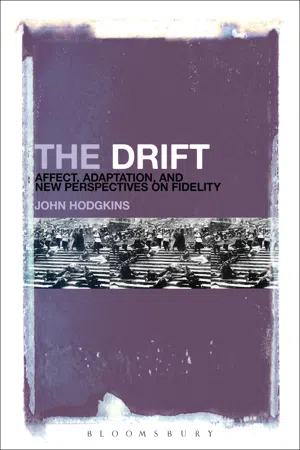
- 176 pages
- English
- ePUB (mobile friendly)
- Available on iOS & Android
eBook - ePub
The Drift: Affect, Adaptation, and New Perspectives on Fidelity
About this book
Information
1
Theorizing the Drift
Adaptation
For Jean-Baptiste Lamarck, an evolutionary theorist writing in the early 1800s, the term connoted positive change, an ability to physiologically adjust in response to the demands of one’s environment, and to then pass along such advantageous characteristics to future generations. For Charles Darwin, adaptation suggested survival: the natural selection of genetic traits that, over time, led to greater life expectancy and reproductive success. As the protean word has increasingly found a home in our everyday parlance, beyond the realm of scientific discourse, it has accumulated additional implications and associations; yet the majority of these newer semantic colorations still adhere to the underlying idea (fundamental to both Lamarck and Darwin) that there is a certain utility to be found in adaptation—that the term by and large indicates an alteration for the better, a modification designed to increase longevity, or efficacy, or suitability. Quite simply, in an historical and a contemporary sense, “adaptation”—in its various incarnations—is most frequently understood as a form of progress.
An exception to this general propensity may be found in the field of critical theory, specifically film and literary theory, where the word adaptation conjures no such favorable connotations. On the contrary, for many scholars, the notion of adaptation (normally conceived as the adapting of a novel or play to the cinema) has traditionally been synonymous with violation. Robert Stam bemoans this tendency to characterize filmic adaptations as artistic assaults on sacrosanct precursor texts, arguing that it has resulted in a critical language which is “extremely judgmental, proliferating in terms that imply film has performed a disservice to literature.”1 Such terms—infidelity, betrayal, deformation, vulgarization, bastardization—may each carry a “specific charge of opprobrium,” Stam concludes, but their collective (and vaguely Platonic) message always seems to be the same: the original was better, and better left alone.2 So much for the utility of adaptation.
This book proposes to challenge such negative inclinations common to literary and film theory, particularly as they are manifested within the field of adaptation studies—a field that draws heavily on both disciplines, yet is embraced by neither. It does so by offering a new theoretical orientation, a new framework, through which to interrogate and understand the complicated relationship between literature and cinema: namely, affect. Specifically, I (re)conceive literary and filmic texts as affective economies that communicate with each other, and with audiences, through the transmission of affective intensities, and the adaptive process as a dissemination of those intensities from one medium to another, where they take root and induce change from within. By rethinking adaptation in this manner, I contend, by conceptualizing the process not merely as a transposition of narrative content from one work to the next, but as a generative drifting of affective forces between works, between mediums, we are able to steer away from the notion of “fidelity” (to story, to character, to theme) which has anchored so many analyses of adaptive texts over the years, and the reproving language generally attending it. We are able to steer away from the sometimes delimiting preoccupations and presuppositions, the deeply ingrained attitudes and agendas historically informing adaptation studies, and thus toward fresher, richer avenues of critical inquiry: What affective work are certain literary and filmic texts performing? How do they foster what Steven Shaviro terms “[i]ntensive affective flows,” and how do these intensities provoke, in turn, new shifts and transformations and becomings?3 What can this tell us, more broadly, about the underexplored affective dimensions of literature and cinema, and the dialogic interactions between them?
Such questions are worth pondering, especially at this moment in time. As Simone Murray notes, adaptation has increasingly come “to comprise the structural logic of contemporary media and cultural industries,” and therefore constructive considerations of adaptation should play a “central role in theorizations of twenty-first century culture.”4 That is, in our global, digital, information age, adaptation represents a new cultural (one might even say intercultural) dominant, as is evident from even the most cursory survey of the latest multinational slew of novels becoming movies, movies becoming videogames, videogames becoming comic books, comic books becoming television series, television series becoming theme park attractions, and so on ad infinitum. Consequently, adaptation studies is advantageously positioned to begin theorizing this new dominant, to begin mapping these intermedial and cross-cultural flows and movements and disseminations, if only it can recalibrate its focus: if only it can displace (or at the very least supplement) its traditional concentration on fidelity and the rendering of judgment with more flexible, more productive analytical models, models which are sensitive to the marked fluidity and hypertextuality of our era. A critical methodology attuned to affect, I submit, is one such model.
Of course, in order to articulate such an argument in full, it is first necessary to lay the theoretical groundwork—to chart out the discursive terrain one intends to traverse, and explain where and how interventions are to be made. To that end, in this opening chapter, I briefly examine the field of adaptation studies (or adaptation theory, as it is also referred to) from its origins to its current state. I do so to call attention to some of the discipline’s most problematic—and enduring—lacunae along the way. I then suggest ways in which a critical focus on affect might be profitably employed to bridge those gaps and fissures within the discourse, and offer us a novel strategy for thinking about the adaptive process. After sketching the parameters of this methodological approach, I conclude by outlining how it will be more comprehensively elaborated, more thoroughly developed, as it is utilized in subsequent chapters to analyze works by John Dos Passos, Don DeLillo, Susanna Moore and Jane Campion, and, finally, Charles Burnett. Although this book limits its immediate scope to adaptive works of literature and film (a strategically advisable move, I felt, when proposing a new analytical turn for adaptation studies, the much-contested literature/film dynamic being at the historical heart of the discipline), one hopes the critical lens it mobilizes will be seen in the end as fully applicable to other mediums as well.
Where we are going, where we have been
Ingmar Bergman, that brooding poet of spiritual crisis and existential angst, once proclaimed: “Film has nothing to do with literature; the character and substance of the art forms are usually in conflict.”5 While he is far from alone in this assessment, it is impossible to deny that since its inception cinema has enjoyed close ties with literature: as long as there have been movies, there have been filmic adaptations of literary works. The first American adaptation, William Heise’s The Kiss, based on the stage musical The Widow Jones, was released in 1896, and it was quickly followed by others.6 Such pioneering adaptations led several authors and directors of the era to draw enthusiastic parallels between literature and the burgeoning cinematic medium. H. G. Wells, for instance, extolled film’s facility for “telling stories by means of pictures” instead of words; and D. W. Griffith, when questioned about the differences between his own work and the novels of Charles Dickens, described his movies as “picture stories; not so different.”7 Yet this initial enthusiasm for nascent cinema, and its penchant for finding creative fodder in the literary arts, was relatively short lived, and it was not long before a range of scholarly scolds were portraying the relationship between film and literature as contentious and artistically counterproductive, and affirming with Bergmanesque certainty that the two mediums had very little to learn from one another. One cannot help but wonder at the speed of this critical turnaround, and feel compelled to ask: Why did the analytical worm so quickly turn?
One possible explanation, proposed by Kamilla Elliott, is that adversarial academics wasted little time in seizing on film adaptations as a fertile new battleground in the “ancient word and image wars.”8 These wars, it is generally agreed, find their contemporary roots in the work of Gotthold Ephraim Lessing. In his 1766 treatise Laocoön: An Essay on the Limits of Painting and Poetry, Lessing famously drew a strong and clear demarcation between the temporal arts (literature) and the spatial arts (visual mediums like painting). Indeed, Lessing went so far as to describe the temporal and spatial arts as “two equitable and friendly neighbors,” neither of whom should be permitted “to take unbecoming liberties in the heart of the other’s domain.”9 This dictum—that the verbal and the visual should remain segregated—has been a guiding tenet for generations of critics, critics of both literature and visual media alike. According to W. J. T. Mitchell, its influence is clearly in evidence today at the heart of such “semiotic oppositions” as sign and symbol, symbol and icon, and—saliently—text versus image.10
Lending credence to Elliott’s theory is the fact that Lessing’s maxim played a major role in the first comprehensive study of cinematic adaptations, George Bluestone’s Novels into Film. Published in 1957, Bluestone’s study was a response to what he described as the “[q]uantitative analyses” that had come to dominate the discourse on filmic adaptations—analyses which were consumed with itemizing similarities and differences in story, character, and theme between an adapted text and its literary precursor, and then using that supposedly quantifiable data to render such verdicts as “The film is true to the spirit of the book,” or “It’s incredible how they butchered the novel.”11 For Bluestone, this type of fidelity criticism, as it would come to be known, this superficial cataloguing of convergences and divergences, did little to illuminate the complexities of the adaptive process (or “the mutational process,” as he termed it), so he set about trying to develop a more enlightening methodology in Novels into Film: one in which he c...
Table of contents
- Cover
- Title
- 1 Theorizing the Drift
- 2 Making the Old Words New: Dos Passos, Modernism, and the Cinematic Infection
- 3 An Epidemic of Seeing: DeLillo, Postmodernism, and Fiction in the Age of Images
- 4 A Dark-Adapting Eye: Moore, Campion, and the Fractured World of Postmodern Noir
- 5 Inventing Nat Turner: Charles Burnett and the Postmodern History Film
- 6 Drifting On
- Bibliography
- Index
Trusted by 375,005 students
Access to over 1.5 million titles for a fair monthly price.
Study more efficiently using our study tools.
Frequently asked questions
Yes, you can cancel anytime from the Subscription tab in your account settings on the Perlego website. Your subscription will stay active until the end of your current billing period. Learn how to cancel your subscription
No, books cannot be downloaded as external files, such as PDFs, for use outside of Perlego. However, you can download books within the Perlego app for offline reading on mobile or tablet. Learn how to download books offline
Perlego offers two plans: Essential and Complete
- Essential is ideal for learners and professionals who enjoy exploring a wide range of subjects. Access the Essential Library with 800,000+ trusted titles and best-sellers across business, personal growth, and the humanities. Includes unlimited reading time and Standard Read Aloud voice.
- Complete: Perfect for advanced learners and researchers needing full, unrestricted access. Unlock 1.5M+ books across hundreds of subjects, including academic and specialized titles. The Complete Plan also includes advanced features like Premium Read Aloud and Research Assistant.
We are an online textbook subscription service, where you can get access to an entire online library for less than the price of a single book per month. With over 1.5 million books across 990+ topics, we’ve got you covered! Learn about our mission
Look out for the read-aloud symbol on your next book to see if you can listen to it. The read-aloud tool reads text aloud for you, highlighting the text as it is being read. You can pause it, speed it up and slow it down. Learn more about Read Aloud
Yes! You can use the Perlego app on both iOS and Android devices to read anytime, anywhere — even offline. Perfect for commutes or when you’re on the go.
Please note we cannot support devices running on iOS 13 and Android 7 or earlier. Learn more about using the app
Please note we cannot support devices running on iOS 13 and Android 7 or earlier. Learn more about using the app
Yes, you can access The Drift: Affect, Adaptation, and New Perspectives on Fidelity by John Hodgkins in PDF and/or ePUB format, as well as other popular books in Social Sciences & Literary Criticism Theory. We have over 1.5 million books available in our catalogue for you to explore.