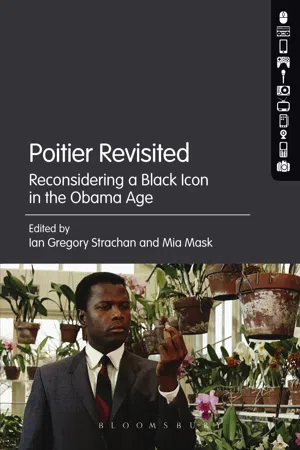
eBook - ePub
Poitier Revisited
Reconsidering a Black Icon in the Obama Age
- 288 pages
- English
- ePUB (mobile friendly)
- Available on iOS & Android
eBook - ePub
Poitier Revisited
Reconsidering a Black Icon in the Obama Age
About this book
Sidney Poitier remains one of the most recognizable black men in the world. Widely celebrated but at times criticized for the roles he played during a career that spanned 60 years, there can be no comprehensive discussion of black men in American film, and no serious analysis of 20th century American film history that excludes him. Poitier Revisited offers a fresh interrogation of the social, cultural and political significance of the Poitier oeuvre. The contributions explore the broad spectrum of critical issues summoned up by Poitier's iconic work as actor, director and filmmaker. Despite his stature, Poitier has actually been under-examined in film criticism generally. This work reconsiders his pivotal role in film and American race relations, by arguing persuasively, that even in this supposedly 'post-racial' moment of Barack Obama, the struggles, aspirations, anxieties, and tensions Poitier's films explored are every bit as relevant today as when they were first made.
Information
1
Walking with Kings: Poitier, King, and Obama
Aram Goudsouzian
It was 2003. A tall, thin man with pointy ears and brown skin named Barack Hussein Obama was running for the US Senate. At first glance, his chances for victory seemed slim. He spoke candidly about his peculiar racial heritage, and unlike some other black politicians, he refused to tack to the center in an effort to reach a broad swath of voters. He opposed the war in Iraq, and, as an Illinois State Senator, he had helped pass legislation to reduce wrongful executions, curb racial profiling of criminal suspects, extend a program for state-sponsored children’s health insurance, and start a job-training program for unskilled workers.
Yet Obama was winning over white voters—even the older, blue-collar types who tended to perceive African American politicians as serving only black interests. “The thing about Obama,” admired one middle-aged white union official, “is that there are no racial lines, there are no party lines. He reaches everybody.” Obama disarmed his audiences with modesty and restraint, and then he appealed to their better instincts, calling for progressive reforms based on the shared ideals of humanity. He often cited his own background as the child of a black man from Kenya and a white woman from Kansas. He both took pride in his blackness and appeared comfortable within elite institutions. He had been the editor of the Harvard Law Review, law professor at the University of Chicago, and Illinois State senator. Now he set his sights even higher.
Early in the race, Obama’s campaign manager Jim Cauley ran focus groups with well-to-do, liberal women from Chicago’s North Shore. If the campaign were to broaden beyond Obama’s base in the African American community, he needed these voters. Cauley showed photos of the candidates to one group of women, aged 55 and older. What did they think when they saw Dan Hynes, the state comptroller from an eminent family in Chicago politics? “Dan Quayle,” they answered. How about the multimillionaire Blair Hull? “Embalmed,” cracked one woman. And how about Barack Obama? “Sidney Poitier.”
“Shit,” thought Cauley. “This is real.”1
It was 1967. Under a cloud of gloom and doubt, Martin Luther King Jr. was introducing the keynote speaker for the tenth anniversary convention banquet of the Southern Christian Leadership Conference (SCLC). In the decade since the formation of the SCLC, the civil rights movement had delivered awe-inspiring accomplishments: it had stirred the nation’s conscience, inspired federal legislation that eroded Jim Crow, and stoked the pride of African Americans. King’s stirring powers of oratory, his appeals to man’s better nature, his fusion of Christian brotherhood and constitutional democracy, and his ethic of nonviolence had defined a generation of black activism, and he had emerged as a central figure in American public life.2
But by SCLC’s tenth anniversary, the movement was in disarray. That summer, race riots had plagued many cities, with particularly bloody results in Detroit and Newark. Many African Americans continued to suffer from deep poverty. The Civil Rights Bill of 1966 had died on the Senate floor, and “white backlash” had become part of the political lexicon. The Vietnam War drained resources to combat domestic ills, and it wasted the lives of young Americans. The recent cry of “Black Power” called for racial pride and unity, but in King’s mind, it remained “a nihilistic philosophy born out of the conviction that the Negro can’t win.” If he occupied the moral center of the movement, he increasingly found himself pulled in multiple directions, and he encountered agonizing political dilemmas—a confusion evident by the convention, whose theme was “Where Do We Go from Here?”3
King called the keynote speaker his “soul brother.” Like King, he expressed a noble ideal, seeking peace in an uncertain time. “From the moment I met him I found him to be one of the finest and warmest human beings that I have ever met. . . . I consider him a real friend. . . . He is a man of great depth. . . . Here is a man who has never lost a basic concern for the least of these God’s children.” King stated that this man “has carved for himself an imperishable niche in the annals of our nation’s history.” He had served his own role in the fight for racial equality by projecting a public dignity, charm, and essential goodness that reflected upon a broader quest for justice. He was, concluded King, “a man with an unswerving devotion to the principles of freedom and human dignity, a man of genuine humanitarian concern and basic goodwill, my friend and your friend, Sidney Poitier.”4
Sidney Poitier never registered a voter, never led a civil rights organization, never ran for elected office. Yet, in the struggle for racial equality, he occupies a central place in the American imagination. His status reveals the power of Hollywood, which can reflect popular ideals and prejudices, as well as mold public opinion. Moreover, it speaks to Poitier’s talents as a barrier-breaking icon. Until Poitier, black film characters were relegated to stock stereotypes of comic sidekicks, loyal servants, and tragic mulattoes. Poitier was Hollywood’s first black leading man, the first black star to consistently portray charismatic characters of integrity. His image possessed profound power, but also showcased the double standards imposed upon black public figures. His life and career intersects, in different and interesting ways, with those of the two most important men in African American political history.5
Poitier’s career was molded by the odyssey of Martin Luther King. Poitier rose to stardom in the mid- to late 1950s through films such as Blackboard Jungle and The Defiant Ones, just as King was emerging as the preeminent voice of the civil rights movement and leading such campaigns as the Montgomery Bus Boycott. In 1964, Poitier won the Academy Award for Best Actor for his role in Lilies of the Field, within a climate created by the Birmingham Campaign and the March on Washington, when King most effectively stirred the nation’s moral conscience. And Poitier’s most successful movies—To Sir, with Love, In the Heat of the Night, and Guess Who’s Coming to Dinner—appeared in the uncertain political atmosphere of the late 1960s, amidst urban riots, Black Power, and conservative backlash, when King and Poitier both sought to recapture a lost ideal. King’s assassination in April 1968 signaled, to some degree, the demise of Poitier’s superstardom.
In the years since then, the memory of Martin Luther King has become sanitized and sanctified, and Sidney Poitier has become his Hollywood stand-in: a symbol of pure black goodness, an archetype of inclusion and forgiveness. That icon has served the political career of Barack Obama. Like the Bahamian-born Poitier, Obama represents Black America without the burden of America’s tortured past of slavery and Jim Crow. Political commentators and voters have understood Obama through their appreciation of Poitier, a “Magic Negro” who transcended the nation’s racial ills, even as political opponents have used Poitier as a weapon against Obama. Again and again during Obama’s historic 2008 campaign for the presidency, his appeal was explained by citing Guess Who’s Coming to Dinner—the movie that most exaggerated the attributes associated with the Poitier hero.
But to fully understand Poitier’s connections to both King and Obama, one must recognize Poitier as not just an actor and icon, but also as a man. He has long considered the links between his humanity and his image, while also recognizing the distinctions between them. He has seen his life as a series of passages, and his identity has straddled national borders. He has constantly appreciated his life’s lessons—the fragile and important faith in his choices, the intricate construction of his personal notions of manhood, and the recognition of his social and political responsibilities. When his life, his career, and his adopted nation approached their crossroads, he confronted the challenges before him. And, when the world recognized his supporting role in the historic milestone of the election of a black president, he appreciated the longer journey.
In 1957, just as Poitier was emerging as a screen actor of consequence, Dorothy Masters of the New York Daily News suggested that “Sidney would, if he elected to change careers, make a fine minister of the gospel.” Four years later, with Poitier’s stardom established, Masters wrote that “with his tremendous empathy, acute sensitivity and inner fire, he ought to approach the Pearly Gates as an evangelist.” Then, in 1962, she elaborated that he “has the attributes of an evangelist—spontaneity, compassion, warmth, courage, and integrity.” Masters liked Poitier as a person, but she was also associating him with the characteristics of Martin Luther King.6
Poitier had supported King since the young minister’s emergence in the mid-1950s, after the Montgomery Bus Boycott. In 1957, he had joined King at the Prayer Pilgrimage in Washington DC, when civil rights leaders sought the attention of the Eisenhower administration. In 1960, he joined a committee to support King’s legal defense against a spurious lawsuit by Alabama officials, and the next year he spoke at a fund-raising “Tribute to Martin Luther King” at Carnegie Hall. In 1963, he participated in the March on Washington, the nationally televised mass meeting climaxed by King’s famous “I Have a Dream” speech. In the late 1960s, as Black Power activists offered public criticisms of King’s core goals of racial integration through nonviolent direct action, Poitier continued to support King, as witnessed by his keynote speech at the 1967 SCLC conference.7
But it was Poitier’s screen image that most tied him to King. In a host of movies, his characters engaged in sacrifice, building bridges of understanding with white characters. In Edge of the City (1957), his Tommy Tyler dies after intervening in a dispute between his white friend and a corrupt dockworker, stimulating his friend’s sense of self-worth. In The Defiant Ones (1958), his Noah Cullen jumps off a train to accompany his fellow escaped convict, a white man whom he once hated and now embraces. In Lilies of the Field (1963), his Homer Smith builds a chapel for some German nuns with altruistic pluck. His mannered, conscientious, dignified screen image—primarily the construction of white liberal screenwriters and directors—served as an advertisement for racial integration. Like civil rights demonstrations, they placed black heroes on a higher moral plane.
Lilies of the Field, in particular, capitalized upon a swelling mood in support of racial equality. In the spring of 1963, SCLC’s civil rights campaign in Birmingham, Alabama, won international support. The world looked on with horror as police responded to nonviolent street demonstrations with attacks from fire hoses and dogs, along with mass arrests of men, women, and children. That August, the March on Washington rallied support for civil rights legislation. Though a modest, low-budget film, Lilies of the Field captured the era’s racial sentiment, making the film an unlikely phenomenon and helping Poitier win the Academy Award for Best Actor.8
Poitier was a “race man,” a hero whose success reflected upon all black people. Yet, African Americans tended to understand that Poitier’s sacrificial characters, like nonviolent civil rights protests, bore costs. Both held black people to a higher standard, suggesting that their path to genuine citizenship demanded that they showcase extraordinary discipline and morality. Famously, in 1958, James Baldwin watched The Defiant Ones in a downtown New York theater and was struck by how the primarily white audience applauded and wept when Poitier’s character dove off the train to stay with his new white friend, even though he could have rode that train to freedom. When Baldwin watched the movie again at a Harlem theater, the black audience scre...
Table of contents
- Cover-Page
- Half-Title
- Title
- Contents
- List of Figures
- Acknowledgments
- Notes on Contributors
- Introduction: The Angry Angel
- 1 Walking with Kings: Poitier, King, and Obama
- 2 Historicizing the Shadows and the Acts: No Way Out and the Imagining of Black Activist Communities
- 3 Caribbean All-Stars: Sidney Poitier, Harry Belafonte, and the Rise of the African American Leading Man
- 4 “Draggin’ the Chain”: Linking Civil Rights and African American Representation in The Defiant Ones and In the Heat of the Night
- 5 Whisper Campaign on Catfish Row: Sidney Poitier and
- 6 To Sir, with Love: A Black British Perspective
- 7 “You’d be criminals!”: Transgression, Legal Union, and Interracial Marriage in 1967 Film and Law
- 8 A Blues for Tom: Sidney Poitier’s Filmic Sexual Identities
- 9 “Black Masculinity on Horseback: From Duel at Diablo to Buck and the Preacher . . . and Beyond”
- 10 Stepping behind the Camera: Sidney Poitier’s Directorial Career
- 11 No Shafts, Super Flys, or Foxy Browns: Sidney Poitier’s Uptown Saturday Night as Alternative to Blaxploitation Cinema
- 12 Transcending Paul Poitier: Six Degrees of Separation and the Construction of Will Smith
- Index
- Copyright
Trusted by 375,005 students
Access to over 1.5 million titles for a fair monthly price.
Study more efficiently using our study tools.
Frequently asked questions
Yes, you can cancel anytime from the Subscription tab in your account settings on the Perlego website. Your subscription will stay active until the end of your current billing period. Learn how to cancel your subscription
No, books cannot be downloaded as external files, such as PDFs, for use outside of Perlego. However, you can download books within the Perlego app for offline reading on mobile or tablet. Learn how to download books offline
Perlego offers two plans: Essential and Complete
- Essential is ideal for learners and professionals who enjoy exploring a wide range of subjects. Access the Essential Library with 800,000+ trusted titles and best-sellers across business, personal growth, and the humanities. Includes unlimited reading time and Standard Read Aloud voice.
- Complete: Perfect for advanced learners and researchers needing full, unrestricted access. Unlock 1.5M+ books across hundreds of subjects, including academic and specialized titles. The Complete Plan also includes advanced features like Premium Read Aloud and Research Assistant.
We are an online textbook subscription service, where you can get access to an entire online library for less than the price of a single book per month. With over 1.5 million books across 990+ topics, we’ve got you covered! Learn about our mission
Look out for the read-aloud symbol on your next book to see if you can listen to it. The read-aloud tool reads text aloud for you, highlighting the text as it is being read. You can pause it, speed it up and slow it down. Learn more about Read Aloud
Yes! You can use the Perlego app on both iOS and Android devices to read anytime, anywhere — even offline. Perfect for commutes or when you’re on the go.
Please note we cannot support devices running on iOS 13 and Android 7 or earlier. Learn more about using the app
Please note we cannot support devices running on iOS 13 and Android 7 or earlier. Learn more about using the app
Yes, you can access Poitier Revisited by Ian Gregory Strachan, Mia Mask, Ian Gregory Strachan,Mia Mask in PDF and/or ePUB format, as well as other popular books in Media & Performing Arts & Film & Video. We have over 1.5 million books available in our catalogue for you to explore.