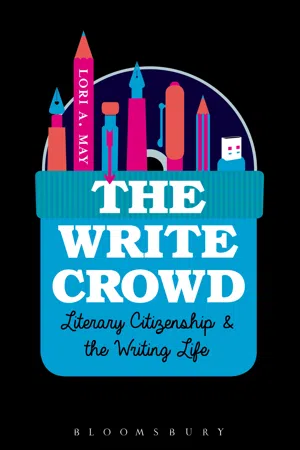
Writing may be a solitary profession, but it is also one that relies on a strong sense of community. The Write Crowd offers practical tips and examples of how writers of all genres and experience levels contribute to the sustainability of the literary community, the success of others, and to their own well-rounded writing life. Through interviews and examples of established writers and community members, readers are encouraged to immerse themselves fully in the literary world and the community-at-large by engaging with literary journals, reading series and public workshops, advocacy and education programs, and more.
In contemporary publishing, the writer is expected to contribute outside of her own writing projects. Editors and publishers hope to see their writers active in the community, and the public benefits from a more personal interaction with authors. Yet the writer must balance time and resources between deadlines, day jobs, and other commitments. The Write Crowd demonstrates how writers may engage with peers and readers, and have a positive effect on the greater community, without sacrificing writing time.
- 144 pages
- English
- ePUB (mobile friendly)
- Available on iOS & Android
eBook - ePub
About this book
Information
1
What is Literary Citizenship? An Introduction
Historical context
The term “literary citizenship” may seem like a new buzzword, but the concept is anything but. Near the beginning of the twentieth century, novelists Virginia Woolf and E. M. Forster, together with other influential artists and intellectuals, formed the Bloomsbury Group. While rebelling against a rigid Victorian social structure, the group worked together to discuss and promote its individual and collective artistic goals. The group was “determined to reinvent society,”1 yet it routinely opened its doors to others in the community by hosting weekly gatherings where writing, art, and societal matters were discussed.
While history has numerous examples of literary citizenship at work, perhaps most often contemporary authors refer back to Walt Whitman’s efforts in advocating for a society connected through literature. In the book Walt Whitman and The World, contributing author Maria Clara Bonetti Paro credits Whitman not just for his poetic esthetic and defiance against his peers, but also for his stance as a “poet of the present and the singer of the common people and the modern world.”2 Studies of Whitman reveal him as the “people’s poet” and we learn of the author’s efforts to engage the average working-class person through poetry. Yet, Whitman’s goal included more than merely exposing readers to verse. Paro argues that Whitman’s vision included a “cosmic consciousness [that] could transform everybody into comrades and equals.”3 In essence, it was Whitman’s goal to unite people—writers, readers, and the average citizen—through the celebration of literature.
Whitman was not alone in his quest to build community. In a graduate seminar I led at Eastern Michigan University back in 2010, I focused on the work of Whitman and Emerson, and how these nineteenth-century authors provide examples for today’s literary citizens. Many of Emerson’s lectures focus on self-improvement and on the association between individual and community. In considering identity, Emerson sought to relate the roles of culture and society. Like Emerson’s analysis of the self in society, Whitman voiced in Leaves of Grass his concerns of stewardship and equality in a national identity.
It was when Whitman apprenticed with the Long Island Patriot—a liberal, working-class newspaper—that he first learned the business of printing and discovered how published words could be immediately communicated to a mass audience.4 He wrote, edited, and eventually began his own newspaper. For Leaves of Grass, Whitman took on the expense of producing the first edition and distributing the book to readers.5 Yes, one of our most lauded poets in history was a productive self-publisher. But he was also strategic in getting his work noticed. Whitman sent out copies to accomplished writers and when Emerson wrote back with the words, “I greet you at the beginning of a great career,” Whitman elected to use this comment—unbeknownst to Emerson—as one of the first promotional blurbs in publishing history.6
In the poem, “Poets to Come,” from Leaves of Grass, Whitman urges the passing on of a legacy, the necessity to perpetually move our society forward:
Poets to come! orators, singers, musicians to come!
Not to-day is to justify me and answer what I am for,
But you, a new brood, native, athletic, continental, greater than before known,
Arouse! Arouse—for you must justify me—you must answer.
I myself but write one or two indicative words for the future,
I but advance a moment, only to wheel and hurry back in the darkness.
I am a man who, sauntering along without fully stopping, turns a casual look upon you, and
then averts his face,
Leaving it to you to prove and define it,
Expecting the main things from you.7
In this poem, Whitman urges others to take responsibility for their art and their role in society. He recognizes that his writing and role in contributing to the literary community is limited and that he will, or should, be surpassed by others. Whitman acknowledges that the community must keep moving forward if it is to continue to thrive and grow and engage others.
Contemporary application
In draft mode, writers and other artists may not immediately acknowledge an inevitable audience, yet once a creative work is complete—that is, ready to share with others—our creations become the catalyst for connecting with others.
“As a writer who has always had one foot on the stage and one on the page, my work is incomplete without human presence,” says Laura E. J. Moran, slam poet and cofounder of B-Trads: Teaching Artist Alliance. Moran argues that skilled contemporary artists interact with audiences with the same intent of our artistic predecessors.
“From the very beginning of what we call humanity when we began making what we call art, taking the images out of our heads and using lines to put them somewhere else outside of us—call it music, call it cave art like that in Lascaux or Chauvet over 30,000 years ago—we have had the need to share stories. Share is the operative word here. No sharing happens without other humans in the room with whom to share. The work then becomes the space between us—not you, not me, not the writing, not the song, but the connection.”
Moran points to the historic role of performance in our culture and civilization as a model for audience interaction. “Dare I say, for those writers who must tour or must present even just once . . . understanding basic stage presence and how to respect your audience grants access into a long and beautiful tradition of public engagement beyond commodification. See what Ralph Waldo Emerson had to say on poets and public speaking. He believed it was our duty, duty, to engage the public. It is our role and not just an adjunct opportunity to sell product.”
Indeed, the contemporary concept of literary citizenship is not unlike Whitman’s or Emerson’s. Today’s writers are actively engaging with their peers and audiences to have an effect on the big picture. They want to have both an immediate impact on their communities and an influence on the future.
So, then, what exactly does it mean to be a literary citizen? Author Kate Gale, the publisher of Red Hen Press, says this: “It means you are not only working on your own creative intellectual work, you are also doing something for the whole literary world. That may be running a reading series, teaching in a Writing in the Schools program, starting a press, or any number of different things.”
Literary citizenship takes the power of the individual and puts it to use in fostering, sustaining, and engaging with the literary community for the benefit of others. The concept is to pay kindness and skill forward, to offer something to the community so that others may learn, engage, and grow from combined efforts. And the possibilities for how that is accomplished are wide and varied, both in effort and in outcome. At the heart of literary citizenship, though, is one constant: contributing something to the literary world outside of one’s own immediate needs.
In keeping with Whitman’s legacy, one critical note is that literary citizenship is not exclusive to some “in-crowd” of well-published writers. Any person, in any town, with any experience—or none whatsoever—in publishing can engage oneself as a literary citizen. Emerging writers and those well established are on equal ground here. Readers and the general community have as much to give and take from literary citizenship as writers have. The concept of literary citizenship is to promote artistic interest, advocate literature, and foster a cultural well-being.
Diane Tarantini, a graduate student who lives in West Virginia, has this to say: “To me, literary citizenship means membership in a community of folks who enjoy words. These individuals may be people who read and write. They may also be people who are readers only.”
As writers, we need one another. We need readers and reviewers, editors and cheerleaders for the highs and lows that invariably come with writing. While the life of a writer continually buoys with the unpredictable waves of publishing, emerging writers especially need mentorship and guidance to weather those uncertainties.
Dinty W. Moore, a renowned author and writing coach, credits his success to those who encouraged him from day one. “My early days as a writer were marked by the usual mistakes: sending juvenile stories to The New Yorker, sending out work before it was fully polished, imagining that ‘literary stand-out’ was a magical splash of fairy dust rather than an honor that is won through ceaseless work and improvement,” he says. “But all along the way folks took the time to show me a bit of the path, teach me a small lesson, correct my course in small ways, just as a tennis coach might correct someone’s backhand. My success, such as it is, is partly hard work and dedication, but also an accumulation of one thousand moments of generosity from other writers and editors, and the more of us in the literary world who recognize this, who act accordingly, the better the writing world is for everyone.”
In fostering our fellow writers, in giving back to our communities and in enhancing what exists and working to develop something new, we not only “pay it forward”8 by generating goodwill among our peers and community members, but also add to the legacy of our literary circles.
This book will share ways other writers have worked to make things happen. Whether it is in starting independent presses, running a blog to showcase new authors and books, or in volunteering at an already established organization, there are countless ways to get involved. And that’s precisely what it comes down to: how we, as writers and readers, can become truly involved, sincerely immersed within the community.
Yet, not all activities that benefit the greater good are the result of volunteering. Later you’ll hear from some writers who are making a living after having cultivated an area of need and developing their efforts into money-making businesses. Volunteering one’s time is certainly the standard for offering something to the greater community, but a sampling of authors will demonstrate how following one’s passion can have unexpected outcomes.
Too, while the ambition of literary citizenship is to help others, to elevate the success of our literary peers, it should not be overlooked that there are most definitely personal rewards. First and foremost is the satisfaction of contributing something for the benefit of others. But, there are also benefits to becoming involved in one’s community: we meet peers, editors, reviewers, and others who may, in turn, have something to offer us and may open doors to new opportunities we may not have otherwise discovered while penning alone in the middle of the night with just the sound of our solo breath to guide us.
Even so, one should not consider literary citizenship as a means to an end for personal gain. It is only through authentic engagement, in wanting to give in a heartfelt manner, that we blossom as individuals. Coming into a community only to craftily weave our way through giving, with the sole intent of receiving, is not a masquerade most others will fall for. Such an agenda would also most likely leave you feeling empty if you don’t feel that you have been properly “repaid” for your efforts. While it cannot be ignored that the individual benefits from the efforts of the whole, that’s not what literary citizenship is about.
Naturally, with good intentions and the desire to contribute to the community, a writer can feel the weight of burden if one overextends oneself. This is sometimes a natural occurrence for any good deed. It can be a challenge to manage one’s efforts and the time it takes to engage within the community, help others, and still feel connected to one’s own creative energies. Later, you’ll see a few real-life examples from authors and editors who have navigated the balancing act between community and personal creative needs, and how they have avoided—or recovered from—burnout.
Whether you consider writing to be a hobby or profes...
Table of contents
- Cover-Page
- Half-Title
- Title
- Contents
- Preface
- 1 What is Literary Citizenship? An Introduction
- 2 The Writer and the Writing Life
- 3 Immersion 101: Finding and Creating Opportunities
- 4 Community (re)Defined
- 5 From the Editor’s Desk
- 6 Book Reviewing: Write (about) What you Read
- 7 In Print and Online: Working with Presses and Journals
- 8 Community Outreach
- 9 In and Outside of Academia
- 10 The Write Direction: Customizing your Community
- Appendix A: Community Organizations
- Appendix B: Sample Book Reviews
- Acknowledgments
- Index
- Copyright
Trusted by 375,005 students
Access to over 1.5 million titles for a fair monthly price.
Study more efficiently using our study tools.
Frequently asked questions
Yes, you can cancel anytime from the Subscription tab in your account settings on the Perlego website. Your subscription will stay active until the end of your current billing period. Learn how to cancel your subscription
No, books cannot be downloaded as external files, such as PDFs, for use outside of Perlego. However, you can download books within the Perlego app for offline reading on mobile or tablet. Learn how to download books offline
Perlego offers two plans: Essential and Complete
- Essential is ideal for learners and professionals who enjoy exploring a wide range of subjects. Access the Essential Library with 800,000+ trusted titles and best-sellers across business, personal growth, and the humanities. Includes unlimited reading time and Standard Read Aloud voice.
- Complete: Perfect for advanced learners and researchers needing full, unrestricted access. Unlock 1.5M+ books across hundreds of subjects, including academic and specialized titles. The Complete Plan also includes advanced features like Premium Read Aloud and Research Assistant.
We are an online textbook subscription service, where you can get access to an entire online library for less than the price of a single book per month. With over 1.5 million books across 990+ topics, we’ve got you covered! Learn about our mission
Look out for the read-aloud symbol on your next book to see if you can listen to it. The read-aloud tool reads text aloud for you, highlighting the text as it is being read. You can pause it, speed it up and slow it down. Learn more about Read Aloud
Yes! You can use the Perlego app on both iOS and Android devices to read anytime, anywhere — even offline. Perfect for commutes or when you’re on the go.
Please note we cannot support devices running on iOS 13 and Android 7 or earlier. Learn more about using the app
Please note we cannot support devices running on iOS 13 and Android 7 or earlier. Learn more about using the app
Yes, you can access The Write Crowd by Lori A. May in PDF and/or ePUB format, as well as other popular books in Langues et linguistique & Écriture créative. We have over 1.5 million books available in our catalogue for you to explore.