The novels of David Foster Wallace, Dave Eggers and Jonathan Safran Foer are increasingly regarded as representing a new trend, an 'aesthetic sea change' in contemporary American literature. 'Post-postmodernism' and 'New Sincerity' are just two of the labels that have been attached to this trend. But what do these labels mean? What characterizes and connects these novels?
Den Dulk shows that the connection between these works lies in their shared philosophical dimension. On the one hand, they portray excessive self-reflection and endless irony as the two main problems of contemporary Western life. On the other hand, the novels embody an attempt to overcome these problems: sincerity, reality-commitment and community are portrayed as the virtues needed to achieve a meaningful life.
This shared philosophical dimension is analyzed by viewing the novels in light of the existentialist philosophies of Søren Kierkegaard, Jean-Paul Sartre, Ludwig Wittgenstein and Albert Camus.
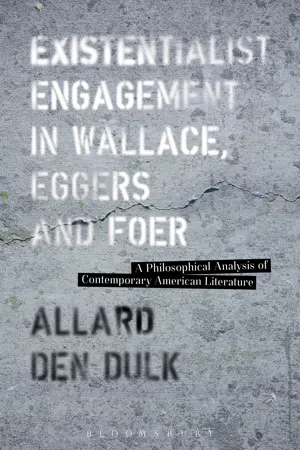
eBook - ePub
Existentialist Engagement in Wallace, Eggers and Foer
A Philosophical Analysis of Contemporary American Literature
- 288 pages
- English
- ePUB (mobile friendly)
- Available on iOS & Android
eBook - ePub
Existentialist Engagement in Wallace, Eggers and Foer
A Philosophical Analysis of Contemporary American Literature
About this book
Information
Part One
Problems
1
Hyperreflexivity
Introduction
The novels of Wallace, Eggers and Foer are filled with characters whose self-consciousness has taken on an excessive form and has come to impede their attempts to live a meaningful life. Wallace’s Infinite Jest describes such characters as identifying ‘their whole selves with their head’. In the novel the problem of addiction is a metaphor for the problem of excessive self-consciousness (which is shown to be the essential characteristic of addiction). One of the slogans of ‘Addicts Anonymous’ (AA) is ‘My Best Thinking Got Me Here’. Infinite Jest describes that ‘most Substance-addicted people are also addicted to thinking’, that almost all of their compulsive thinking is about themselves, and that the AA term for this addictive self-reflection is ‘Analysis-Paralysis’.1 In Foer’s Extremely Loud & Incredibly Close, a similar dynamic of paralysing, alienating self-reflection is described by Thomas, Oskar’s grandfather: ‘[T]he distance that wedged itself between me and my happiness wasn’t the world, [it was me, my thinking]. I think and think and think, I’ve thought myself out of happiness one million times, but never once into it.’2 In Eggers’s You Shall Know Our Velocity, the main character Will is also plagued by the constant, self-reflective discussions in his head: ‘It would be fun, I suppose, if it wasn’t constant and so loud. [. . .] after many years of enjoying the debates, I wanted them to end. I wanted the voices silenced and I wanted less of my head generally.’3
Just to clarify: I will regard consciousness as the conscious experience of oneself and the world (for example, of pain, or of a tree); subsequently, in reflection consciousness turns back on that experience, making the experience as such the object of consciousness, reflecting on it (what does the pain feel like, what does the tree look like?); finally, in self-reflection (or: reflexivity) consciousness turns its attention towards itself, towards the consciousness that ‘has’ that experience and that performs the reflection upon it – so, it turns in on the consciousness feeling the pain, seeing the tree. By excessive self-reflection is meant a form of consciousness that, because of its constant thinking about (distancing from, doubting) itself, estranges from that self, losing sight of (and contact with) its relations to the world and other people (leading to feelings of emptiness and even depression). To refer to this problematic form of self-consciousness, I will adopt the term ‘hyperreflexivity’, defined by phenomenological-psychologists Louis Sass and Josef Parnas as ‘forms of exaggerated self-consciousness in which aspects of oneself are experienced as akin to external objects’. It is interesting to note that they regard hyperreflexivity as belonging to the ‘prodromes’ (early symptoms) of what they describe in general as ‘self-disorders’ (disturbances of the relation to or perception of the self).4
Whereas constant self-reflection is often regarded as a good thing, as the philosophical activity par excellence, precluding naïveté and forcing us to constantly re-evaluate our assumptions and judgements,5 the novels of Wallace, Eggers and Foer portray it as also potentially damaging to the self. Such a portrayal does not imply a plea for mindlessness and is in fact a valid philosophical position. As Sass writes: ‘According to one influential tradition, philosophical reflection is a sort of ultimate expression of the vitality of the human essence, but there is another tradition that has seen philosophy as something unnatural and “out-of-order”, contrary to the health of the human condition.’6 Watchfulness for such ‘unhealthy’ habits of thought has always been a central concern of Wallace. James Ryerson writes: ‘[Wallace] was perpetually on guard against the ways that abstract thinking (especially thinking about your own thinking) can draw you away from something more genuine and real.’7
This chapter will offer an analysis of the problem of hyperreflexivity, as portrayed in the novels of Wallace, Eggers and Foer, in light of Sartre’s early, phenomenological-existentialist philosophy. But because these novels show constant self-reflection as a problem that has become exacerbated and widespread in contemporary Western culture, in section 1, I will first explore the aspects of Western life that are portrayed in the novels as contributing to the increased reflexivity of the contemporary individual’s existence (and, thus, to the corresponding rise of the problem of hyperreflexivity). I will do so by identifying in these works five factors described by Anthony Giddens as making the contemporary self into a necessarily ‘reflexive project’.8 Having established that contemporary Western life indeed seems to require constant self-reflection, we then have to understand why this can have problematic effects. To that end, in section 2, I will first offer an outline of Sartre’s view of being, (self-)consciousness and the self, and connect this to the (existentialist) view underlying Wallace’s work. This will establish why, for Sartre, the problem of self-reflection lies in the fact that it turns consciousness into an object, which conflicts with its ‘non-thinglike’ character, and results in alienation from the self; this also connects Sartre’s analysis to the above-quoted definition of hyperreflexivity, which, as said, is based on a phenomenological view as well.9 Subsequently, in section 3 I will analyse, from this heuristic perspective supplied by Sartre’s philosophy, the different instances of reflexive self-alienation portrayed in the fiction of Wallace, Eggers and Foer. I will discuss the following five (Sartrean) instances of increasing reflexive self-alienation (which follow and build on each other) that can be identified in these works: (1) the internalization of the look; (2) language as objectification; (3) the ‘poisoning’ of experience; (4) bad faith; and (5) solipsism.
1. Factors of heightened contemporary reflexivity
The problem of excessive self-consciousness is portrayed in the works of Wallace, Eggers and Foer against the background of the Western world at the end of the twentieth or beginning of the twenty-first century. Though this problem is in no way unique to the current, postmodern period in Western culture, and probably not even to the past century, it has become exacerbated and more widespread in current times. Through their depiction of this problem, the literary works in question offer insight into different aspects of contemporary Western life that contribute to the increased reflexivity of the contemporary individual’s existence and, thereby, to the rise of the problem of hyperreflexivity. This section offers a brief exploration of these contributive aspects.
In Modernity and Self-Identity (1991) Anthony Giddens describes five factors that can also be discerned in the works of Wallace, Eggers and Foer. For Giddens, as in the novels, ‘[t]he backdrop here is the existential terrain of late modern life’. He writes that ‘[i]n the settings of what I call “high” or “late” modernity – our present-day world – the self’ has become ‘a reflexive project’. Giddens explains: ‘Modernity’s reflexivity refers to the susceptibility of most aspects of [social life] [. . .] to chronic revision in the light of new information or knowledge.’ Contemporary Western life forces individuals to constantly perform reflexive operations: to reconsider, to doubt previous insights and decisions. According to Giddens this ‘radical doubt is an issue which [. . .] is not only disturbing to philosophers but is existentially troubling for ordinary individuals’.10 Giddens mentions the following five factors as contributing to the contemporary Western individual’s heightened reflexivity: (1) ‘living in a post-traditional order’; (2) the ‘pluralisation of life-worlds’; (3) ‘the contextual nature of warranted beliefs under conditions of modernity’; (4) ‘the prevalence of mediated experience’; and (5) ‘the transformation of intimacy’.11 I will use these factors listed by Giddens to outline the general portrayal of the contemporary Western individual’s life (and its heightened reflexivity) offered in the literary works of Wallace, Eggers and Foer.12
1.1. Living in a post-traditional order
First of all, contemporary Western culture can be characterized as ‘a post-traditional social universe’. Giddens writes: ‘by definition, tradition or established habit orders life within relatively set channels’. He adds that, however, ‘the signposts established by tradition now are blank’.13 The lives of most Western individuals are no longer guided by a clear tradition, something that orders and directs all of their choices. In his essay ‘E Unibus Pluram’, Wallace describes the effect of the fact that there are ‘no sources of insight on comparative worth, no guides to why and how to choose among experiences, fantasies, beliefs, and predilections’, as follows: ‘When all experience can be deconstructed and reconfigured, there become simply too many choices. And in the absence of ...
Table of contents
- Cover
- Half-Title
- Introduction
- Part One
- Part Two
- Acknowledgements
- Works Cited
- Index
- Copyright
Trusted by 375,005 students
Access to over 1.5 million titles for a fair monthly price.
Study more efficiently using our study tools.
Frequently asked questions
Yes, you can cancel anytime from the Subscription tab in your account settings on the Perlego website. Your subscription will stay active until the end of your current billing period. Learn how to cancel your subscription
No, books cannot be downloaded as external files, such as PDFs, for use outside of Perlego. However, you can download books within the Perlego app for offline reading on mobile or tablet. Learn how to download books offline
Perlego offers two plans: Essential and Complete
- Essential is ideal for learners and professionals who enjoy exploring a wide range of subjects. Access the Essential Library with 800,000+ trusted titles and best-sellers across business, personal growth, and the humanities. Includes unlimited reading time and Standard Read Aloud voice.
- Complete: Perfect for advanced learners and researchers needing full, unrestricted access. Unlock 1.5M+ books across hundreds of subjects, including academic and specialized titles. The Complete Plan also includes advanced features like Premium Read Aloud and Research Assistant.
We are an online textbook subscription service, where you can get access to an entire online library for less than the price of a single book per month. With over 1.5 million books across 990+ topics, we’ve got you covered! Learn about our mission
Look out for the read-aloud symbol on your next book to see if you can listen to it. The read-aloud tool reads text aloud for you, highlighting the text as it is being read. You can pause it, speed it up and slow it down. Learn more about Read Aloud
Yes! You can use the Perlego app on both iOS and Android devices to read anytime, anywhere — even offline. Perfect for commutes or when you’re on the go.
Please note we cannot support devices running on iOS 13 and Android 7 or earlier. Learn more about using the app
Please note we cannot support devices running on iOS 13 and Android 7 or earlier. Learn more about using the app
Yes, you can access Existentialist Engagement in Wallace, Eggers and Foer by Allard den Dulk in PDF and/or ePUB format, as well as other popular books in Literature & Literary Criticism. We have over 1.5 million books available in our catalogue for you to explore.