On February 21, 1803, Colonel Edward (Ned) Marcus Despard was publicly hanged and decapitated in London before a crowd of 20,000 for organizing a revolutionary conspiracy to overthrow King George III. His black Caribbean wife, Catherine (Kate), helped to write his gallows speech in which he proclaimed that he was a friend to the poor and oppressed. He expressed trust that “the principles of freedom, of humanity, and of justice will triumph over falsehood, tyranny, and delusion.”
And yet the world turned. From the connected events of the American, French, Haitian, and failed Irish Revolutions, to the Anthropocene’s birth amidst enclosures, war-making global capitalism, slave labor plantations, and factory machine production, Red Round Globe Hot Burning throws readers into the pivotal moment of the last two millennia. This monumental history, packed with a wealth of detail, presents a comprehensive chronicle of the resistance to the demise of communal regimes. Peter Linebaugh’s extraordinary narrative recovers the death-defying heroism of extended networks of underground resisters fighting against privatization of the commons accomplished by two new political entities, the U.S.A. and the U.K., that we now know would dispossess people around the world through today. Red Round Globe Hot Burning is the culmination of a lifetime of research—encapsulated through an epic tale of love.
eBook - ePub
Red Round Globe Hot Burning
A Tale at the Crossroads of Commons and Closure, of Love and Terror, of Race and Class, and of Kate and Ned Despard
- 488 pages
- English
- ePUB (mobile friendly)
- Available on iOS & Android
eBook - ePub
Red Round Globe Hot Burning
A Tale at the Crossroads of Commons and Closure, of Love and Terror, of Race and Class, and of Kate and Ned Despard
About this book
Trusted by 375,005 students
Access to over 1.5 million titles for a fair monthly price.
Study more efficiently using our study tools.
Information
PART ONE
THE QUEST
A
THE QUEST
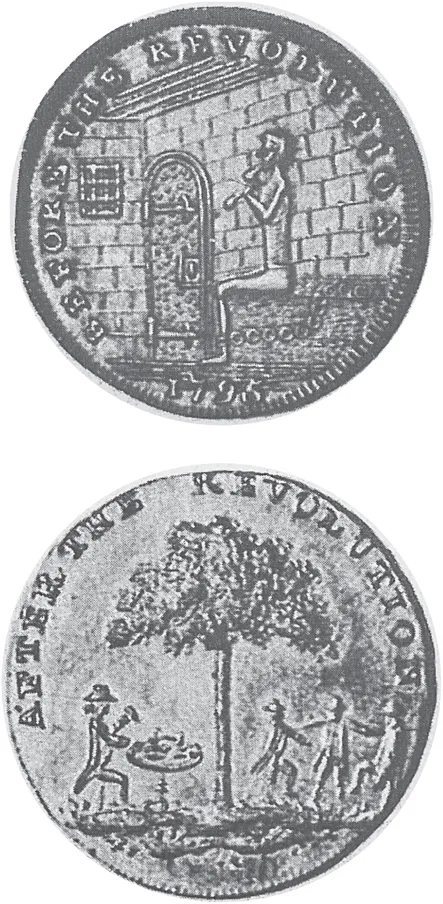
FIGURES 1 AND 2. “Before the Revolution” and “After the Revolution.” Two trade tokens struck by Thomas Spence.
ONE
The Grave of a Woman
ON A BLUSTERY AUTUMN SUNDAY afternoon in the year 2000, I went for a stroll with family and friends on the towpath of the Grand Canal outside Dublin. We were taking a weekend break from archival work in the records of the Irish Rebellion of 1798. The ’98 was at the crux of that revolutionary epoch. The idea was to combine a pleasant excursion with a preliminary reconnoitering. On the towpath, I stopped at a rose bush growing wild. A single red rose was still in bloom, its petals glistening in the afternoon sunlight with droplets from a recent shower. Besides being part of a revolutionary epoch, the ’98 took place during the age of Romanticism, and this rose, at this place, at that time, seemed to me an encouraging sign.
I was searching for the remains of Catherine Despard. After her husband, Colonel Edward Marcus Despard, was hanged and beheaded in London on 21 February 1803, as a traitor to the Crown, his widow, Catherine, the intrepid African American revolutionary, after doing what she could to ensure his decent burial, disappeared, it seems, from the archival record into historical silence.1
Was I to think of her as a slave woman or as an African American woman—lost now and far from her ethnic culture—who had been emancipated from the Atlantic slave plantation, whose terrors were the basis of European riches? Or were there other ways to think about her—as a prison reformer; as a helpmeet and comrade; as a figure of London’s West End, bustling under the recently (1789) planted plane trees of Berkeley Square, where Charles James Fox, the great reform politician, was her neighbor? She had led an effort to limit the enclosing instincts of the elite, the lords of empire. Are we, therefore, to thank her for making sure that Jeremy Bentham’s panopticon remained only a dystopian idea of the totalitarian imaginary? Was I to think of her as an acquaintance of Lord Horatio Nelson, already the nation’s hero? She who could so disturb the chief magistrate of the new London police force that he was reduced to whinging pathetically to the home secretary, wishing that she’d simply go away?
One on one, a woman to a man, a descendant of slaves to a lord of the realm, Catherine Despard expressed truth to power. Experienced on two or three continents, she was a revolutionary of the time. Her story is that of the working class at a time when women, like African American slaves, generated the wealth of Europe and, so it was intended, also reproduced that impossible commodity, future workers. In the context of Irish history, she should be compared to Anne Devlin, the faithful comrade of Robert Emmet, himself hanged and decapitated in September 1803, six months after Despard. Devlin, who led a clandestine, revolutionary life, lived long until 1851 but was unremembered. Women were couriers of revolutionary ideals. In faraway Saint Domingue, soon to be the independent republic of Haiti, Rochambeau, Napoleon’s commander against the former slaves, ordered Cap-Francais (Haiti) in February 1803 “to force all women back in their houses, especially négresses.”2 Catherine could not be “forced back.”
A tantalizing allusion to Catherine in the Recollections of Valentine Lawless, the second Lord Cloncurry, notes that she had left London after her husband Edward’s dreadful death, to be looked after at Lyons—a reference not to the second city of France but to one of those magnificent mansions, like Jefferson’s Monticello or the English country estates of the Whig ruling class, this one built and inhabited by Cloncurry on the border between counties Dublin and Kildare. “We became a sort of centre of refuge for the hosts of poor people driven from their homes by the atrocious deeds of an army,” he wrote. A half century later he wrote, “She lived in my family at Lyons for some years.”3 Here he was able to offer her “an asylum from destitution.” Lyons is adjacent to the Grand Canal in county Kildare. The Grand Canal was completed in 1803, the same year that Catherine fled to Lyons. If this is where her life ended, perhaps we could find her remains?
The following themes did not vanish with Edward’s death or Catherine’s disappearance. The abolition of slavery, the independence of Ireland, the amelioration of the prison, and the emancipation of women had been the causes of her day, and they were nearly extinguished by instruments of counterrevolution—the hangman’s rope and executioner’s blade. Would I find evidence of her remains in the actual dust caked on the coffins in the sarcophagus of Valentine Lawless, Lord Cloncurry? (And even if I did find her remains, what then?)
Lyons is a mansion with a private lake, whose construction began in 1785. On the death of his father in 1799, Cloncurry came into its possession. “I created a fine place, and employed an army of men” to improve his property.4 Its shallow bows on either side of the central building consist of granite, rusticated ashlars. The grand, pedimented entranceway is topped by a granite sculpture of bull and ram and a coat-of-arms with badge and coronet. Doric colonnades on either side of the main building join the two wings, in themselves ample as any palace. He hired skilled craftsmen like Gaspare Gabrielli to do the frescoes and the roundels. Pope Pius VII gave him a marble stoup for the entrance. That was 1801, the year the Act of Union abolishing the Irish Parliament came into force and when this pope concluded the concordat with Napoleon. Usually a stoup holding holy water was just inside the door of a church. Pope, Napoleon, Cloncurry: all hostile to the English Crown.
Born in 1773, Valentine Lawless was younger than Despard but Portarlington, county Laois, was the place of his birth, so he would have at least known the name Despard. Friendship, however, was based not on their proximity as countrymen; they were both United Irishmen, that is, revolutionary comrades. Lawless joined the United Irishmen in 1793. Like Robert Emmet, who came after him, he dressed in green and remained close to the leadership. He was arrested, along with Despard, as part of the 1798 roundup of radicals in London and committed to the Tower of London for six weeks. He was arrested again in April 1799 and remained in the Tower until 1801. In September 1802, a rumor reached the Privy Council that Cloncurry had advanced £700 to Despard.5
Upon his release, Cloncurry went to live in Rome. This was the time when Britain and France fought for control of Egypt and the eastern Mediterranean, pillaging whenever possible. Lord Elgin began the systematic plunder of the marble sculptures of the Parthenon and Erechtheum on the Greek acropolis.6 Cloncurry also “collected” ancient sculptures and furniture: twelve-foot columns of Egyptian granite, a statue of Venus excavated from Ostia (Rome’s port), three red granite pillars from the Golden House of Nero, another pillar from the baths of Titus, sculptures from the Temple Fortuna Virilis, three boatloads of plunder that he shipped back to be freighted up the Grand Canal to Lyons, and one boatload that sank in a storm in Wicklow Bay. The revolutionary bourgeoisie venerated Greece and Rome and surrounded themselves in the classical style of stately architecture in Whitehall; Monticello; Washington, DC; Dublin; or Lyons.
As Catherine gazed at this booty from Africa and Rome, what were her thoughts? She may have shared the Irish revolutionary’s regret that in 1798 Napoleon decided to invade Egypt rather than Ireland. Years later (c. 1850). the American former slave Wells Brown experienced an epiphany in Paris while beholding the obelisk from the Nile: the greatness of the builders of Egypt suggested the priority of African to European civilization. This was common knowledge in Catherine’s time, because it was the theme of the most popular radical book of the time, Constantine Volney’s Ruins, which provided evidence of the African origin of civilization. Thus it refuted the emerging doctrine of white supremacy with its corollary, the innate inferiority of Africans.
In the National Gallery of Ireland, there is a marble sculpture. A female figure, “Lady Liberty,” rests her left arm around the shoulder of a marble bust of Cloncurry. The marble of the statue expresses the contradictory nature of Cloncurry, his house, and his cause: the bourgeois revolution proclaims universal liberty in terms only white rich people could afford.
Before they built railways, steamships, automobiles, or jets, the bourgeoisie built canals.7 The two great canals that spread out to the west from Dublin—the Royal Canal north of the river Liffey, built between 1790 and 1817, and the Grand Canal south of the river, built between 1756 and 1803—provided a clandestine milieu for the conduit of revolutionary ideas as well as commerce. The Grand Canal went eighty-two miles to the river Shannon. These were the waterways that drained the wealth of central Ireland, its wheat and potatoes, for instance, into the “‘world system” of commerce. They helped put an end to local subsistence production. While subsequent historians are inclined to see in them the infrastructure of progress, not all contemporaries could afford such a view. On the one hand, great wealth arose from the grain trade; on the other hand, famine awaited the grain producers.
The construction of canals was gang work—digging with shovels and hauling by barrow. Thousands were employed in dirty, dangerous conditions. The unskilled laborers were known as “navvies,” shortened from navigators. Rebels and fugitives lifted a spade among them. Richard Griffith joined the board of the Grand Canal in 1784, bringing a West Indian fortune accumulated from the gang labor of slaves. In summer 1798, the military used the canal to transport troops out of Dublin and prisoners to the city. The canal masons combined for higher wages in the winter Despard was hanged. A report referred to the “unchecked spirit of combination among the artificers and workmen of every denomination.” In 1803, advertisements appeared in Irish newspapers offering workers six shillings a day to cut canals in England, double the rate for workers in Ireland.8
Lyons is named for the hill behind it, with a rath on top, Cnoch Liamhna in Irish, or for Liamhain, the name of the territory, including the house, its demesne, and most of the parish of Newcastle, county Dublin. The hill was a medieval inauguration and assembly site. Celtic kings had resided there. Here Brian Boru obtained a victory. The story of the place’s name is recorded in twenty-eight verses of the twelfth-century Book of Leinster, written in the Irish language.9 The canal navvies spoke Irish. The heroic tales of Gaelic history that arose in pastoral periods of what James Connolly called “Celtic communism” were preserved by the scholars and bards among them who were Irish speakers.10 In Connolly’s day, the countryside still seethed with grief, defeat, and loss, and not for the first time either. “Many were the tales of bravery and indomitable daring of repulse and defeat did he hear in his boyhood from his father’s workmen as they ploughed and harrowed up the ancient demense around the old ruins of the lordly O’Byrne.”11 The stories belonged to the land; they were of it and in it. Was Catherine aware that Liamuin disobeyed a king? Were the servants...
Table of contents
- Title
- Copyright
- Dedication
- Epigraph
- Contents
- Acknowledgments
- Foreword
- Introduction
- Part One • The Quest
- Part Two • Atlantic Mountains
- Part Three • Love and Struggle
- Notes
- Works Cited
- Index
Frequently asked questions
Yes, you can cancel anytime from the Subscription tab in your account settings on the Perlego website. Your subscription will stay active until the end of your current billing period. Learn how to cancel your subscription
No, books cannot be downloaded as external files, such as PDFs, for use outside of Perlego. However, you can download books within the Perlego app for offline reading on mobile or tablet. Learn how to download books offline
Perlego offers two plans: Essential and Complete
- Essential is ideal for learners and professionals who enjoy exploring a wide range of subjects. Access the Essential Library with 800,000+ trusted titles and best-sellers across business, personal growth, and the humanities. Includes unlimited reading time and Standard Read Aloud voice.
- Complete: Perfect for advanced learners and researchers needing full, unrestricted access. Unlock 1.5M+ books across hundreds of subjects, including academic and specialized titles. The Complete Plan also includes advanced features like Premium Read Aloud and Research Assistant.
We are an online textbook subscription service, where you can get access to an entire online library for less than the price of a single book per month. With over 1.5 million books across 990+ topics, we’ve got you covered! Learn about our mission
Look out for the read-aloud symbol on your next book to see if you can listen to it. The read-aloud tool reads text aloud for you, highlighting the text as it is being read. You can pause it, speed it up and slow it down. Learn more about Read Aloud
Yes! You can use the Perlego app on both iOS and Android devices to read anytime, anywhere — even offline. Perfect for commutes or when you’re on the go.
Please note we cannot support devices running on iOS 13 and Android 7 or earlier. Learn more about using the app
Please note we cannot support devices running on iOS 13 and Android 7 or earlier. Learn more about using the app
Yes, you can access Red Round Globe Hot Burning by Peter Linebaugh in PDF and/or ePUB format, as well as other popular books in Histoire & Histoire du 19ème siècle. We have over 1.5 million books available in our catalogue for you to explore.