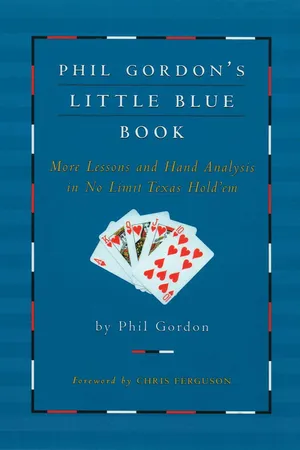
Phil Gordon's Little Blue Book
eBook - ePub

Phil Gordon's Little Blue Book

More Lessons and Hand Analysis in No Limit Texas Hold'em

  1. 416 pages
  2. English
  3. ePUB (mobile friendly)
  4. Available on iOS & Android
eBook - ePub

Phil Gordon's Little Blue Book

More Lessons and Hand Analysis in No Limit Texas Hold'em

About this book

In Poker: The Real Deal and Phil Gordon's Little Green Book, Phil Gordon -- a world-class player and teacher -- shared the strategies, tips, and expertise he's gleaned during his phenomenally successful career. Now, he shows players how to apply those theories to actual hands in order to make smart, confident decisions with every move.

Gordon walks readers through hands that he's encountered in cash games; early, middle, and late tournament play; Sit & Gos; satellites and supersatellites; and the final table of the World Series of Poker, revealing not only what plays he made but also why he made them. He relates what goes through a pro's mind in every situation, whether it's a timely bluff or a questionable call, and helps players calculate their own best moves in the most pressure-fueled of situations. In analyzing specific hands, Gordon also imparts important lessons in key poker skills such as calculating odds, shorthanded play, and discovering tells. And he discusses memorable plays -- the good and the oh-so-bad -- explaining why certain moves were made and, in many cases, how the hands should have been played differently.

Insightful, witty, and filled with real-life pro secrets, Phil Gordon's Little Blue Book is required reading for every player looking to make a profit and raise his game to the next level.
Frequently asked questions

Yes, you can cancel anytime from the Subscription tab in your account settings on the Perlego website. Your subscription will stay active until the end of your current billing period. Learn how to cancel your subscription.
No, books cannot be downloaded as external files, such as PDFs, for use outside of Perlego. However, you can download books within the Perlego app for offline reading on mobile or tablet. Learn more here.
Perlego offers two plans: Essential and Complete
  • Essential is ideal for learners and professionals who enjoy exploring a wide range of subjects. Access the Essential Library with 800,000+ trusted titles and best-sellers across business, personal growth, and the humanities. Includes unlimited reading time and Standard Read Aloud voice.
  • Complete: Perfect for advanced learners and researchers needing full, unrestricted access. Unlock 1.4M+ books across hundreds of subjects, including academic and specialized titles. The Complete Plan also includes advanced features like Premium Read Aloud and Research Assistant.
Both plans are available with monthly, semester, or annual billing cycles.
We are an online textbook subscription service, where you can get access to an entire online library for less than the price of a single book per month. With over 1 million books across 1000+ topics, we’ve got you covered! Learn more here.
Look out for the read-aloud symbol on your next book to see if you can listen to it. The read-aloud tool reads text aloud for you, highlighting the text as it is being read. You can pause it, speed it up and slow it down. Learn more here.
Yes! You can use the Perlego app on both iOS or Android devices to read anytime, anywhere — even offline. Perfect for commutes or when you’re on the go.
Please note we cannot support devices running on iOS 13 and Android 7 or earlier. Learn more about using the app.
Yes, you can access Phil Gordon's Little Blue Book by Phil Gordon in PDF and/or ePUB format. We have over one million books available in our catalogue for you to explore.

Information

Publisher
Gallery Books
Year
2009
eBook ISBN
9781416938705
Image
Tournaments like the World Series of Poker (WSOP) or the World Poker Tour (WPT) may get all the headlines, but there are a lot of purists who believe that cash games represent the only ā€œtrueā€ way to play poker. In a cash game, you can’t get eliminated by a bad beat, at least as long as you have cash in your wallet. There aren’t any artificial constraints like short stacks or increasing blinds and antes—the best strategies are the ones that most effectively separate your opponents from their money. Most important, especially to the pros who make their living at the game, the good players will eventually win, while the bad players will ultimately get their comeuppance.
Cash games are all about long-term results. The goal, therefore, is to make decisions that carry positive equity. In tournaments it’s generally a bad idea to risk all of your chips in situations where you are only a slight favorite—get into two 55-45 ā€œraces,ā€ and odds are, you’re going to lose one and find yourself stumbling for the exit. In a cash game, however, as long as you have a big enough bankroll, the statistically favorable play is always the best play. You’ll still face your share of bad luck, but a player who consistently makes quality decisions will survive these short-term fluctuations and, over time, come out ahead. Hopefully far ahead. Very far ahead.
ALOHA, FULL HOUSE!
Image
THE SITUATION: A loose, drunken nine-handed No Limit cash game on a Friday night at the Palms Casino, Las Vegas.
—— No Limit Hold’em ——
Image
POT: $37 TO CALL: $18 POT ODDS: 2.1—1
I love playing pocket pairs in multiway pots. I’m either going to flop a set (or better) and have a chance to win a very big pot, or I’ll miss and escape without doing too much damage to my stack.
The action gets to ā€œHawaii,ā€ a middle-aged guy wearing a bright floral-print button-up, in Seat 7. That wardrobe should be illegal, and it’s more than moderately distracting. In keeping with the island theme, he’s ordering piƱa coladas by the bucketful. He raises to $20.
At the moment, the pot isn’t giving me favorable odds.… I’m only getting 2—1 to call, while the odds of my flopping a set or better are around 8—1 against. My implied odds, however, are excellent—if Hawaii turns out to have any kind of hand and I make my set, I’ll have a very good shot of doubling up. I love that he has a grand in front of him.
I call the raise. So do Seats 2 and 5. There is $85 in the pot.
—— The Flop ——
Image
Mahalo! I suppress the urge to break out and hula dance, though Kool and the Gang’s ā€œCelebrationā€ starts echoing in my subconscious. Now the key is to figure out how to maximize the amount of money I stand to win. Do I bet out, or slowplay?
What would you do?
I begin my decision-making process by creating a mental image of how this hand is likely to play out. Hawaii, the preflop aggressor, seems likely to bet; I’m confident that I’ll be able to separate him from some money. But I’m greedier than that: I want to trap the two players in the middle as well.
If Hawaii were on my immediate left, I’d probably check my hand, allow him to bet and hope that the two players in the middle call, then trap them all with a raise when the action returned to me. With Hawaii last to act, however, I’m going to have to trap the two players in the middle before the action gets to him. I’ll make a small bet here, one that I hope one or two players in the middle can call, and pray that Hawaii can raise.
I bet $20. Seats 2 and 5 both call. Perfect! Hawaii raises to $150. Sucker! The plan worked to perfection! There is $295 in the pot, and it will cost me $w30 to call. As ā€œHannibalā€ Smith used to say to the A-Team, ā€œI love it when a plan comes together!ā€ Now, do I just call the bet here, or bring down the hammer with a raise?
What would you do?
I’m inclined to re-raise here for three reasons:
1. Hawaii’s bet is probably large enough to scare off our other two opponents, so there’s not much point in trying to keep them around much longer.
2. If Hawaii has a flush draw, say A♣K♣, he’ll probably be willing to put all of his money into the pot right now. If he doesn’t have a flush draw and another club comes on the turn, he might shut down.
3. If Hawaii is overplaying an overpair, as tourists wearing Hawaiian shirts to a casino are apt to do, say T-T, J-J, or Q-Q, and an overcard or flush card comes on the turn, it will be very difficult to extract all of his chips. If he has an overpair, I think it’s very likely he’ll push all-in against me right away.
I decide to re-raise and give him a chance to jump into molten lava.
I re-raise to $300. Seats 2 and 5 quickly fold. Hawaii doesn’t hesitate: He pushes all-in. Luau time! I move my chips into the middle so fast that I burn skid marks into the felt. My somewhat dazed opponent turns over pocket queens, an overpair to the board. He’s drawing slim to two outs. The turn and river rain harmless clubs, the K♣ and J♣. I scoop the pot with both hands.
ā€œI put you on a flush draw,ā€ Hawaii comments as he slurps the last of his drink and fishes for the cherry.
In retrospect it was a good thing I made my move when I did—the turn probably would have slowed him down. In comparison to the grand I won from the big fish, the extra $40 I won by betting right out seems insignificant. But it’s $40 I wouldn’t have won had I just checked the flop, and it will come in handy when Antonio ā€œMr. Bottle Serviceā€ Esfandiari and I meet up for drinks at the Ghost Bar in a few hours. I’ve been out with that guy about thirty times, and I’ve never left a bar without parting with at least $500. Antonio is a one-man bankroll wrecking machine at and away from the tables.
KEY ANALYSIS
Pocket pairs possess a lot of implied value, especially in multiway pots, where they present you with a chance to win a lot or lose a little. When you are lucky enough to flop a monster hand, take a minute to figure out how the action is likely to play out… and how you can maximize your winnings. Poker isn’t about winning pots: It’s about winning as much money as you possibly can on the hands you decide to play.
A WEIRD DRAW
Image
THE SITUATION: Midnight in a loose seven-handed No Limit Hold’em game at the Borgata in Atlantic City, New Jersey.
—— NO LIMIT HOLD’EM CASH GAME——
Image
POT: $22 TO CALL: $5 POT ODDS: 4.4—1
Decisions, decisions. Seven-six offsuit isn’t a great hand, but I’m in position with excellent pot odds and no one has shown any kind of strength here. This feels like a ā€œfamily potā€ situation.
What would you do?
If this were the middle or late stages of a tournament, I’d give serious thought to raising here against a group of loose limpers. But in a loose ā€œno fold’em hold’emā€ game like this, that play never works. The real value in this hand comes from the implied odds and my position—if I can flop a great hand, I will have a chance to win a big pot.
Before I limp in, however, I will consider the players left to act, behind me: Are any of them likely to make the ā€œraise the limpersā€ play I was just considering? In this case neither player has demonstrated much aggression or skill, so the answer is probably no. If one of them does raise, though, I’m done with this hand.
I call $5 from the button. The small blind tosses in three bucks to complete the blind, and the big blind checks. There are six players and $30 in the pot.
—— THE FLOP——
Image
This is a dangerous flop for me. I perform a bit of quick mental calculus:
ā€œDumbā€ end of a straight draw
+ A very weak flush draw
+ 5 loose opponents
Image
= A perfect opportunity for me to lose a lot of money
All five players check to me. Should I bet or check? What would you do?
I know, I said this was a dangerous flop. But I can’t just leave that money lying there in the middle with all the weakness on display, can I?
When I flop a draw in position against many opponents and it gets checked around to me, I’ll often just check and take a free look at the turn card. In this situation, however, I really don’t have that much of a draw… or, better said, I have several draws that I might not want to make.
First let’s look at the kinds of hands that my opponents were likely to limp in with: weak aces, medium pocket pairs, suited cards and/or connectors.
A heart will make me a flush, but w...

Table of contents

  1. Cover Page
  2. Title Page
  3. Copyright Page
  4. Dedication Page
  5. Introduction
  6. Player Attributes
  7. Cash Games
  8. Early Tournament Play
  9. Middle Tournament Play
  10. Late Tournament Play
  11. The Final Table
  12. Sit & Gos
  13. Satellites and Supersatellites
  14. Afterword
  15. Further Study
  16. A Short Guide to Poker Jargon