The Shipping News
eBook - ePub

The Shipping News

A Novel

  1. 368 pages
  2. English
  3. ePUB (mobile friendly)
  4. Available on iOS & Android
eBook - ePub

The Shipping News

A Novel

About this book

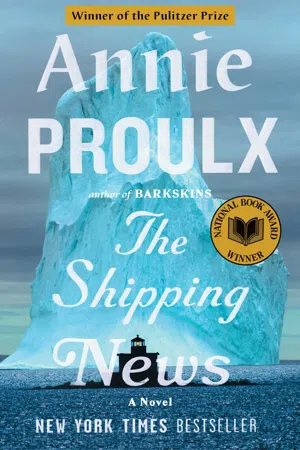
Winner of the Pulitzer Prize, The Shipping News is a vigorous, darkly comic, at times magical portrait of the contemporary North American family, and "a rare creation, a lyric page-turner" (Chicago Tribune).

At thirty-six, Quoyle, a third-rate newspaperman is wrenched violently out of his world when his two-timing wife meets her just desserts. He retreats with his two daughters to his ancestral home on the starkly beautiful Newfoundland coast, where a rich cast of local characters all play a part in Quoyle’s struggle to reclaim his life. As three generations of his family cobble up new lives, Quoyle confronts his private demons—and the unpredictable forces of nature and society—and begins to see the possibility of love without pain or misery.

The Shipping News “is charged with sardonic wit—alive, funny, a little threatening: packed with brilliantly original images…and now and then, a sentence that simply takes your breath away” (USA TODAY).
Frequently asked questions

Yes, you can cancel anytime from the Subscription tab in your account settings on the Perlego website. Your subscription will stay active until the end of your current billing period. Learn how to cancel your subscription.
No, books cannot be downloaded as external files, such as PDFs, for use outside of Perlego. However, you can download books within the Perlego app for offline reading on mobile or tablet. Learn more here.
Perlego offers two plans: Essential and Complete
  • Essential is ideal for learners and professionals who enjoy exploring a wide range of subjects. Access the Essential Library with 800,000+ trusted titles and best-sellers across business, personal growth, and the humanities. Includes unlimited reading time and Standard Read Aloud voice.
  • Complete: Perfect for advanced learners and researchers needing full, unrestricted access. Unlock 1.4M+ books across hundreds of subjects, including academic and specialized titles. The Complete Plan also includes advanced features like Premium Read Aloud and Research Assistant.
Both plans are available with monthly, semester, or annual billing cycles.
We are an online textbook subscription service, where you can get access to an entire online library for less than the price of a single book per month. With over 1 million books across 1000+ topics, we’ve got you covered! Learn more here.
Look out for the read-aloud symbol on your next book to see if you can listen to it. The read-aloud tool reads text aloud for you, highlighting the text as it is being read. You can pause it, speed it up and slow it down. Learn more here.
Yes! You can use the Perlego app on both iOS or Android devices to read anytime, anywhere — even offline. Perfect for commutes or when you’re on the go.
Please note we cannot support devices running on iOS 13 and Android 7 or earlier. Learn more about using the app.
Yes, you can access The Shipping News by Annie Proulx in PDF and/or ePUB format, as well as other popular books in Literature & Classics. We have over one million books available in our catalogue for you to explore.

Information

Publisher
Scribner
Year
2008
eBook ISBN
9780743519809
1
Quoyle
Quoyle: A coil of rope.
“A Flemish flake is a spiral coil of one layer only. It is made on deck, so that it may be walked on if necessary.”
THE ASHLEY BOOK OF KNOTS
images
HERE is an account of a few years in the life of Quoyle, born in Brooklyn and raised in a shuffle of dreary upstate towns.
Hive-spangled, gut roaring with gas and cramp, he survived childhood; at the state university, hand clapped over his chin, he camouflaged torment with smiles and silence. Stumbled through his twenties and into his thirties learning to separate his feelings from his life, counting on nothing. He ate prodigiously, liked a ham knuckle, buttered spuds.
His jobs: distributor of vending machine candy, all-night clerk in a convenience store, a third-rate newspaperman. At thirty-six, bereft, brimming with grief and thwarted love, Quoyle steered away to Newfoundland, the rock that had generated his ancestors, a place he had never been nor thought to go.
A watery place. And Quoyle feared water, could not swim. Again and again the father had broken his clenched grip and thrown him into pools, brooks, lakes and surf. Quoyle knew the flavor of brack and waterweed.
From this youngest son’s failure to dog-paddle the father saw other failures multiply like an explosion of virulent cells—failure to speak clearly; failure to sit up straight; failure to get up in the morning; failure in attitude; failure in ambition and ability; indeed, in everything. His own failure.
Quoyle shambled, a head taller than any child around him, was soft. He knew it. “Ah, you lout,” said the father. But no pygmy himself. And brother Dick, the father’s favorite, pretended to throw up when Quoyle came into a room, hissed “Lardass, Snotface, Ugly Pig, Warthog, Stupid, Stinkbomb, Fart-tub, Greasebag,” pummeled and kicked until Quoyle curled, hands over head, sniveling, on the linoleum. All stemmed from Quoyle’s chief failure, a failure of normal appearance.
A great damp loaf of a body. At six he weighed eighty pounds. At sixteen he was buried under a casement of flesh. Head shaped like a crenshaw, no neck, reddish hair ruched back. Features as bunched as kissed fingertips. Eyes the color of plastic. The monstrous chin, a freakish shelf jutting from the lower face.
Some anomalous gene had fired up at the moment of his begetting as a single spark sometimes leaps from banked coals, had given him a giant’s chin. As a child he invented stratagems to deflect stares; a smile, downcast gaze, the right hand darting up to cover the chin.
His earliest sense of self was as a distant figure: there in the foreground was his family; here, at the limit of the far view, was he. Until he was fourteen he cherished the idea that he had been given to the wrong family, that somewhere his real people, saddled with the changeling of the Quoyles, longed for him. Then, foraging in a box of excursion momentoes, he found photographs of his father beside brothers and sisters at a ship’s rail. A girl, somewhat apart from the others, looked toward the sea, eyes squinted, as though she could see the port of destination a thousand miles south. Quoyle recognized himself in their hair, their legs and arms. That sly-looking lump in the shrunken sweater, hand at his crotch, his father. On the back, scribbled in blue pencil, “Leaving Home, 1946.”
At the university he took courses he couldn’t understand, humped back and forth without speaking to anyone, went home for weekends of excoriation. At last he dropped out of school and looked for a job, kept his hand over his chin.
Nothing was clear to lonesome Quoyle. His thoughts churned like the amorphous thing that ancient sailors, drifting into arctic half-light, called the Sea Lung; a heaving sludge of ice under fog where air blurred into water, where liquid was solid, where solids dissolved, where the sky froze and light and dark muddled.
images
He fell into newspapering by dawdling over greasy saucisson and a piece of bread. The bread was good, made without yeast, risen on its own fermenting flesh and baked in Partridge’s outdoor oven. Partridge’s yard smelled of burnt cornmeal, grass clippings, bread steam.
The saucisson, the bread, the wine, Partridge’s talk. For these things he missed a chance at a job that might have put his mouth to bureaucracy’s taut breast. His father, self-hauled to the pinnacle of produce manager for a supermarket chain, preached a sermon illustrated with his own history—“I had to wheel barrows of sand for the stonemason when I came here.” And so forth. The father admired the mysteries of business—men signing papers shielded by their left arms, meetings behind opaque glass, locked briefcases.
But Partridge, dribbling oil, said, “Ah, fuck it.” Sliced purple tomato. Changed the talk to descriptions of places he had been, Strabane, South Amboy, Clark Fork. In Clark Fork had played pool with a man with a deviated septum. Wearing kangaroo gloves. Quoyle in the Adirondack chair, listened, covered his hand with his chin. There was olive oil on his interview suit, a tomato seed on his diamond-patterned tie.
images
Quoyle and Partridge met at a laundromat in Mockingburg, New York. Quoyle was humped over the newspaper, circling helpwanted ads while his Big Man shirts revolved. Partridge remarked that the job market was tight. Yes, said Quoyle, it was. Partridge floated an opinion on the drought, Quoyle nodded. Partridge moved the conversation to the closing of the sauerkraut factory. Quoyle fumbled his shirts from the dryer; they fell on the floor in a rain of hot coins and ballpoint pens. The shirts were streaked with ink.
“Ruined,” said Quoyle.
“Naw,” said Partridge. “Rub the ink with hot salt and talcum powder. Then wash them again, put a cup of bleach in.”
Quoyle said he would try it. His voice wavered. Partridge was astonished to see the heavy man’s colorless eyes enlarged with tears. For Quoyle was a failure at loneliness, yearned to be gregarious, to know his company was a pleasure to others.
The dryers groaned.
“Hey, come by some night,” said Partridge, writing his slanting address and phone number on the back of a creased cash register receipt. He didn’t have that many friends either.
The next evening Quoyle was there, gripping paper bags. The front of Partridge’s house, the empty street drenched in amber light. A gilded hour. In the bags a packet of imported Swedish crackers, bottles of red, pink and white wine, foil-wrapped triangles of foreign cheeses. Some kind of hot, juggling music on the other side of Partridge’s door that thrilled Quoyle.
images
They were friends for a while, Quoyle, Partridge and Mercalia. Their differences: Partridge black, small, a restless traveler across the slope of life, an all-night talker; Mercalia, second wife of Partridge and the color of a brown feather on dark water, a hot intelligence; Quoyle large, white, stumbling along, going nowhere.
Partridge saw beyond the present, got quick shots of coming events as though loose brain wires briefly connected. He had been born with a caul; at three, witnessed ball lightning bouncing down a fire escape; dreamed of cucumbers the night before his brother-in-law was stung by hornets. He was sure of his own good fortune. He could blow perfect smoke rings. Cedar waxwings always stopped in his yard on their migration flights.
images
Now, in the backyard, seeing Quoyle like a dog dressed in a man’s suit for a comic photo, Partridge thought of something.
“Ed Punch, managing editor down at the paper where I work is looking for a cheap reporter. Summer’s over and his college rats go back to their holes. The paper’s junk, but maybe give it a few months, look around for something better. What the hell, maybe you’d like it, being a reporter.”
Quoyle nodded, hand over chin. If Partridge suggested he leap from a bridge he would at least lean on the rail. The advice of a friend.
“Mercalia! I’m saving the heel for you, lovely girl. It’s the best part. Come on out here.”
Mercalia put the cap on her pen. Weary of prodigies who bit their hands and gyred around parlor chairs spouting impossible sums, dust rising from the oriental carpets beneath their stamping feet.
images
Ed Punch talked out of the middle of his mouth. While he talked he examined Quoyle, noticed the cheap tweed jacket the size of a horse blanket, fingernails that looked regularly held to a grindstone. He smelled submission in Quoyle, guessed he was butter of fair spreading consistency.
Quoyle’s own eyes roved to a water-stained engraving on the wall. He saw a grainy face, eyes like glass eggs, a fringe of hairs rising from under the collar and cascading over its starched rim. Was it Punch’s grandfather in the chipped frame? He wondered about ancestors.
“This is a family paper. We run upbeat stories with a community slant.” The Mockingburg Record specialized in fawning anecdotes of local business people, profiles of folksy characters; this thin stuff padded with puzzles and contests, syndicated columns, features and cartoons. There was always a self-help quiz—“Are You a Breakfast Alcoholic?”
Punch sighed, feigned a weighty decision. “Put you on the municipal beat to help out Al Catalog. He’ll break you in. Get your assignments from him.”
The salary was pathetic, but Quoyle didn’t know.
images
Al Catalog, face like a stubbled bun, slick mouth, ticked the back of his fingernail down the assignment list. His glance darted away from the back of Quoyle’s chin, hammer on a nail.
“O.k., planning board meeting’s a good one for you to start with. Down at the elemennary school. Whyn’t you take that tonight? Sit in the little chairs. Write down everything you hear, type it up. Five hunnerd max. Take a recorder, you want. Show me the piece in the A.M. Lemme see it before you give it on to that black son of a bitch on the copy desk.” Partridge was the black son of a bitch.
Quoyle at the back of the meeting, writing on his pad. Went home, typed and retyped all night at the kitchen table. In the morning, eyes circled by rings, nerved on coffee, he went to the newsroom. Waited for Al Catalog.
Ed Punch, always the first through the door, slid into his office like an eel into the rock. The A.M. parade started. Feature-page man swinging a bag of coconut doughnuts; tall Chinese woman with varnished hair; elderly circulation man with arms like hawsers; two women from layout; photo editor, yesterday’s shirt all underarm stains. Quoyle at his desk pinching his chin, his head down, pretending to correct his article. It was eleven pages long.
At ten o’clock, Partridge. Red suspenders and a linen shirt. He nodded and patted his way across the newsroom, stuck his head in Punch’s crevice, winked at Quoyle, settled into the copy desk slot in front of his terminal.
Partridge knew a thousand things, that wet ropes held greater weight, why a hard-boiled egg spun more readily than a raw. Eyes half closed, head tipped back in a light trance, he could cite baseball statistics as the ancients unreeled The Iliad. He reshaped banal prose, scraped the mold off Jimmy Breslin imitations. “Where are the reporters of yesteryear?” he muttered, “the nail-biting, acerbic, alcoholic nighthawk bastards who truly knew how to write?”
Quoyle brought over his copy. “Al isn’t in yet,” he said, squaring up the pages, “so I thought I’d give it to you.”
His friend did not smile. Was on the job. Read for a few seconds, lifted his face to the fluorescent light. “Edna was in she’d shred this. Al saw it he’d tell Punch to get rid of you. You got to rewrite this. Here, sit down. Show you what’s wrong. They say reporters can be made out of anything. You’ll be a test case.”
It was what Quoyle had expected.
“Your lead,” said Partridge. “Christ!” He read aloud in a highpitched singsong.
Last night the Pine Eye Planning Commission voted by a large margin to revise earlier recommendations for amendments to the municipal zoning code that would increase th...

Table of contents

  1. Cover
  2. Title Page
  3. Dedication
  4. Epigraph
  5. Chapter 1: Quoyle
  6. Chapter 2: Love Knot
  7. Chapter 3: Strangle Knot
  8. Chapter 4: Cast Away
  9. Chapter 5: A Rolling Hitch
  10. Chapter 6: Between Ships
  11. Chapter 7: The Gammy Bird
  12. Chapter 8: A Slippery Hitch
  13. Chapter 9: The Mooring Hitch
  14. Chapter 10: The Voyage of Nutbeem
  15. Chapter 11: A Breastpin of Human Hair
  16. Chapter 12: The Stern Wave
  17. Chapter 13: The Dutch Cringle
  18. Chapter 14: Wavey
  19. Chapter 15: The Upholstery Shop
  20. Chapter 16: Beety’s Kitchen
  21. Chapter 17: The Shipping News
  22. Chapter 18: Lobster Pie
  23. Chapter 19: Good-bye, Buddy
  24. Chapter 20: Gaze Island
  25. Chapter 21: Poetic Navigation
  26. Chapter 22: Dogs and Cats
  27. Chapter 23: Maleficium
  28. Chapter 24: Berry Picking
  29. Chapter 25: Oil
  30. Chapter 26: Deadman
  31. Chapter 27: Newsroom
  32. Chapter 28: The Skater’s Chain Grip
  33. Chapter 29: Alvin Yark
  34. Chapter 30: The Sun Clouded Over
  35. Chapter 31: Sometimes You Just Lose It
  36. Chapter 32: The Hairy Devil
  37. Chapter 33: The Cousin
  38. Chapter 34: Dressing Up
  39. Chapter 35: The Day’s Work
  40. Chapter 36: Straitjacket
  41. Chapter 37: Slingstones
  42. Chapter 38: The Sled Dog Driver’s Dream
  43. Chapter 39: Shining Hubcaps
  44. Acknowledgments
  45. About the Author
  46. Copyright