Be Compassionate, Create a Connection
It’s becoming clear that organizations willing to explore compassion’s complexities—its hows and whys, nuances, and manifestations—can reap the rewards of far-reaching and culture-changing effects. However, before compassion can become part of organizational culture, we need a common language. Beyond offering a definition, this book provides actionable strategies to practice compassion.
Author Dee Borgoyn will show you why we need compassion, how we are healthier and happier when we show our compassion, that we are born to be compassionate, and how this translate to the workplace.
?With 28 Ways of Compassion, Borgoyn has created a useful tool for leaders in the healthcare industry and beyond who are looking to optimize employee retention and engagement while improving customer satisfaction.
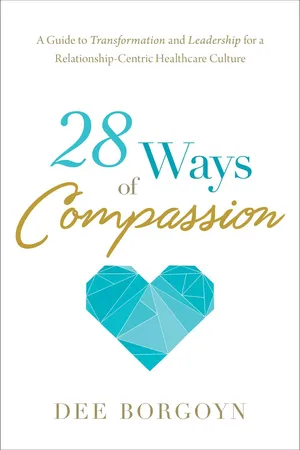
eBook - ePub
28 Ways of Compassion
A Guide to Transformation and Leadership for a Relationship-Centric Healthcare Culture
- 200 pages
- English
- ePUB (mobile friendly)
- Available on iOS & Android
eBook - ePub
28 Ways of Compassion
A Guide to Transformation and Leadership for a Relationship-Centric Healthcare Culture
About this book
Information
Topic
MedicinaSubtopic
Atención sanitariaSECTION THREE
Act
We deliberately propel forward to take action, to have an effect on our environment. We move.
We become increasingly adept at creating motion by practicing small, specific behaviors. We repeat them until they start to become habits. We then build on these new foundations.
We lean beyond reaction; we are proactive.
We drive change.
15.
Model Compassion to Others
“We learn by example and by direct experience because there are real limits to the adequacy of verbal instruction.”
—MALCOLM GLADWELL
Health-care organizations, like most companies, spend millions of dollars every year on training and staff education. When there’s a well-crafted approach to staff development, this education takes a wide variety of forms and formats, from formal orientation and onboarding of new hires to in-servicing for new products, policies, and protocols, and attendance at conferences, enrollment in college courses, and mentoring and buddy-type programs.
For healthcare, the bulk of the training provided is required by regulation and is heavily monitored by outside agencies as a condition of licensing. Even in good companies with the best intentions these trainings sometimes become an exercise of checking off boxes on government lists. The value of the initial investments can be diminished when there is a lack of follow-up or a lack of continuation of the learning relationship.
In addition to the documented millions budgeted and spent, money is lost when training is absent or has been ineffective. These dollars are hard to capture. Here are some examples:
- Spending $1,000 for two weeks of scheduled training for a new hire but failing to provide more dollars for additional support as the new employee transitions into the workforce
- Not studying why and how a costly training effort with a current employee failed, so that possible remedies can be considered rather than losing the value of the training or letting the employee go
- Money lost in productivity and errors from untrained employees who stay
- Loss of morale when team-building is absent
- Decline in consumer satisfaction, employee engagement, quality scores and outcomes, and other measurables due to lessened confidence in the competence of staff
Overall the impact is staggering. So what do we do? If we had more resources, we might do what all great organizations strive to do: reach past the required training to invest in organizational efficiencies, competency confirmation, cross-departmental work, individual growth projects, and projects affecting all cultural and communication areas.
Let’s assume, though, that we are limited in terms of additional dollars or hours for training and staff development. This is a frequent response to any suggestion of new initiatives. What can we do to make the best of the money and time we put into training and growing our people?
Let’s talk about a free and invaluable tool called modeling. When someone acts or takes action, they’re modeling a behavior or activity. Modeling is a very powerful teaching method. People often learn more about us from what we do than from what we say. So it’s imperative that we pay attention to what we’re telling them.
I observed a very clear example of people saying one thing and modeling another a few days ago, when I was having breakfast at Denny’s. Two women were at an adjoining booth with an infant and a toddler. Both of them, apparently mother and grandmother, were teaching good manners to a darling little girl by having her use “please” and “thank you” as she interacted with them during breakfast. “Pancake” and a pointed finger was changed to “Pancake, please.” As I watched the two women conversing and making requests of the young waiter, I noticed that they weren’t using please or thank you with him. I wondered if the little girl was paying attention. She kept close watch on her mother and grandmother and the waiter as he fetched ketchup, more napkins, and coffee refills. It was obviously lost on them that they weren’t doing what they were telling her to do.
This story shows how easily we can send conflicting messages despite our best intentions.
Before we get to your exercise for today, please consider and choose to agree that one of the most effective, lasting, and low-cost methods we can use for teaching the people around us, the people who may work for us, and the people we serve and care for is modeling. Modeling basically works when a subject is watched doing or acting or being in a way that is correct and acceptable and then another subject copies (mimics) what they’ve seen so that they can repeat the desired behavior.
Almost everything about us, everywhere we go, is being continually observed. What we do, how we move, what we say, and how we say it. No matter what we try to put forth about who we are, and what is right and what is important to us, others will most often look to our actions to determine what is true and real.
In the world of work, regardless of what has been shared as the “desired” behavior or culture, the new employee who’s trying to fit in or the current employee who wants to excel and move up will take note of what the successful “other” models. The successful other could be a nurse who is popular or has longevity, a coworker who is being promoted or recognized publicly, or someone who has been chosen as a leader, such as a manager or administrator.
New hires may receive formal training on policies, protocols, and practices, and may see literature on company culture and expectations. But some of the most meaningful education takes place after the training when they observe what people actually say and do.
We all strive to portray ourselves to the world in a specific way, the way in which we’d like to be viewed. I want to be seen as caring, competent, trustworthy, and a little brave, and I want to leave having made a difference in this world. If this rings a bell with you, we both need to realize that it’s not about what we say we want or who we say we are or what we tell others to do in our daily interactions. It’s more important that we actually practice how we would like to be viewed. For example, we should strive to model compassion, moment by moment, action by action, if we want to be viewed as a compassionate person. If you strive to be viewed as compassionate, you should show people what it looks like so they can mimic it, experience the results, and become intentionally compassionate themselves.
Exercises for Day 15
Thoughtfully consider your actions. How much difference is there between what you are telling others to say and do vs. what you actively model in your words and actions? How do your behaviors align with company culture?
- As you work with those around you, your coworkers, those who look up to you as an authority, and even your patients or residents, what do your actions say about you?
- Are you modeling compassion in your actions, words, and tone of voice? How are you modeling the compassion that you expect to see in others? If you’re not, what could you have done to handle things differently?
- Stretch exercise: Consider what is being modeled to you by your peers and leaders.

- Who did you observe exercising compassion today? How did it affect you? Can you mimic it?
- How can formal and informal leaders line their words up with their actions when it comes to compassion?
- What type of modeling, or steps, do you think can “teach” compassion in the workplace? How would you help the best and most caring nurses share what they know and help others act more compassionately?
16.
Choose Personal Interaction over Technology Whenever Possible
“We get addicted to the rush at work, or to the endless flow of the online world, and your life changes. Attention spans go down, patience decreases, essential tasks are left undone, and most of all, our humanity starts to fade away.”
—SETH GODIN
My first real job was in 1979. I worked for the state of Nevada as a public service intern. This meant that I basically did all kinds of reports, studies, memos, and odd assignments—the work that was important enough to get done but not so earth-shaking that an intern couldn’t do it. My office consisted of three cubicle walls, a phone, yellow legal pads, pens, a desk calculator, a stapler, and staples. The only keyboard in sight was a shared IBM Selectric typewriter on a rolling stand. When people needed to communicate they either called each other on the telephone or they met face to face.
Fast forward to today. My most recent in-office work setting looked very different. Walking through an office suite, I’d see people staring into computer screens, typing away to share information, say hello, and communicate with their teams. On their desk was a cellphone, which got a glance every few minutes throughout the day. Face-to-face meetings happened, but it seemed that people were constantly communicating through technology—even during their face-to-face meetings. I’d often hear someone in the hall greet a coworker with, “Did you get my email?”
Recently I passed a bus stop on a beautiful spring morning in Washington, D.C., and it struck me that there were six people standing within feet of each other, each staring and “engaging” on their cell phone with someone in another place. Hopefully they were planning a future get-together!
Although technology such as email and texting may help us communicate with other people on the fly, I believe its highest value might be in helping us plan to meet in person and catch up on ideas we want to discuss or share. What we hopefully are seeking in email and text messages is to arrange a true connection.
Technology is useful when we need to get a consistent, repetitive message out to a large number of people at once. Or if we have to share plans that include lots of details, numbers, or other types of data, whether in-house or across geographic areas and companies.
Managers and leaders who want to actually have real relationships and show others the optimal way to do that must step a-w-a-y from technology, which is merely a tool, and interact in person. This also means leaving your cell phone at your desk. I feel the need to say this because I have seen leaders leave their office only to walk down the halls with—you guessed it—their eyes glued to their cell phone.
Interestingly, I read recently that younger managers and those hoping to be managers actually do not support teleworking for their company’s top executives. It seems that they want these role models physically in the office where they can have personal contact and facetime, which they feel contributes much more to their success than virtual encounters. This is very insightful on their part and reinforces my point that in person trumps technology.
When it comes to relationships, email and autobots might be better than nothing, but it may be best to reserve them as a last resort. When email is used to express opinions and feelings, it can lead to very serious misunderstandings. (I say this from decades of human resources experience!) How often have we found that we need to circle back to clarify, give more information, or calm down an irate person who misinterpreted what was said? What might have been a “missed” communication has now become a “miscommunication.” There’s no efficiency there...
Table of contents
- Cover Page
- Title
- Copyright
- Dedication
- Contents
- Acknowledgments
- Introduction
- How to Use this Book
- Listen
- Engage
- Act
- Dare to Care
- Conclusion
- Next Steps: The Compassion Component
- About the Author
Trusted by 375,005 students
Access to over 1.5 million titles for a fair monthly price.
Study more efficiently using our study tools.
Frequently asked questions
Yes, you can cancel anytime from the Subscription tab in your account settings on the Perlego website. Your subscription will stay active until the end of your current billing period. Learn how to cancel your subscription
No, books cannot be downloaded as external files, such as PDFs, for use outside of Perlego. However, you can download books within the Perlego app for offline reading on mobile or tablet. Learn how to download books offline
Perlego offers two plans: Essential and Complete
- Essential is ideal for learners and professionals who enjoy exploring a wide range of subjects. Access the Essential Library with 800,000+ trusted titles and best-sellers across business, personal growth, and the humanities. Includes unlimited reading time and Standard Read Aloud voice.
- Complete: Perfect for advanced learners and researchers needing full, unrestricted access. Unlock 1.5M+ books across hundreds of subjects, including academic and specialized titles. The Complete Plan also includes advanced features like Premium Read Aloud and Research Assistant.
We are an online textbook subscription service, where you can get access to an entire online library for less than the price of a single book per month. With over 1.5 million books across 990+ topics, we’ve got you covered! Learn about our mission
Look out for the read-aloud symbol on your next book to see if you can listen to it. The read-aloud tool reads text aloud for you, highlighting the text as it is being read. You can pause it, speed it up and slow it down. Learn more about Read Aloud
Yes! You can use the Perlego app on both iOS and Android devices to read anytime, anywhere — even offline. Perfect for commutes or when you’re on the go.
Please note we cannot support devices running on iOS 13 and Android 7 or earlier. Learn more about using the app
Please note we cannot support devices running on iOS 13 and Android 7 or earlier. Learn more about using the app
Yes, you can access 28 Ways of Compassion by Dee Borgoyn in PDF and/or ePUB format, as well as other popular books in Medicina & Atención sanitaria. We have over 1.5 million books available in our catalogue for you to explore.