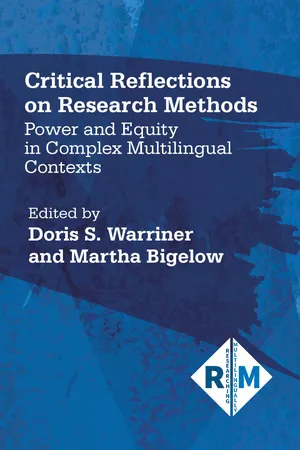
This book explores the challenges and opportunities involved in conducting research with members of immigrant, refugee and other minoritized communities. Through first-hand reflective accounts, contributors explore community-based collaborative work, and suggest important implications for applied linguistics, educational research and anthropological investigations of language, literacy and culture. By critically reflecting on the power and limits of university-based research conducted on behalf of, or in collaboration with, members of local communities and by exploring the complicated relationships, dynamics and understandings that emerge, the chapters collectively demonstrate the value of reflecting on the possibilities and challenges of the research process, including the ethical and emotional dimensions of participating in collaborative research.
eBook - ePub
Critical Reflections on Research Methods
Power and Equity in Complex Multilingual Contexts
- English
- ePUB (mobile friendly)
- Available on iOS & Android
eBook - ePub
Critical Reflections on Research Methods
Power and Equity in Complex Multilingual Contexts
About this book
Information
Part 1: Language, Culture and Identity
1 ‘I have so many things to tell you, but I don’t know English’: Linguistic Challenges and Language Brokering
Chatwara Suwannamai Duran
In 2009, I received a forwarded email, originally written by a volunteer, who worked with a Phoenix-based refugee resettlement agency. She wrote that she taught English to newly-arrived refugee families, predominantly from Burma,1 and ‘help them get started in Arizona.’ She hoped to recruit more volunteers to work with the families at the refugees’ homes. I was excited about being a volunteer and emailed her for more details. She promptly replied:
‘These refugees speak a variety of tribal languages, but also some Burmese, Lao and Thai.’ (E-mail conversation, 16 September 2009)
After a few more email exchanges with her, I learned that many refugees are very homesick and in need of friends. The volunteer added, ‘Just having someone to talk to them in their native language and encourage them would be a big help’ and ‘Some of the teenagers – they speak Thai very well but they are having difficulty learning English.’ She expressed that she knew some Thai words and that ‘there is a lot lost in translation’ during communication with these newcomers. She believed that native Thai or Burmese speakers would be better able to help these refugees in some way.
Being a native speaker of Thai, who has had first-hand experiences of acculturation in the USA, and being a graduate student in the field of language and literacy education at the time, I enthusiastically offered my assistance without hesitation. Through the volunteer work, I was introduced to many Karenni families in town, whose multiple languages, literacy practices, and skills not only intrigued me but also augmented my understanding of the linguistic complexity of refugees from Burma. I enjoyed weekly visits and hangouts, teaching English at their homes, helping with the children’s homework, accompanying the parents on errands, and giving them rides. Eventually, my volunteer work evolved into a dissertation research project. The primary goal of the project was to document and analyze the Karenni refugees’ out-of-school multilingual resources (Canagarajah, 2009; Kramsch, 2009) through the lens of language socialization in bilingual and multilingual communities (Bayley & Schecter, 2003; Duff, 2011; Fogle, 2012).
In this chapter, I examine and reflect on my experiences as a researcher working in this context, the methods and approaches I used, and the challenges I encountered while working with recently-arrived Karenni families who were originally from Burma but who had lived in Thailand’s fenced refugee camp for at least fifteen years prior to coming to Phoenix, Arizona. The Karenni families I worked with spoke, read and wrote languages that are considered (by applied linguists) to be Less Commonly Taught Languages (LCTLs) in the USA. These families are underserved because of their unrecognized languages in their host nation. Lack of linguistic knowledge to communicate with marginalized populations has become an issue of linguistic inequality, and for my part, I was eager to learn from the families. In my multiple roles (e.g. as a tutor, family mentor and friend to the families), I drew on a range of linguistic resources to communicate on a regular basis. Working to negotiate meaning with each other, the participants and I relied on our multilingual repertoires and a variety of strategic communication such as translating and interpreting (converting one language to another involving a dictionary or a bi/multilingual person) and code-switching (using two or more linguistic codes). Some participants and I also communicated in English, a language that had come, over time, to serve as a lingua franca. With some of the participants’ family members, I spoke Thai because they had learned Thai as an additional language when they lived in the refugee camps in Thailand. (Participants’ detailed linguistic inventories are discussed below.) All of these communicative techniques and languages were used contingently among the Karenni families and me.
While working to establish relationships I began to question my role as a university-based researcher that was distant from the refugee participants in addition to my previous roles as a volunteer tutor and a friend. I had been trying to find and use transparent and culturally-sensitive approaches to understand the lived experiences and views of the multilingual participants who had been minoritized and underrepresented throughout their life trajectories. I knew that language was a key in both data and process (Green & Thorogood, 2004) and that attempting to complete the project involved unlocking multiple communicative languages. I was afraid that things wouldn’t work. Therefore, I tried to recall what worked in my previous communication with the participant families so that I could use those approaches and methods in the research setting. My worries included how to present what I learned from the participants to a wider audience, who were not there with me during the data collection period.
In the literature on conducting research in/with/for minoritized and marginalized communities, researchers sometimes mention the fact that they encounter cross-cultural differences that present challenges similar to mine when dealing with linguistic diversity. In many cases, employing translators/interpreters is recommended as a way to solve communication difficulties. Knowing this, I first looked for translators/interpreters for my project because the participants and I did not share the same native language. However, as the scholarship shows (Edwards, 1998; Liamputtong, 2010; Temple, 1997), there are drawbacks even with this approach. For example, researchers have to depend on translators/interpreters’ ‘certain extent for perspective’ and that might not be the research participant’s perspective (Temple, 1997: 608). This is because translators/interpreters’ views are influenced by ‘their own lived experiences’ (Liamputtong, 2010: 150–151). Professional translators/interpreters in particular appear to be strangers to the research participants, who may not wish an outsider to know about or be an interpreter for them when they express their important yet sensitive issues (Edwards, 1998). In addition, professional translators/interpreters tend to select word choice that is more formal than what the participants really say or what they intend to convey (Tsai et al., 2004). Other difficulties include the translators/interpreters’ focus on verbal language without non-verbal signal and cultural meaning (Liamputtong, 2010).
During my fieldwork, I came across the term Language/Linguistic Brokering (LB), meant to capture the practices used for translating and interpreting both in formal communication (e.g. at a doctor’s clinic) and informal conversation but with linguistically and culturally sensitive and comprehensible approaches. That is, in addition to translating and interpreting words similar to translators and interpreters, language brokers also serve as linguistic, cultural, and knowledge mediators (Tse, 1996a). They are also known as ‘cultural brokers’ who provide culturally-contextualized explanation. American Speech-Hearing-Language Association (ASHA) has defined a language broker as a person who knows the client’s speech community, environment, sociolinguistic norms, and community-related information (ASHA, 2016). In this way, as Liamputtong (2010) emphasized, the involvement of a language-cultural broker helps researchers understand the participants’ local culture, ‘avoid social errors, and sustain good relationships’ (2010: 67) with the participants. Within this framework, LB is a social, cultural, methodological, and professional practice and technique rather than a theory.
In educational research, Wenger (1998) defined ‘brokering’ as ‘connecting’ people and creating continuities across boundaries (1998: 103). Brokers are members of multiple communities and therefore can be agents of these communities. As I considered my ethnographic study to be a collaborative venture with deep roots in a community of practice where my participants – both children and adults – and I learned from one another, I adopted this concept and technique of brokering and connecting, with my goal being to unlock the participants’ linguistic and cultural meaning as well as creating interpersonal relationship and learning opportunities between the broker and brokee (Lee et al., 2011).
However, the pathway to incorporating LB was not as easy as it seemed. At first, based on the definition of LB above, combined with the communicative techniques that the participants and I had been using, and the amicable relationship that the participants and I had established, I believed that I could recruit language brokers from the participants’ very own community. In fact, it took me some time to figure out how to manage to use LB at the research site. In the remainder of this chapter, I focus on the processes, complications, and outcomes of employing LB in my research. In the first section ‘So close but yet so far’, I reflect on insider/outsider issues that drove me to find a solution for cross-linguistic data collection. I include dilemmas from the research process that remain unaddressed even to this day. Second, I discuss demands and complexities of the linguistic diversity and conflicting logistics that emerged when I tried to employ LB. I highlight ‘linguistic inventory’ that I used both to resolve the linguistic puzzle and to match an interviewee with the right language broker due to each participant and language broker’s unique multilingual repertoires. Third, I discuss what I gained from these multi-layered processes. Apart from a better understanding of the participants’ socio-historical and cultural backgrounds, LB particularly had a significant role in building relationships between the participants and me on the research site. Altogether, this chapter highlights the value of multilingual practices in general, and language brokering in particular, that might be used to create rapport and understanding between researchers and researched.
So Close But Yet So Far
My research was a collaborative undertaking involving researchers and research participants, who shared similar backgrounds yet pertaining insider/outsider issues (Liamputtong, 2010). I felt that I was an insider of the participants’ community considering my own immigrant status in the USA and my use of English as a second language (Kusow, 2003). The Karenni families seemed delighted to interact with me, perhaps because they had lived in Thailand for many years before arriving in the USA, and they communicated with me using Thai, English, Karenni, and code-switching of all the languages they knew. We also shared several Southeast-Asian cultural practices and beliefs (e.g. taking off shoes before entering one’s house, sitting on the floor comfortably, welcoming both invited and unexpected guests by offering food no matter what time it is, eating rice as the main carbohydrate source, celebrating social and cultural events in accordance with the lunar calendar). At the same time, there were also differences in our historical and educational backgrounds and immigration experiences that made me an outsider (Kusow, 2003). Most participants had lived a rural lifestyle with agricultural backgrounds and limited formal schooling. They had experienced war, persecution, and lived in a remote refugee camp. After arriving in the USA, they lived in a socio-economically disadvantaged neighborhood, where there was a high crime rate. All of the Karenni families I worked with lived below the poverty line and were eligible for food stamps. My background, conversely, was described as ‘educated’ and ‘having no problems’ by the participants. I had had more than 20 years of formal schooling; earned a college degree, came to the USA as an international graduate student, and have benefited from an American middle-class lifestyle.
Despite the differences, both the participants and I worked hard to get to know each other and build rapport. I adjusted how I presented myself (e.g. I dressed down when visiting their home and neighborhood) and timed my visits so that they would work with their schedules. I communicated my availability and demonstrated my sincerity by helping the refugee parents when they needed help with translating documents that came in the mail, obtaining services they needed (e.g. auto insurance, truck rental, doctor’s clinic, drugstore) and assisting their children with their homework. In return, the Karenni families offered me food and company. After many months of regular visits, it seemed that I had gained their trust and respect, and there was a level of comfort between us. Over time, these families (and even their neighbors) began to affectionately call me ‘saramo’2 (teacher), allowed me to take their children to stores, events, churches, and restaurants; and invited me to their community meetings and social gatherings.
Although a rapport had been established, the participants and I did not share the same native language. Hesitation to talk about complicated issues that needed lexical knowledge in a second language sometimes prevented the participants from speaking up (Kosny et al., 2014). Sometimes, during a conversation, when the participants couldn’t find a word in the language that I understood, we skipped the unsolved part, avoided certain topics, or even changed the subject. During one of my visits to their apartment units, Sherry, a 45-year-old mother, said to me, ‘When you come to my house, I have many things to tell you. But, I don’t know English.’All of these experiences made me realize that many stories might go untold as a result of our language differences, even though they wanted to catch up with me as much as I wanted to learn more about them and their families. The participants blamed their limited English proficiency while I blamed the fact that I did not speak Karenni or Burmese.
I enjoyed socializing with the participants, collecting artifacts during my visits and observations (e.g. documents and photos) and taking field notes, but I became pre-occupied with the linguistic challenges facing us. As a result, planning to conduct interviews with three families (16 individuals) living in the same apartment complex was delicate, particularly because each participant had a unique linguistic repertoire. Attempting to find a way to manage the linguistic challenges, I asked myself many questions, including: How can data collection be done in multiple languages? What language should I use as a medium of communication? Should I work with interpreters? Professional ones? Where can I find them? Can I ask the participants to be my interpreter? Surprisingly, participant children responded well with my weekly presence and appeared to be natural interpreters, helping their parents and neighbors and bridging the linguistic gap in countless conversations. I saw some solutions, but more questions emerged. For instance, I wondered whether it was okay to ask the children to act as interpreters. What kind of ethical issues might come up if I did? To work through these questions and identify which methodological approaches to consider, I reviewed scholarship on research methods and cross-cultural communication with a focus on how to work effectively and respectfully with minoritized and marginalized populations. I also reflected on how my relationship with the participants seemed to be influenced by my insider/outsider status – i.e. by the fact that I was not an outsider but I was also not a complete insider to the community (Kusow, 2003). Taking all of this into consideration, I decided to try out a few different approaches.
Linguistic Inventory and the Path from Interpreting to Language Brokering
One of the challenges that came up early on during my work with the Karenni refugees was that each family seemed to speak a different variety of a language associated with their ethnic group. Burma, the refugees’ country of origin, has at least 130 subgroups and 117 living languages. Under the term Karenni, which is an eastern state of Burma, individuals and families from different villages and regions of the Karenni State may speak different dialects or even languages. For example, the participants claimed that ‘Kayah or Karenni’ and ‘Kayan,’ which linguists considered as ‘various Kayan clusters’ (Dudley, 2010: 12), were not mutually intelligible. The participants explained that Kayan was learned and spoken particularly by the long-neck group (those with brass neck rings) in Lai-Go village. Despite the linguistic diversity, the participants called themselves Karenni because of their shared pride and geographical origin of the Karenni State. They also do so to distinguish themselves from those from Chin, Mon, Kachin, Karen, Rakhine and Shan states of Burma.
Even more complicated, because many Karenni participants spoke what they called ‘a small language’, they have had to learn other languages to communicate with other ethnic groups, and such interethnic communications had been a vital part of their lives since they lived in Burma and Thailand. Some also said they could speak Karen, which is a big umbrella term that covers many different Karenic languages such as Gekho, Pa-o, Sgaw, among others. In addition, members from the same family might have different levels of proficiency in different languages. For example, in one family of four, the parents spoke Kayan to one another but spoke Burmese and Karenni to their children because their children could not communicate in Kayan. In addition to managing the linguistic differences between us, interpreters helped with logistics (e.g. scheduling the participants for formal interviews) and this was especially useful when interviewees felt ambivalent to speaking English as a lingua franca. In all, most of my participants speak LCTLs and it was difficult to find professional interpreters for these languages in the Phoenix area where I collected data at the time of data collection. I, ...
Table of contents
- Cover-Page
- Half-Title
- Series
- Title
- Copyright
- Contents
- Contributors
- Introduction
- Part 1: Language, Culture and Identity
- Part 2: Researcher Roles and Reciprocity
- Part 3: Relationships, Ethics, Power and Equity
- Index
Trusted by 375,005 students
Access to over 1.5 million titles for a fair monthly price.
Study more efficiently using our study tools.
Frequently asked questions
Yes, you can cancel anytime from the Subscription tab in your account settings on the Perlego website. Your subscription will stay active until the end of your current billing period. Learn how to cancel your subscription
No, books cannot be downloaded as external files, such as PDFs, for use outside of Perlego. However, you can download books within the Perlego app for offline reading on mobile or tablet. Learn how to download books offline
Perlego offers two plans: Essential and Complete
- Essential is ideal for learners and professionals who enjoy exploring a wide range of subjects. Access the Essential Library with 800,000+ trusted titles and best-sellers across business, personal growth, and the humanities. Includes unlimited reading time and Standard Read Aloud voice.
- Complete: Perfect for advanced learners and researchers needing full, unrestricted access. Unlock 1.5M+ books across hundreds of subjects, including academic and specialized titles. The Complete Plan also includes advanced features like Premium Read Aloud and Research Assistant.
We are an online textbook subscription service, where you can get access to an entire online library for less than the price of a single book per month. With over 1.5 million books across 990+ topics, we’ve got you covered! Learn about our mission
Look out for the read-aloud symbol on your next book to see if you can listen to it. The read-aloud tool reads text aloud for you, highlighting the text as it is being read. You can pause it, speed it up and slow it down. Learn more about Read Aloud
Yes! You can use the Perlego app on both iOS and Android devices to read anytime, anywhere — even offline. Perfect for commutes or when you’re on the go.
Please note we cannot support devices running on iOS 13 and Android 7 or earlier. Learn more about using the app
Please note we cannot support devices running on iOS 13 and Android 7 or earlier. Learn more about using the app
Yes, you can access Critical Reflections on Research Methods by Doris S. Warriner,Martha Bigelow in PDF and/or ePUB format, as well as other popular books in Languages & Linguistics & Multicultural Education. We have over 1.5 million books available in our catalogue for you to explore.