How our understanding of calculus has evolved over more than three centuries, how this has shaped the way it is taught in the classroom, and why calculus pedagogy needs to change
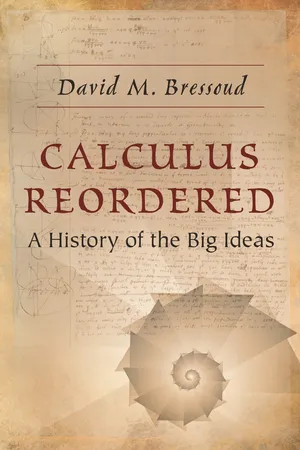
Calculus Reordered takes readers on a remarkable journey through hundreds of years to tell the story of how calculus evolved into the subject we know today. David Bressoud explains why calculus is credited to seventeenth-century figures Isaac Newton and Gottfried Leibniz, and how its current structure is based on developments that arose in the nineteenth century. Bressoud argues that a pedagogy informed by the historical development of calculus represents a sounder way for students to learn this fascinating area of mathematics.
Delving into calculus's birth in the Hellenistic Eastern Mediterranean—particularly in Syracuse, Sicily and Alexandria, Egypt—as well as India and the Islamic Middle East, Bressoud considers how calculus developed in response to essential questions emerging from engineering and astronomy. He looks at how Newton and Leibniz built their work on a flurry of activity that occurred throughout Europe, and how Italian philosophers such as Galileo Galilei played a particularly important role. In describing calculus's evolution, Bressoud reveals problems with the standard ordering of its curriculum: limits, differentiation, integration, and series. He contends that the historical order—integration as accumulation, then differentiation as ratios of change, series as sequences of partial sums, and finally limits as they arise from the algebra of inequalities—makes more sense in the classroom environment.
Exploring the motivations behind calculus's discovery, Calculus Reordered highlights how this essential tool of mathematics came to be.
- 243 pages
- English
- PDF
- Available on iOS & Android
eBook - PDF
About this book
Information
Publisher
Princeton University PressYear
2019Print ISBN
9780691218786
9780691181318
eBook ISBN
9780691189161
Table of contents
- Cover
- Contents
- Preface
- Chapter 1. Accumulation
- Chapter 2. Ratios of Change
- Chapter 3. Sequences of Partial Sums
- Chapter 4. The Algebra of Inequalities
- Chapter 5. Analysis
- Appendix. Reflections on the Teaching of Calculus
- The Last Word
- Notes
- Bibliography
- Index
- Image Credits
Trusted by 375,005 students
Access to over 1.5 million titles for a fair monthly price.
Study more efficiently using our study tools.
Frequently asked questions
Yes, you can cancel anytime from the Subscription tab in your account settings on the Perlego website. Your subscription will stay active until the end of your current billing period. Learn how to cancel your subscription
No, books cannot be downloaded as external files, such as PDFs, for use outside of Perlego. However, you can download books within the Perlego app for offline reading on mobile or tablet. Learn how to download books offline
Perlego offers two plans: Essential and Complete
- Essential is ideal for learners and professionals who enjoy exploring a wide range of subjects. Access the Essential Library with 800,000+ trusted titles and best-sellers across business, personal growth, and the humanities. Includes unlimited reading time and Standard Read Aloud voice.
- Complete: Perfect for advanced learners and researchers needing full, unrestricted access. Unlock 1.5M+ books across hundreds of subjects, including academic and specialized titles. The Complete Plan also includes advanced features like Premium Read Aloud and Research Assistant.
We are an online textbook subscription service, where you can get access to an entire online library for less than the price of a single book per month. With over 1.5 million books across 990+ topics, we’ve got you covered! Learn about our mission
Look out for the read-aloud symbol on your next book to see if you can listen to it. The read-aloud tool reads text aloud for you, highlighting the text as it is being read. You can pause it, speed it up and slow it down. Learn more about Read Aloud
Yes! You can use the Perlego app on both iOS and Android devices to read anytime, anywhere — even offline. Perfect for commutes or when you’re on the go.
Please note we cannot support devices running on iOS 13 and Android 7 or earlier. Learn more about using the app
Please note we cannot support devices running on iOS 13 and Android 7 or earlier. Learn more about using the app
Yes, you can access Calculus Reordered by David M. Bressoud in PDF and/or ePUB format, as well as other popular books in Mathematics & Calculus. We have over 1.5 million books available in our catalogue for you to explore.