- 66 pages
- English
- ePUB (mobile friendly)
- Available on iOS & Android
eBook - ePub
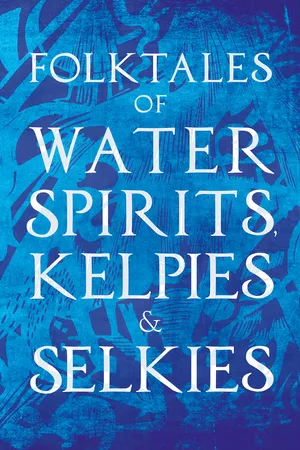
Folktales of Water Spirits, Kelpies, and Selkies
About this book
The beautiful and powerful landscape of Scotland has always inspired awe in any traveller, in this book we look at the superstitions built up around this breath taking scenery. Many of the earliest books, particularly those dating back to the 1900's and before, are now extremely scarce and increasingly expensive. We are republishing these classic works in affordable, high quality, modern editions, using the original text and artwork.
Information
Print ISBN
9781445521107
9781528772723
Subtopic
Scottish HistorySELKIES.
Orkney. In Orkney, selkie was the popular name for seal. Seals were popularly divided into two classes; namely, first, the common seal, here called tang fish, which had no power to assume the human form. These, like other inhabitants of the sea, were called fish. To the other class belonged all seals larger in size than the Phoca vitulina; such as the great seal, rough seal, Greenland seal, crested seal, and gray seal,—all of which have been seen in Orkney waters. And it was this class of larger seals that were called “selkie folk,” because they had the power of assuming the human form. The believers in this myth were never at a loss to account for its existence; but the causes assigned for the origin of this amphibious human race, so far as known to me, must have been imagined since the introduction of Christianity. Some say the selkie folk were fallen angels, who, for a more trivial fault than that of those consigned to the infernal regions, were condemned to their present state. Others held that the selkie folk were human beings, who, for some grave misdemeanour were condemned to assume the seal’s form, and to live in the sea, and were yet allowed to take human form and shape when on dry land. “And who kens,” said one of my old gossips, “but they’ll maybe some day get leave to come back tae their auld state?”
It was believed that males among the selkie folk sometimes held secret and illicit intercourse with females of the human race. Sometimes these marine gallants became the paramours of married women. The ballad which I hope later on to give is an instance of such connection. And however ungainly the appearance of these gentlemen when in the sea, on assuming human shape they became in form fair, attractive, and in manner winning; and by their seductive powers the female heart seems to have been easily conquered. And if the selkie gentlemen were attractive in the eyes of earth-born women, the selkie females were no less charming in the estimation of men.
Indeed, to see a bevy of these lovely creatures, their seal skins doffed, disporting themselves on a sea-side rock, was enough to fire with admiration the coldest heart.
Let it be noted that the selkie nymphs always appear in groups; they never sit alone combing their hair like the mermaid; and, unlike her, are not represented as wearing long golden hair. And, unlike the mermaid, the selkie folk were never represented as dwelling in “Finfolk-a-heem.”
The only home of the selkie folk was some far outlying skerry, or sea-surrounded rock. Indeed, my old informants regarded the selkie folk as a wholly different race of beings from the Finfolk.
Writers on the subject, trusting to incorrect versions of old stories, have often confounded mermaids and seals together, and have often treated the two as identical.
Hibbert in his valuable work on Shetland has fallen into this error, and has been followed by most others whose writings on the subject I have seen. This error is easily accounted for. Most of those writers were unfamiliar with, and had not from childhood lived among the peasantry; had not sat for long winter evenings by the cottage fireside listening to the often tedious and long-winded, but spontaneous flow of old tales, from the lips of men and women who believed in the truth of what they told; and, more essential still, those narrators had not a doubt but that their fireside hearers believed in what they heard.
No Orcadian peasant would lay bare the treasures of his wild lore before the eyes of a stranger. The peasant believed, often correctly, that educated people held his lore in contempt When they asked questions on old subjects, he suspected their only object was to make him and his stories objects for amusement. In asking for old lore among the Orkney peasantry, I suspect the proverb must be read, “Seek and ye shall not find it.”
But to return, the seals when in human shape were generally seen on a dry, but sea-surrounded rock, where in groups they lay basking in the sunshine, or gambolling about in the sunny atmosphere, with their seal skins lying beside them on the rock. The moment that any disturbance arose, or alarm was given, the whole flock flung their sea garments on, and leaped into the sea.
It was only at certain periods and conditions of the tide in which the seals had power to assume the human shape. But these periods were a subject of dispute among my oral authorities.
Versions of the story I am now to tell were at one time rife in every Orkney island; and some of them have already appeared in print. The man who told me this tale was a native of North Ronaldshay, was well read in English literature, and so familiar with Shakespeare that any six lines of that author you quoted he would tell you from what play your quotation was taken. Though above superstitious belief in, he possessed an inexhaustible store of old-world tales. He often assisted me in clearing up some difficulty in Orkney folk-lore.
The goodman of Wastness was well-to-do, had his farm well-stocked, and was a good-looking and well-favoured man. And though many braw lasses in the island had set their caps at him, he was not to be caught. So the young lasses began to treat him with contempt, regarding him as an old young man who was deliberately committing the unpardonable sin of celibacy. He did not trouble his head much about the lasses, and when urged by his friends to take a wife, he said, “Women were like many another thing in this weary world, only sent for a trial to man; and I have trials enouch without being tried by a wife.” “If that ould fool Adam had not been bewitched by his wife, he might have been a happy man in the yard of Edin to this day.” The old wife of Longer, who heard him make this speech, said to him, “Take doo heed de sell, doo’ll may be de sell bewitched some day.” “Ay,” quoth he, “that will be when doo walks dry shod frae the Alters o’ Seenie to dae Boar of Papa.”
Well, it happened one day that the goodman of Wastness was down on the ebb (that portion of the shore left dry at low water), when he saw at a little distance a number of selkie folk on a flat rock. Some were lying sunning themselves, while others jumped and played about in great glee. They were all naked, and had skins as white as his own. The rock on which they sported had deep water on its seaward side, and on its shore side a shallow pool. The goodman of Wastness crept unseen till he got to the edge of the shallow pool; he then rose and dashed through the pool to the rock on its other side. The alarmed selkie folk seized their seal skins, and, in mad haste, jumped into the sea. Quick as they were, the goodman was also quick, and he seized one of the skins belonging to an unfortunate damsel, who in terror of flight neglected to clutch it as she sprang into the water.
The selkie folk swam out a little distance, then turning, set up their heads and gazed at the goodman. He noticed that one of them had not the appearance of seals like the rest. He then took the captured skin under his arm, and made for home, but before he got out of the ebb, he heard a most doleful sound of weeping and lamentation behind him. He turned to see a fair woman following him. It was that one of the selkie folk whose seal skin he had taken. She was a pitiful sight; sobbing in bitter grief, holding out both hands in eager supplication, while the big tears followed each other down her fair face. And ever and anon she cried out, “O bonnie man! if there’s onie mercy i’ thee human breast, gae back me skin! I cinno’, cinno’, cinno’ live i’ the sea without it. I cinno’, cinno’, cinno’ bide among me ain folk without my ain seal skin, Oh, pity a peur distressed, forlorn lass, gin doo wad ever hope for mercy theesel’!” The goodman was not too soft-hearted, yet he could not help pitying her in her doleful plight. And with his pity came the softer passion of love. His heart that never loved women before was conquered by the sea-nymph’s beauty. So, after a good deal of higgling and plenty of love-making, he wrung from the sea-lass a reluctant consent to live with him as his wife. She chose this as the least of two evils. Without the skin she could not live in the sea, and he absolutely refused to give up the skin.
So the sea-lass went with the goodman and stayed with him for many days, being a thrifty, frugal, and kindly goodwife.
She bore her goodman seven children, four boys and three lasses, and there were not bonnier lasses or statelier boys in all the isle. And though the goodwife of Wastness appeared happy, and was sometimes merry, yet there seemed at times to be a weight on her heart; and many a long longing look did she fix on the sea. She taught her bairns many a strange song, that nobody on earth ever heard before. Albeit she was a thing of the sea, yet the goodman led a happy life with her.
Now it chanced, one fine day, that the goodman of Wastness and his three eldest sons were off in his boat to the fishing. Then the goodwife sent three of the other children to the ebb to gather limpits and wilks. The youngest lass had to stay at home, for she had a beelan foot. The goodwife then began, under the pretence of house-cleaning, a determined search for her long-lost skin. She searched up, and she searched down; she searched but, and she searched ben; she searched out, and she searched in, but never a skin could she find, while the sun wore to the west. The youngest lass sat in a stool with her sore foot on a cringlo. She says to her mother, “Mam, what are doo leukan for?” “O bairn, deu no tell,” said her mother, “but I’m leukan fora bonnie skin, tae mak a rivlin that wad ceur thee sare fit.” Says the lass, “May be I ken whar hid is. Ae day, whin ye war a’ oot, an’ ded tought I war sleepan i’ the bed, he teuk a bonnie skin doon; he gloured at it a peerie minute, dan folded hid and led hid up under dae aisins abeun dae bed.” (Und...
Table of contents
- Cover
- Title
- Contents
- Water-Spirits
- More Water-Spirits
- Selkies
- Kelpie Stories from the North of Scotland
- Kelpie Stories
Trusted by 375,005 students
Access to over 1.5 million titles for a fair monthly price.
Study more efficiently using our study tools.
Frequently asked questions
Yes, you can cancel anytime from the Subscription tab in your account settings on the Perlego website. Your subscription will stay active until the end of your current billing period. Learn how to cancel your subscription
No, books cannot be downloaded as external files, such as PDFs, for use outside of Perlego. However, you can download books within the Perlego app for offline reading on mobile or tablet. Learn how to download books offline
Perlego offers two plans: Essential and Complete
- Essential is ideal for learners and professionals who enjoy exploring a wide range of subjects. Access the Essential Library with 800,000+ trusted titles and best-sellers across business, personal growth, and the humanities. Includes unlimited reading time and Standard Read Aloud voice.
- Complete: Perfect for advanced learners and researchers needing full, unrestricted access. Unlock 1.5M+ books across hundreds of subjects, including academic and specialized titles. The Complete Plan also includes advanced features like Premium Read Aloud and Research Assistant.
We are an online textbook subscription service, where you can get access to an entire online library for less than the price of a single book per month. With over 1.5 million books across 990+ topics, we’ve got you covered! Learn about our mission
Look out for the read-aloud symbol on your next book to see if you can listen to it. The read-aloud tool reads text aloud for you, highlighting the text as it is being read. You can pause it, speed it up and slow it down. Learn more about Read Aloud
Yes! You can use the Perlego app on both iOS and Android devices to read anytime, anywhere — even offline. Perfect for commutes or when you’re on the go.
Please note we cannot support devices running on iOS 13 and Android 7 or earlier. Learn more about using the app
Please note we cannot support devices running on iOS 13 and Android 7 or earlier. Learn more about using the app
Yes, you can access Folktales of Water Spirits, Kelpies, and Selkies by Various Authors in PDF and/or ePUB format. We have over 1.5 million books available in our catalogue for you to explore.