- 122 pages
- English
- ePUB (mobile friendly)
- Available on iOS & Android
eBook - ePub
Copper Work
About this book
"Copper Work" is a vintage high school coursebook on metalworking with copper, with chapters on everything from tools and their proper use, to designing, producing and beyond. Originally intended for teenage students, it offers a fantastic introduction to the subject complete with step-by-step instructions and many helpful diagrams and illustrations. Contents include: "Metal Work", "Preface", "Introduction", "Problems", "Drawer and Door Pulls", "Finger Plates", "Sconce A", "Raised Forms", "Porringer", "Ink Pot", "Spoons, Sugar Tongs and Tea Scoops", "Enameling", etc. Many vintage books such as this are increasingly scarce and expensive. It is with this in mind that we are republishing this volume now in an affordable, modern, high-quality edition complete with a specially-commissioned new introduction on metal work.
Information
Chapter I.
INTRODUCTION.
During the past few years many experiments have been tried in the development of Manual Training Courses and much time has been spent in discussion of what lines of work they should consist. Wood and iron were the first materials used and are yet indispensable, but experience has led those who are developing this work to believe that there are other materials as well adapted to Manual Training work in all its various forms. Clay, used not only for modeling but for ceramic work as well, leather, brass, and copper are materials that have also been put to the test and found satisfactory in many ways.
In ancient times copper was known as a useful metal, and down through the ages it not only held its own but increased in usefulness. Among its valuable properties may be mentioned toughness and ductility; its toughness enables it to be beaten into thin strong sheets, while its ductility enables it to be drawn out into fine wire. Copper readily forms important alloys, such as brass from copper and zinc.
Work in sheet copper and brass has been introduced into the public school course with gratifying results. It has proved itself to be a valuable departure from other branches of Manual Training work and gives promise of being permanent. Sheet copper and brass offer possibilities for various kinds of treatment, either in the flat work which includes saw piercing, embossing and enameling, or in the raised work.
There is something about this work that appeals to pupils and holds their interest. The nature of the material, hard enough to offer some resistance and yet pliable enough to allow its being wrought into many forms, the durability of the object when completed, and the variety of colors that may be obtained, especially with copper, all tend to make the subject not only interesting but fascinating.
All exercises in sheet metal should be of some real value to the pupil; no time should be spent on work done simply for practice, but the various steps should be learned in the making of useful objects of artistic worth. In this, as in other work, it seems best to give each member of the class the same work for a while until he has become acquainted with the different tools and learned the limitations of the material. When this has been accomplished, each pupil may be allowed to work out his own designs. In this the educational value is very greatly increased. The pupil conceives the idea and makes several sketches of it, carrying it through repeated changes until it is brought to the perfected design appropriate in every way to the idea. Some may not be fortunate enough to get a full equipment so that all of the various kinds of metal work may be done, but such may be able to make a beginning by doing light work in saw piercing, which requires a very limited equipment.

EQUIPMENT.
The equipment necessary for a start in Copper work need cost but little if the teacher is somewhat ingenious, for the patterns of the various anvils may be made by him; from these patterns the castings can be made at any foundry for three or four cents per pound. It is better to begin with a few anvils and tools and to add one or two at a time as the need is felt for a more varied supply. If the work can be done in a room already fitted with benches and vises, it will reduce the first cost considerably. Any homemade bench will do if a regulation one is not to be had. One that has given satisfaction was made of 2″ × 4″ studding with plank tops in lengths of 12 feet, giving space for four vises at each bench. A swivel vise that may be turned at any angle will be found satisfactory.
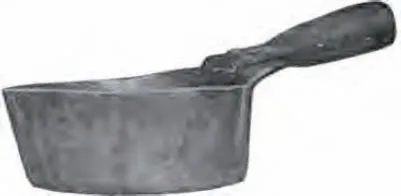
FIGURE 1.

FIGURE 2.

FIGURE 3.
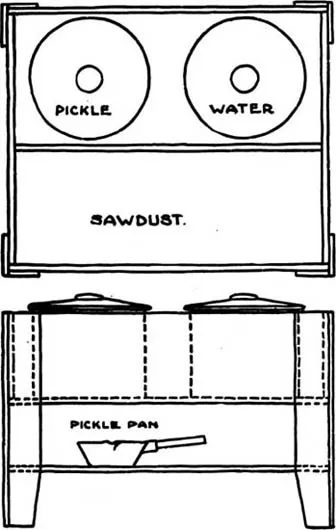
FIGURE 4.
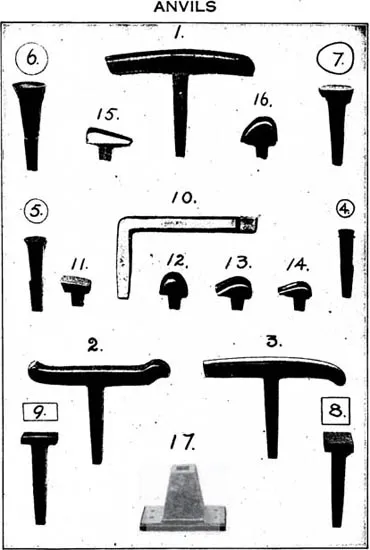
PLATE 1.
An annealing tray made of a piece of sheet iron in the s...
Table of contents
- Cover
- Title
- Table of Contents
- Preface
- List of Illustrations
- Chapter I.—Introduction, Equipment, Materials
- Chapter II.—Problems, Escutcheons and Hinge Tails
- Chapter III.—Drawer and Door Pulls and Hinges
- Chapter IV.—Finger Plates, Pad Corners, Box Corners, Stamp Box and Match Box
- Chapter V.—Sconce, Picture Frame, Soldering, Repoussé or Embossing
- Chapter VI.—Raised Forms
- Chapter VII.—Porringer, Trays or Plates
- Chapter VIII.—Ink Pot, Sealing Wax Set and Watch Fobs
- Chapter IX.—Spoons, Sugar Tongs, and Tea Scoops, Rivets, Drawing Wire, and Tubing, Polishing Stamping Work, Coloring
- Chapter X.—Enameling
Trusted by 375,005 students
Access to over 1.5 million titles for a fair monthly price.
Study more efficiently using our study tools.
Frequently asked questions
Yes, you can cancel anytime from the Subscription tab in your account settings on the Perlego website. Your subscription will stay active until the end of your current billing period. Learn how to cancel your subscription
No, books cannot be downloaded as external files, such as PDFs, for use outside of Perlego. However, you can download books within the Perlego app for offline reading on mobile or tablet. Learn how to download books offline
Perlego offers two plans: Essential and Complete
- Essential is ideal for learners and professionals who enjoy exploring a wide range of subjects. Access the Essential Library with 800,000+ trusted titles and best-sellers across business, personal growth, and the humanities. Includes unlimited reading time and Standard Read Aloud voice.
- Complete: Perfect for advanced learners and researchers needing full, unrestricted access. Unlock 1.5M+ books across hundreds of subjects, including academic and specialized titles. The Complete Plan also includes advanced features like Premium Read Aloud and Research Assistant.
We are an online textbook subscription service, where you can get access to an entire online library for less than the price of a single book per month. With over 1.5 million books across 990+ topics, we’ve got you covered! Learn about our mission
Look out for the read-aloud symbol on your next book to see if you can listen to it. The read-aloud tool reads text aloud for you, highlighting the text as it is being read. You can pause it, speed it up and slow it down. Learn more about Read Aloud
Yes! You can use the Perlego app on both iOS and Android devices to read anytime, anywhere — even offline. Perfect for commutes or when you’re on the go.
Please note we cannot support devices running on iOS 13 and Android 7 or earlier. Learn more about using the app
Please note we cannot support devices running on iOS 13 and Android 7 or earlier. Learn more about using the app
Yes, you can access Copper Work by Augustus F. Rose in PDF and/or ePUB format, as well as other popular books in Technology & Engineering & Mining Engineering. We have over 1.5 million books available in our catalogue for you to explore.