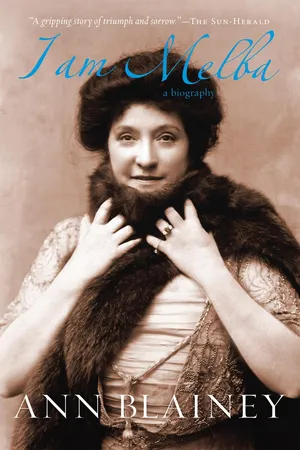
The story of an Australian girl who defied convention and became the most famous singer of her era. Growing up in Melbourne, Nellie Mitchell dreamed of fame, but her devout father disapproved. When a chance arose to go to Paris, she trusted in her musical talent and hoped for a lucky break.Within a few years, reborn as Nellie Melba, she was performing to overflowing concert halls, hobnobbing with European royalty and collaborating with some of the most renowned composers of the age. Audiences swooned over the 'heavenly pleasures' of her voice, while the public showed an insatiable appetite for news of her sometimes passionate private life.Dame Nellie Melba was Australia's first international superstar. In this important biography, enhanced by new research, Ann Blainey captures the exuberance, controversy and pathos of Melba's remarkable career. Winner of the 2009 National Biography Award. Shortlisted, 2008 Age Book of the Year Awards. 'Blainey … writes with clarity and panache. This is an entertaining biography. Everyone should read it and be reminded of what a remarkable singer we once had in our midst.' —Sydney Morning Herald 'There have been five biographies of Melba, together with her own rather fanciful memoirs; but the present one by Ann Blainey is superior to them all.' —The Age 'Thoroughly researched, excellently written and beguilingly human biography of Nellie Melba' —Australian Book Review 'Blainey brings a freshness to the story, giving us the feeling that we are reading about a life in progress.' —Good Reading 'Welcome and timely, shedding new light on the diva' —Courier Mail 'This is a gripping story of triumph and sorrow.' —Sun-Herald 'Meticulously researched biography' — The Australian Ann Blainey is the author of I Am Melba. She has written five biographies, and her most recent biography of Dame Nellie Melba reflects her fascination with singing and opera. She has served on the council of two Australian opera companies and of the Percy Grainger Museum in Melbourne, where she lives.
- 400 pages
- English
- ePUB (mobile friendly)
- Available on iOS & Android
eBook - ePub
About this book
Trusted by 375,005 students
Access to over 1.5 million titles for a fair monthly price.
Study more efficiently using our study tools.
Information
Subtopic
Historical Biographies1
The Incomparable Miss Mitchell
The Incomparable Miss Mitchell
ON A WARM AUSTRALIAN EVENING in December 1869, a small girl stood nervously beside a stage waiting her turn to perform. A commonplace scene, there was nothing to suggest that this child would become Madame Melba, one of the great singers in the history of opera.
The stage was in the new town hall in the Melbourne suburb of Richmond, to which 700 spectators had come to witness the grand opening concert. The mayor presided, and the brass-bandsmen of the Richmond Volunteer Rifle Corps, in splendid uniforms, played the overture. In the wings a cast of amateur singers awaited their call. All were adults, except one. Her name was Nellie Mitchell, and though very young, she was something of a veteran. Indeed, a reporter from the local newspaper sat forward eagerly as little Miss Mitchell, with her long loose hair and short dress, came out to face the audience.
Her first item was the sea shanty known as “Can’t You Dance the Polka”, of which she presumably sang an expurgated version, for the traditional words were risqué. She tossed it off – to quote the reporter – “in really first rate style”, accompanying herself on the piano. There followed such a storm of clapping that she swung immediately into an encore. In the reporter’s estimation she was already “the gem” of the evening.
At interval it was announced that there would be no more encores, but the order was forgotten when Miss Mitchell came on stage again. This time she sang and played an Irish ballad called “Barney O’Hea”, and by popular acclaim was compelled to repeat the song. “The incomparable Miss Mitchell”, enthused the reporter, “is indeed a musical prodigy”, and no more than ten years old. Here he was mistaken: she was only eight.
In that year of 1869, Melbourne was no wild-west town, but a civilised city of almost 200,000 inhabitants – the largest in Australia and one of the main gold and wool ports of the world. Its fortunes had soared eighteen years before when gold was discovered four days’ ride from the cluster of riverside buildings that was the city. Since then, rich miners had poured money into its public works. Melbourne now had broad streets, handsome buildings, a safe water supply and one of the most democratic parliaments in the world. Its citizens were predominantly young. Lured by the hope of gold and adventure, young Europeans had come in their thousands to this gateway to the goldfields, and many stayed on, finding steady jobs, marrying and raising families.
Among the young immigrants were little Nellie Mitchell’s parents. Her father, David Mitchell, was twenty-three when he arrived in Melbourne in 1852, a stonemason just past his apprenticeship who chose to leave his home near Forfar in eastern Scotland to make a new life on the far side of the world. Shrewd, determined and resourceful, he sensed that in this burgeoning city his building skills could make his fortune. Though he was said to have arrived with nothing in his pocket except a single gold sovereign, he soon managed to acquire several acres of land on the Yarra River at Rich mond, a mile or so from the centre of the city. There, after an unsuccessful visit to the goldfields, he set up his builder’s yard and built himself a cottage. A few years later, realising Melbourne was turning from a city of wood to a city of stone and brick, he added a brickworks. By 1856 he was a rising contractor and a large employer. When, that same year, the stonemasons of Melbourne won the right to an eight-hour day – possibly the first workers in the world to do so – David Mitchell’s voice was raised in their support, though not too loudly.
Mitchell’s life revolved around his work and the Scots’ Presbyterian Church in Collins Street. Scottish to the core, David loved his church, and when he decided to marry he chose a bride from within its congregation. His choice was Isabella Ann Dow, the 23-year-old daughter of a Scottish engineer named James Dow, who seems also to have had Spanish blood. Isabella had olive skin, dark eyes, a quick wit and an artistic nature: she played the piano, harp and organ and painted china. David Mitchell was almost the opposite, being “very broad and thick set” and “very reserved, very Scotch, and, you might think, very shy”. According to observers, he “did not talk so much as twinkle”. Nevertheless it was said of him that he could “say more with his eyes than most men with their lips”. Isabella liked the twinkle. On 11 June 1857, Isabella Dow and David Mitchell were married.
Nine months after the wedding a child named Margaret was born. The baby died four days short of her first birthday. Four months later Isabella became pregnant again and in July 1859 gave birth to the longed-for son. They named him William after his paternal grandfather, and watched him anxiously. He died just a month short of his first birthday. Infant mortality being high in Melbourne, the deaths were not wholly unexpected, but to see two children failing to reach their first birthday was a severe trial. When Isabella became pregnant the following year, every possible precaution was taken, and this time all went well. The daughter, born on Sunday 19 May 1861, thrived well past her first year.
The baby was named Helen Porter, after Isabella’s third sister, Helen, but from the start she was known as Nellie. Dark-eyed and dark-haired like her mother, and strong-willed and sturdy like her father, she grew into a little tomboy. She loved her rocking horse, despised dolls and liked boys’ games. For over two years young Nellie had the nursery to herself; then, in November 1863, her sister Annie was born. Her sister’s birth was in all probability a blow to her – later in life she did not take kindly to competitors. It was an experience, however, she was forced to tolerate, because Annie was followed by Isabella, Frank, Charles, Dora, Ernest and Vere.
David Mitchell’s cottage beside his kilns and workshops was soon replaced by a large family house. Built of brick and stucco, it had bow windows and a veranda on the ground floor, and a square tower rising above the upper storey. In front, the house looked on to the simple gravelled surface of Burnley Street; at the back, its garden extended to the low cliff s that fl anked the Yarra River. Though there was nothing obviously Scottish about the Yarra, David Mitchell thought it resembled the Scottish river Doon, and he called his house Doonside. His attachment to the house rather puzzled his colleagues, because other businessmen, once they had made money, invariably moved away from their workplaces to the fashionable suburbs east of the river. David Mitchell, however, remained obstinately at Doonside. He said he had no peace of mind unless he could wake of a morning and see his own brickyard chimneys smoking.
David Mitchell became Nellie’s hero. Her infant mind was quick to grasp that within her little world of Doonside his word was law, and as she grew older she sensed that he was important in the outside world as well. Over the next twenty years his Victoria Steam Brickworks poured bricks into a market that could rarely get enough of them. Not content with brick-making, he invested in quarrying stone and making cement, so that his building empire grew to be almost self-sufficient.
His business associates often thought David Mitchell a difficult man. Though scrupulously upright, he drove a hard bargain and demanded perfection. Within his family he was a taskmaster who exhibited “black disapproval” when his children’s standards failed to meet his own. Though he was capable of sympathy, his children did not always recognise it: his softness lay under a forbidding face. Nellie, however, seems instinctively to have understood him from babyhood. “Throughout my life”, she would later write, “there has always been one man who meant more than all others, one man for whose praise I thirsted, whose character I tried to copy – my father.”
From her mother, Nellie gained a passion for music. When not much more than a baby, she would crawl under the piano while her mother played, and later try to reproduce the sounds of the music by dabbling her fingers across the keys. Her aunt Lizzie Dow, providing her first piano lessons, quickly recognised an unusual talent. The Dows had little doubt that the gift came from their side of the family. Although David Mitchell sang hymns in a resonant bass, and picked away at the harmonium and fiddle, the Dow girls were trained musicians with voices of “rare beauty”.
Nellie seems to have been six when she appeared at her first concert, a very simple affair probably connected to the local Sunday school. She remembered that she sang a song called “Shells of the Ocean”, followed by an encore of “Comin’ thro’ the Rye”, sung in the authentic Scottish dialect of her Dow grandmother. When she spoke about the concert later in life, she was apt to confuse the details. Sometimes she said that she stood on a chair to sing and sometimes she said that she accompanied herself on the piano. Always she remembered the applause, and that, on returning home, she eagerly questioned a female playmate about how she had performed. In Nellie’s words, the spiteful girl “inclined her face toward mine and lowering her voice to a signifi cant pitch answered, ‘Nellie Mitchell, I saw your drawers!’”
A few months after her eighth birthday, Nellie appeared in two more concerts, designed as money-raisers for the Richmond Presbyterian Church. The first, staged in the Richmond Lecture Hall in Lennox Street in October 1869, left much to be desired, droning on for more than three hours, causing some of the spectators to jeer. A reporter from the Richmond Australian expected the worst when a little Miss Mitchell and a little Miss Grimwood came skipping across the stage. Within minutes he reversed his opinion. These little girls, both of whom sang and played the piano, were “the best part of the entertainment”, and he described Miss Mitchell as a “perfect wonder”. Two months later, on 6 December, Nellie appeared in the “grand vocal and instrumental concert” described at the start of this chapter. The same reporter who had then mistaken her age was astonished by her performance. “She is indeed a musical prodigy”, he wrote, “and will make crowded houses wherever she is announced again.”
Nellie needed the praise. By the age of eight she was often receiving blame, being the ringleader in every nursery prank. Some attributed her naughtiness to her “inexhaustible energy and irrepressible spirits”, while others said that it came from the local lads, whose company she kept on the river flat behind Doonside. While the boys’ influence may have been partly the cause, she exhibited enough energy for a couple of children, and she “hated to be still herself, and hated to see other people still, particularly if they, as a consequence, exacted quietude from her”. She had also learned that naughtiness gained attention, and with an ever-increasing brood of brothers and sisters, attention was a commodity she craved.
Stories of her misdeeds entered family folklore. Once, while her father was playing whist, she crawled under the table and puff ed a bellows up his trouser leg. Another time she woke the family in the middle of the night by playing the Moonlight Sonata on the drawing-room piano. The worst behaviour, in the eyes of her parents, came during the visit of a dour Scottish preacher. When Nellie was summoned to play him a hymn, she struck up “Can’t You Dance the Polka”. The stories were embellished over time, but the theme remained the same: in childhood Nellie was an imp of mischief.
She needed discipline, and her father decided to send her to boarding school. He chose Leigh House, a school for young ladies housed in a large house in Bridge Road, Richmond. Nellie hated it. Thirty years later she would remember: “I was always at the bottom of the class, and generally in disgrace.” One morning she rebelled. When the pupils took their cold showers at 6 a.m., she took hers under an umbrella. The dripping umbrella was soon found, and henceforth her showers were supervised.
Leigh House was built on high ground, and from the top storey she could just see the tower of Doonside. Occasionally she would stand at the top windows, screaming piteously. She could sometimes glimpse her father on his daily journeys to the city, riding in his buggy or sitting on the horse-drawn omnibus. “To be in sight of my home”, she would recall, “and unable to go there, to see my father and not to be noticed by him, so filled me with sorrow that I was constantly in floods of tears.” She called it “perhaps the bitterest experience of my younger days”.
Her pleasures were the family holidays in the freedom of the countryside. As early as 1863 her father had taken a lease on a wooden farmhouse and over 10,000 acres of bush and pasture about forty miles east of Melbourne. Named Steel’s Flats, it had tall eucalypts and shaded fern gullies and fresh, running streams. The little girl would later say that she was never so happy as when staying at the “old house, shaded by immense gum trees, on the side of the steep hill”.
To travel to Steel’s Flats was always an adventure, and Nellie would remember the thrill of expectation as they waited at the coach-stop. When the public coach pulled in, “with its four patient horses, flicking the flies with their tails”, the Mitchells would clamber aboard – children, adults, servants and carpet bags – and Nellie would crawl up to the box to sit next to the driver because “all exciting things happen there”. At the pretty little township of Lilydale the Mitchells would eat a simple lunch and then load themselves and their baggage onto a waiting wagonette, which jolted them the last fifteen miles to the rambling farmhouse.
Such journeys remained in her memory: “The flocks of sheep and herds of cattle being driven to market – the glaring heat – the burnt-up fields – the strange remoteness, as though we were alone in the world.” That strange remoteness was what she prized. When she finally alighted at the house, she would race down the hill, heedless of snakes, and sit by a water-wheel beside the stream. Here she could think her own thoughts and sing her own songs while she cooled herself in the dripping water.
At Steel’s Flats she rode, swam and fished, often in company with her father. Despite her naughtiness, their relationship had deepened, for they shared many qualities. David Mitchell rejoiced that his daughter had inherited his energy and resourcefulness, though he may have been less pleased that she had also inherited his stubbornness and quick temper. He observed, too, her ability to meet a challenge. This was brought home to him when, at the age of twelve, she started twice-weekly organ lessons at St Peter’s Church on Eastern Hill with the young but talented Joseph Summers, an Oxford graduate in music.
David Mitchell approved of the organ, a godly instrument. To assist Nellie’s studies, he had one built into the drawing room at Doonside and watched his daughter’s progress with silent pride. He offered her a gold watch if she learned to play twelve pieces by heart, and she rushed to learn the twelve pieces in as many days. She earned her prize, but one evening, when she was running home, she dropped her gold watch in the gutter. She searched until darkness fell. Weeks later the watch was returned to her, ruined. When her father saw the watch, he said: “You will never get another from me.” And she never did. It was a lesson she never forgot.
Withdrawn by her parents from Leigh House, Nellie was now being taught at home, and while her music was fl ourishing, her general education was languishing. The only subject in which she thrived was literature. Devouring the novels in the library at Doonside, she fell in love with the works of Charles Dickens, laughing aloud at Mr Pickwick and suffering with David Copperfield. When her third sister was born, almost twelve years to the day after her own birth, she was determined that the baby should be called after David Copperfield’s wife. “I insisted”, she later wrote, “on my young sister being called Dora.” The girl was named Dora Elizabeth Octavia, but she was always known simply as Dora, so Nellie and Dickens scored their victory.
Like true Scots, David and Isabella Mitchell believed in education, even for girls, and while they encouraged their older girls’ reading, they did not believe it was enough to equip them for life. Thirteen-year-old Nellie and eleven-year-old Annie needed proper schooling, but where would they find it? Leigh House had shown that Nellie was too homesick for a boarding school and too high-spirited for a young ladies’ academy, and they suspected that Annie was the same. By a stroke of luck an answer presented itself. While David Mitchell was rebuilding Scots’ Church, he learned that the Presbyterian Church was planning to open a school for girls. Tenders for the building were being sought, and he applied for, and won, the contract.
The proposed school’s most obvious asset, in David Mitchell’s eyes, was its location, being only a mile or so from Doonside. Another was its Presbyterian ownership: as a church institution, it was bound to give a sound religious education. Its third asset – and in hindsight the most valuable – was the headmaster, Professor Charles Henry Pearson. At a time when women’s brains were considered inferior to men’s, and female schooling was usually a polite smattering of literature, art, needlework and sums, Pearson’s curriculum was little short of revolutionary. Except for Greek, he was offering a course of study that was identical to that of a competent boys’ school: an unheard-of proposal in Australia, and rare in England and America. He was also advocating lessons in piano, singing, drawing and painting for girls who showed promise.
The Presbyterian Ladies College opened its doors in February 1875 and within months Pearson had attracted nearly 200 pupils. Five members of parliament enrolled their daughters, as did scores of wealthy professional men – and so too did a publican, for the school was at pains to be democratic. A few of the pupils were hoping to earn their livings as teachers, which delighted Pearson, who believed fervently in careers for women. In the following years, the school would educate many of Australia’s earliest female doctors, lawyers and scientists.
Entering the school on 1 October 1875, Nellie and Annie were marked down as numbers 166 and 167 on the school roll, though an error was made with Nellie’s name and she was described as Ellen Mitchell. Each day the two schoolgirls put on their tight, high-necked bodices and long skirts, collected their books and boarded the horse-drawn omnibus that plodded down Victoria Street. In the impressive stone building with its arched windows and pointed turret, more like a Scottish castle than a school, they studied English, French, Latin, history, geography, mathematics, astronomy and physics.
The teachers expected serious application and, rather surprisingly, Nellie seems to have given it, even though she was fond of describing herself as the worst pupil in the school. In the words of one of her teachers, she was “no plaster saint”, but within the classroom, she was a “diligent, honourable and obedient pupil”. Mathematics bored her, and she was apt to gaze into space, but she was never bored in her art classes with “dear Miss Livingstone”, whom she described as “one of the best mistresses who ever held a brush”, and on many evenings she stayed behind to paint until the light faded. In her English and elocution classes, too, she was a more than creditable student, indeed quite the pet of Mr George Lupton, the dashing elocution master. He tentatively prophesied that her voice would one day bring her fame. He also fostered her love of poetry. Many years later she would tell music students that they must fill their minds with great poems like Shelley’s “Ode to a Skylark” and Shakespeare’s sonnets. “Let them become the delightful companions of what might other wise be somewhat lonely hours”, she told them. “Learn to speak them aloud with distinction and understanding.”
Music was her chief enthusiasm. Oft en she would forgo lunch in order to run across the Fitzroy Gardens to practise for an hour on the organ at the new Scots’ Church. Once she skipped her Latin class ...
Table of contents
- COVER PAGE
- TITLE PAGE
- COPYRIGHT PAGE
- CONTENTS
- PREFACE
- 1. THE INCOMPARABLE MISS MITCHELL
- 2. THE COMING OF KANGAROO CHARLIE
- 3. A VOICE IN TEN THOUSAND
- 4. MY FIRST GREAT MOMENT
- 5. I AM MELBA
- 6. AT LAST A STAR
- 7. IT IS APPLAUSE I LIVE FOR
- 8. MELBA’S DUKE
- 9. WHAT SAY THEY? LET THEM SAY
- 10. FEAR NOTHING, MELBA
- 11. ACROSS THE ATLANTIC
- 12. I WON’T SING “HOME SWEET HOME”
- 13. BRÜNNHILDE
- 14. WITH THE AMERICANS HEART AND SOUL
- 15. THERE IS NO MELBA BUT MELBA
- 16. MY NATIVE LAND
- 17. PATIENCE, DEAR MADAME, PATIENCE
- 18. HAMMERSTEIN SWALLOWS THE CANARY
- 19. NOBODY SINGS LIKE MELBA AND NOBODY EVER WILL
- 20. SO MANY TRIUMPHS AND SO LITTLE HAPPINESS
- 21. THE GREATEST MUSICAL EVENT
- 22. THE QUEEN OF PICKPOCKETS
- 23. SINGING TO THE GHOSTS
- 24. AUSTRALIA’S GREATEST DAUGHTER
- NOTES & SOURCES
- CONCISE DISCOGRAPHY
Frequently asked questions
Yes, you can cancel anytime from the Subscription tab in your account settings on the Perlego website. Your subscription will stay active until the end of your current billing period. Learn how to cancel your subscription
No, books cannot be downloaded as external files, such as PDFs, for use outside of Perlego. However, you can download books within the Perlego app for offline reading on mobile or tablet. Learn how to download books offline
Perlego offers two plans: Essential and Complete
- Essential is ideal for learners and professionals who enjoy exploring a wide range of subjects. Access the Essential Library with 800,000+ trusted titles and best-sellers across business, personal growth, and the humanities. Includes unlimited reading time and Standard Read Aloud voice.
- Complete: Perfect for advanced learners and researchers needing full, unrestricted access. Unlock 1.5M+ books across hundreds of subjects, including academic and specialized titles. The Complete Plan also includes advanced features like Premium Read Aloud and Research Assistant.
We are an online textbook subscription service, where you can get access to an entire online library for less than the price of a single book per month. With over 1.5 million books across 990+ topics, we’ve got you covered! Learn about our mission
Look out for the read-aloud symbol on your next book to see if you can listen to it. The read-aloud tool reads text aloud for you, highlighting the text as it is being read. You can pause it, speed it up and slow it down. Learn more about Read Aloud
Yes! You can use the Perlego app on both iOS and Android devices to read anytime, anywhere — even offline. Perfect for commutes or when you’re on the go.
Please note we cannot support devices running on iOS 13 and Android 7 or earlier. Learn more about using the app
Please note we cannot support devices running on iOS 13 and Android 7 or earlier. Learn more about using the app
Yes, you can access I Am Melba by Ann Blainey in PDF and/or ePUB format, as well as other popular books in Media & Performing Arts & Historical Biographies. We have over 1.5 million books available in our catalogue for you to explore.