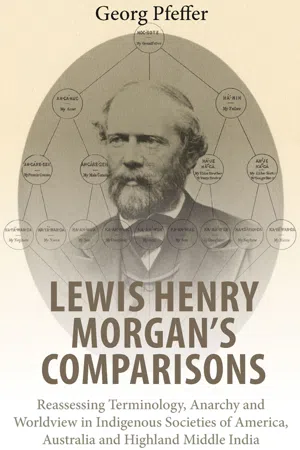
About 150 years ago Lewis Henry Morgan compared relationship terminologies, societal forms and ideas of property to recognize the interdependence of the three domains. From a new perspective, the book re-examines, confirms and criticizes Morgan's findings to conclude that reciprocal affinal relations determine most 'classificatory' terminologies and regulate many non-state societies, their property notions and their rituals. Apart from references to American and Australian features, such holistic socio-cultural constructs are exemplified by elaborate descriptions of little known contemporary Indigenous societies in Highland Middle India, altogether comprising many millions of members.
Trusted by 375,005 students
Access to over 1.5 million titles for a fair monthly price.
When I was a student in the 1960s, our beginner courses mentioned Louis Henry Morgan as the founder of anthropology, but regarding the content of his writings, our German teachers had little more than mockery. His books, we were told, had spread absurd theories on periods of social evolution and on kinship systems, two topics that have, without further qualification, always been regarded as eccentric preoccupations to anthropologists of the German1 tradition and worth little more than a condescending smile. Today, such a general attitude has remained unchanged. Fifty years ago, we also learnt about Morgan’s sin of having been posthumously praised by Marx and Engels, but by now this particular lapse may no longer cause the resentment it did at that time.
As expected, we followed our elders’ authority. Later, when gradually moving beyond the German ethnological haze that, over many decades, had been known as ‘cultural history’,2 it came as a surprise to notice how, without much common ground in terms of theory, prominent thinkers such as Claude Lévi-Strauss (1949), George Peter Murdock (1949) and Meyer Fortes (1969) had located their own scholarly endeavours in Morgan’s tradition. For the centenary of Systems of Consanguinity and Affinity of the Human Family (Morgan 1871) mutually opposed but equally outstanding specialists composed a joint Festschrift (Reining 1972) for Morgan. The contribution of one of these luminaries, David M. Schneider, had a sustained impact on the future by announcing that: ‘“Kinship” … is a non-subject, since it does not exist in any culture known to man’ (Schneider 1972: 59).
Morgan had been the ‘inventor’ of an anthropological subdiscipline that later spread under the label of ‘kinship’, as Trautmann (1987) elaborated in his equally meticulous and exciting account. About a century after Morgan, Schneider had spent more than thirty years of his impressive academic career examining his nonsubject. To this day, a number of international kinship experts, all inspired by Morgan’s open mind, meet at conferences, of which the published results (see e.g. Trautmann and Whiteley 2012) are taken, at least in some circles, as a guide to continue on his path. It goes without saying that the following chapter is equally intended to recall Morgan’s genius.
Morgan
The fascinating aspect of Morgan is his ability to combine a personal commitment marked by empathy, industry and clarity with a mind for purely formal analyses of semantic patterns within a general sociocultural domain. Very personally and on a long-term basis, he was engaged in fighting for his fellow humans and their equal rights. However, this did not in the least prevent him from intellectual feats such as the worldwide comparison of certain sociocultural features with those of other such general patterns. Never did he ignore contemporary problems of the people he described. At the same time, neither his ethnography nor his social theory could in any way be labelled as ‘problem-oriented’. The political crises of his time were not altogether excluded from his texts, and yet these treatises are, when intended for scholarly readers, articulated in an unemotional or academic language. As demanded by the legal sciences or his primary qualification, Morgan took note of day-to-day behaviour, but gave weight to it only when it could and should be subsumed under some general pattern of social order. For him, observed action was of general interest only as an aspect of a formal framework. When issues of the discipline were being articulated, personal matters remained in the domain of the personal. The overall aim of the research effort was to gradually become familiar with an unknown sociocultural field rather than find facile explanations by reference to individual action.
Until his basic shift in 1865, Morgan’s approach was that of an ‘understanding’ (verstehende) rather than an ‘explaining’ kind of anthropology. Thereafter, when proposing certain ‘causes’ of given institutions or patterns, his theoretical refinement suffered, though he was praised by the scholars of his time. In what follows, I will try to recover the twists and turns in his efforts and eventually defend his lasting insights. Whenever he was able to recognize the constructed character of phenomena under study within more general patterns, his discoveries have mostly lasted the test of time. It goes without saying that they were far from obvious. To this day, they remain incomprehensible for many anthropologists.
Morgan was, of course, fully aware of the sharp differences between Amerindian social formalities and those of the bourgeois establishment in his hometown Rochester, but as an ethnographer, his approach was lacking any educational bent and did not interfere in the regular activities of the people he was trying to understand. At the same time, he was literarily fighting ‘Satan’ in the minds of those Euro-American fellow citizens, whose performances he was bound to witness directly on his extended excursions into the domains of politics, business and economic development. The epoch after the American Revolution had it that the leading lights in these sectors were equally violent and corrupt. Through long-term measures that were always executed pragmatically, Morgan was actively defending the right of Native Americans to be culturally different. When speaking of his legacy, I think of his civil commitment to defend the direct victims of imperial expansion and at the same time of his careful field research in an age of armchair scholarship, covering many material and immaterial details of Amerindian cultures. Last but not least, his theories on the sociocultural potential of anthropos have been substantial contributions to our knowledge on societal order.
Morgan spent a restless life full of frictions that affect his political convictions, his inclination towards ethnographic precision and detail, and his ambitious generalizations on human organization and social evolution. Because of these rather different and at times contradictory commitments, his scholarship has survived the rigours of time. Over decades of untiring efforts, he was able to combine personal empathy with exact observations and purely formal analysis.
Biography and Sources
The life and work of Morgan may be subdivided into four major phases:
• After 1837, as a result of the major and lasting economic crisis in his country, the young Morgan did not have many clients. The cases he was entrusted with did not really excite him. Much of his time was devoted to the politics of his state and to defending the rights of Iroquois Amerindians in his neighbourhood.
• From the year before his marriage (1851), all of his efforts were directed towards furthering his professional career. Within a decade, he was able to acquire a considerable fortune.
• Being rich was reflected neither in the Puritan conduct of his private life nor in his social ideals. From 1857 onwards, his restless mind was once again preoccupied with Amerindian research. After 1861, his regular profession became a secondary matter. With breathtaking intensity, he devoted himself to field excursions and international research campaigns, as well as to the ordering and writing up of the results of these. After a decade of uninterrupted work and the investment of the (then considerable) sum of at least $25,000, his monumental Systems of Consanguinity and Affinity of the Human Family was finally published in 1871.
• Though Morgan continued as an activist in defence of Amerindian rights, he also published Ancient Society (1877) and lesser known works of a high quality. In 1881, for example, or more than a century before ‘house societies’ (Carsten and Hugh-Jones 1995) become a general topic of sociocultural anthropology, he published a book on Houses and House-Life of the American Aborigines, a work that stood the test of time.
My information on Morgan’s life and family and on the details of his career have been obtained from Leslie H. White’s foreword to The Indian Journals (Morgan 1859), Carl Resek’s biography (1960) and Peter M. Whiteley’s article of 2004, but by far the most important source is Trautmann’s analytically ambitious and historically precise account (1987). Referring to every single one of my adoptions from this latter work would make this volume unreadable.
Resek’s account gives a good impression of the general and frequently violent westward drive after the revolutionary impetus in the United States had captured the minds of the many pioneers. This campaign greatly influenced Morgan’s life and work. Whiteley’s essay is a response to current criticism within the discipline, an inclination that has ever so often mistakenly accused elders of complicity in imperialist misdeeds. Whiteley points out obvious gaps in the historical knowledge of these critics by recalling details of Morgan’s civil rights campaigns.
As the founding father of anthropology, Morgan was especially engaged in promoting the rights of women. He left his entire fortune to the University of Rochester on condition that it was spent for the promotion of female education.3 After the sister of his Seneca Iroquois consultant Ely Parker had been of great help in his ethnographic work, he financed her college education (Trautmann 1987: 44, 61–63).4
Commitment and Ethnography
In 1818, Morgan was born into a settler’s family living in an Iroquois neighbourhood on their old territory. He grew up where, in the previous century, these Native Americans had remained allies of the British, but were free from foreign domination and where they were subsequently subjected to the expansionism and greed of the U.S. revolutionaries. The joint appellation Iroquois stands for the five nations who had settled on the five finger-like lakes and were known as the Mohawk, Onondaga, Seneca, Oneida and Cayuga, while the Tuscarora at a later date had joined this so-called league.
The army of the new United States of America broke down all Iroquois resistance, forcing these people into reservations, though some of the latter were again dissolved even before the end of the eighteenth century. The land was then distributed among army veterans. After several decades, all Indigenous peoples of the woodlands were ordered to march to the treeless so-called ‘Indian Territory’ to the west of the Mississippi, where they were made to survive on farming and cattle-keeping, even though ploughs and dairies were absolutely alien to their former existence. If they survived the march, they were doomed all the same. But the Iroquois resisted.
The U.S. policy towards the Indigenous population was, in short, characterized by two procedures. Initially threats and bribes made a majority of the respective chiefs give up their nation’s inherited lands to the state, even though majority decisions made no sense in Amerindian constitutions, which do not give such territorial sovereignty to chiefs. After the passage of only a few years, the state authorities broke the old contracts and substituted them with new ones of equal validity, until finally the other side of such ‘agreements’ was no more.
In 1830, the notorious President Andrew Jackson signed the so-called Removal Acts that concerned Amerindian resettlement, including that of the Iroquois. In their own territory, real estate speculators of the Ogden Land Company hoped to gain massive profits from investments in the promising region between New York and the Great Lakes. The Iroquois resisted and so did their Euro-American neighbours, since Morgan had cleverly and inconspicuously, but without any concessions, won over these settlers for the Indigenous cause. He was the elected leader of the farmers and was simultaneously the advisor of the two Sachem, or leaders, of the Seneca. These dignitaries utilized the translation services of Ely S. Parker, a young man who his nation had sent to college in order to strengthen the resistance movement. Through unexpected circumstances, he and Morgan became friends. The Seneca was able to convince his family to support the ethnographic work of the urban lawyer, who was thereby able to bring out the first major anthropological monograph entitled League of the Ho-De-No-Sau-Nee, or Iroquois in 1851 (1901). On its ‘dedication page’, Morgan explicitly referred to Parker, introducing the book as ‘the fruit of our joint researches’.5 To this day, it is quoted as an important piece of empirical research, even if Morgan, over the course of time, discovered some incorrect passages and offered corrections and improvements in later publications. In the subsequent decades, the young Parker was able to fill several high positions. He was sponsored by his college mate Ulysses S. Grant, the commander of the victorious Unionist Army and the eighteenth President of the United States.
Much earlier, in 1846, Parker was on Morgan’s side when the latter addressed a note of protest directly to the President and the Senate, but by a very narrow margin, Congress refused to repeal the Removal Acts. However, the Senate did (better late than never) impose a Federal Commissioner to inquire the opinions of the affected Iroquois. Following this, the Ogden Land Company sent in hired thugs, who drove away about 200 Iroquois and killed several others. Because of these interventions, the scandal received country-wide press coverage, leading to a revision of the Removal Acts, so that at least some Iroquois could remain and survive.
For years, Morgan spent considerable time and money on canvassing for the defence of the Iroquois. He delivered countless speeches and wrote petitions and articles for popular magazines, the predecessors of our blogs. Through such public activism, he was able to win over the settlers who switched to the side of the earlier despised ‘redskins’. I will only quote two of Morgan’s appeals, clothed as questions, to demonstrate his commitment: ‘
Is this a heathen land that such a sacrifice should be permitted?
Have justice and humanity fled? (Emphasis in original)6
Rather than applying the term ‘heathen’ to the ‘redskins’, as was done by others, Morgan was pointing to the real estate sharks and their politicians. After his detailed description of the League, Morgan added a chapter (1901 [1851] II: 108–26) with recommendations on practical policies in relation to the Amerindian population. According to Whiteley (2004: 506): ‘He argued strongly against the national climate for removal.’ The careful account of the Iroquois culture with numerous ethnographic details was completed by this outspoken and constructive political engagement. In general, Morgan’s ‘whole scientific endeavour, in his own conception, had a policy bearing’ (Trautmann 1987: 31).
Throughout Morgan’s career, he was engaged as an untiring and yet formally restrained politician and businessman, though primarily as a conscientious scholar. He was definitively assertive and yet his conduct was always disciplined. His puritan sobriety7 and honesty was all too obvious and went so far as to make him, a regular participant of Presbyterian Sunday services, omit the second part of the Christian confession of faith, the belief in...
Table of contents
Cover
Title Page
Copyright Page
Contents
Figures and Tables
Acknowledgements
Introduction. The Initiative
Chapter 1. The Life and Work of Lewis Henry Morgan (1818–81)
Chapter 2. Tools and Types
Chapter 3. Seneca Revisited
Chapter 4. Omaha Skewing Reconsidered
Chapter 5. Highland Middle Indian Terminologies
Chapter 6. Schneider, Relatedness, ‘Malayan’ and a General Comparison
Chapter 7. Social Evolution and the Australian Anomaly
Chapter 8. Order in Anarchy: HMI ‘Gentile Organization’ Compared
Chapter 9. Bridewealth and Gender in Highland Middle India
Chapter 10. The Dark Side of the Moon
Conclusion. For the Record
Glossary
References
Index
Frequently asked questions
Yes, you can cancel anytime from the Subscription tab in your account settings on the Perlego website. Your subscription will stay active until the end of your current billing period. Learn how to cancel your subscription
No, books cannot be downloaded as external files, such as PDFs, for use outside of Perlego. However, you can download books within the Perlego app for offline reading on mobile or tablet. Learn how to download books offline
Perlego offers two plans: Essential and Complete
Essential is ideal for learners and professionals who enjoy exploring a wide range of subjects. Access the Essential Library with 800,000+ trusted titles and best-sellers across business, personal growth, and the humanities. Includes unlimited reading time and Standard Read Aloud voice.
Complete: Perfect for advanced learners and researchers needing full, unrestricted access. Unlock 1.5M+ books across hundreds of subjects, including academic and specialized titles. The Complete Plan also includes advanced features like Premium Read Aloud and Research Assistant.
Both plans are available with monthly, semester, or annual billing cycles.
We are an online textbook subscription service, where you can get access to an entire online library for less than the price of a single book per month. With over 1.5 million books across 990+ topics, we’ve got you covered! Learn about our mission
Look out for the read-aloud symbol on your next book to see if you can listen to it. The read-aloud tool reads text aloud for you, highlighting the text as it is being read. You can pause it, speed it up and slow it down. Learn more about Read Aloud
Yes! You can use the Perlego app on both iOS and Android devices to read anytime, anywhere — even offline. Perfect for commutes or when you’re on the go. Please note we cannot support devices running on iOS 13 and Android 7 or earlier. Learn more about using the app
Yes, you can access Lewis Henry Morgan's Comparisons by Georg Pfeffer in PDF and/or ePUB format, as well as other popular books in Social Sciences & Social Science Biographies. We have over 1.5 million books available in our catalogue for you to explore.